If parking your newer SUV feels tighter than parking the family car you grew up with, your garage probably isn't the problem. American vehicles have grown wider, longer, taller, and heavier over the past few decades, while much of the infrastructure around them has stayed roughly the same size.
That long-term increase in vehicle size is often described as car bloat. The effects are noticeable in everyday use. Larger footprints can leave less room in parking spaces and garages designed around smaller vehicles. Overall vehicle safety has improved over time as crash protection and crash-avoidance technology have advanced, but research shows that vehicle size and front-end design can still affect pedestrian risk.
Key takeaways
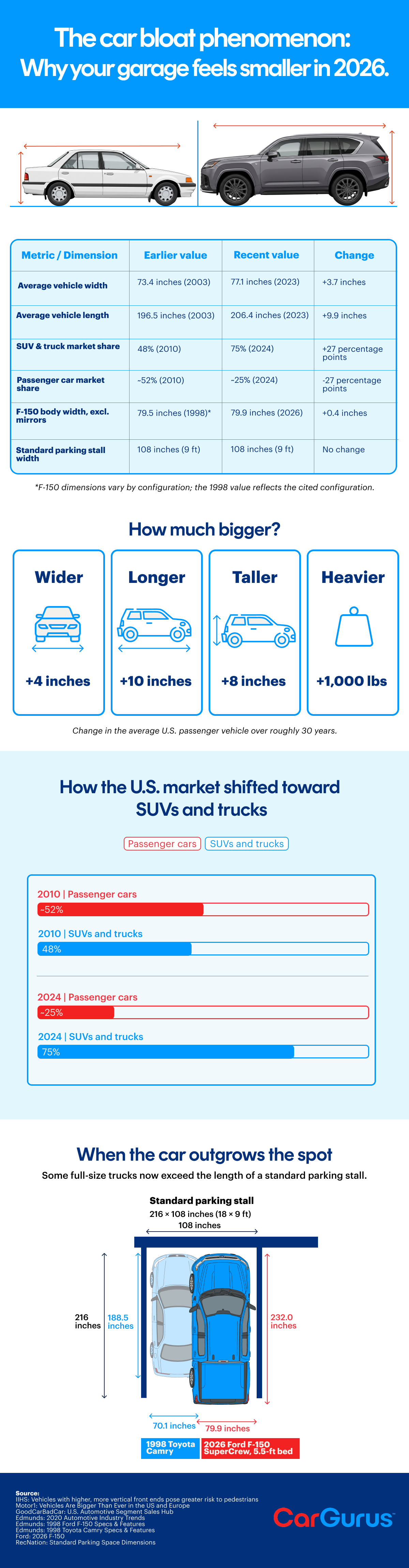
- Car bloat describes how vehicles have grown larger and heavier over time. Over roughly three decades, the average U.S. passenger vehicle has become about 4 inches wider, 10 inches longer, 8 inches taller, and 1,000 pounds heavier, according to IIHS.
- SUVs and trucks now dominate U.S. new-vehicle sales. They accounted for 75% of sales in 2024, making larger vehicles a much more common part of the U.S. fleet.
- “Carspreading” happens when bigger vehicles have to fit into spaces designed for smaller cars. Wider and longer vehicles can leave less room in parking spots, garages and other tight spaces.
- Modern safety technology has reduced some pedestrian crash risk, but larger vehicles still pose larger threats. IIHS research links pedestrian-detection AEB to a 27% lower pedestrian crash rate, while vehicles with hoods above 40 inches were 45% more likely to cause pedestrian fatalities than those with hoods 30 inches or lower.
- Larger vehicles can offer useful space and capability. Extra seating, cargo room, towing capacity and ground clearance can make an SUV or truck a practical choice, but buyers should also consider how its size fits their everyday driving and parking needs.
Embed this infographic on your site:
What is car bloat, and why is it happening?
Car bloat is the long-term increase in vehicle dimensions and weight, especially as SUVs and trucks have taken a larger share of the U.S. market.
According to the Insurance Institute for Highway Safety (IIHS), the average U.S. passenger vehicle is about 4 inches wider, 10 inches longer, 8 inches taller, and 1,000 pounds heavier than it was roughly 30 years ago.
Part of that shift comes from what Americans buy. SUVs and trucks accounted for 75% of U.S. new-vehicle sales in 2024, compared with 48% in 2010. As SUVs and trucks have taken more of the market, larger vehicles have become a more common choice for everyday family use.
EVs have also contributed to the more recent increase in vehicle weight because their battery packs can make them heavier than comparable gas-powered models. EPA data show that battery-electric and plug-in hybrid vehicles added about 72 pounds to the average new-vehicle weight in model year 2024. The broader rise in vehicle weight, however, began well before widespread EV adoption.

Why do drivers choose bigger vehicles?
Larger SUVs and trucks can offer practical advantages for drivers who need more space or capability. Three-row SUVs can accommodate larger families, while pickups and full-size SUVs can provide the cargo room and towing capacity needed for trailers, equipment, or recreational gear.
Other buyers value the higher seating position, available all-wheel or four-wheel drive, and extra ground clearance offered by many SUVs and trucks. Those features can be useful in poor weather or on rougher roads, depending on the vehicle and how it is equipped.
The growth of SUVs and trucks reflects those benefits as well as changing buyer preferences. A larger vehicle will not be the right fit for every driver, but for households that regularly use the added seating, cargo space or towing capacity, the extra size can serve a clear purpose.
The data: Decades of vehicle dimension growth
Car size growth is easier to see in fleet-wide averages than in any single oversized model. JATO Dynamics data show average U.S. vehicle width increasing from 73.4 inches in 2003 to 77.1 inches in 2023, while average length rose from 196.5 to 206.4 inches. IIHS's longer, roughly 30-year benchmark shows the same upward direction across width, length, height, and weight.
Modern vs. classic: A size comparison
Our infographic compares a 1998 Toyota Camry with a 2026 Ford F-150 SuperCrew at the same scale. The comparison shows how much more physical space a modern full-size truck can occupy than a typical late-1990s sedan.
That difference becomes noticeable in places designed decades ago. A few extra inches of width can reduce the clearance available beside a parked vehicle. Greater length can make maneuvering through a small garage more difficult. Added height changes what drivers can see immediately in front of the vehicle.
Comparing modern and older cars puts those measurements into context. Four inches of average width growth may sound modest until that change is placed inside a parking space whose dimensions have not expanded along with the vehicle.
How the U.S. market shifted toward SUVs and trucks
Vehicle growth has happened alongside a major change in what Americans drive. Passenger cars accounted for about 52% of the U.S. market in 2010, compared with 48% for SUVs and trucks. By 2024, that relationship had reversed: passenger cars represented about 25% of sales, while SUVs and trucks reached 75%. As SUVs and pickups make up more of the market, their larger footprints show up more often in parking lots, streets, and residential garages.
"Carspreading": The strain on urban infrastructure
"Carspreading" refers to the pressure larger vehicles place on parking spaces and streets designed around smaller cars.
Outgrowing standard parking spots
A standard U.S. perpendicular parking stall is commonly about 9 feet wide and 18 feet long, although dimensions vary by location. The 2026 Ford F-150 SuperCrew shown in the infographic measures 232 inches long and 79.9 inches wide excluding mirrors, making it 16 inches longer than an 18-foot stall.
For historical context, the Ford F-Series was the best-selling vehicle in the U.S. in 1998, while the Toyota Camry was the best-selling passenger car. The 1998 Camry measured about 188.5 inches long and 70.1 inches wide, giving it substantially more room within the same parking-space footprint than the modern F-150 shown in our infographic. A 1998 F-150 was already about 79.5 inches wide excluding mirrors, however, so width alone does not explain the change. Vehicle length, configuration, and the broader shift toward SUVs and trucks also affect how today's vehicles fit into spaces designed decades ago.
Larger vehicle footprints can also leave less room in older garages and tight urban spaces.
How vehicle size affects pedestrian safety
Vehicle safety has improved substantially over the past few decades. Newer vehicles benefit from advances in crash protection as well as driver-assistance technology designed to help prevent crashes in the first place. Modern active safety systems can also warn drivers about hazards they may not see and, in some cases, brake automatically.
Those gains do not eliminate the effect of vehicle size and front-end design on pedestrian risk. IIHS found that vehicles with hood heights above 40 inches were 45% more likely to cause pedestrian fatalities than vehicles with hoods 30 inches or lower, with taller and more vertical front ends associated with greater risk.
Active safety technology can help reduce that risk. IIHS found that pedestrian-detection automatic emergency braking was associated with a 27% lower rate of pedestrian crashes compared with vehicles without the technology. These systems use forward-facing sensors to detect pedestrians and can warn the driver or brake automatically if a collision is imminent.
What to consider before buying a large SUV or truck
Before choosing a large SUV or truck, consider how much space, seating, and capability you use day to day, along with a few practical questions:
Before moving into a larger SUV or truck, consider a few practical questions:
- Will it fit comfortably in your garage with enough room to open the doors?
- How often do you need its full passenger, cargo or towing capacity?
- Will its dimensions make the parking environments you use every day harder to manage?
- Could a smaller vehicle meet the same needs?
Drivers who genuinely need a large SUV can still compare models for efficiency and everyday usability. See The Best Large SUVs for Gas Mileage in 2026 for options that balance size with fuel economy.
Large vehicles can be the right choice for drivers who need their passenger, cargo, or towing capacity. Vehicle size is another factor to weigh alongside price, fuel economy, and features when deciding what fits your needs.