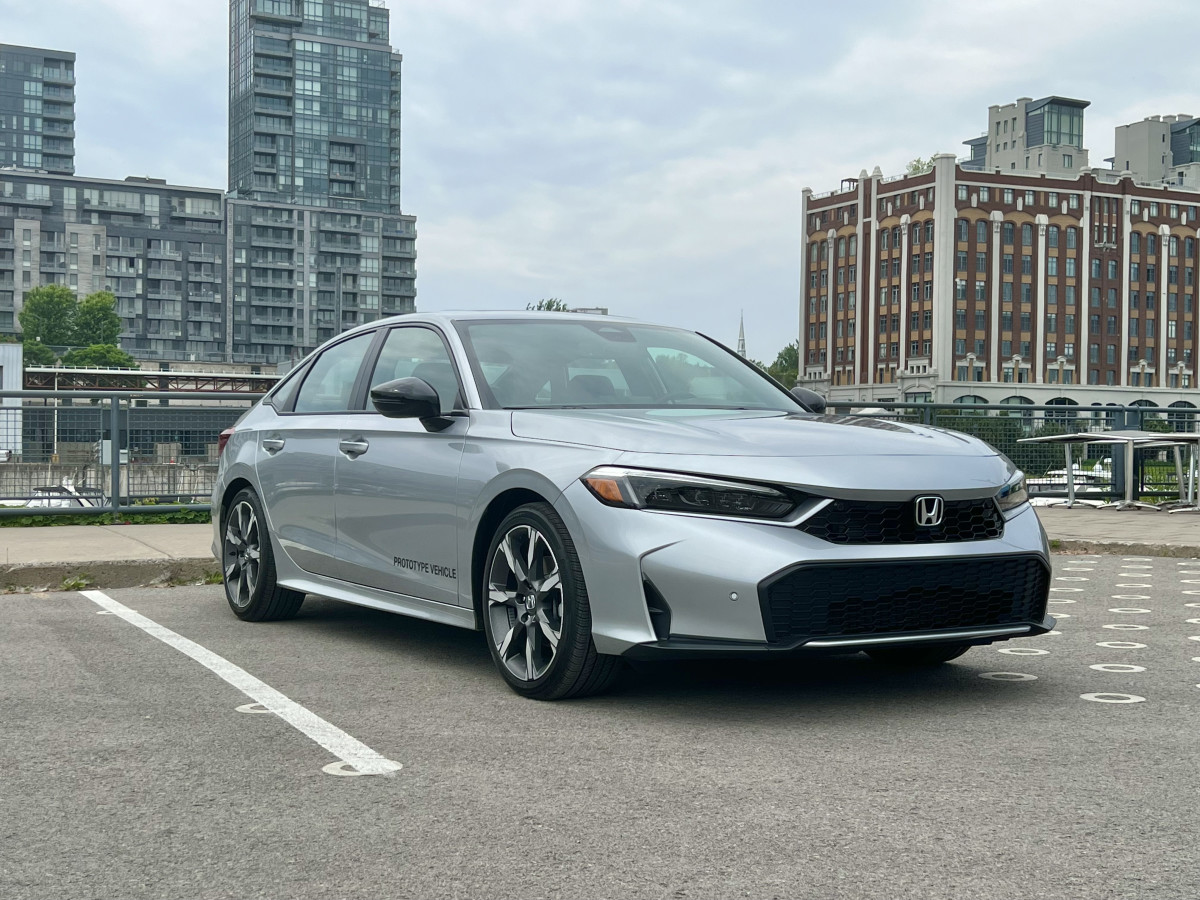
Kia Optima Fourth Generation (2016-2020)
The fourth generation of Kia’s mainstream midsize sedan hit the U.S. market for the 2016 model year. Although it was a clean-sheet redesign, the 2016 Optima looked a lot like the version it replaced. Its steeply sloping rear roofline was beautiful but impacted rear-seat passenger space. The latest version of Kia’s tiger-nose corporate grille was pinched in the center and filled with an interesting mesh pattern.
Underneath the slender sheet metal was a unibody structure that used more high-strength steel than the previous version, improving stiffness and enhancing safety. The wheelbase was stretched by 0.4 inches, and the width was up by an inch. A set of 16-inch wheels came standard, but options up to 18 inches were available. LX, LX Turbo, EX, SX Turbo and SXL trim levels were offered.
As before, a 2.4-liter four-cylinder engine was standard in LX and EX models and produced 185 horsepower and 178 pound-feet of torque. A 2.0-liter turbocharged engine was again available and standard in SX and SXL models, now producing 245 hp and 260 lb-ft of torque. A six-speed automatic transmission sent that power to the front wheels. New for 2016 was a turbocharged 1.6-liter four-cylinder engine in LX Turbo models that produced 178 hp and 195 lb-ft and was mated to a seven-speed dual-clutch automatic gearbox.
The new 1.6-liter engine offered the best fuel economy of the engines available for 2016 with EPA estimates of 28 mpg in the city, 37 mpg on the highway, and 31 combined. The base 2.4-liter got 24 city, 34 highway, and 28 combined (or 25 city, 36 highway, and 29 combined in FE trim). The powerful 2.0-liter turbo was still reasonably efficient at 22 city, 31 highway, and 25 combined.
The 2016 Kia Optima offered a good amount of room inside. Our review of the 2016 Optima referred to the vehicle as “an entry-level luxury car” and described the rear seat as “generous” and “expansive”. Trunk space measured 15.9 cubic feet, which was half a cubic foot larger than the outgoing version.
Kia’s UVO touchscreen infotainment system was standard in the fourth-generation Optima. LX models had a small 5-inch unit and EX models came standard with a 7-inch screen and could optionally be equipped with the largest 8-inch unit that was standard in the SX models. In a first for the brand, wired Apple CarPlay and Android Auto were supported on models fitted with 7- or 8-inch screens. In addition to the touchscreen, a series of buttons on the steering wheel or certain voice commands could be used to control the infotainment tech. A six-speaker audio system was standard, but an upgraded Harman Kardon system with 10 speakers was available.
The 2016 Optima could optionally be equipped with adaptive cruise control, blind-spot monitors, rear cross-traffic alert, and automatic emergency braking. A rearview camera was standard, and SX and SXL trims came with a surround-view camera system.
The 2016 Kia Optima earned a Top Safety Pick+ award from the Insurance Institute for Highway Safety (IIHS), with the top Good ratings in all crashworthiness tests. It also received the top five-star overall safety rating from the National Highway Traffic Safety Administration (NHTSA) with matching five-star ratings in each of the NHTSA’s crash tests.
Early in 2016, Kia announced a new Optima Hybrid model for 2017. A 2.0-liter four-cylinder engine was paired with a 38-kW electric motor to produce 193 combined horsepower. A compact 1.62-kWh lithium ion battery pack was located underneath the trunk floor. With an EPA-estimated rating of 39 mpg city, 36 highway, and 42 combined, Kia claimed the fourth-generation Optima Hybrid was 10% more efficient than the outgoing version.
Also new for 2017 was a Kia Optima Plug-In Hybrid model that also used a 2.0-liter four-cylinder engine. A 50-kW electric motor mounted inside the six-speed automatic transmission casing got power from a 9.8-kWh lithium-ion polymer battery pack, which equated to a 60% increase in capacity over the old Optima PHEV and allowed the 2017 version to travel up to 27 miles on electricity. The onboard charger could use either 120- or 240-volt outlets, and the latter allowed for a recharge in less than three hours.
The SXL model was discontinued for 2018, but a new Limited package on the SX included all that trim level’s goodies. A new S trim level added a sporty flair to the Optima range. The small 5-inch touchscreen was gone, leaving the 7- and 8-inch units. That also meant Apple CarPlay and Android Auto came standard across the Optima range.
The Optima lineup was refreshed for the 2019 model year with revised styling, new wheels, and added driver-assistance features. Automatic emergency braking, forward-collision warning, lane-keep assist, lane-departure warning, and a driver-attention monitor were all made standard. Pedestrian detection was added in 2020, which would be the final year for the Optima nameplate. Kia introduced the K5 sedan as a replacement for the Optima starting in 2021.
According to CarGurus used pricing data, the average price for a fourth-generation Kia Optima ranged from around $9,000 to $13,000 at the time of writing. CarComplaints.com shows a lot more complaints for 2016 models than 2017–2020 Optimas, and J.D. Power similarly rates the 2018–2020 models higher for reliability than earlier ones.
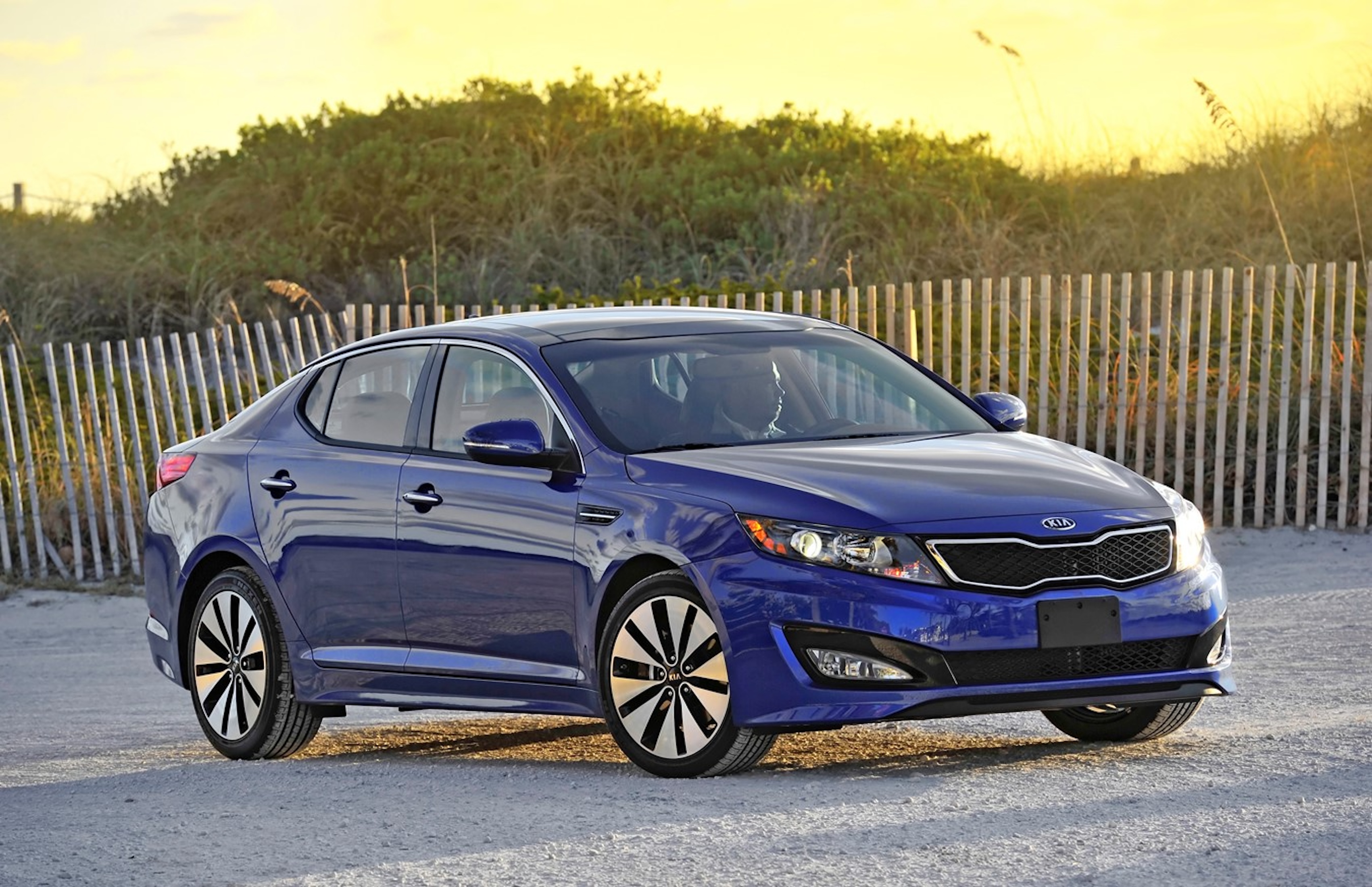
Kia Optima Third Generation (2011-2015)
Kia introduced an all-new third-generation Optima in 2011, and with it set a new standard for classy exterior design. It was certainly sleek and refined, with an almost fastback roofline, flared wheel arches, and a bold front fascia highlighted by a grille that was pinched in the center and flanked by projector headlamps. A set of 16-inch wheels was standard on LX models, the EX got 17-inch alloy wheels, and the top-level SX model wore 18-inch wheels and featured HID headlamps, LED rear lights, and a body kit that included side sills and a rear spoiler.
The 2011 Optima was 1.7 inches longer and sat on a wheelbase that was stretched 2.9 inches over the outgoing model. A stronger unibody chassis resulted in improved handling characteristics.
A 2.4-liter four-cylinder engine was standard and sent 200 hp to the front wheels. A turbocharged 2.0-liter with 274 hp was optional. Base LX models came standard with a six-speed manual transmission, but most versions were equipped with a six-speed automatic. Kia also introduced an Optima Hybrid in 2011 that paired a 2.4-liter engine with a single electric motor for a total of 206 hp.
Optima models powered by the base 2.4-liter engine in 2011 were rated by the EPA to deliver 23 mpg in the city, 33 on the highway, and 27 combined. Turbocharged Optima models were rated at 22 city, 33 highway, and 26 combined, while 2011 Optima Hybrid sedans returned 34 city, 38 highway, and 36 combined.
All 2011 Optima models came standard with a USB audio input jack and Bluetooth wireless connectivity. Optima EX and SX models featured a 7-inch infotainment screen that ran UVO by Microsoft software. A power panoramic sunroof, leather seats, a memory driver’s seat, heated and cooled front seats, heated rear seats, and a heated steering wheel were optional in EX and SX trims.
Dual front, side, and side curtain airbags were standard, along with anti-lock brakes, electronic stability control, and traction control. The IIHS awarded the 2011 Optima with a Top Safety Pick rating and it received the top five-star overall safety rating from the NHTSA.
Kia made few changes to the Optima in 2012. A new Limited trim level was added in 2013 while the EX Turbo trim was dropped. The 2012 Optima Hybrid got a slight reduction in power to 199 hp, but fuel economy improved to 36 city, 40 highway, and 38 combined.
The Optima was refreshed for the 2014 model year with new styling front and rear along with a 4.3-inch digital instrument screen and a new 8-inch infotainment screen. Optional driver-assistance features included blind-spot monitors, rear cross-traffic alert, and rear parking sensors. For 2015, the Optima received upgraded infotainment software, and a new SXL trim level. An all-new fourth-generation Optima replaced the third-generation version in 2016. Average prices for used third-generation Optimas ranged from around $6,000 to $9,000 at the time of writing.
Unfortunately, third-generation Optima models had far more reliability issues than other years, and some of the problems—such as complete engine failures, excessive oil consumption, and engine knocking—are serious enough that buyers should consider skipping the 2011–2015 model years entirely. On the plus side, CarGurus used pricing data suggests a reasonably good Optima from 2017 or 2018 can be found for less than $10,000.
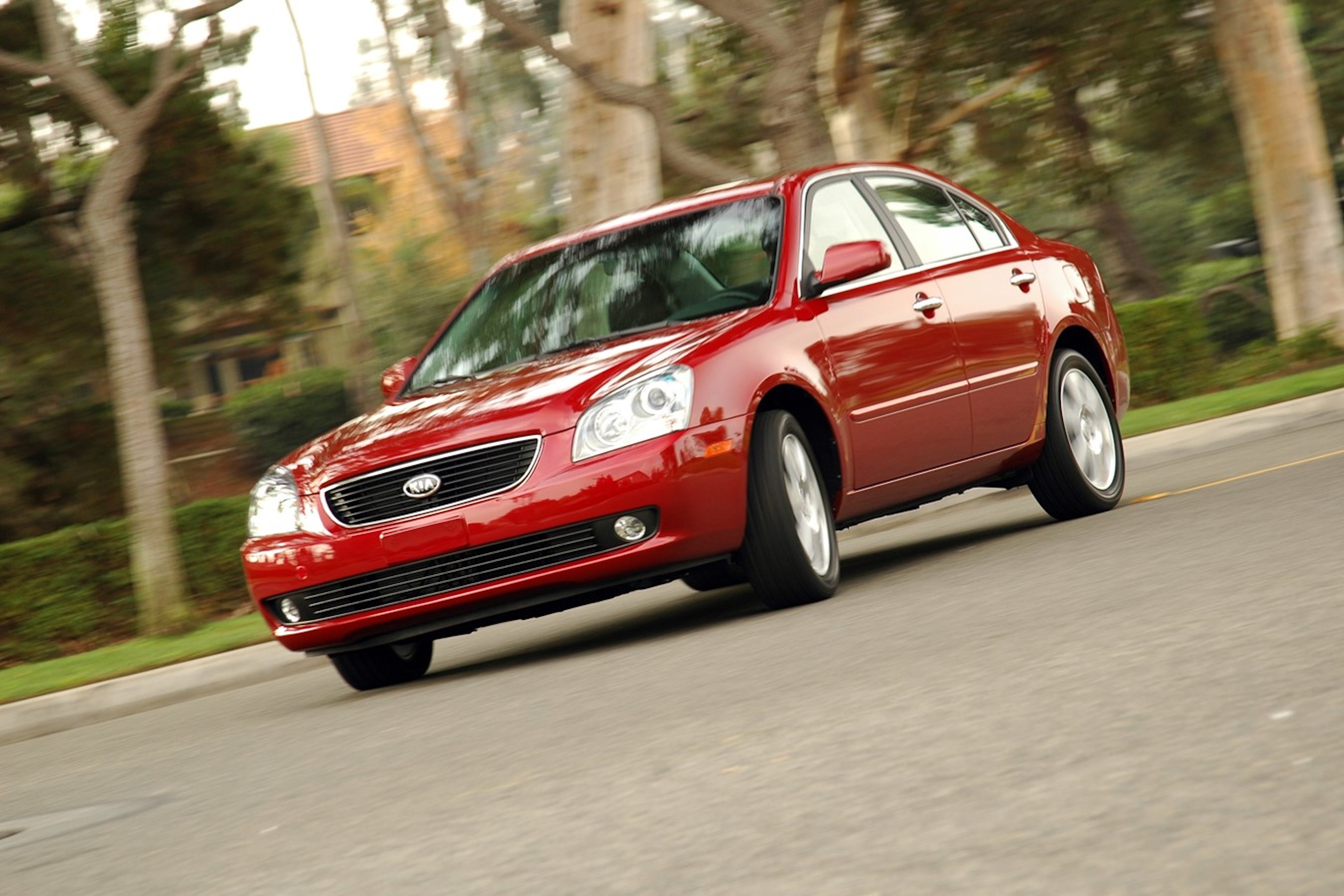
Kia Optima Second Generation (2007-2010)
The second-generation Kia Optima midsize sedan launched in 2007. As before, major components were shared with the Hyundai Sonata, but the two vehicles looked different. The new Optima was larger, more stylish, and more refined than the model it replaced. Along with the Sonata, the new 2007 Optima competed on nearly level ground with other contemporary midsize sedans, including the Chevrolet Malibu, the Chrysler Sebring, the Ford Fusion, the Honda Accord, the Nissan Altima, and the Toyota Camry, while undercutting them on price.
The 2007 Optima was offered in LX and EX trim levels. A 2.4-liter four-cylinder engine that produced 162 hp and 164 lb-ft was offered with either manual or automatic transmissions, both with five speeds. Four-cylinder Optimas were rated at 21 mpg city, 31 highway, and 25 combined with either transmission. A 2.7-liter V6 engine was optional, producing 185 hp and 182 lb-ft and only offered with the five-speed automatic transmission. It received EPA-estimated fuel mileage ratings of 20 city, 28 highway, and 23 combined.
Anti-lock brakes were not standard on 2007 Optima models. An available Stability Package added ABS along with stability control and traction control. Dual front airbags and side curtain airbags were standard.
The IIHS crash-tested a 2007 Kia Optima and gave it Good ratings in the moderate overlap front test, an Acceptable rating in the side impact test, and a Marginal rating in the roof strength test. The Optima received the top five-star rating from the NHTSA in its frontal and side-impact crash tests.
The second-generation Optima was updated for the 2009 model year with revised styling, a sporty new SX trim level, and optional navigation. Anti-lock brakes and stability control were made standard. Both engines were upgraded, with the 2.4-liter four-cylinder now producing 175 hp and the 2.7-liter V6 194 hp. There weren’t any major changes for 2010, which would be the second-generation Optima’s final model year.
CarComplaints.com shows relatively few complaints for Optimas built between 2007 and 2010, but many were for serious issues. Online data suggests the 2007 and 2008 model years had more engine troubles than the updated 2009 and 2010 models, so it’s worth sticking to the latter years.
Kia Optima First Generation (2001-2006)
Though it was never sold in the United States, Kia’s first midsize sedan was known as the Credos. The Optima replaced the Credos in 2001 and was heavily based on the Hyundai Sonata. Both Korean sedans had to compete with popular midsize cars in the United States including the Ford Taurus, the Honda Accord, and the Toyota Camry, all of which sold in very high numbers.
In order to persuade buyers to consider a new car from an unknown brand, Kia equipped the first-generation Optima with a generous list of standard features for the time, including air conditioning, power windows and door locks, and variable wipers. Cruise control, remote keyless entry, a CD player, a moonroof, and a power driver’s seat were available.
A 2.4-liter four-cylinder engine came standard with the 2001 Optima and produced 149 hp, while an optional 2.5-liter V6 produced 170 hp. A five-speed manual transmission was standard and a four-speed automatic was optional. Fuel economy for the four-cylinder and manual transmission came in at 19 mpg city, 26 highway, and 21 combined. The automatic dropped those figures to 18 city, 24 highway, and 20 combined. The V6 returned 18 city, 24 highway, and 21 combined with the manual, or 17 city, 23 highway, and 19 combined with the automatic transmission.
Kia introduced a new 2.7-liter V6 engine in 2002. With ratings of 178 hp and 181 lb-ft, the new V6 was a solid upgrade over the old unit. A facelift for the 2003 model year introduced a new front fascia with small, round lights in addition to the normal headlamps, and a new grille with bold vertical bars rounded out the front end. Additionally, the interior design was updated, and the base LX model got more standard equipment, including cruise control. Though the engine options carried over, their power outputs were revised to 138 hp for the four-cylinder and 170 hp for the V6.
Another new grille showed up for 2004, but the small, round secondary lights remained. Kia made a few minor changes to the Optima sedan in 2005 and 2006, and an all-new second-generation model was introduced for the 2007 model year.
The first-generation Kia Optima was generally reliable, with common complaints focusing more on the quality of trim pieces than engine or transmission failures. Still, Kia’s first midsize sedan for the American market wasn’t quite as refined as the majority of its competitors. There aren’t many first-generation Optimas available on the used market these days, but when they appear, they should cost less than $5,000.
Related Topics