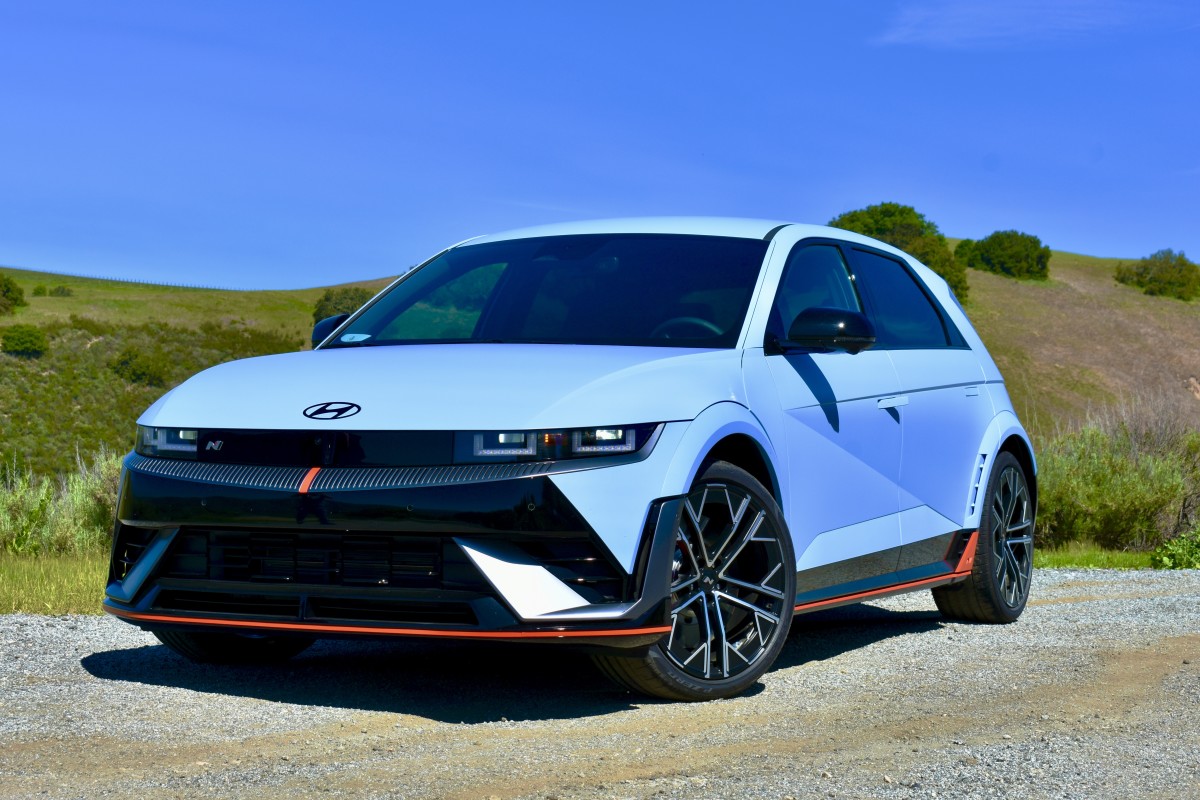
When it was introduced in 2022, the Hyundai Ioniq 5 was quite revolutionary as a compact EV that cost less than many rivals but offered faster charging. It was the first Hyundai on the new Electric-Global Modular Platform (E-GMP) and, in optimal conditions, could charge from 10% to 80% battery capacity in just 18 minutes. Other vehicles that now use this platform include the Hyundai Ioniq 6 and Ioniq 9, as well as the Kia EV6, EV9, and Genesis GV60.
Although it has a hatchback-like shape, the Hyundai Ioniq 5 competes in the compact EV crossover class against cars such as the Chevrolet Equinox EV, the Ford Mustang Mach-E, the Kia EV6, and the Tesla Model Y. The Ioniq 5 compares favorably to many of these on price and, despite some reliability issues, its excellent passenger space, stellar safety ratings, and plethora of standard safety features make it an appealing family EV.
Our buying guide looks at how the single model generation of the Hyundai Ioniq 5 has evolved over time, with details of its specs, prices, and the best and worst versions to buy.
Hyundai Ioniq 5 Buying Guide: Cost, Reliability, and the Best Years to Buy
Frequently Asked Questions
Which Hyundai Ioniq 5 years are the best?
In its short lifespan, the Hyundai Ioniq 5 hasn’t had the best of reliability ratings. Consumer Reports hasn’t given it a better-than-average reliability verdict yet, and consumer complaints on the National Highway Traffic Safety Administration (NHTSA) website number in the hundreds for every model year. However, if we had to pick a year, we’d go for 2024. This is a pre-refresh model, but consumer complaints drop significantly at this point, especially for later versions, and the Consumer Reports Reliability Verdict improves a little, too. This year also has the best reliability score out of every model year, including 2025, according to the Auto Reliability Index.
Which Hyundai Ioniq 5 years are the worst?
We typically recommend steering clear of the first couple of model years of any new vehicle, and such is the case with the Hyundai Ioniq 5. In addition to early models (2022 to 2024) lacking a rear wiper, there have been numerous software issues in the 2022 to 2023 models. One of the biggest problems, which affects 2022 to early 2024 cars, is a faulty Integrated Charging Control Unit (ICCU) that leads to the 12-volt battery (almost all EVs still have one) failing to charge. Additionally, the parking mechanism in 2022 to 2023 models has been known to disengage and cause the vehicle to roll away. Both issues should have been repaired via recalls or software updates, but earlier models require more attention than later ones. According to the Auto Reliability Index, the first two model years log the lowest scores and have the most consumer complaints.
Is a used Hyundai Ioniq 5 a good deal?
We generally think a used Hyundai Ioniq 5 is a good deal, as long as buyers ensure all the recall work has been carried out by a certified Hyundai retailer. First, know that depreciation is fairly high. Take the 2024 model year as an example. CarGurus pricing data says the average price is about $28,000, when a new vehicle ranged between $43,000 and $60,000. EVs tend to need less routine maintenance, which creates savings, but the cost of body repairs is generally higher. Plus, if repairs to the ICCU fall outside of the recall or warranty, that fix could cost up to $3,500.
Pros and Cons
Pros:
- Spacious
- Impressive technology
- Standard advanced safety features
Cons:
- Potentially polarizing design
- Fairly pedestrian performance
- Competitors have more storage space
Hyundai Ioniq 5 Generations
Hyundai Ioniq 5 First Generation (2022-Present)
When the Hyundai Ioniq 5 was introduced in 2022, it was a huge leap forward, not only for the brand but also for vehicles in this compact crossover EV class. It was one of the first EVs that combined affordable pricing with an 800-volt (rather than 400-volt) architecture that offered fast charging and a vehicle-to-load (V2L) capability that allowed owners to power external devices using the car’s battery. The Ioniq 5's retro-modern geometric design caught the eye, too, while its long wheelbase and flat cabin floor gave it a spacious interior.
The 2022 Ioniq 5 had two battery options: a 58-kWh pack matched to rear-wheel drive (RWD) or a longer-range 77.4-kWh pack available with either RWD or all-wheel drive (AWD). Range for the base battery pack was 220 miles, but it went up to 303 miles for the long-range models. AWD versions topped out at about 256 miles of range. The base model with the standard battery pack delivered 168 horsepower, but models equipped with the long-range battery and RWD delivered 225 hp and dual-motor AWD models delivered 320 hp.
At launch, the Ioniq 5 was offered in four trims: SE Standard Range (the only model with the base battery pack), SE, SEL, and Limited. Standard features included the likes of a power-adjustable driver’s seat, dual 12.3-inch digital displays, heated front seats, 19-inch wheels, and wired Apple CarPlay and Android Auto. SEL trim added features such as ambient lighting and a hands-free power liftgate. Limited trim included a head-up display, a sliding center console, a glass roof, ventilated front seats, blind-spot monitors in the gauge cluster, remote smart park, and a premium Bose audio system.
The top Limited trim is worth seeking out for its bells and whistles. We are huge fans of the sliding console (more space to put a purse, a grocery bag, or a briefcase) and the tech features, such as the blind-spot monitors, are really well done.
The first few model years of the Hyundai Ioniq 5 saw minor improvements rather than big changes. In 2023, the AWD model got more range, and battery preconditioning (which warms or cools the battery for maximum efficiency) became standard across the lineup. In 2024, more standard safety features and a Wi-Fi hotspot (subscription required) became available on all trims.
A refresh came three years into the Ioniq 5’s lifecycle, with updates for the 2025 model year. Exterior changes consisted of new front and rear bumpers, new wheel designs, the addition of a rear windshield wiper and the availability of roof rails. Inside, there was a redesigned center console with more physical buttons, a new steering wheel, wireless Apple CarPlay and Android Auto, and USB-C charging ports. The biggest changes weren't visible, with larger battery packs (63 kWh and 84 kWh) giving longer ranges (245 to 318 miles for RWD models and up to 290 miles for AWD models) and the switch to North American Charging Standard (NACS) ports. This model year also added two new versions—an off-road-focused XRT trim with all-terrain tires and the Ioniq 5 N, a heavily modified high-performance version best viewed as an entirely separate model.
Throughout this generation, the Hyundai Ioniq 5 has been equipped with a wealth of standard advanced safety features such as automatic emergency braking, blind-spot monitors, rear cross-traffic alert, lane-keep assist, adaptive cruise control, safe-exit assist, and high-beam assist. Available features include blind-spot monitor displays in the gauge cluster, collision-avoidance assist, parking sensors, and surround-view camera systems. Remarkably, every year of the first-gen Ioniq 5 has received an Insurance Institute for Highway Safety (IIHS) Top Safety Pick+ designation, and the NHTSA gave it a five-star overall safety rating for every year it was tested.
The biggest known issue with the first-generation Hyundai Ioniq 5 is the ICCU, which can fail due to electrical stress. This means the 12-volt battery may not recharge and could result in a loss of drive power. This affects 2022 to 2024 models and is subject to a recall. As long as this has been properly repaired, it's not an issue. The 2022 model year also has a digital parking brake rollaway issue, which is also covered by a recall. There are also a smattering of complaints for the 2022 to 2025 model years concerning charging interruptions and infotainment bugs, and 2024 to 2025 models have a high number of climate control complaints with HVAC errors and heater performance concerns.
According to CarGurus pricing data, the average price of a used Hyundai Ioniq 5 is about $28,000. There's only around a $10,000 range in prices between the 2022 and the 2025 model years, though, so if a 2022 model is about $23,000, then 2023 and 2024 models average $28,000, while 2025 models increase to $32,000.
Related Topics