2025 Hyundai IONIQ 5 N Reviews, Pricing & Specs
Write a reviewPros
Fun to drive
Great handling
Wireless Apple CarPlay/Android Auto
Cons
Unimpressive electric range
Poor value for money
Not as much fun to drive at normal speeds
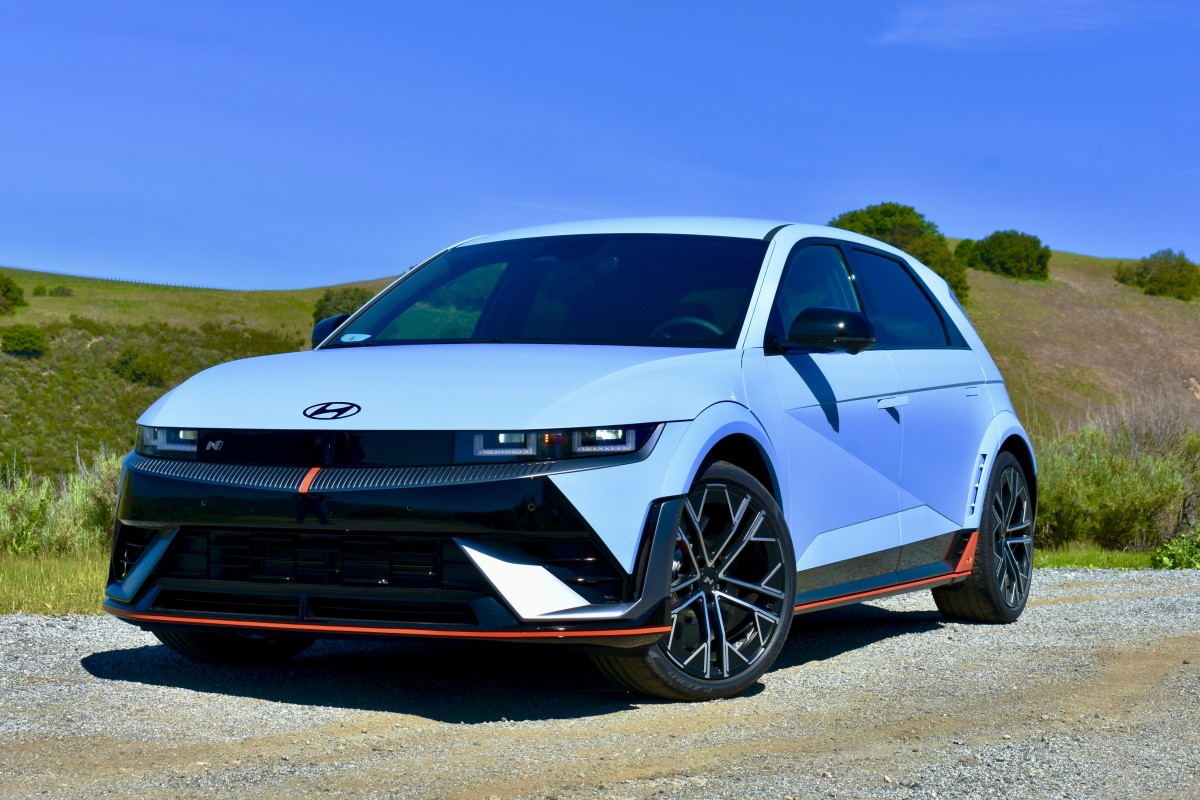
Hyundai’s N division turned the Ioniq 5 EV into a track-ready performance car.
The 2024 Hyundai Ioniq 5 N is the first electric car from Hyundai’s N performance sub-brand. It applies the same formula from gasoline models like the high-performance Elantra N to the Ioniq 5, upping power and adding stickier tires, a track-tuned suspension, and better aerodynamics to improve on-track performance.
Verdict: The Ioniq 5 N is a true track-capable performance car that just happens to be electric.
The regular Ioniq 5 was already one of the most distinctive-looking EVs on the road, thanks to sharp-edged styling based on the Hyundai 45 concept. The 5 N is even harder to ignore.
The N sits 0.79 inch lower than the standard Ioniq 5, while 2-inch fender flares housing wider Pirelli P Zero tires on 21-inch wheels contribute to the hunkered-down stance. Hyundai also added prominent front and rear spoilers and a rear diffuser that makes the N 3.2 inches longer than the standard Ioniq 5. Checkered-flag reflectors at the back nicely complement the Ioniq 5’s neat-looking pixelated taillights, while a few splashes of orange complete the look.
The body shell was also stiffened with additional welding and structural adhesives, as well as strengthened mounts for the battery pack, motors, and steering rack. A stiffer structure is the foundation for better handling, as it more firmly anchors the suspension components bolted to it.
Designers also punched a larger air intake into the front fascia, along with small slots on the mustache-like section below the headlights, to aid cooling of the battery pack and other components. These visual changes make the Ioniq 5 N less aerodynamic than the non-N model, but the tradeoff is better on-track performance. A system of “air curtain” vents also compensate a bit by smoothing out airflow around the wheels, while the wheels themselves have an aerodynamic design.
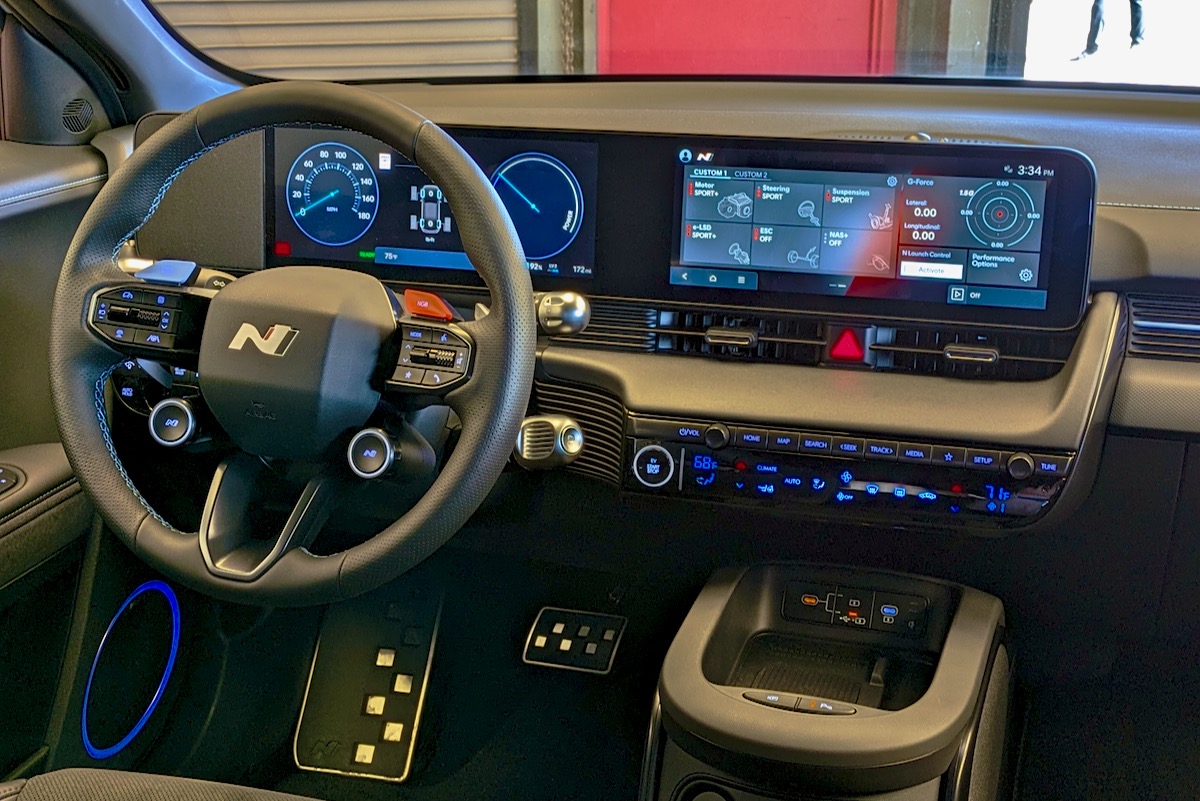
The interior gets typical performance-car changes, including a new steering wheel festooned with buttons and paddles to control the various drive modes and settings and heavily bolstered (and heated) front seats with Alcantara and synthetic leather upholstery to hold you in place during high-g cornering. Also helping with that is a center console with knee pads, which breaks up the distinctive open interior layout of the standard Ioniq 5, but provides something to brace against and to secure smaller items. Our only real complaint is the mainly black color of the interior, which gets blue accents that don’t stand out as much as the orange used for the exterior.

The standard dual-motor all-wheel drive (AWD) powertrain produces 601 horsepower and 546 pound-feet of torque most of the time, making this the most powerful Hyundai production car ever. If that’s not enough, 641 horsepower and 568 lb-ft of torque is available in 10-second bursts with the N Grin Boost mode. Engage this mode, as well as launch control, and the Ioniq 5 N will do zero to 60 mph in 3.2 seconds, according to Hyundai. The top speed is 162 mph.
The Ioniq 5 N also has more gizmos than an early 1990s Formula One car. N e-shift makes the Ioniq 5 N feel like it has the eight-speed dual-clutch transmission used in gasoline N cars. N Active Sound+ replicates the sound of those cars, and N Pedal uses the regenerative braking to improve turn-in. You also get N Drift Optimizer with Torque Kick Drift to make getting sideways easier, plus an N Race drive mode with Endurance or Sprint options to emphasize range or pace, respectively, on track.
All of these customization features mean you don’t simply get in the Ioniq 5 N and go. But once everything is dialed in, this car has a surprisingly natural feel. Regenerative and friction braking blend seamlessly together, as do the various software functions, which also help mask the fact that the Ioniq 5 N’s curb weight registers a portly 4,861 pounds. That lets you sit back and enjoy what is ultimately just a great car, albeit a heavy one. It corners flat, feels remarkably neutral, and, despite the massive amount of power on tap, it has grip for days.
There was no hiding that N Active Sound+ and N Pedal were artificial add-ons to the driving experience, though. They didn’t detract, but they didn’t feel necessary either. Hyundai included them in part to maintain some of the cues that help drivers judge speed in internal combustion-engined (ICE) cars, but during our test drive lapping California’s Weathertech Raceway Laguna Seca, we found it more helpful to simply focus on visual cues like braking markers. As much as we love a good exhaust note, the Ioniq 5 N was so engaging to drive that we didn’t need the additional soundtrack, either. We found ourselves driving the Ioniq 5 N on the racetrack like any other car, focusing on braking points and the racing line rather than what kind of powertrain was providing the thrust.
Such features might have a place in lower-speed road driving, though. When you can’t unleash the Ioniq 5 N’s full power, or peg the g-meter in corners, the fun definitely diminishes. The Ioniq 5 N still feels competent on twisty roads, thanks in part to very precise steering, but not as lively as it does in full attack mode. It settles down well, at least. While the suspension remains firm in even the mildest settings, it’s livable. And you’d never know this car has over 600 hp from its low-speed demeanor.
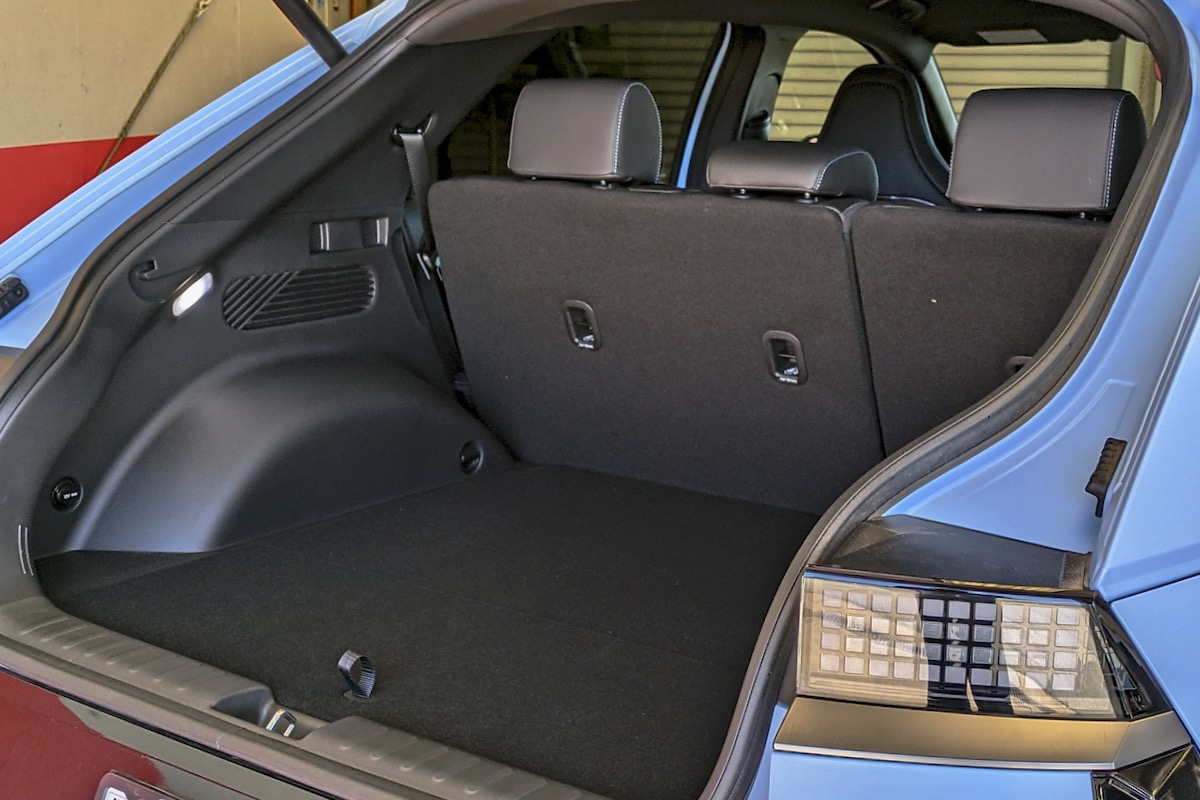
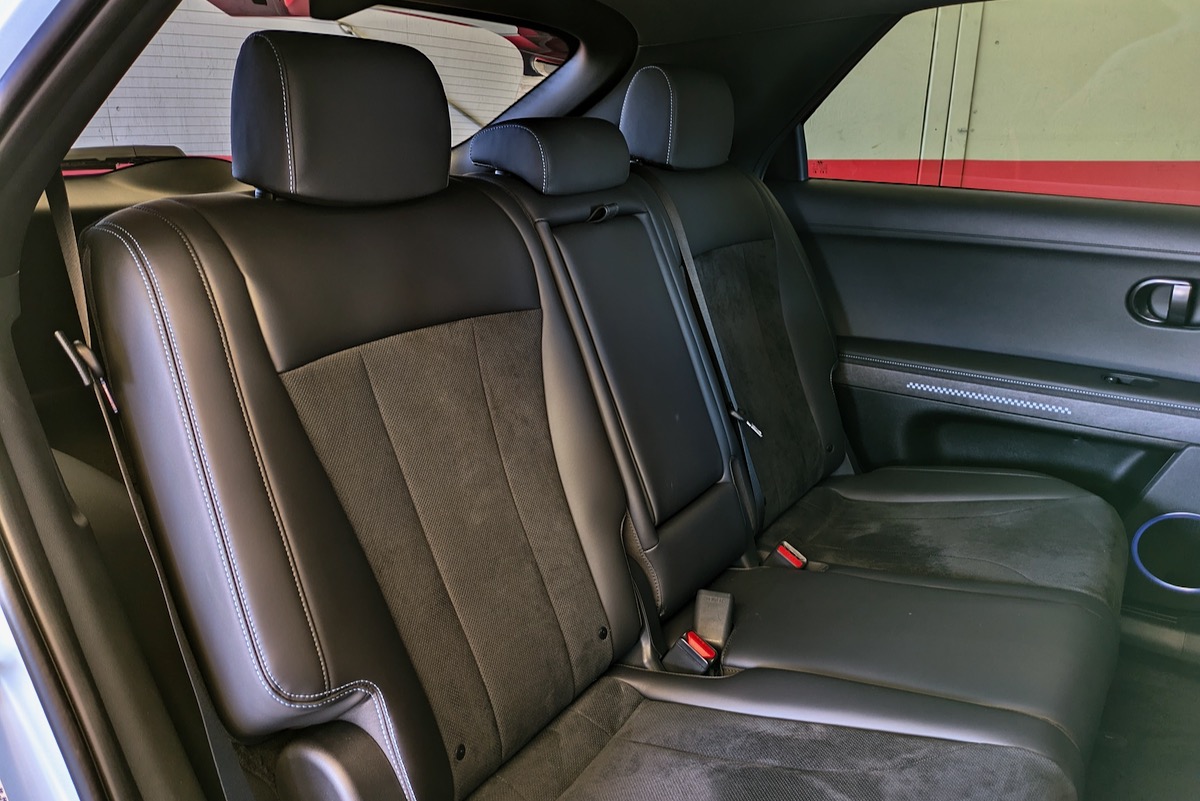
The Ioniq 5 N preserves the interior dimensions of the standard Ioniq 5, meaning it’s more practical than a dedicated sports car, but not as roomy as similar-sized EVs. The Ioniq 5, for example, has more front and rear legroom than a Volkswagen ID.4 but less than a Tesla Model Y. It also has more rear-seat headroom than the VW, but the low roof means there isn’t a lot overall.
Cargo space is nearly identical to the standard Ioniq 5, at 26.1 cubic feet of cargo space with its rear seats up and 59.3 cubic feet with the 60/40 split-folding second row down. There’s slightly less cargo space with the rear seats up due to wider wheel wells, part of the structural reinforcements added to make the body shell more rigid. Again, other EVs with a similar footprint offer more space, but that’s still plenty of usable room, making the Ioniq 5 N a practical choice among performance cars. There’s no frunk, but that’s no longer a given feature in EVs these days.
The Ioniq 5 N’s more conventional center console provides a bit more flexibility for storing small items than the setup in the base model. The flat rear section includes a pair of cupholders that can be rotated out of the way, freeing up enough space for a small handbag. A covered storage bin is positioned ahead of it. A 12-volt outlet and USB ports are positioned on the sides of the console and on top.
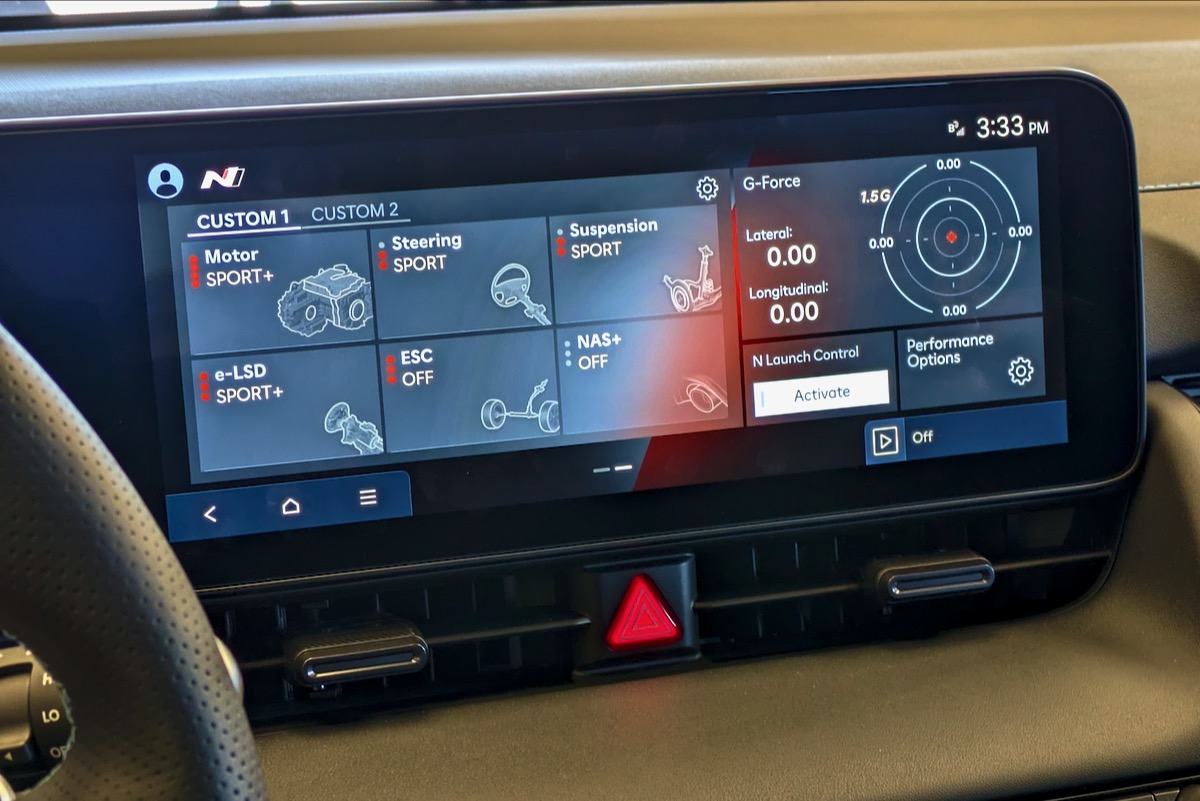
The Ioniq 5 N’s infotainment system is similar to that of the base Ioniq 5. A 12.3-inch touchscreen and 12.3-inch digital instrument cluster are placed side-by-side on the dashboard. Wireless Apple CarPlay and Android Auto, wireless phone charging, Wi-Fi connectivity, two-device Bluetooth pairing, and an eight-speaker Bose audio system are standard.
N-specific features include readouts for battery and motor temperatures, lap times, g-forces, and the amount of throttle or brake being used, spread across the two displays. Hyundai’s user-experience team did a good job of managing all of the information packed onto the display menus although, particularly in the instrument cluster, some items are reduced to small icons that are hard to read at a glance.
The Ioniq 5 N also has Hyundai’s digital key system, which allows compatible smartphones to function as key fobs, and the Hyundai Pay in-vehicle payment service. Launched in late 2023 on the 2024 Hyundai Kona, Hyundai Pay lets drivers pay for things like parking directly from a vehicle’s touchscreen.
Safety ratings for the N model weren’t available at the time of publication, but the Insurance Institute for Highway Safety (IIHS) named the base Ioniq 5 a 2024 “Top Safety Pick.” The Ioniq 5 missed out on the higher “Top Safety Pick+” award because the IIHS hadn’t run it through the updated moderate front-overlap crash test that’s now mandatory for the organization’s safety awards.
The National Highway Traffic Safety Administration (NHTSA) hadn’t released any crash-test ratings for the 2025 Ioniq 5 at the time of publication. And ratings from either the IIHS or the NHTSA for the standard Ioniq 5 may not carry over to the N model.
What does carry over is the complement of available driver-assist features. Like other Ioniq 5 models, the N gets a blind-spot monitoring system with cameras, rear cross-traffic alert, lane keep assist, forward collision warning, automatic emergency braking, adaptive cruise control, and Highway Driving Assist 2, which augments adaptive cruise with automated lane centering.
Also standard is an advanced rear-occupant alert system. Unlike many other systems, which simply remind drivers to check the back seats with audio tones and instrument-cluster messages, this version uses radar to actively scan for children or pets in the rear seats.

The Ioniq 5 N has a larger battery pack than the standard Ioniq 5, at 84 kilowatt-hours, compared to 77.4 kWh for other dual-motor Ioniq 5 models. But while the pack is larger, range drops to 221 miles, down from the maximum 260 miles of non-N models with dual electric motors. That’s likely due to the less-aerodynamic bodywork and Pirelli P Zero tires, which trade low rolling resistance for added grip.
The N battery pack’s more energy-dense cells means it should be able to charge from 10%-80% in the same 18 minutes as the 77.4-kWh pack, using a 350-kilowatt DC fast-charger in ideal conditions. A 10%-100% Level 2 AC charge takes an estimated seven hours and 20 minutes. The Ioniq 5 N also retains the standard model’s vehicle-to-load (V2L) power export function that lets you charge electronic devices from the battery pack.
Warranty coverage is expected to be the same as the base Ioniq 5. That means a five-year, 60,000-mile, new vehicle warranty, 10-year, 100,000-mile, powertrain warranty, and 10-year, 100,000-mile, battery warranty. Hyundai’s new vehicle warranty remains one of the best in the industry, while the battery warranty is comparable to those provided by other automakers for their EVs.
The Ioniq 5 N’s mix of performance and practicality makes it seem like an electric interpretation of classic hot hatchbacks like the Volkswagen Golf GTI, but the pricing says otherwise. At $67,475 (including the $1,395 destination charge), the Ioniq 5 N is no bargain. It costs $8,700 more than a dual-motor Ioniq 5 Limited—the next-priciest Ioniq 5 model—and more than similar-sized performance EVs like the Ford Mustang Mach-E GT Performance, Kia EV6 GT, and Tesla Model Y Performance.
But while those EVs comprise the standard Ioniq 5’s competitive set, the Ioniq 5 N power slides off in a different direction. Fast electric vehicles are a dime a dozen, but the Ioniq 5 N’s boy racer styling, long list of drive modes and features, and focus on track capability make it a more well-rounded performance car, one that delivers on the promise of driving fun beyond just organ-compressing acceleration. Hyundai didn’t compromise daily usability either, so the Ioniq 5 N does at least give you a lot of car for the money.

User reviews for 2025 Hyundai IONIQ 5 N
Write a review2025 Hyundai IONIQ 5 N Pricing
Trims & specs
Air Conditioning
Automatic climate control front air conditioning · Dual front air conditioning zones
Airbags
Dual front airbags · Passenger airbag deactivation: occupant sensing deactivation · Rear side airbags · Rear side curtain airbags
Audio System
Antenna Type: mast · Voice recognition audio system · Auxiliary audio input: jack · Premium Brand: Bose · HD radio · Satellite Radio: SiriusXM · 1 subwoofer · Total Number of Speakers: 7
Brakes
ABS: 4-wheel · Braking assist: hill start assist · Electronic parking brake: auto off · Front brake diameter: 15.7 · Front brake width: 1.3 · Front brakes: ventilated disc · Rear brake diameter: 14.2 · Rear brake width: 0.8 · Rear brakes: disc
Comfort Features
Armrests: rear center with cupholders · Door sill trim: aluminum · Floor Material: carpet · Steering wheel trim: leather
Convenience Features
Adaptive stop and go cruise control: semi-automatic · Ambient lighting: color-adjustable · Assist handle: rear · Autonomous lane guidance: lane changing · Cargo area power outlet: 12V · Center console: front console with armrest and storage · Cruise control: adaptive · Cupholders: front · Dimming rearview mirror: auto-dimming · Footwell lights: color-adjustable · Multi-function remote: keyless entry with panic alarm · One-touch windows: 2 · Power outlet(s): 12V front · Power steering: speed-proportional · Power windows: lockout button · Reading lights: front · Steering wheel: tilt and telescopic · Steering wheel mounted controls: paddle shifter · Storage: door pockets · Sunshade: side window · Universal garage door opener: Homelink · Vanity mirrors: dual illuminating
Driver Seat
Adjustable lumbar support: manual · Manual adjustments: 6
Drivetrain
4WD Type: full time · Limited slip differential: rear
Engine
EV battery capacity: 84 kWh · EV on-board charger rating: 10.9 kW · Electric Motor Battery Type: lithium ion · Electric Motor HP: 641 · Electric Motor Power Output (Kilowatts): 478 · Electric Motor Torque: 568 · Electric motor charger: DC fast charging · Electric motor charger connector: vehicle-to-load capable (V2L) · Electric motor charging time (240V): 7.2 hours · Electric motor miles per charge: 221
Exterior Features
Door handle color: body-color · Fender lip moldings: body-color · Front bumper color: black · Grille color: black · Mirror color: black · Rear spoiler: roofline spoiler · Rear spoiler color: body-color · Rear trunk/liftgate: sensor-activated · Rocker panel color: black · Window trim: black
Headrests
Front headrests: adjustable · Number of front headrests: 2 · Number of rear headrests: 3
In Car Entertainment
Connected in-car apps: Google POIs · Infotainment: Blue Link · Infotainment screen size: 12.3 in. · Smartphone integration: wireless Apple CarPlay
Instrumentation
Fuel economy display: range · Instrument cluster screen size: 12.3 in. · Warnings and reminders: turn off headlights
Lights
Daytime running lights: LED · Headlights: automatic high beam dimmer · Tail and brake lights: LED
Mirrors
Exterior mirrors: power
Passenger Seat
Adjustable lumbar support: manual · Manual Adjustments: 6
Rear Seats
Type: 60-40 split bench
Safety
Automatic emergency braking: intersection/junction cross · Camera system: surround view · Child seat anchors: LATCH system · Cross Traffic Alert: rear · Crumple zones: front · Evasive steering assist: head-on collision avoidance · Parking sensors: rear · Pre-Collision Warning System: audible warning · Pre-collision warning system: pedestrian detection · Programmable safety key: MyKey · Rear pre-collision warning system: pedestrian detection · Rearview monitor: in dash · Traffic sign recognition: adaptive speed limiting
Seatbelts
Front seatbelts: 3-point · Seatbelt force limiters: front · Seatbelt pretensioners: front and rear · Seatbelt warning sensor: driver and passenger · Second row seatbelts: 3-point
Seats
Driver seat manual adjustments: reclining · Front seat type: sport bucket · Passenger seat manual adjustments: reclining · Rear headrests: adjustable · Rear seat manual adjustments: reclining · Upholstery: suede · Upholstery accents: leatherette
Security
Power door locks: anti-lockout
Spare Tire
Kit: tire sealant
Steering
Steering ratio: 12.5 · Turns lock-to-lock: 2.27
Suspension
Front Arm Type: lower control arms · Front Shock Type: gas shock absorbers · Front Spring Type: coil springs · Front Suspension Classification: independent · Front Suspension Type: MacPherson struts · Rear Shock Type: gas shock absorbers · Rear Spring Type: coil springs · Rear Suspension Classification: independent · Rear Suspension Type: multi-link · Stabilizer bar(s): rear · Suspension control: electronic
Telematics
Driver assistance app: roadside assistance · Electronic messaging assistance: with voice recognition · Navigation system: hard drive navigation system · Phone: voice activated · Phone wireless data link: Bluetooth · Smart device app compatibility: MyHyundai with Blue Link · Smart device app function: engine start · Wifi: hotspot
Tires
Type: all season
Tires and Rims
Wheel type: aluminum alloy
Windows
Front wipers: variable intermittent · Laminated glass: acoustic · Liftgate window: fixed · Power windows: with safety reverse · Rear wiper: intermittent · Solar-tinted glass: front

