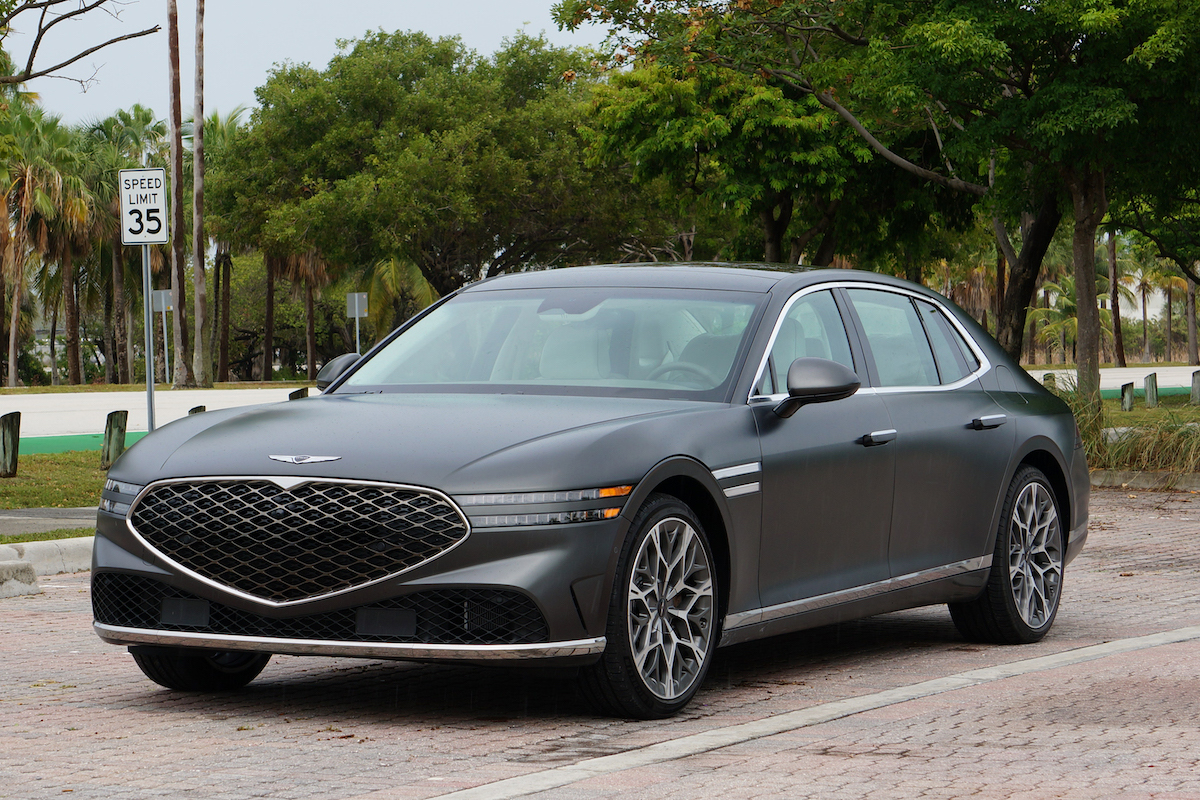
Genesis made a big splash in the luxury sedan segment in 2017 when it launched its flagship G90 sedan alongside the smaller G80. While the nameplate was brand new, the car was a fairly straightforward replacement for the Hyundai Equus, with the South Korean company deciding to spin off its luxury cars into a new sub-brand at this point. The first-generation G90 was produced through 2022, while a second-generation model was launched for the 2023 model year.
The G90 was pitched as a lower-cost alternative to European luxury cars such as the Audi A8, the BMW 7 Series, and the Mercedes-Benz S-Class. Competition also included the Lexus LS that sent shockwaves through the luxury sedan segment when it launched in 1990. Despite a few bargain-bin interior details that kept the G90 from fully matching the established luxury brands, Genesis’ top-shelf sedan was tens of thousands of dollars cheaper than its German rivals.
The first-generation Genesis G90 included turbocharged V6 and naturally aspirated V8 engine options, but outright performance wasn’t the sedan’s calling card. The G90 was about comfort, with a smooth ride, seats that featured a dizzying number of power adjustments, and a lavishly appointed rear passenger compartment. An all-new second-generation G90 appeared in 2023 and was equipped with a pair of V6 engines, one of which was both turbocharged and electrically supercharged. Still, in a segment where buyers can choose German luxury sedans with more than 500 horsepower, Genesis’ focus on comfort and elegance makes the G90 a car that’s just as nice to be driven in as it is to drive.
Our Genesis G90 buying guide covers the history and specs of the two model generations available, with advice on how much buyers can expect to pay and which are the best and worst versions to buy.
Genesis G90 Buying Guide: Cost, Reliability, and the Best Years to Buy
Frequently Asked Questions
Which Genesis G90 years are the best?
Large luxury sedans like the Genesis G90 sell in relatively low numbers, which means there are generally fewer complaints than in other more popular vehicle segments. That’s true of the G90, and there are so few issues listed on CarComplaints.com overall that it’s hard to point to a best year. In general, the second generation that began production in 2023 is more opulent, more stylish and has more features than the first.
Which Genesis G90 years are the worst?
Although the overall number of issues raised on CarComplaints.com is tiny, the 2017 model year has the highest number. In general, first-generation Genesis G90 models powered by the 3.3-liter turbocharged V6 engine were subject to a few recalls for issues that could lead to fires under the hood. If buyers aren't sure a vehicle with the turbocharged V6 has had these recalls addressed, we’d suggest looking for another car with better service history. G90 models powered by the 5.0-liter V8 had no such issues. Second-generation G90s have proven reliable, but have also been the subject of a few recalls that need to be addressed. One covers 2023-2026 models and relates to a fuel leak that could increase the risk of fire.
Is a used Genesis G90 a good deal?
Used Genesis G90 sedans are generally priced well below their European competitors, so can be viewed as a good deal. A first-generation G90, especially the updated version from 2020-2022 equipped with the optional V8 engine, represents excellent value.
Pros and Cons
Pros:
- Excellent value for money
- Stylish design
- Spacious back seat
Cons:
- Fairly pedestrian performance
- Outdated technology in older models
- Little interior storage
Genesis G90 Generations
Genesis G90 Second Generation (2023-Present)
The 2023 Genesis G90 improved upon the original in every way, with more comfort, technology, efficiency, and style. From the outside, design touches such as Genesis’ oversized Crest Grille, slim two-line headlamps, and a pair of bodyside lines (Genesis calls one a Parabolic Line and the other an Athletic Power Line) project a premium look.
As elegant as the second-generation G90’s exterior may be, its best features are found inside the cabin. “If you’re looking for a supremely comfortable car, the G90 is it,” we wrote in our review of the 2023 G90. Its front seats employ 12 air cells and feature four massaging routines and various duration and strength options. The rear seats can be reclined separately, and the right rear seat (Genesis calls it the VIP seat) has leg supports and a footrest.
Dual 12.3-inch screens were mounted in the 2023 G90’s dashboard, while rear-seat passengers got their own 8-inch touchscreen in the armrest. Genesis’ digital key technology worked with both iOS and Android devices to provide keyless entry and startup, and also kept track of multiple drivers’ personal settings. While Apple CarPlay and Android Auto were standard, they required a wired connection in 2023 and 2024 before an update in 2025 introduced wireless connectivity.
The 2023 Genesis G90 featured a Bang & Olufsen 23-speaker system with a "Virtual Venue" mode to recreate sound experiences at venues that include Boston Symphony Hall and Wembley Stadium. This, in addition to a fragrance system and ambient lighting, creates what Genesis calls the "Mood Curator". All four doors had a power function that closed them for the passengers. All of these features are designed to coddle occupants, making the G90 a great car to be driven in. That notion was further emphasized by the fact that the G90 offered both Chauffeur and Sport driving modes.
The 2023 G90 was available with two engine options. The base engine was a 3.5-liter twin-turbo V6 with 375 horsepower and 391 pound-feet of torque, and a version of that engine with an electric supercharger pushed the power figures to 409 hp and 405 lb-ft. An eight-speed automatic transmission sent power to all four wheels. A multi-chamber air suspension system was available, as was a rear-wheel steering function that cut the G90’s turning diameter from 40.1 to 37.1 feet.
The second-generation G90 features a comprehensive suite of safety features. Included as standard are automatic emergency braking, lane-keep assist, lane following assist, blind-spot monitors, rear cross-traffic alert, adaptive cruise control with stop and go, speed-limit assist, a driver attention monitor, and high-beam assist. Genesis Highway Driving Assist II is also standard and allows for semi-autonomous driving with a degree of self-steering, acceleration, and braking.
The G90 earned a Top Safety Pick+ designation from the Insurance Institute for Highway Safety (IIHS) in 2023 and 2024, but dropped to the standard Top Safety Pick in 2025 and 2026 due to an Acceptable (as opposed to Good) rating in the IIHS updated moderate overlap front crash test.
There have been a few recalls for the second-generation G90. A fuel leak prompted a recall of 2023-2026 models, as did a software error that could cause the digital instrument display to go black. Two other recalls for 2023-2026 G90s were issued for faulty seat belt anchors and, bizarrely, a problem with the Saville Silver exterior color could confuse the car’s cameras and cause unintended braking from the Highway Driving Assist system.
The 2023 Genesis G90 carried an MSRP of around $90,000, which was over $13,000 more than the 2022 G90. The 3.5T e-SC model with its electric supercharger cost just under $100,000. That was more than a 2023 Lexus LS, right around the same price as an Audi A8, a few thousand dollars cheaper than a BMW 7 Series, and considerably less than the benchmark Mercedes-Benz S-Class.
There weren’t any major changes made to the G90 in 2024 or 2025 (with the exception of wireless smartphone connectivity in 2025), and the price crept up only slightly. For 2026, though, the G90’s base price jumped to $94,245 (including destination). At the top of the 2026 G90 lineup is the 3.5T e-SC Prestige Black trim that features a blacked-out exterior and a black quilted leather interior for $107,945.
While starting prices for the second-generation G90 are closer to the car’s German competitors than they were for the first-generation model, Genesis’ value play is that every G90 comes pretty much loaded. The 2026 G90 with the e-SC engine has all the goodies Genesis offers as standard equipment, whereas it’s very easy to push the price of a BMW 7 Series or Mercedes-Benz S-Class tens of thousands of dollars higher with options.
On the used market, the second-generation Genesis G90 represents good value. According to CarGurus pricing data, a used 2023 Genesis G90 averages less than $55,000. A 2023 BMW 7 Series averages closer to $65,000, while a 2023 Mercedes-Benz S-Class is nearly $80,000. Granted, BMW and Mercedes-Benz offer some very pricey versions of their flagship sedans that skew the averages upward, but it’s clear that buyers looking for a bargain and who like the idea of ultimate comfort in their luxury sedans should definitely give the G90 a serious look.
Genesis G90 First Generation (2017-2022)
Genesis was an entirely new brand when the first-generation G90 was launched in 2017. Parent company Hyundai had previously used it as a model name for a premium sedan, and that model became the Genesis G80. The replacement for the larger Hyundai Equus luxury sedan was the Genesis G90.
Launched to compete against luxury sedan heavyweights from America, Germany, and Japan with well-established nameplates and decades of history, the Genesis brand’s future hinged on the success of those two sedans. Fortunately, the G80 and G90 were well-designed and well-priced cars that offered a compelling alternative to better-known competitors.
The G90, in particular, was built around a high-end interior swathed in leather and wood, with seats that offered heating, ventilation, and a massive range of power adjustments. The 22-way power-adjustable driver’s seat was approved by Aktion Gesunder Rücken, a consortium of back and spine specialists in Germany. The G90’s cabin was also extremely quiet, thanks to solid build quality, acoustically laminated glass, and sound-deadening wheels.
Power came from either a 3.3-liter turbocharged V6 with 365 hp or a 5.0-liter naturally aspirated V8 that produced 420 hp. Both were mated to an eight-speed automatic transmission and available with rear-wheel drive (RWD) or all-wheel drive (AWD). Genesis’ H-TRAC AWD system was tuned to send most of the engine’s power to the rear wheels under normal circumstances, but could send up to 40% to the front wheels for improved traction.
The 2017 Genesis G90 offered Eco, Smart, Sport, and Individual driver-selectable modes that each had specific calibration settings for suspension, steering, stability control, engine, transmission and, if equipped, AWD. The G90 was also fitted with Genesis Adaptive Control Suspension (GACS), with electronic damping control that continuously adjusted the suspension based on driver inputs and road conditions.
Infotainment duties were handled by a 12.3-inch touchscreen running software that was generally easy to use. Unfortunately, neither Apple CarPlay nor Android Auto were supported. A head-up display that projected useful information onto the windshield was standard, as was a Lexicon Premium Sound System with QuantumLogic Surround sound, 17 speakers, and a 10-inch subwoofer.
Genesis equipped all 2017 G90 sedans with automatic emergency braking with pedestrian detection, blind-spot monitors, adaptive cruise control with stop and go, lane-keep assist, rear cross-traffic alert, a driver attention monitor, dynamic bending light headlights with high-beam assist, and a surround-view camera system. The Genesis G90 received a Top Safety Pick+, the highest rating, from the IIHS from 2017 through 2022.
The G90 picked up Adaptive LED headlights for the 2018 model year, and while there weren’t any real changes for 2019, a thorough refresh for 2020 brought many welcome upgrades. Every body panel other than the roof and doors was updated, resulting in a more modern and upscale appearance. Genesis’ latest crest grille led the way up front, flanked by quad lamps on either side. The rear lighting followed a similar format, which was part of Genesis’ “Athletic Elegance” design language. Inside, the G90 got a revamped infotainment setup that still used a 12.3-inch screen but now featured Apple CarPlay and Android Auto.
Lane-following assist, forward-collision warning that could detect bicycles and vehicles, safe-exit assist that alerted occupants to objects moving toward an opening door, and Highway Driving Assist were all new or upgraded for 2020. Highway Driving Assist was Genesis’ first semi-autonomous system, combining lane centering with smart cruise control. A few small packaging changes were made in 2021 and 2022 ahead of the second-generation G90’s release.
While the first-generation G90 proved reliable, it was the subject of a few recalls. The two that stand out concern the 3.3-liter turbocharged V6 engine, with both relating to a turbocharger oil supply tube or pipe that could leak onto hot exhaust parts, increasing the risk of fire. Prospective buyers of used G90s from 2017-2022 should make sure any vehicle they're considering has had these and any other recalls addressed.
In 2017, the Genesis G90 carried an MSRP of around $70,000. By 2022, the first-generation G90’s final model year, the price had risen to just over $76,000. Those prices were tens of thousands of dollars less than comparable European luxury sedans such as the Audi A8, the BMW 7 Series, and the Mercedes-Benz S-Class, and close to the starting price of a base Lexus LS.
At the time of writing, CarGurus pricing data suggested buyers could find a 2017-2019 Genesis G90 with reasonable mileage for $25,000 or less. Models with the V8 engine tend to carry a premium compared with the turbocharged V6. G90 models from 2020-2022 with the refreshed styling and upgraded list of features are predictably pricier than earlier editions but generally start below $30,000.
Related Topics