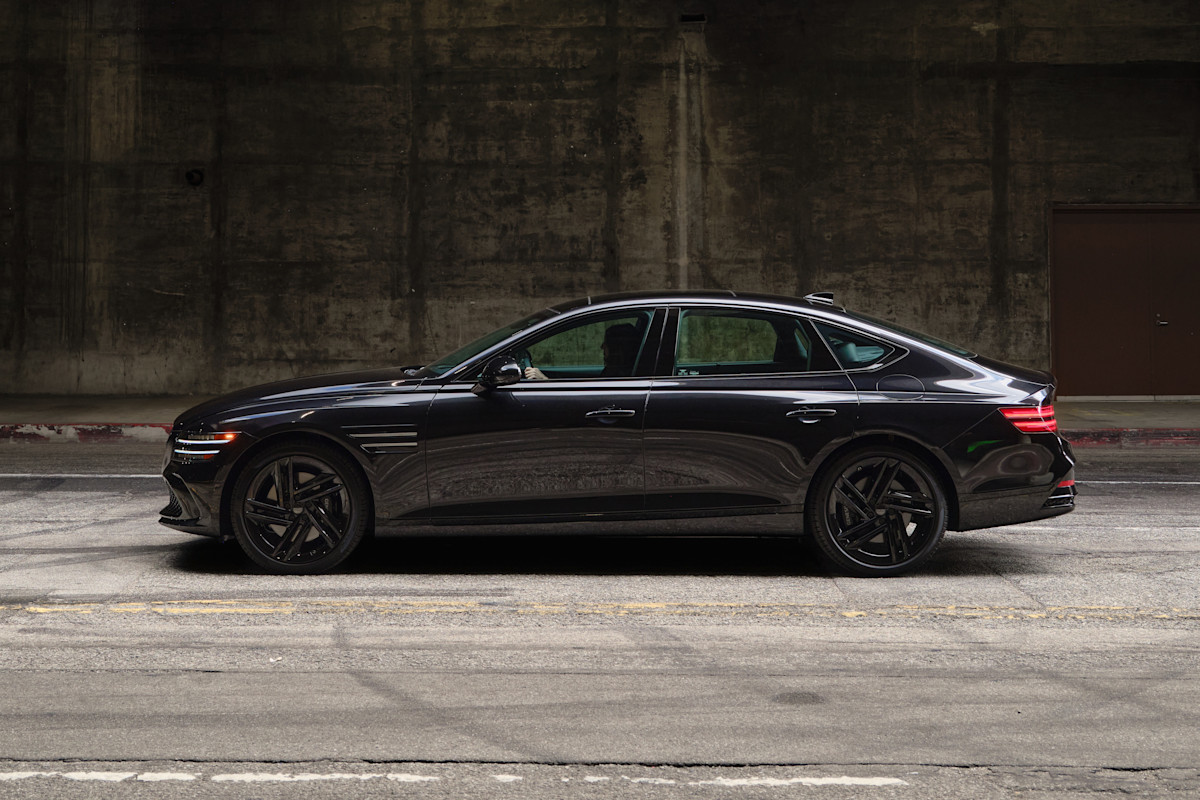
The Genesis G80 was launched as a 2017 model alongside the larger G90 sedan, but its history goes back a lot further. Parent company Hyundai signaled its intention to move upmarket and compete with luxury brands including BMW, Mercedes-Benz, and Lexus in 2009 with the introduction of the Hyundai Genesis sedan. That model name would later be used for the standalone premium brand we know today.
The Hyundai Genesis that spanned two generations between 2008 and 2016 was well received by the media and buyers alike. It was the second-generation model that became the Genesis G80 luxury sedan, and in that metamorphosis, it was upgraded with more standard equipment, improved technology, and free scheduled maintenance (with valet service) for the first three years of ownership. Both V6 and V8 engine options were offered, as was the buyer’s choice of rear-wheel drive (RWD) or all-wheel drive (AWD).
The Genesis G80 had everything it needed, on paper at least, to compete on a level footing with European luxury sedans from respected brands with much longer histories. Its ace in the hole, though, was the price. The 2017 Genesis G80’s base MSRP of $42,375 was around $10,000 less than that of an equivalent BMW 5 Series or Mercedes-Benz E-Class with turbocharged four-cylinder engines that offered less power than the G80’s base V6 unit. A loaded Genesis G80 with a V8 engine and AWD could be purchased for the base price of either of those German machines, which further underscored the price disparity.
Genesis debuted the second-generation G80 luxury sedan as a 2021 model. The new G80 wore a bolder design, was powered by a pair of turbocharged engines, and benefited from a luxurious interior. It still undercut its German rivals by thousands of dollars, further cementing the G80’s status as a legitimate contender for buyers who want luxury trimmings and love good value. On the negative side, Genesis offers neither a hybrid nor a dedicated performance version powertrain in the G80 lineup, and while an electrified G80 was produced from 2023 to 2025, it was dropped for 2026.
Genesis G80 Buying Guide: Cost, Reliability, and the Best Years to Buy
Frequently Asked Questions
Which Genesis G80 years are the best?
The first-generation Genesis G80 earned a Great reliability rating from J.D. Power every year it was assessed. The second-generation G80 got Great scores in 2023 and 2024, but Average in 2025 and 2026, so the best years for reliability are for the first generation. That said, only a small number of G80 issues are reported by CarComplaints.com across all model years. Considering all Genesis G80 models have at least average reliability scores, shoppers may want to base their search on price, powertrain, and mileage.
Which Genesis G80 years are the worst?
Technically, CarComplaints.com’s data shows that the 2018 Genesis G80 is the worst for problems, with more reported complaints than other model years. The actual number of issues is low, though.
How much does a late-model Genesis G80 cost?
Late-model prices climb quickly with each newer year. A one-year-old 2025 Genesis G80 averages around $54,200, a three-year-old 2023 model around $35,800, and a five-year-old 2021 example around $30,800—still a strong luxury value next to comparable German sedans.
Research Genesis G80 Price Trends on CarGurus
Is a used Genesis G80 a good deal?
Yes, a Genesis G80 can be a good deal. Prices were lower than comparable German luxury sedans when new, and that's equally true in the used market. Used car shoppers who want a reliable luxury sedan with room for four adult passengers ought to add the G80 to their shopping list.
Pros and Cons
Pros:
- Stylish design
- Excellent value for money
- Premium interior materials
Cons:
- Unintuitive technology
- Fairly pedestrian performance
- Poor fuel economy
Genesis G80 Generations
Genesis G80 Second Generation (2021-Present)
Genesis had established itself as a legitimate contender in the midsize luxury sedan segment with its first-generation G80, but the second-generation model that debuted in 2021 was better in every meaningful way.
With a chassis that was stiffer, lighter, and designed with a lower center of gravity than the version it replaced, the 2021 Genesis G80 was built atop improved bones. Along with the equally new GV80 SUV, the 2021 G80 debuted Genesis’ “Athletic Elegance” design philosophy, including a large “Crest Grille” and double-lined “Quad Lamp” lighting elements.
Inside, Genesis debuted its “Beauty of White Space” interior design language in the G80. It prioritized outward visibility, with thin roof pillars, a split steering wheel with open space at the top, and a lower dashboard. When CarGurus reviewed the G80 in 2022, we called the interior “a complete work of art”. A 12.3-inch digital instrument cluster joined a wide 14.5-inch infotainment screen and a head-up display projected onto the windshield.
The 2021 G80’s base 2.5-liter inline-four made 300 horsepower and 311 pound-feet of torque. An optional 3.5-liter twin-turbo V6 produced a stout 375 hp and 391 lb-ft of torque. An eight-speed automatic was the only available transmission, and both RWD and AWD were available with either engine. Fuel economy ranged from 21 mpg to 26 mpg across the two engines.
The 2021 Genesis G80 came standard with a comprehensive suite of advanced driver-assistance systems (ADAS). Included were Highway Driving Assist II (HDA II, a semi-autonomous system that combined steering, braking, and acceleration on the highway), Smart Cruise Control with Machine Learning (SCC-ML), blind-spot monitors, and forward-collision warning. The sedan scored a Top Safety Pick+ award from the Insurance Institute for Highway Safety (IIHS) in 2021 (the award continued through the 2026 model year at the time of writing) and the top five-star overall safety rating from the National Highway Traffic Safety Administration (NHTSA).
When it was new, the 2021 Genesis G80’s starting MSRP of $48,745 was thousands less than that of an Audi A6 ($55,945), a BMW 530i ($55,195), or a Mercedes-Benz E350 ($55,300). That attractive price point didn’t come with any caveats. The 2021 Genesis G80 was fully competitive with the best that America, Japan, and Germany had to offer, as evidenced by its score of 8.3 out of 10 when CarGurus tested the G80. That was also the year that Genesis launched the 3.5T Sport and Sport Prestige models that had a sportier look inside and out, and, in the case of the Sport Prestige, a rear-wheel steering system.
A redesigned console-mounted infotainment controller appeared in 2023, but bigger news was the launch of the Electrified G80 in a limited number of U.S. states that year. The Genesis Electrified G80 offered a range of up to 282 miles per charge, thanks to its 87.2-kWh battery pack. Power came from dual motors that produced 365 hp and powered all four wheels. On the positive side, the Electrified G80 was just as smooth as the gasoline G80. On the negative side, integrating the battery pack reduced interior and cargo space. The EV would be built for three years, with production ending following the 2025 model year.
The Genesis G80 gained standard all-wheel drive in 2024. For 2025, some slight exterior tweaks were made, and the interior was newly blessed with a wide 27-inch OLED screen that spanned the dashboard from the area left of the steering wheel all the way to the other side of the center console. The new screen incorporated a digital gauge cluster and the touchscreen infotainment system, both of which were easy to use and configure. Wireless Apple CarPlay and Android Auto were standard. For 2026, a new 3.5T Prestige Black AWD trim replaced the previous 3.5T Sport Advanced AWD, and the digital key and manual rear sunshades became available on more trim levels.
The Genesis G80 has been the subject of several recalls, with some of them for the turbocharged V6 involving oil leaks that can increase the risk of fire under the hood. It’s important to make sure that any recalls have been addressed.
At the time of writing, base prices for a new 2027 Genesis G80 ranged from $60,945 to $82,295 (including destination). On the used market, 2021 and 2022 models—averaging around $30,800 and $30,600, respectively—present a serious luxury value proposition, with 2023 examples averaging around $35,800. According to CarGurus pricing data, models from 2024 through 2026 carry higher asking prices—averaging around $45,100, $54,200, and $60,300, respectively—but are still attractive when judged against their German competition.
Genesis G80 First Generation (2017-2020)
The second-generation Hyundai Genesis that would become the G80 was launched in 2014 for the 2015 model year and on sale for just two years before it was rebranded as the Genesis G80. There were few changes in the transition, especially since the model already wore Genesis rather than Hyundai badges on its hood and trunk lid.
Power came from either a 3.8-liter V6 engine that produced 311 hp and 293 lb-ft of torque, or a 5.0-liter V8 with 419 hp and 383 lb-ft. Genesis G80 models with V6 engines were offered in both RWD and AWD configurations, but the V8 was RWD only. The G80’s AWD system actively shifted power between the front and rear axles, while an eight-speed automatic transmission handled shifting duties.
With the standard V6 engine, the 2017 G80 delivered estimated fuel economy between 19 mpg and 22 mpg combined. With the V8, the 2017 G80 got 18 mpg combined. That wasn’t as good as the 2017 BMW 530i or the 2017 Mercedes-Benz E300. Keep in mind, though, the Genesis G80 ran on regular fuel and had a lot more power than the German sedans that required premium fuel.
The first-generation Genesis G80 came standard with automatic emergency braking, adaptive cruise control, blind-spot monitors, lane-keep assist, high-beam assist, and a rear-view camera (all of which were optional on the BMW 5 Series of the time). The first-generation Genesis G80 sedan earned a Top Safety Pick+ award, the highest possible rating, from the IIHS every year it was produced and took home the top five-star rating from the NHTSA.
If there was one place where the 2017 Genesis G80 didn’t measure up to the competition from BMW, Lexus, and Mercedes-Benz, it was the interior. When CarGurus tested the 2017 model, we said, “The Genesis G80’s switchgear looks and feels too much like that of a Hyundai”. Which, of course, it was. Fortunately, the cabin and the G80’s suspension both offered plenty of comfort, with well-cushioned seats and tuning that prioritized body control over cornering performance.
A more performance-oriented model debuted in 2018 in the form of the G80 3.3T Sport. A twin-turbocharged 3.3-liter V6 engine borrowed from the larger G90 sent 365 hp and 376 lb-ft to either the rear or all four wheels, and while the V8 was still available and slightly more powerful, the 3.3T was more fun to drive. The G80 Sport’s adaptive suspension delivered both comfort and good road-holding, depending on how the car was being driven. Copper and carbon fiber accents set the Sport model apart from more sedate G80 models.
A Sport package was added to Genesis G80 sedans powered by the standard 3.8-liter V6 in 2019, and while it added copper and carbon-fiber trim, it didn’t have the extra power of the turbocharged engine. There weren’t any meaningful changes for 2020, but an all-new G80 was right around the corner.
According to CarGurus pricing data, buyers shopping for a used first-generation Genesis G80 sedan should expect to pay around $16,100 to $24,900 for a reasonable example with comparatively low mileage. The 3.3T Sport models are generally a few thousand dollars more than G80s powered by the base 3.8-liter V6, and while finding a G80 with the powerful 5.0-liter V8 may be a little harder, these models aren’t much more expensive than those with the turbocharged V6.
Related Topics