2026 Honda HR-V Reviews, Pricing & Specs


Pros & cons
What we like
Comfortable driver’s seat
Easy-to-use technology
Great safety ratings
What to consider
Sluggish performance
Poor fuel economy
Uncomfortable back seat
The CarGurus verdict
The 2026 Honda HR-V is a simple, uncomplicated thing. And that’s its most appealing attribute.
Available in three trim levels equipped with an underpowered engine and optional all-wheel drive (AWD), the HR-V is an unremarkable subcompact SUV. A refresh for the 2026 model year adds an improved standard infotainment system and minor styling and interior modifications, but nothing that addresses this model’s primary shortcomings. The changes include a larger touchscreen with faster response times, wireless Apple CarPlay and Android Auto, and wireless smartphone charging.
Verdict: Simply put, the 2026 HR-V is not one of the best subcompact SUVs. It is dreadfully slow, disappointingly inefficient, and barely meets the minimum technological expectations of the young people who might want to buy it. Plus, it demonstrates none of the innovation seen in the original HR-V and in some competitors in the small SUV segment.
out of 10 expert review
Look & feel
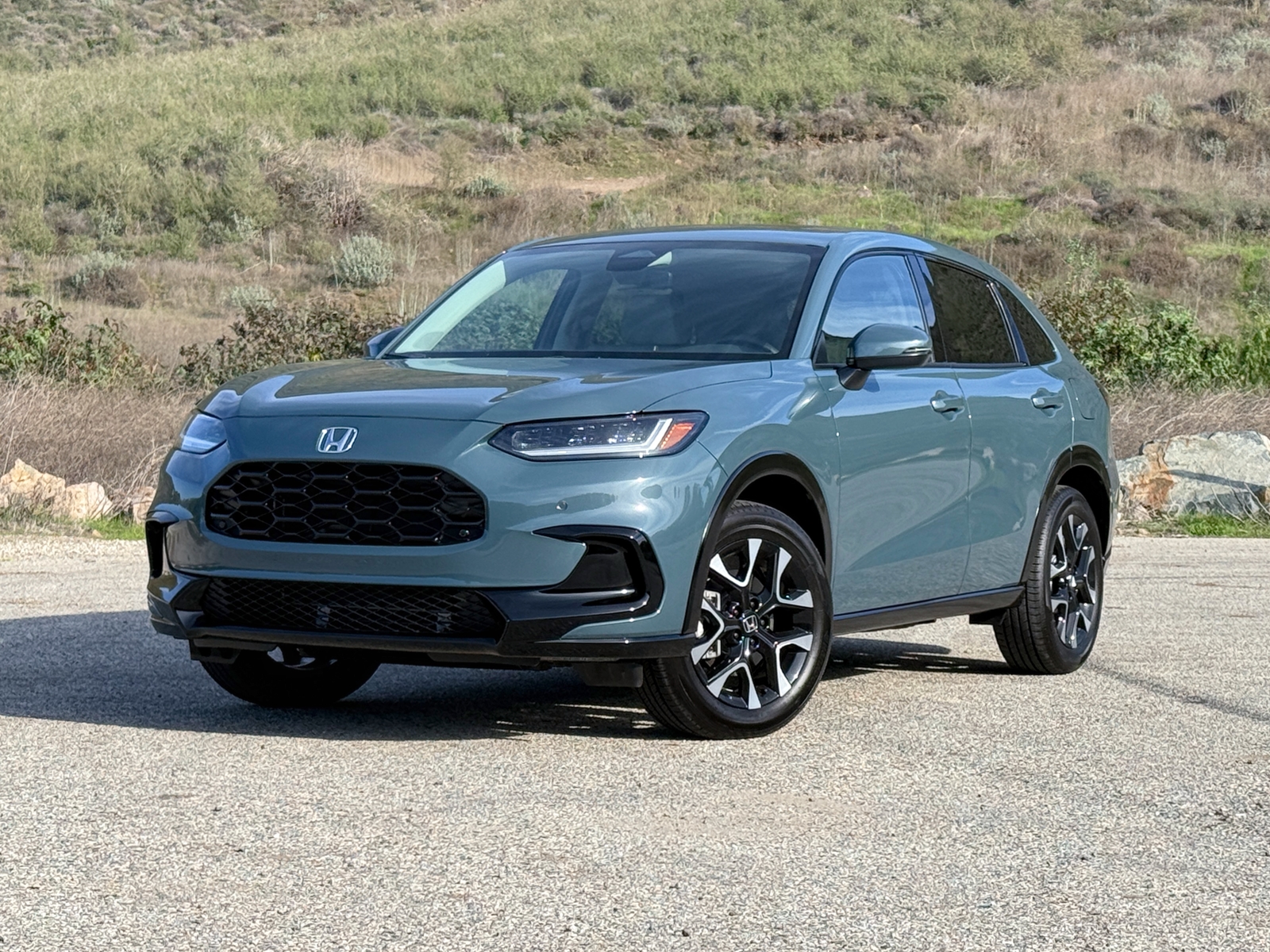
The 2026 HR-V trim levels include LX, Sport, and EX-L. Pricing ranges from $27,650 to $31,500, including a $1,450 destination charge, and adding AWD incurs a $1,500 upcharge. Our test vehicle arrived in EX-L AWD specification with extra-cost Nordic Forest Pearl (green) paint, wearing a manufacturer’s suggested retail price (MSRP) of $33,455 with destination.
The test vehicle looked great—for a Honda HR-V. This little crossover’s blobby grille, stubby butt, and weird profile—which makes it appear as though it's leaning forward—are not inherently appealing. But the green paint and the EX-L’s 18-inch alloy wheels tucked under the gloss-black wheelarches make the HR-V look about as good as it can.
Those wheels reflect the most substantial styling changes for the 2026 HR-V. All three trim levels have new ones, with a 17-inch gray design for the LX and a 17-inch black design for the Sport. In addition, dark-tinted rear privacy glass is now standard on all three trim levels, and new paint colors include Boost Blue (Sport only) and Solar Silver (LX and EX-L).
Inside, the HR-V is more appealing, especially with available gray upholstery and trim, which create an upscale visual contrast against the otherwise black interior. Unfortunately, gray is available only with LX and EX-L trims and only with selected exterior colors. The LX and Sport have cloth seats, while the EX-L has genuine leather with perforated surfaces and interesting Z-pattern stitching. Honda has upgraded the EX-L model’s cabin lighting and detailing for 2026, adding front footwell lighting and silver steering wheel spokes.
The rest of the EX-L’s interior features the typical attention to detail for which Honda is known. From the unusual metal mesh dashboard trim and contrast color padding on the dash and the center console, to the tamboured knobs and the satisfying control operation, the EX-L cabin looks and feels like it’s from a higher class of vehicle.

Performance
Honda installs a 2.0-liter four-cylinder engine under the HR-V’s hood. It produces 158 horsepower at 6,500 rpm and 138 pound-feet of torque at 4,200 rpm in a vehicle that weighs up to 3,336 pounds. Needless to say, the engine works hard.
So does the continuously variable transmission (CVT). In urban driving, you don’t notice the CVT, as it makes the best possible use of the available power. However, when you’re trying to get up to speed on wide suburban boulevards, accelerate onto fast-flowing freeways, or pass slower vehicles, the HR-V’s lack of grunt is a genuine liability. The powertrain’s gutlessness also made overtaking nearly impossible, and maintaining momentum crucial when climbing steep grades.
One might expect impressive fuel economy as the reward for putting up with the meek acceleration, and official EPA ratings say the HR-V will get 28 mpg in combined city and highway driving with front-wheel drive (FWD) or 27 mpg combined with AWD. Maybe that’s possible under ideal conditions, but the HR-V averaged 24.8 mpg on our Southern California test loop.
Compare that to the 31.9 mpg achieved by a Honda Civic Sport we recently evaluated on the same route. Heck, the HR-V barely outperformed a BMW X3 30 xDrive we reviewed last year (24.2 mpg). That 255-hp turbocharged BMW weighed 4,155 pounds and could accelerate to 60 mph in six seconds flat.
Speaking of turbocharging, we think that could cure what ails the Honda HR-V. The turbocharged four-cylinder engine in the Acura ADX, the HR-V’s platform-mate, produces 190 hp and 179 lb-ft of torque while achieving the same EPA combined fuel efficiency as the naturally-aspirated HR-V engine. Better yet, Honda should give the HR-V the same two-motor hybrid powertrain it offers in the Civic, bumping power and improving the HR-V’s dismal real-world fuel economy.
At least Honda got the dynamic tuning right. The HR-V has a multi-link rear suspension instead of the cheaper torsion-beam setup usually seen in small crossovers. Paired with a standard brake-based torque vectoring system called Agile Handling Assist, it makes the HR-V feel lively in twists and turns.
The steering isn’t particularly quick, but the brake pedal feels good, and the brakes didn’t fade during a mountain descent from nearly 2,000 feet in elevation to sea level. The EX-L’s 18-inch wheels and tires offer impressive grip, too, and though it's modest, the seven inches of ground clearance allowed us to straddle a rock in the road that likely would have damaged a Civic.

Form & function
Once upon a time, the Honda HR-V was innovative. Now, it’s not. What made the original HR-V unique was its rear “Magic Seat,” which you could configure in several ways to carry various items. Now, it just flops down flat, like every other crossover.
Honda could have made up for this by copying the Buick Encore GX and the Chevrolet Trailblazer by adding a fold-flat front passenger seat to better accommodate long items. At a minimum, a 40/20/40 split-folding rear seat (instead of a 60/40 split-fold) would be nice, so that skis and your ski-bum buddies could travel to the slopes together. But no, the HR-V doesn’t have any of those features. Or a panoramic sunroof (though a smaller moonroof is standard on the EX-L). Or rear climate control vents and USB charging ports. Or storage wells and nets in the cargo area to secure loose items.
At least the storage situation for the driver and front passenger is reasonable, even if the surfaces are plastic and produce scratching noises when things slide in them. The seats are pretty comfortable, too, especially the height-adjustable driver’s seat with eight-way power operation in the HR-V EX-L. Those who live in cold-weather climates will also appreciate the heated front seats in the HR-V Sport and EX-L.
The back seat offers enough headroom, legroom, and footroom to carry adults, but the seat cushion is low, the seatback angle is too reclined, and there's no center armrest, so support is unsatisfactory. In addition to the missing air-conditioning vents and USB charging ports, the back seat doesn’t have cupholders.
Opening the liftgate reveals a 24.4 cubic-foot cargo area behind the rear seats, which is about the same as that of the Honda Civic Hatchback. However, the HR-V’s boxier roofline ups the practicality quotient a bit. Honda doesn’t publish a cargo space figure for the Civic Hatch with the rear seats folded, but it likely doesn’t quite match the HR-V’s 55.1 cubic feet.

Technology
For 2026, Honda increased the standard touchscreen size from 7 to 9 inches and installed a faster processor to make the screen more responsive to inputs. Additionally, the infotainment system now includes wireless Apple CarPlay and Android Auto, and every HR-V features a wireless smartphone charger.
However, the standard system still doesn’t offer built-in navigation or SiriusXM satellite radio. Also, the base LX has only four speakers, while the Sport trim has six and the EX-L has eight. HondaLink is standard, but it’s a basic collection of app-based services and doesn't offer features such as automatic collision notification or an SOS emergency call button.
The tech is simple, and it played well with an iPhone. We had no trouble pairing to the infotainment system, using Siri, or streaming music via Pandora and Apple Music. The EX-L’s eight-speaker audio system sounded good, too. The 7-inch digital instrumentation panel is smart, and a surprise-and-delight feature is the walk-away automatic vehicle locking feature. Still, while some might value the HR-V’s technological simplicity, it pales in comparison to rivals such as the Hyundai Kona.

Safety
Honda equips every HR-V with Honda Sensing, a collection of driver-assistive features. They include forward collision warning, automatic emergency braking, lane departure warning, lane-keeping assist, lane-centering assist, adaptive cruise control, traffic jam assist, and automatic high-beam headlights.
The automaker reserves a blind-spot monitoring system with rear cross-traffic alert for the Sport and EX-L trim levels. Front and rear parking sensors with low-speed automatic braking are exclusive to the EX-L, and were helpful in cramped parking situations.
Overall, the Honda Sensing technology proved unintrusive, but the adaptive cruise control did not work as expected on several occasions. In one situation, after changing lanes, it did not quickly recognize a vehicle we were following, which braked after we got behind it. That delay triggered a forward collision warning, requiring driver intervention.
Later, while driving up Ventura County’s Conejo Grade on the 101 freeway, as the HR-V negotiated a gentle left curve, it falsely identified slower vehicles in the adjacent lane to the right as traffic directly in front. As a result, the Honda suddenly slowed, which the motorists behind the HR-V were not expecting. Again, driver intervention was necessary. The gutless HR-V also took its time regaining its speed on the hill.
Closer to Los Angeles, while driving in dense, stop-and-go traffic, the driver aids were slow to react when cars ahead sped up. Then, when they braked and slowed down again, the HR-V was caught in the middle of an acceleration event to resume the set speed. Honda Sensing’s delayed reaction to the slowing traffic ahead required driver intervention to brake and ensure a safe following distance.
As for crash tests, the HR-V earns favorable ratings from the National Highway Traffic Safety Administration (NHTSA). For 2025, the 2025 HR-V also scored a Top Safety Pick+ rating from the Insurance Institute for Highway Safety (IIHS). As of this writing, the IIHS hadn’t published ratings for the 2026 HR-V, so be sure to check those for any changes.

Cost-effectiveness
The 2026 Honda HR-V is the second-cheapest vehicle in the automaker’s lineup. Only the base Civic LX Sedan costs less, and compared to the Civic Hatchback, the HR-V Sport commands only a $205 premium.
That seems like a bargain. The HR-V sits higher off the ground, making it easier to get into and out of while providing extra clearance and improved outward visibility. You can also get AWD with the HR-V, but not with the Civic. However, the Civic is faster and more efficient, and offers an available hybrid powertrain that delivers even quicker acceleration while significantly boosting fuel economy.
Compared to other small crossover SUVs, the HR-V is priced relatively high and doesn’t offer a compelling value story such as lengthy warranty coverage, complimentary scheduled service (Honda offers one dealership visit only), or free connected service plans. For example, a Hyundai Kona costs less but offers a significantly more comprehensive warranty, roadside assistance plan, and complimentary Bluelink+ services plan.
A Toyota Corolla Cross might be an even smarter buy. When priced like our HR-V EX-L test vehicle, it offers several connected service plans with free trial subscriptions, two years or 25,000 miles of complimentary maintenance, and a hybrid powertrain with 196 hp, AWD, and a 42-mpg rating in combined driving. If you’re planning to go off-road, the popular Subaru Crosstrek is an obvious choice, thanks to its superior AWD system and ground clearance. Plus, Subaru now offers the Crosstrek Hybrid, which is good to drive and rated to get 36 mpg.
While these alternatives are appealing, the biggest problems with the Honda HR-V pertain to its lack of power, an uncomfortable back seat, and the absence of standard blind spot monitoring with rear cross-traffic alert. It's hard to believe that the manufacturer is unaware of those shortcomings, so the delay in resolving them is difficult to understand. In a price-sensitive segment like this one, Honda can’t expect people to pay more for the HR-V simply because it's a Honda.

What owners say
Trims & specs
Base MSRP $28,300 | Seating 5 |
Engine 2.0L 158 hp I4 | Cargo Capacity 24.4 cu ft |
Combined MPG 29 | Drivetrain FWD |
Base MSRP $28,000 | Seating 5 |
Engine 2.0L 158 hp I4 | Cargo Capacity 24.4 cu ft |
Combined MPG 27 | Drivetrain AWD |
Base MSRP $29,800 | Seating 5 |
Engine 2.0L 158 hp I4 | Cargo Capacity 24.4 cu ft |
Combined MPG 27 | Drivetrain AWD |
Base MSRP $30,350 | Seating 5 |
Engine 2.0L 158 hp I4 | Cargo Capacity 24.4 cu ft |
Combined MPG 29 | Drivetrain FWD |
Base MSRP $31,850 | Seating 5 |
Engine 2.0L 158 hp I4 | Cargo Capacity 24.4 cu ft |
Combined MPG 27 | Drivetrain AWD |
Base MSRP $26,500 | Seating 5 |
Engine 2.0L 158 hp I4 | Cargo Capacity 24.4 cu ft |
Combined MPG 29 | Drivetrain FWD |


Pricing trends
MSRP range
$26,500 - $31,850
Current avg. market price
$28,302
Trending down by 1.1% this month
May 2026 - November 2026