2026 Nissan Rogue Plug-In Hybrid Reviews, Pricing & Specs
Write a review$45,990 to $49,990
Original MSRP
6.8
of 10
expert review
avg user rating
(0 reviews)
Pros
High quality interior
Impressive electric range and hybrid functionality
Third row jump seat
Cons
Least efficient in the class
Outdated technology
Poor value
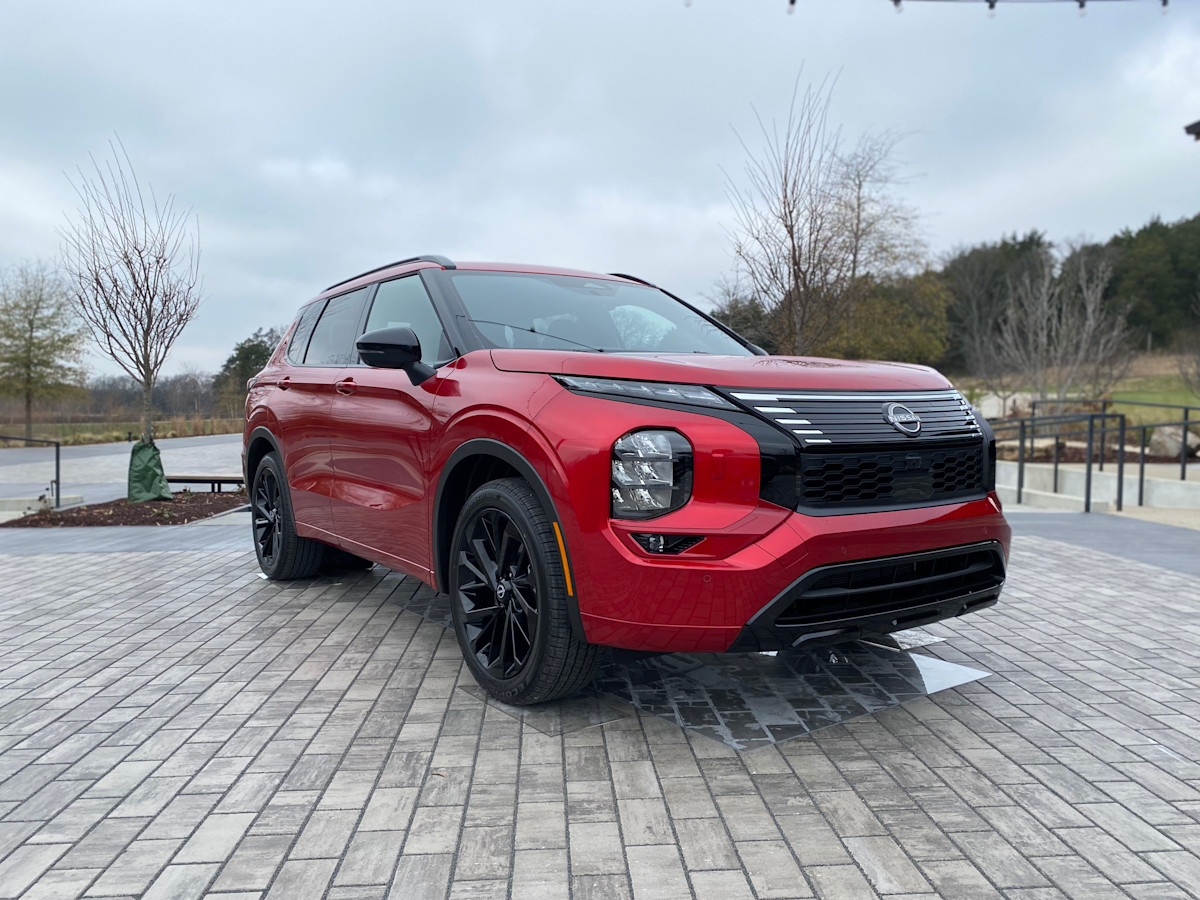
Nissan copies a copy of its own car, the Mitsubishi Outlander, to sell as the company's first plug-in hybrid.
Plug-in hybrid crossovers are typically high-achieving but low-volume sellers. For 2026, the Nissan Rogue Plug-in Hybrid (PHEV) joins as the ninth such vehicle to offer an electric-only driving experience and quicker acceleration versus its standard gas trims. Visually and mechanically, the 2026 Rogue PHEV—built in Japan by Mitsubishi—shares virtually nothing in common with the regular 2026 Rogue except the name. Adding more confusion is Nissan's unusual marketing plan to discontinue the Rogue PHEV within a year when the next-generation Rogue debuts with the company's in-house hybrid, without plug-in capability. Or, Nissan executives say, they might sell the new hybrid and the old plug-in hybrid side by side. Either way, the Rogue PHEV is a compelling, if perplexing, compact SUV.
Verdict: Good in its own right, the Rogue PHEV is ultimately a rebadged Mitsubishi with a much shorter warranty, no included maintenance, and lots of missing equipment.
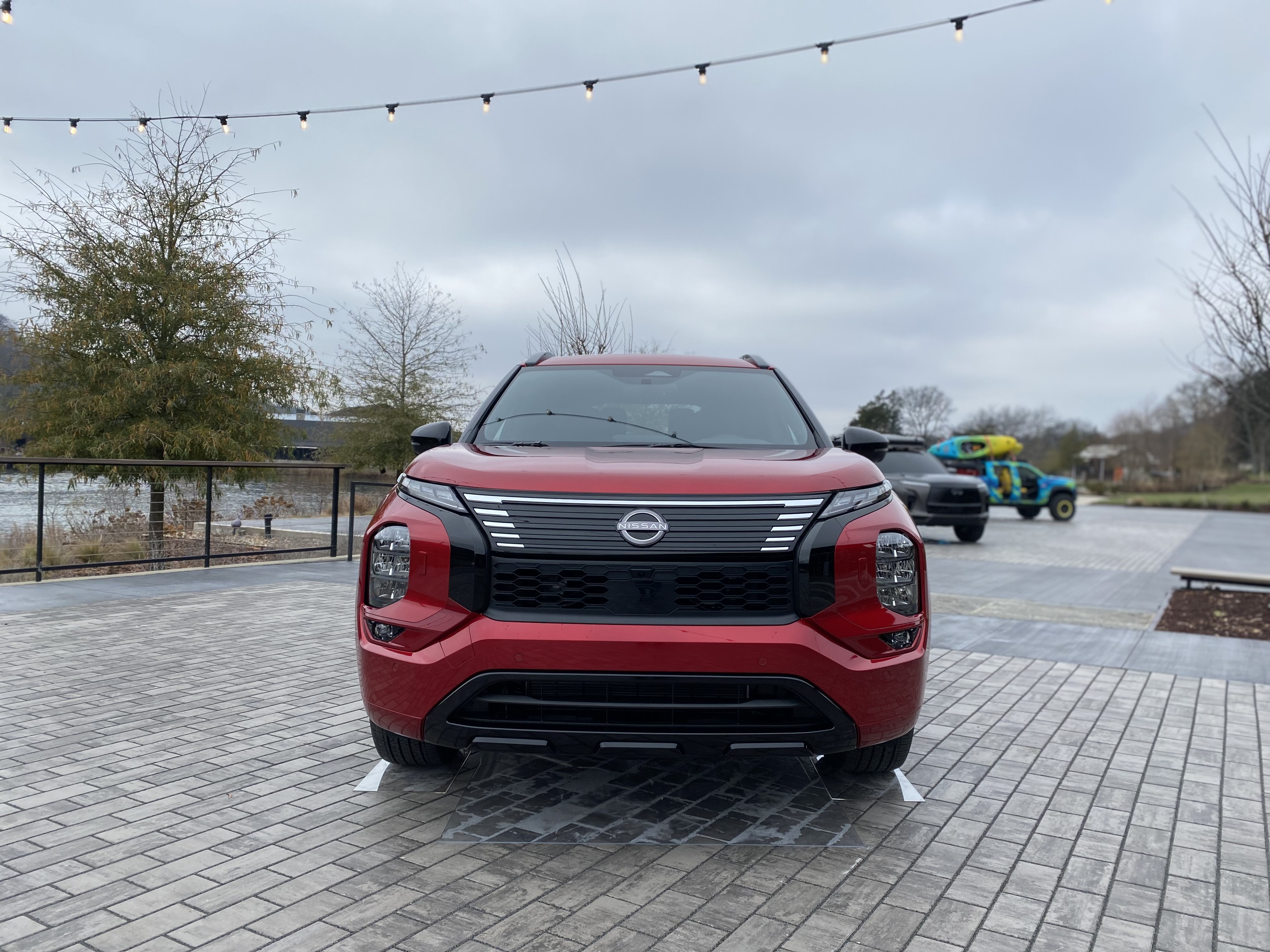
Here are all the styling differences between a Rogue PHEV and an Outlander PHEV. Nissan swapped the Outlander's solid black grille and three chrome lines for a solid black grille with one chrome line and four black lines. Four short chrome bars on either side trace diagonally to the identical lower grille. Mitsubishi's three-diamond badge trades for Nissan's intersected circle. The chrome trim hugging those grilles from the upper daytime running lamps down to the fog lamps is now half-black, half body-color. The lower bumper is all black. Collectively, this all works with Nissan's current design language even though Mitsubishi had made the whole thing for itself. The combination of stacked headlamps pushed to the far corners and DRLs that mimic eyelashes is a choice. Weirdly again, it works. In the rear, Nissan designers connected the taillamps with a piece of black trim, glued a couple new badges, changed the wheel center caps, and went out for drinks.
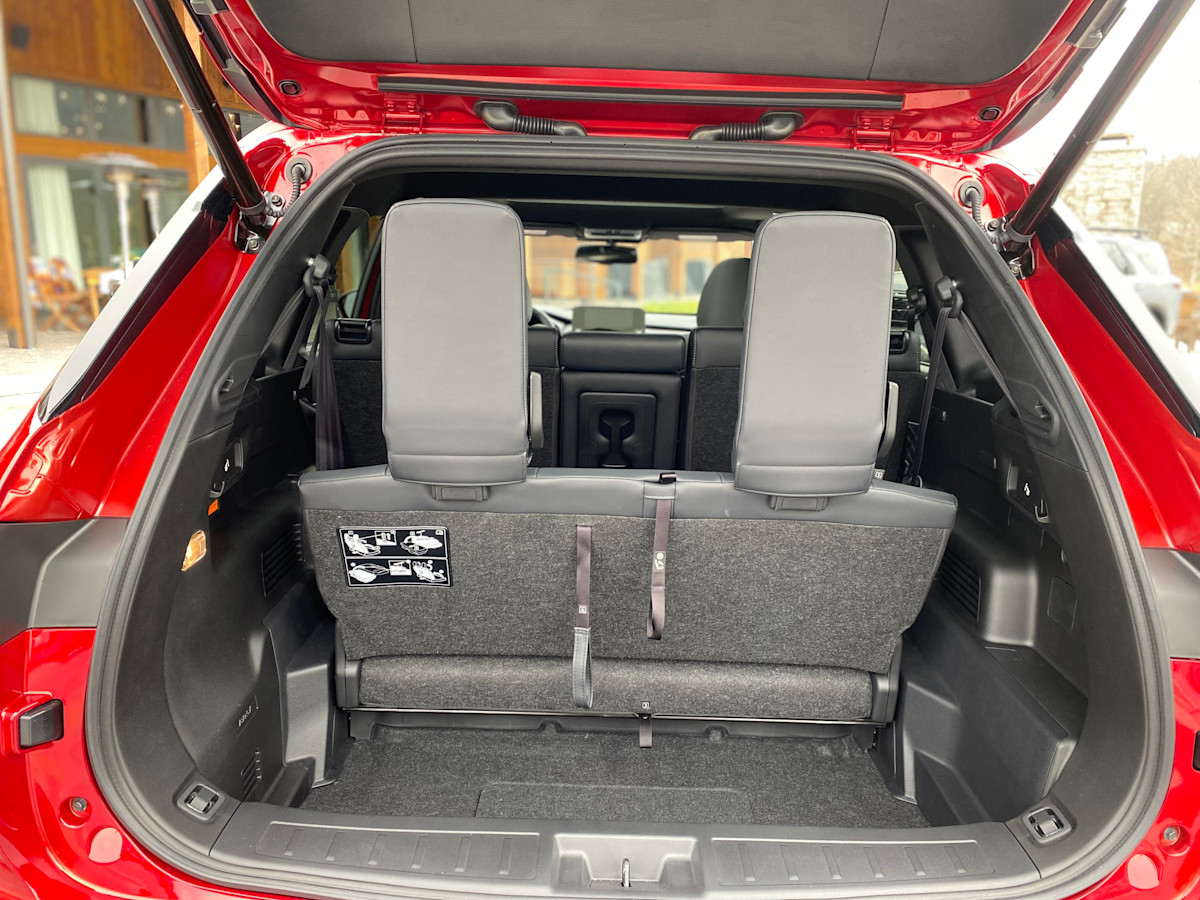
The Outlander already looked good, yet what its unique exterior hides is a third row of seats which the real Rogue does not have. The absurdly tall headrests are the telltale that this row is a jump seat for two small kids. But no other compact SUV offers a third row, other than an Outlander.
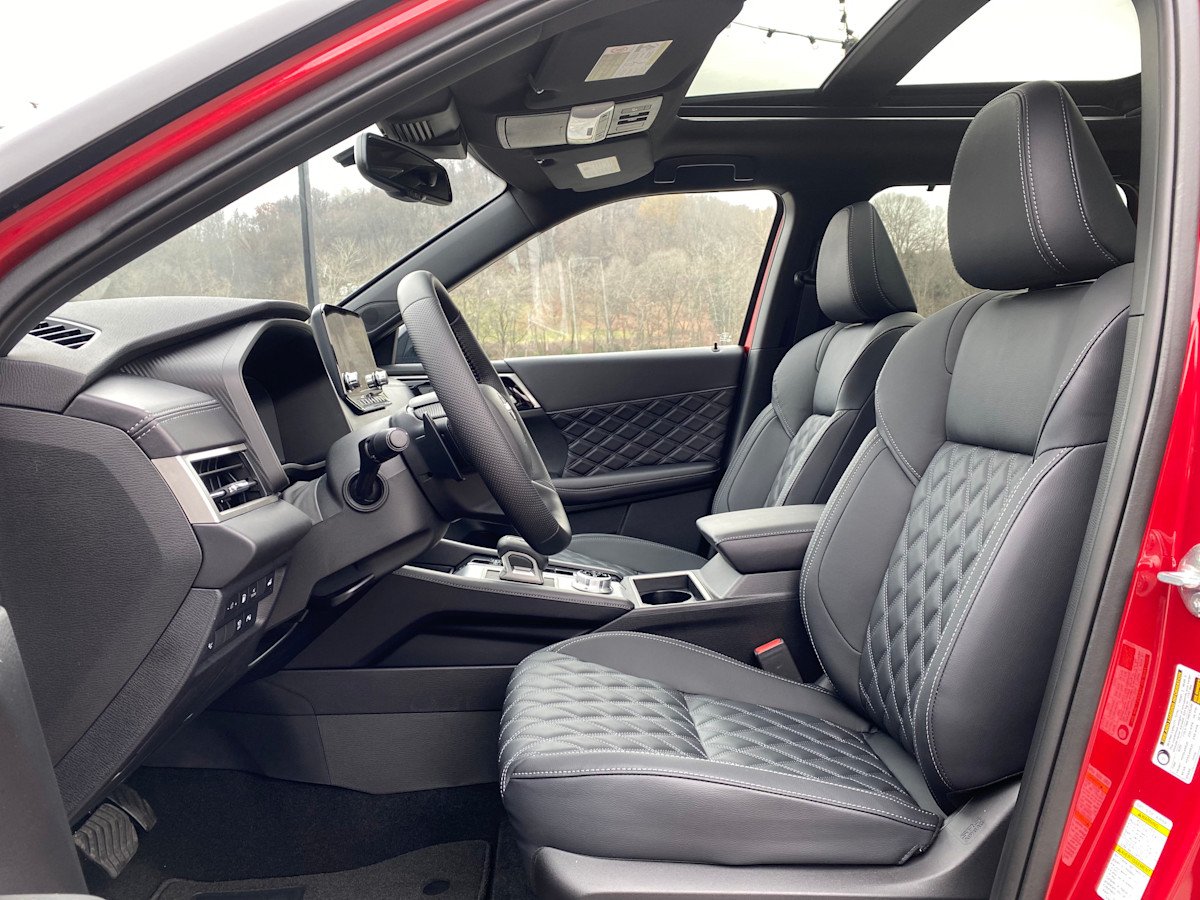
In many ways, the Rogue benefits from the Outlander's gussied up interior. Like the Outlander, our Rogue PHEV Platinum test car had quilted semi-aniline leather that's a few grades higher than the gas Rogue's, extra leatherette on the door panels and dash, knurled window switches, real aluminum trim on the console, and exclusive colorways. But the front seats in the Rogue PHEV do not cool or massage like they do in the Outlander PHEV Platinum. That's only the start of many missing features on this Rogue PHEV.
With an EPA-estimated 38 miles in EV mode and 420 miles of range combined, the Rogue PHEV is a multitool. A 20-kWh battery, twin electric traction motors that directly drive the axles, and a 2.4-liter four-cylinder engine can work together as a series hybrid, parallel hybrid, or a full EV. In other words, the Rogue PHEV can drive on only the battery, only the engine, or both in tandem depending on the drive mode, the state of charge, and the driver's input. It's complex but works so well in concert. The powertrain makes 248 horsepower and 332 pound-feet of torque, the latter of which is immediately felt at lower speeds. Acceleration is swift and generally quiet, though under strain, the gas engine shows its coarseness. Still, since there is no traditional transmission, the Rogue PHEV moves with more smoothness and less vibration than a regular Rogue.
But while the Outlander PHEV offers a DC fast-charge port that can top the battery off in just 38 minutes, the Rogue PHEV rips out this unique capability. Arguably in most cases, PHEV owners won't stop to charge since their cars run on gas and Mitsubishi used the older 50-kW CHAdeMO port, yet this was a rare convenience. Overnight, on a Level 2 charge, figure 7.5 hours. The better number: 16 hours. That's on a Level 1 charge using a household outlet, which means that even if you don't top off to 100 percent charge, you won't have to rewire your home to see the benefit of a Rogue PHEV. That's because the car can recharge itself on the go with the gas engine acting as a generator (using the Charge mode) or maintain the battery charge (Save mode). There are five levels of brake regeneration, adjusted with the steering wheel paddles, and an e-pedal mode that provides one-pedal driving. You can tailor the brakes to how you feel at any given moment.
So what's the rub? While the Rogue PHEV's electric performance and its hybrid operation are impressive, the efficiency is at the very bottom compared to the Toyota RAV4 Plug-in Hybrid (the current and upcoming generation). Combined fuel economy is 64 MPGe, the worst of any PHEV SUV in the segment, (and well below the 2025 RAV4's 94 MPGe). The Dodge Hornet PHEV is considerably smaller but more efficient at 77 MPGe, while the front-wheel drive Escape PHEV hits 101 MPGe. That means the Rogue PHEV eats more electrons per mile, and in hybrid mode, its combined 26 mpg is also the segment's lowest and nowhere near Toyota's 38 mpg. Worse, the 2026 RAV4 PHEV is supposed to crack 50 miles of electric range while making 300-plus horsepower. Worse still, compared to the 2026 Rogue PHEV, the updated 2026 Outlander PHEV is packing a larger battery, just over 300 horsepower, and additional tweaks that may see its mileage improve significantly. And yet by the time both cars are on sale, this Nissan will not see any of those improvements.
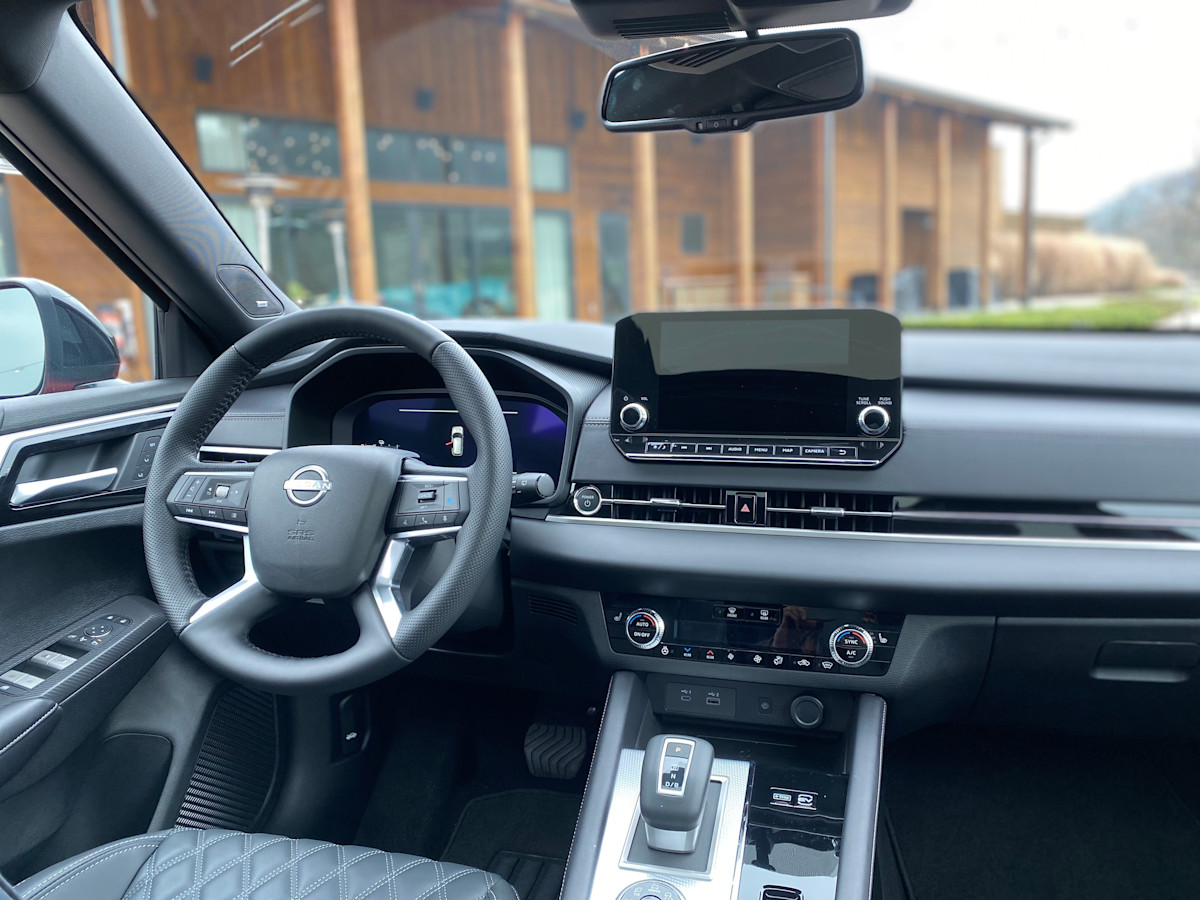
Plenty of physical controls adorn the cabin below a 9-inch touchscreen and near the standard 12-inch digital instrument panel. The screens are easy to operate using buttons and scroll wheels, there are volume and tuning knobs, and there is little to reexamine. The driving position is at an appropriate medium height for an SUV this size, visibility is good in all directions, and comfort from all the padded surfaces make the Rogue PHEV a good road tripper.
The rear doors open 70 degrees, which allows for easy ingress and egress. Headroom and legroom are generous, except for the third row which is meant as a "just in case someone needs a ride." Cargo space is 12.8 cubic feet behind that row, 30.8 cubic feet behind the second, and 64.7 with both rows folded. Nissan says the cargo hold is tall enough to fit a mountain bike and wide enough for four golf bags. It's not as cavernous as a regular Rogue, but back there is an AC outlet capable of providing up to 1500 watts of power along with another in the second row. In the Platinum, the second row adds heated seats, window sunshades and a separate climate zone (a heat pump is standard, which warms the car more quickly without drawing as much power from the battery).
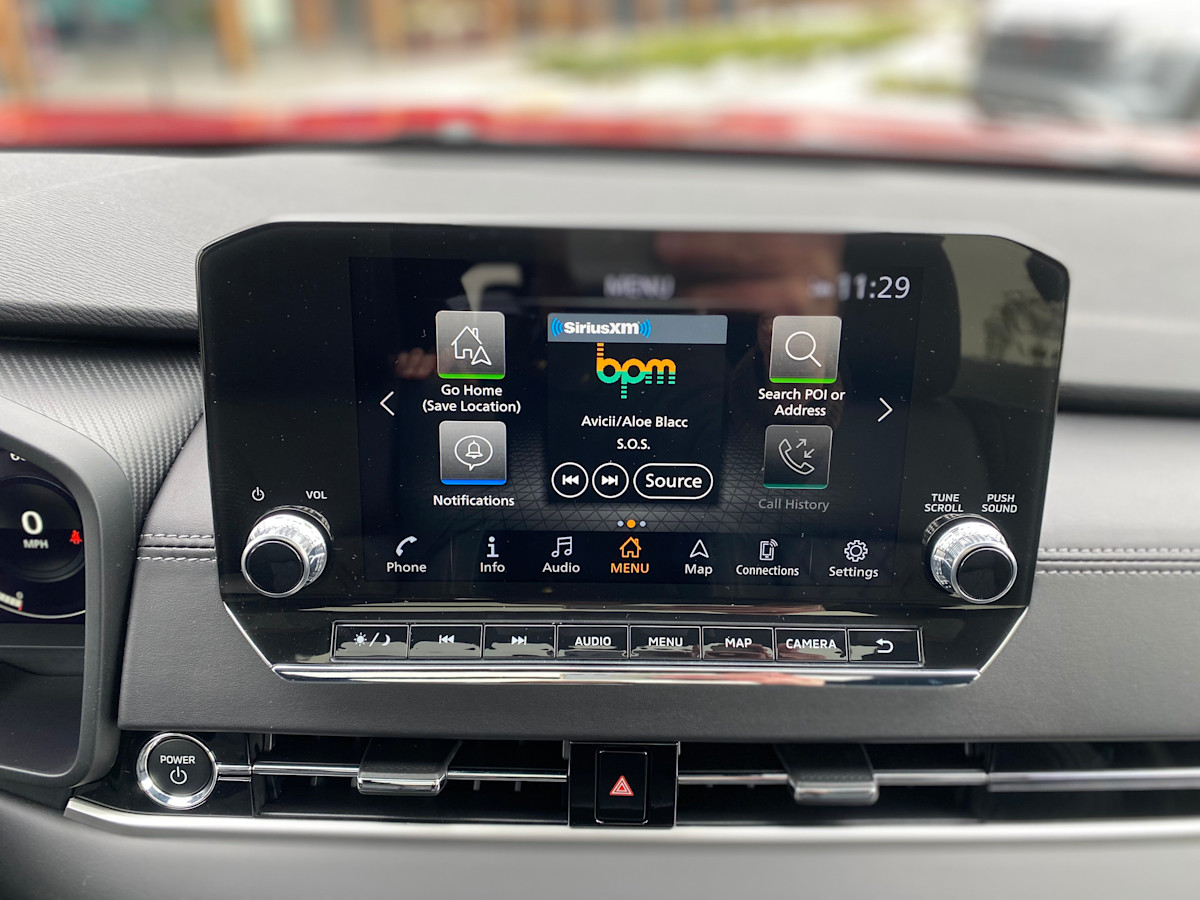
Nissan's newest infotainment software that debuted on the 2025 Rogue and Mitsubishi's 2025 gas-only Outlander is not here. Granted, we prefer the older system's shortcut buttons and two knobs for tuning and volume on the Rogue PHEV. But what they control is now a dated, slower system with less capability. The new 12.3-inch display in the gas Rogue and Outlanders is higher in resolution, has wireless Android Auto, and operates faster without lag. It also runs Google Maps, Assistant, and the Play Store natively in the system and has over-the-air updates.
The 9-inch touchscreen in the Rogue PHEV, however, has none of those features. It also does not have the Yamaha stereo that in the Outlander sounds like a much more expensive system that belongs in a luxury car and features software that compensates for the sound of the air rushing through the vents or the wipers dragging along the windshield.
A wireless charging pad, wireless Apple CarPlay, wired Android Auto, a 9-speaker Bose stereo, and SiriusXM come standard on the SL, with a head-up display on the Platinum. ProPilot Assist 1.1 is also standard, which uses information from the navigation to adjust vehicle speed around turns. But it's not Nissan's newest version 2.1 which allows hands-free driving on the 2026 Rogue Platinum. Driver assists are comprehensive, though again, the 360-degree cameras don't show a 3D version or an "invisible hood" view like on the regular 2026 Rogue.
Every safety feature is standard on the Rogue PHEV, even without some of the regular Rogue's updated driver assistance systems. Rear side airbags, a rare feature on most cars, are standard along with a central side airbag mounted in the driver's seat that is meant to prevent injury from two people colliding with each other. Rear emergency braking, inattentive driver alert, and blind spot monitoring are also standard.
While the Rogue PHEV has not been crash-tested, the identical Outlander PHEV has been tested multiple times. The 2023 Outlander PHEV was awarded a Top Safety Pick by the Insurance Institute for Highway Safety after Mitsubishi made improvements to the body structure and airbags during that model year. Crash scores for the side impact and small offset frontal impact tests conducted by Mitsubishi scored the top "good" ratings. The 2025 Nissan Rogue was also awarded the same accolade. The 2025 Outlander in gas-only AWD trim and the 2025 Nissan Rogue earned five stars overall in tests conducted for the National Highway Traffic Safety Administration, though both vehicles scored four out of five stars for the frontal test.

While pricing was unavailable at the time of writing, we expect the Rogue PHEV to start well above the Rogue Platinum's $39,000 MSRP. If Nissan is smart, figure $42,000 for the SL and $45,000 for the Platinum—below the prices of the Outlander PHEV. Still, the value proposition is minimal. Technically, it is a brand-new model. In reality, it is four years old and will be quickly outdated when it launches in early 2026. With the arrival of the faster, more efficient, and sportier RAV4 Hybrid and Nissan's own E-Power hybrid on the 2027 Rogue, it makes little sense to buy a Rogue PHEV unless there is a hefty incentive offered by Nissan.
The car itself is good. On electric range and amenities, the Rogue PHEV outclasses plug-in versions of the Dodge Hornet, Kia Niro, and Ford Escape, all of which are significantly smaller (or only offer front-wheel drive). It's closer in electric efficiency to plug-in versions of the Hyundai Tucson, Kia Sorento, and Kia Sportage, though these SUVs have significantly higher fuel economy when running on gas. The nearest competitor is the Outlander PHEV, which for 2026 is updated with more safety, performance, and technology features that the Rogue PHEV will not offer. Plus, the Mitsubishi offers a superior warranty (5-year/60,000-mile bumper-to-bumper, 10-year/100,000-mile powertrain, and two years of maintenance) that Nissan will not match.
We think Nissan should have skipped the Rogue PHEV and patiently waited to launch its own hybrids. In the meantime, the Rogue PHEV may confuse buyers and possibly insult them if they’re convinced to buy a second-rate car when a newer, better Rogue is following immediately behind it.

User reviews for 2026 Nissan Rogue Plug-In Hybrid
Write a review2026 Nissan Rogue Plug-In Hybrid Pricing
Trims & specs
Air Conditioning
Automatic climate control front air conditioning · Dual front air conditioning zones
Airbags
Dual front airbags · Dual front knee airbags · Passenger airbag deactivation: occupant sensing deactivation · Front side airbags · Front side curtain airbags
Audio System
Antenna Type: diversity · Voice recognition audio system · USB auxiliary audio input · AM/FM radio · Satellite Radio: SiriusXM · Total Number of Speakers: 6
Brakes
ABS: 4-wheel · Braking assist: hill start assist · Electronic parking brake: auto off · Front brake diameter: 13.8 · Front brakes: ventilated disc · Rear brake diameter: 13.0 · Rear brakes: ventilated disc
Comfort Features
Armrests: rear center with cupholders · Door trim: leatherette · Floor Material: carpet · Shift knob trim: leather · Steering wheel trim: leather
Convenience Features
Adaptive stop and go cruise control: fully automated · Assist handle: front · Autonomous lane guidance: lane centering · Cargo area power outlet: 12V · Center console: front console with armrest and storage · Cruise control: adaptive · Cupholders: front · Easy entry: manual rear seat · Memorized settings: liftgate · Multi-function remote: keyless entry with panic alarm · One-touch windows: 4 · Power outlet(s): 12V front · Power steering: electric · Power windows: lockout button · Reading lights: front · Steering wheel: tilt and telescopic · Steering wheel mounted controls: audio · Storage: in-floor · Vanity mirrors: dual illuminating
Driver Seat
Adjustable lumbar support: power · Power adjustments: 8
Drivetrain
4WD Type: on demand
Engine
Battery rating: 420 CCA · EV battery capacity: 20 kWh · EV on-board charger rating: 3.5 kW · Electric Charge Cord: 120 volt · Electric Motor Battery Type: lithium ion · Electric Motor HP: 134 · Electric Motor Power Output (Kilowatts): 100 · Electric Motor Torque: 144 · Electric motor charger connector: SAE J1772 · Electric motor charging time (120V): 16 hours · Electric motor charging time (240V): 7.5 hours · Electric motor miles per charge: 38 · Hybrid Gas Engine HP: 131 · Hybrid Gas Engine HP@RPM: 5000 · Hybrid Gas Engine Torque: 144 · Hybrid gas Engine Torque@RPM: 4300
Exterior Features
Door handle color: body-color · Fender lip moldings: black · Front bumper color: body-color · Grille color: black with chrome accents · Mirror color: black · Rear bumper color: body-color · Rear spoiler: roofline spoiler · Rear spoiler color: body-color · Rear trunk/liftgate: sensor-activated · Rocker panel color: black · Window trim: black
Headrests
Front headrests: adjustable · Number of front headrests: 2 · Number of rear headrests: 3 · Number of third row headrests: 2
Hybrid
Starter Type: motor/generator
In Car Entertainment
Connected in-car apps: SiriusXM Weather · Infotainment: Android Auto ready · Infotainment screen size: 9 in. · Smartphone integration: wireless Apple CarPlay
Instrumentation
Fuel economy display: MPG · Instrument cluster screen size: 12.3 in. · Warnings and reminders: coolant temperature warning
Lights
Daytime running lights: LED · Front fog lights: LED · Headlights: automatic high beam dimmer · Tail and brake lights: LED
Mirrors
Exterior mirrors: heated · Inside rearview mirror: manual day/night
Passenger Seat
Manual Adjustments: 4
Rear Seats
Type: 40-20-40 split bench
Safety
Automatic emergency braking: front · Camera system: surround view · Child seat anchors: LATCH system · Cross Traffic Alert: rear · Crumple zones: front · Impact sensor: battery disconnect · Parking sensors: front · Pre-Collision Warning System: visual warning · Pre-collision warning system: pedestrian detection · Programmable safety key: MyKey · Rearview monitor: in dash · Traffic sign recognition: adaptive speed limiting
Seatbelts
Emergency locking retractors: front, rear, third, and fourth row · Front seatbelts: 3-point · Seatbelt force limiters: front and rear · Seatbelt pretensioners: front and rear · Seatbelt warning sensor: driver and passenger · Second row seatbelts: 3-point · Third row seatbelts: 3-point
Seats
Driver seat power adjustments: height · Front seat type: bucket · Passenger seat manual adjustments: reclining · Rear seat folding: split · Rear seat manual adjustments: reclining · Third row headrests: foldable · Third row manual adjustments: reclining · Third row seat folding: split · Upholstery: leatherette
Security
Power door locks: anti-lockout
Spare Tire
Kit: inflator kit
Stability and Traction
Traction control: with trailer stability control
Steering
Steering ratio: 14.1 · Turns lock-to-lock: 2.6
Suspension
Front Arm Type: lower control arms · Front Shock Type: gas shock absorbers · Front Spring Type: coil springs · Front Suspension Classification: independent · Front Suspension Type: MacPherson struts · Rear Shock Type: gas shock absorbers · Rear Spring Type: coil springs · Rear Suspension Classification: independent · Rear Suspension Type: multi-link · Stabilizer bar(s): front
Telematics
Driver assistance app: roadside assistance · Electronic messaging assistance: with voice recognition · Navigation system: touch screen display · Phone: voice activated · Phone wireless data link: Bluetooth · Smart device app compatibility: NissanConnect · Smart device app function: maintenance scheduling
Third Row Seat
Type: bench
Tires
Type: all season
Tires and Rims
Wheels: painted aluminum
Windows
Front wipers: speed sensitive · Laminated glass: acoustic front side · Liftgate window: fixed · Power windows: with safety reverse · Rear wiper: auto-on in reverse · Solar-tinted glass: front
Air Conditioning
Automatic climate control front air conditioning · Dual front air conditioning zones · Automatic climate control rear air conditioning · Single rear air conditioning zones
Airbags
Dual front airbags · Dual front knee airbags · Passenger airbag deactivation: occupant sensing deactivation · Rear side airbags · Rear side curtain airbags
Audio System
Antenna Type: diversity · Voice recognition audio system · USB auxiliary audio input · Premium Brand: Bose · HD radio · Satellite Radio: SiriusXM · 1 subwoofer · Total Number of Speakers: 8
Brakes
ABS: 4-wheel · Braking assist: hill start assist · Electronic parking brake: auto off · Front brake diameter: 13.8 · Front brakes: ventilated disc · Rear brake diameter: 13.0 · Rear brakes: ventilated disc
Comfort Features
Armrests: rear center with cupholders · Center console trim: aluminium · Door trim: leatherette · Floor Material: carpet · Shift knob trim: leather · Steering wheel trim: leather
Convenience Features
Adaptive stop and go cruise control: fully automated · Assist handle: front · Autonomous lane guidance: lane centering · Cargo area power outlet: 115V · Cargo cover: retractable · Center console: front console with armrest and storage · Cruise control: adaptive · Cupholders: rear · Dimming rearview mirror: auto-dimming · Easy entry: power driver seat · Memorized settings: liftgate · Multi-function remote: vehicle and key memory · One-touch windows: 4 · Power outlet(s): USB-C rear · Power steering: speed-proportional · Power windows: lockout button · Reading lights: front · Rear power outlet: 115V · Steering wheel: tilt and telescopic · Steering wheel mounted controls: paddle shifter · Storage: sunglasses holder · Sunshade: side window · Vanity mirrors: dual illuminating
Driver Seat
Adjustable lumbar support: power · Power adjustments: 8
Drivetrain
4WD Type: on demand
Engine
Battery rating: 420 CCA · EV battery capacity: 20 kWh · EV on-board charger rating: 3.5 kW · Electric Charge Cord: 120 volt · Electric Motor Battery Type: lithium ion · Electric Motor HP: 134 · Electric Motor Power Output (Kilowatts): 100 · Electric Motor Torque: 144 · Electric motor charger connector: SAE J1772 · Electric motor charging time (120V): 16 hours · Electric motor charging time (240V): 7.5 hours · Electric motor miles per charge: 38 · Hybrid Gas Engine HP: 131 · Hybrid Gas Engine HP@RPM: 5000 · Hybrid Gas Engine Torque: 144 · Hybrid gas Engine Torque@RPM: 4300
Exterior Features
Door handle color: body-color · Fender lip moldings: black · Front bumper color: body-color · Grille color: black with chrome accents · Mirror color: black · Rear bumper color: body-color · Rear spoiler: roofline spoiler · Rear spoiler color: body-color · Rear trunk/liftgate: liftgate · Rocker panel color: body-color · Window trim: black
Headrests
Front headrests: adjustable · Number of front headrests: 2 · Number of rear headrests: 3 · Number of third row headrests: 2
Hybrid
Starter Type: motor/generator
In Car Entertainment
Connected in-car apps: SiriusXM Travel Link · Infotainment: Android Auto ready · Infotainment screen size: 9 in. · Smartphone integration: wireless Apple CarPlay
Instrumentation
Fuel economy display: range · Instrument cluster screen size: 12.3 in. · Warnings and reminders: low fuel level
Lights
Daytime running lights: LED · Exterior entry lights: puddle lamps · Front fog lights: LED · Headlights: Auto on/off · Tail and brake lights: LED
Mirrors
Exterior mirrors: integrated turn signals
Passenger Seat
Adjustable lumbar support: power · Power adjustments: 8
Rear Seats
Type: 40-20-40 split bench
Roof
Moonroof: power panoramic · Moonroof / Sunroof: power sunshade · Roof rails: black
Safety
Automatic emergency braking: front pedestrian · Camera system: surround view · Child seat anchors: LATCH system · Cross Traffic Alert: rear · Crumple zones: rear · Impact sensor: alert system · Parking sensors: front · Pre-Collision Warning System: audible warning · Pre-collision warning system: pedestrian detection · Programmable safety key: MyKey · Rearview monitor: in dash · Traffic sign recognition: adaptive speed limiting
Seatbelts
Emergency locking retractors: front and rear · Front seatbelts: 3-point · Seatbelt force limiters: front · Seatbelt pretensioners: front · Seatbelt warning sensor: driver and passenger · Second row seatbelts: 3-point · Third row seatbelts: 3-point
Seats
Driver seat power adjustments: height · Front seat type: bucket · Passenger seat power adjustments: height · Rear seat folding: split · Rear seat manual adjustments: reclining · Third row headrests: foldable · Third row manual adjustments: reclining · Third row seat folding: split · Upholstery: leather-trimmed
Security
Power door locks: anti-lockout
Spare Tire
Kit: inflator kit
Stability and Traction
Traction control: with trailer stability control
Steering
Steering ratio: 14.1 · Turns lock-to-lock: 2.6
Suspension
Front Arm Type: lower control arms · Front Shock Type: gas shock absorbers · Front Spring Type: coil springs · Front Suspension Classification: independent · Front Suspension Type: MacPherson struts · Rear Shock Type: gas shock absorbers · Rear Spring Type: coil springs · Rear Suspension Classification: independent · Rear Suspension Type: multi-link · Stabilizer bar(s): front
Telematics
Driver assistance app: roadside assistance · Electronic messaging assistance: with voice recognition · Navigation system: with voice recognition · Phone: voice activated · Phone wireless data link: Bluetooth · Smart device app compatibility: NissanConnect · Smart device app function: maintenance status
Third Row Seat
Type: bench
Tires
Type: all season
Tires and Rims
Wheels: painted aluminum
Windows
Front wipers: rain sensing · Laminated glass: acoustic front side · Liftgate window: fixed · Power windows: with safety reverse · Rear wiper: with washer · Solar-tinted glass: front

