2026 Lexus NX Reviews, Pricing & Specs

Pros & cons
What we like
Multiple powertrain options
Standard advanced safety features
Fuel-efficient hybrid models
What to consider
Potentially polarizing design
Poor ride quality
Not much cargo space compared to rivals
The CarGurus verdict
The 2026 Lexus NX offers daring styling, an array of powertrains, and the assurance of the Lexus badge.
The NX is the compact crossover SUV of the Lexus lineup. It’s between the Lexus UX and Lexus RX in size and price, and competes with small luxury crossovers like the Acura RDX, Audi Q5, BMW X3, Genesis GV70, Mercedes-Benz GLC-Class, and Volvo XC60. This second-generation version arrived for the 2022 model year and receives minimal updates for 2026. The previous NX 250 base model is gone, but Lexus made some changes to the lineup to make the hybrid and plug-in hybrid NX models more affordable.
Verdict: The NX is a good value in hybrid form, but otherwise doesn’t feel like a true luxury vehicle.
out of 10 expert review
Look & feel
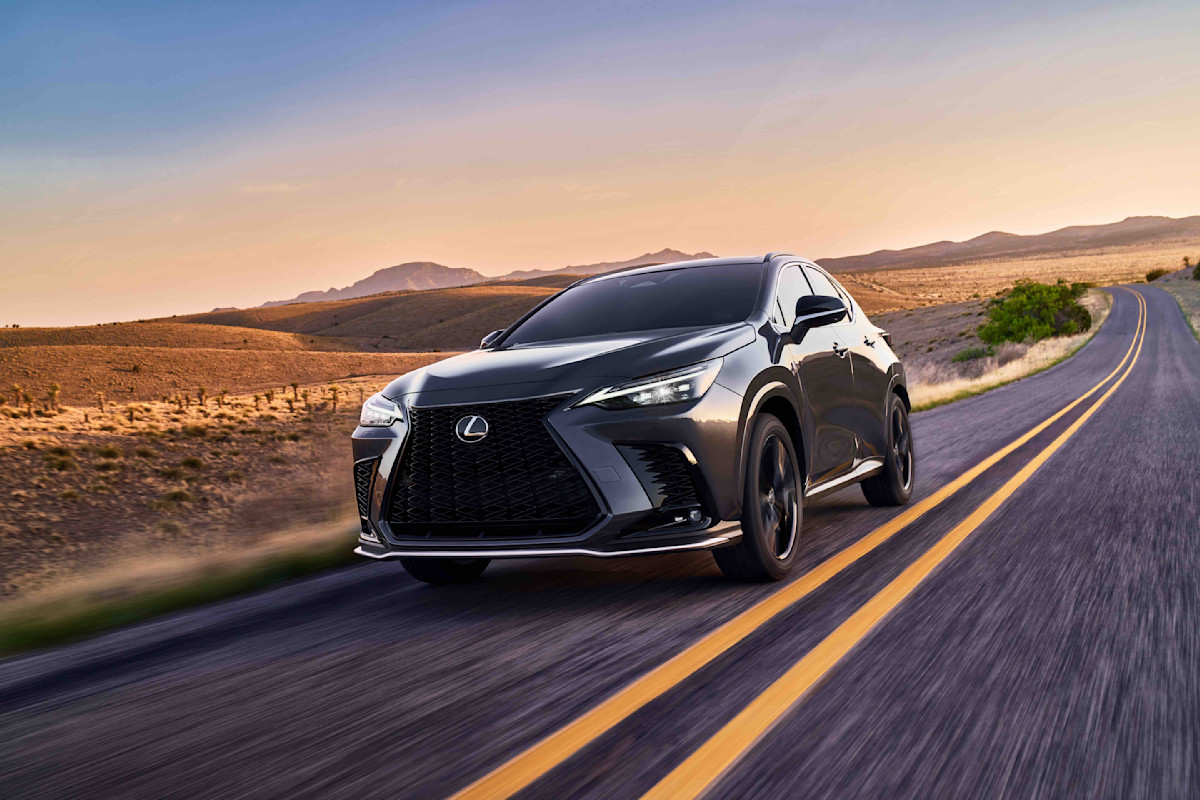
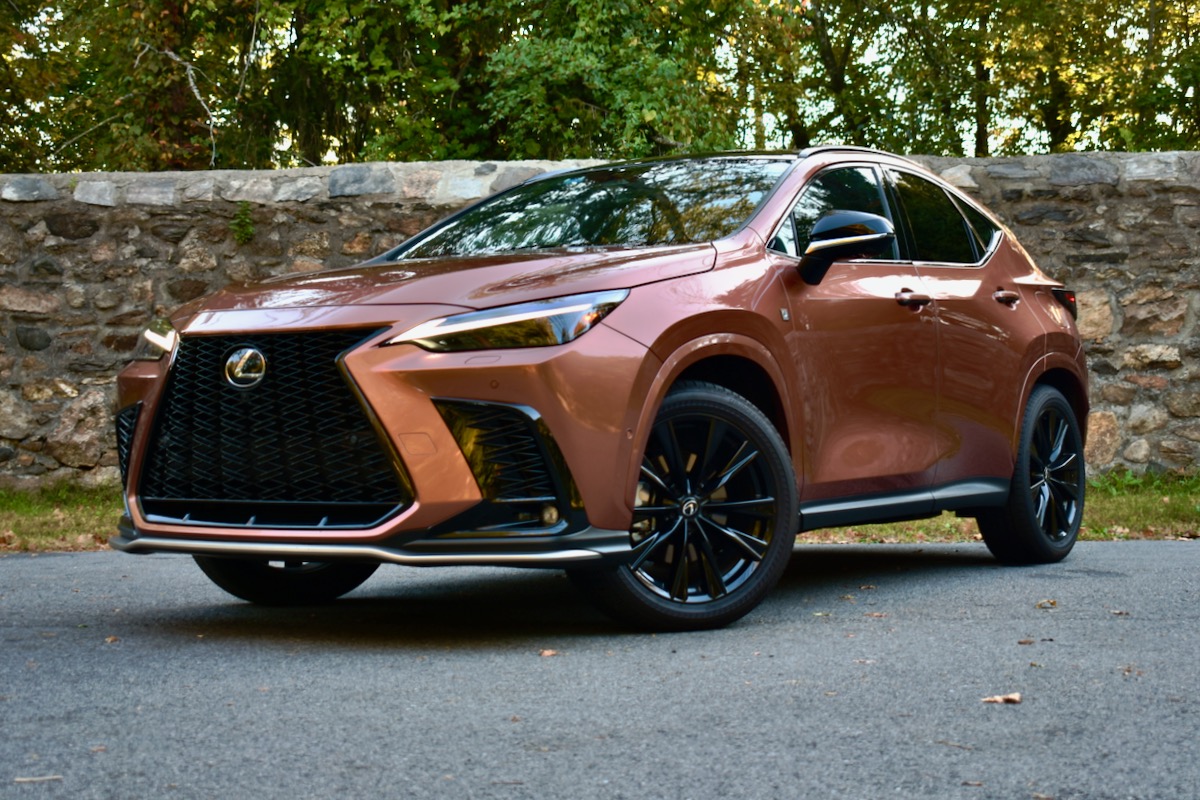
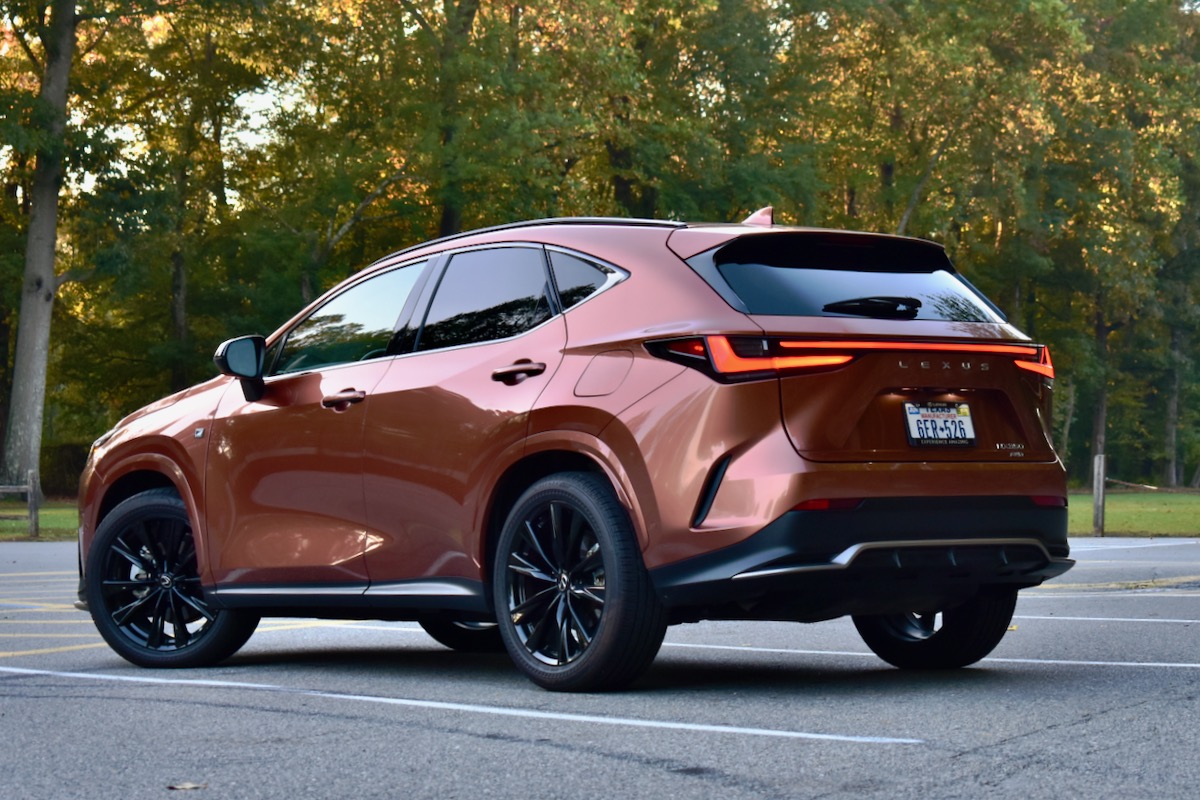
While the second-generation Lexus NX has been on sale for a few years now, it still looks fairly fresh. The various styling elements—including chunky fenders, headlights with integrated LED daytime running lights, taillights connected by a thin strip, and the always-controversial Lexus spindle grille—are nicely integrated. The NX isn’t as classically handsome as the more straight-laced Genesis GV70 or Volvo XC60, but nor is it as awkward as the latest Audi Q5 or BMW X3.
That’s because, compared to their colleagues in Germany, the Lexus design team did a better job of refining an existing recipe. Many of the key elements—such as the big grille and LED DRLs—carried over from the previous-generation NX. But here they look like they were actually intended to be part of the overall design, not just slapped on to punch things up visually. Even the oversized grille, which some people still haven’t gotten used to more than a decade after its introduction, is balanced out by the placement of the headlights and side air intakes.
For the 2026 model year, Lexus offers the NX in non-hybrid NX 350, hybrid NX 350h, and plug-in hybrid NX 450h+ specs. Trim levels across those three powertrain options include base, Premium, Luxury, and F Sport Handling, except for the NX 450h+, which isn’t available in base trim. The F Sport Handling grade adds adaptive dampers and black 20-inch wheels, as well as a different front fascia, black roof rails, and black window framing.
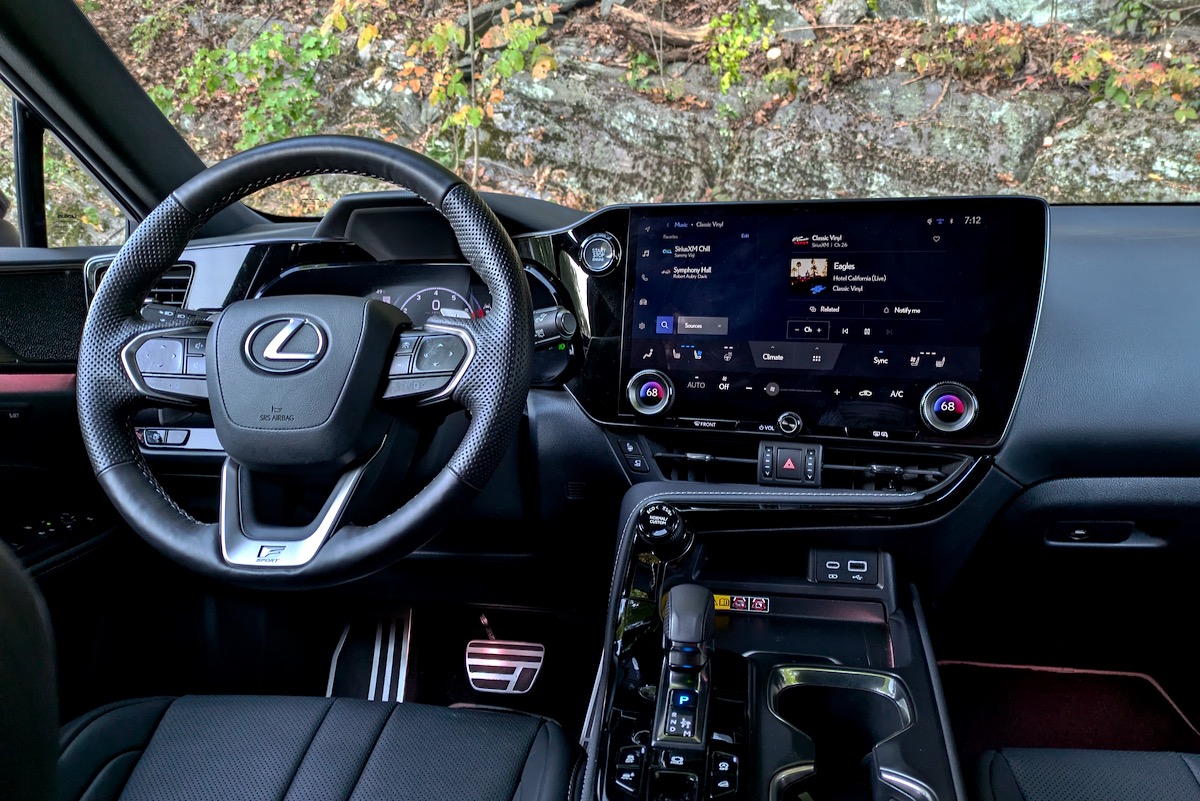
Lexus sales didn’t exactly take a nosedive when the automaker’s styling became more extroverted, showing just how much equity customers put in the brand itself, regardless of what the cars look like. However, that’s based in part on an expectation of luxury that the base NX 350 doesn’t quite live up to. Our F Sport Handling test car’s all-black interior didn’t feel like a significant upgrade over high-end versions of the Toyota RAV4, with which the NX shares a platform. Sport seats, aluminum pedals, and an F Sport steering wheel didn’t quite compensate for that. The similarly-priced NX 350 Luxury grade does offer leather upholstery, and heated and ventilated front seats and a power-adjustable steering column are standard on the one-step-lower NX 350 Premium trim.
Performance
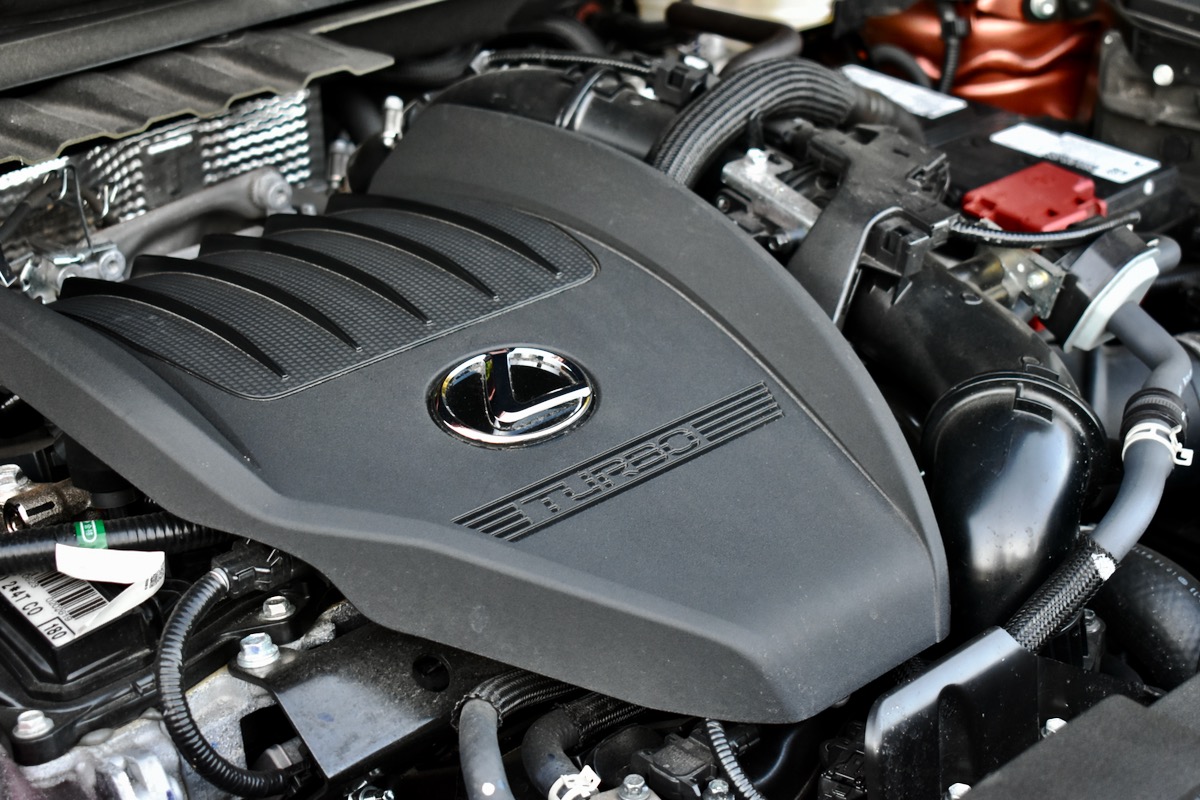
Lexus offers a variety of powertrain options in the NX, which is good, because the standard hardware in our NX 350 F Sport test car did not impress. The NX 350 uses a turbocharged 2.4-liter four-cylinder engine generating 275 horsepower and 317 pound-feet of torque, which is supplied to a standard all-wheel drive (AWD) system via an eight-speed automatic transmission.
This turbo-four is related to the engine used in the Toyota Tacoma, and it definitely felt more appropriate for a pickup truck than a luxury SUV. Its coarse exhaust note was thankfully dulled by the NX’s sound deadening material, but no similar solution existed for the lack of urgency with which it revved. Lexus quotes a respectable 6.6-second zero to 60 mph time, but the lethargic eight-speed automatic does its best to make that unachievable in the real world. This is one of the few non-performance cars where manual control via the steering wheel paddle shifters is a necessity.
While we only had the opportunity for a full review of the NX 350 this time around, the Lexus NX 350h hybrid and NX 450h+ plug-in hybrid models seem more compelling on paper. For the 2026 model year, the NX 350h is the only NX model available with either AWD or front-wheel drive (FWD). It uses a naturally-aspirated 2.5-liter four-cylinder engine and the familiar Toyota/Lexus hybrid system to generate 240 hp, getting it from zero to 60 mph in 8.2 seconds with FWD or 7.2 seconds with AWD. The NX 450h+ uses a bigger battery pack for more continuous electric power, boosting the numbers to 304 hp and 6 seconds to 60 mph.
However, it’s unclear if powertrain upgrades can cancel out the indifferent chassis tuning we experienced in our test car. Said car was equipped with the F Sport Handling upgrade, which includes adaptive performance dampers and 20-inch wheels. Even in their default setting, the dampers were too firm to deal with pavement imperfections. And even on smooth pavement, the NX never felt settled. That made for uncomfortable ride quality and an unengaging driving experience, the latter made even worse by lifeless steering.
Despite roughly 15 years of F Sport packages, Lexus just hasn’t gotten the hang of diet performance models the way Audi, BMW, and Mercedes-Benz have. One could argue that Lexus’ core competency lies more with quiet, comfort, and refinement, but the poor ride quality means the NX doesn’t score well here either. And while engineers did a good job of tuning out most unwanted sounds, wind noise at highway speeds still made the cabin less than serene.
Form & function
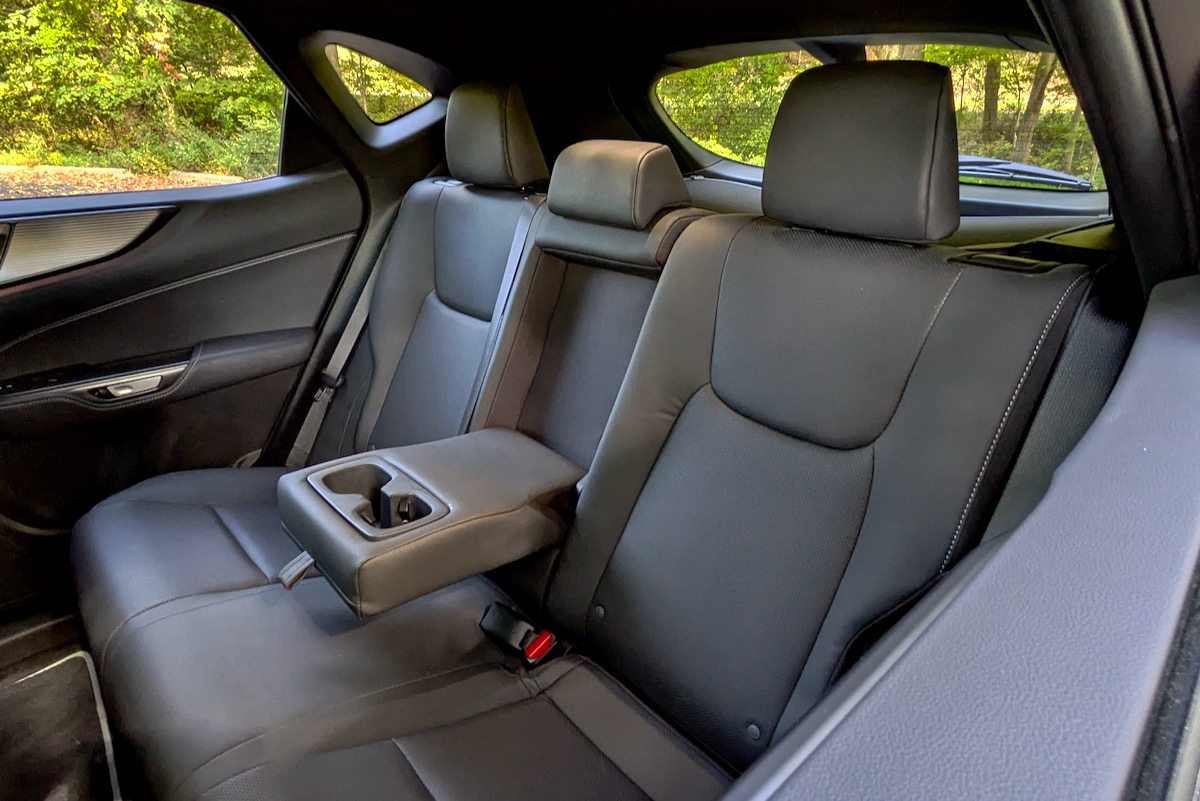
When it comes to passenger space, the NX compares favorably with other compact luxury SUVs, but comes with a few compromises. Rear-seat headroom is close to rivals like the Acura RDX, Audi Q5, and Mercedes-Benz GLC-Class, but all three offer a bit more legroom. Front-seat legroom is closer to the Audi and Mercedes, although the Acura offers even more. First-row headroom matches the Audi, but trails the Acura and Mercedes.
Subjectively, the front seats felt a bit constrained for a crossover SUV. The relative lack of headroom was apparent, and the deep dashboard and large exterior mirrors combined to hinder outward visibility. The rear window is also pretty small, but our test car’s digital rearview mirror helped with that. Our car’s F Sport Handling spec also included sport seats with a bit of extra bolstering, which proved reasonably comfortable, if unnecessary considering the NX’s lack of performance chops.
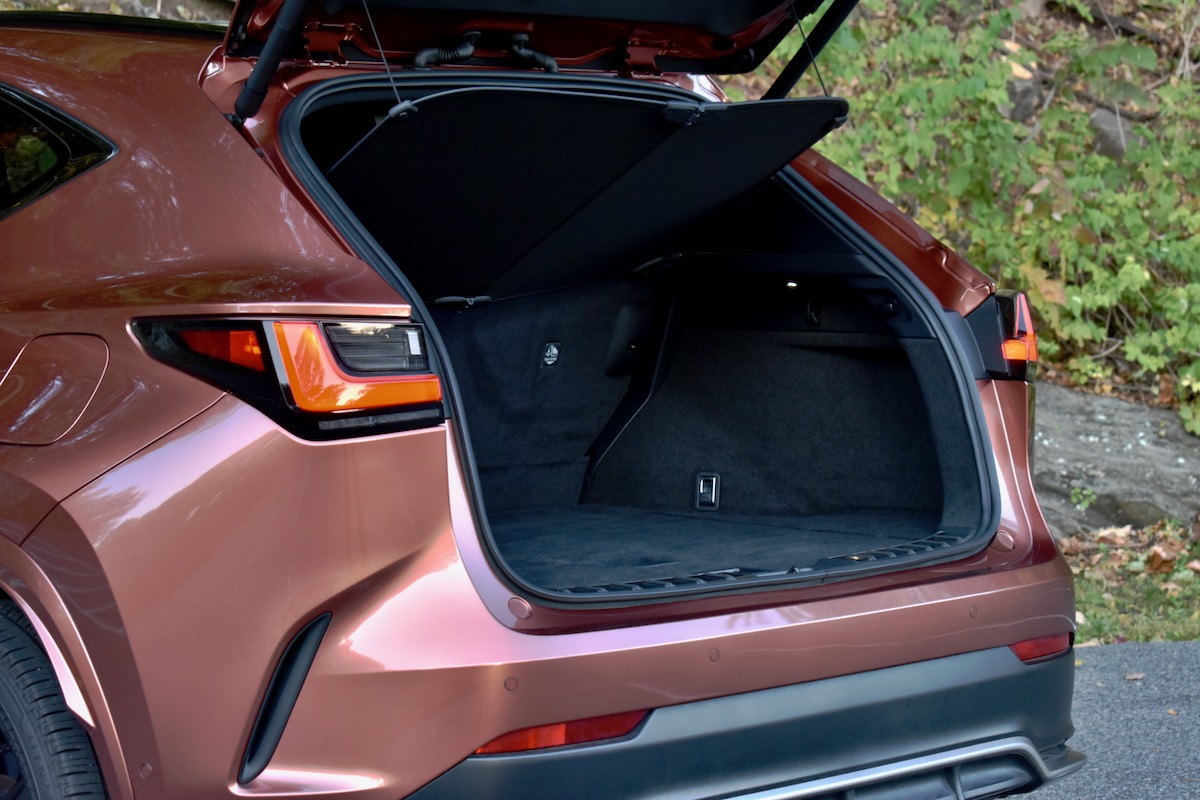
According to Lexus, cargo space measures 22.7 cubic feet with the 60/40 split-folding second-row bench seat in place, and 56.3 cubic feet with the rear bench folded. Those numbers trail most of the NX’s competitive set, and its 2,000-pound maximum towing capacity is also far from class-leading. Two giant center-console cupholders—made possible by a small shifter located at the console’s upper-lefthand corner—make hauling hydration easier, at least.
Technology
A 9.8-inch infotainment touchscreen is standard on base and Premium trim levels, while a 14-inch display is optional on the Premium grade and standard on all higher trim levels. All 2026 Lexus NX models come standard with a 7-inch digital instrument cluster, wireless Apple CarPlay/Android Auto connectivity, and six USB ports. Wireless device charging is also available, along with a head-up display and 17-speaker Mark Levinson audio system.
Other tech features require data connectivity packages, which come with free trials but require subscriptions after those trial periods end. Drive Connect enables cloud-based navigation (including Google points of interest) and native voice recognition. Remote Connect enables digital key functionality, allowing the car to be unlocked, started, and driven away via a connected smartphone. Safety Connect provides emergency assistance in the event of a crash or theft, and Service Connect helps schedule maintenance at dealerships.
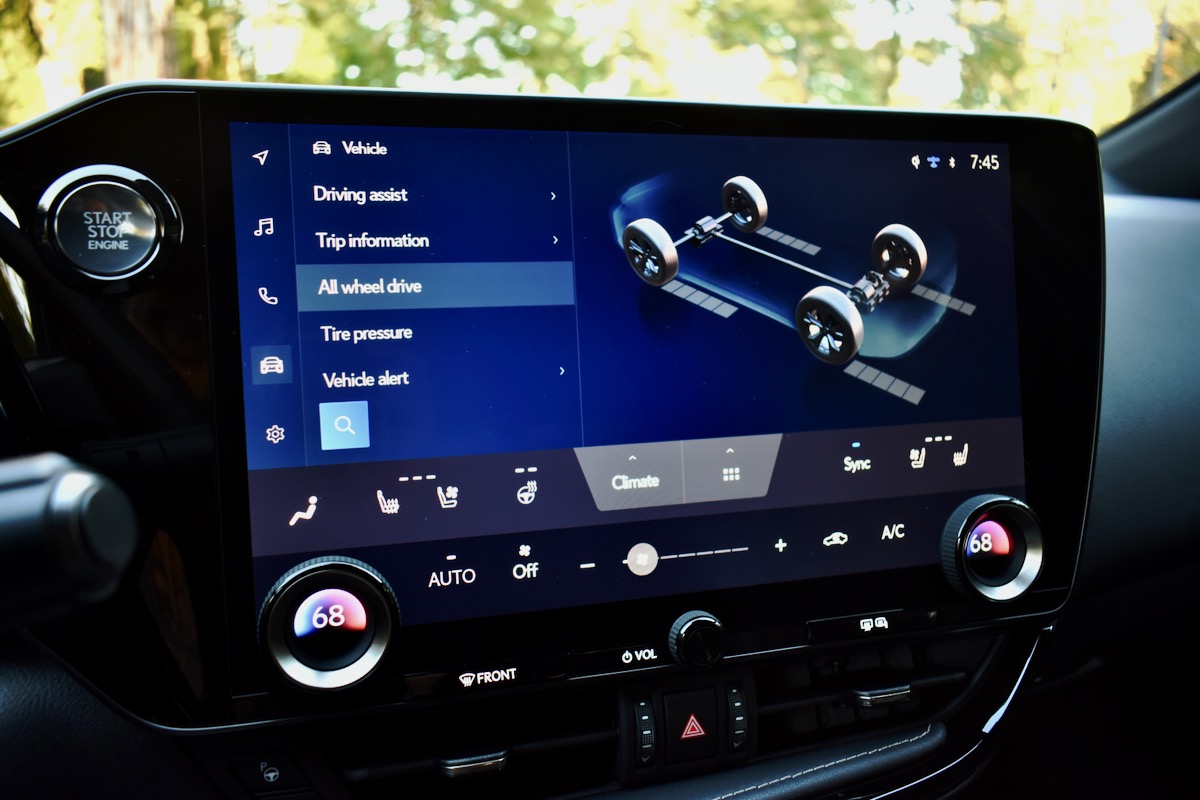
Sprouting from the instrument cluster like bracket fungus on a tree trunk, the 14-inch touchscreen in our test car was well-placed for easy tapping, but there was still room for improvement. Lexus provides large knobs for temperature control, but fan speed can only be adjusted with an awkward touch slider. Dual-zone climate control is standard, but an eco-minded setting that only directs airflow to occupied seats failed to detect a back seat passenger.
If enabled, the voice recognition system helps a bit here. Like comparable systems from Audi, BMW, and Mercedes, it responds to “Hey (insert car brand name here),” and will adjust the temperature if you tell it that you’re hot or cold, although specific temperatures can’t be set. In our test car at least, it also couldn’t switch SiriusXM satellite radio stations, simply pulling up the audio menu when prompted.
The instrument cluster efficiently presents information. A numerical speedometer readout is surrounded by a round sweep serving as a tachometer in F Sport models or a powertrain-state meter in hybrids, with engine temperature and fuel readouts on either side. Everything else is presented in smaller text or graphics, making this modern digital cluster look a bit like the analog displays in cars from the 1990s.
Safety
When it comes to driver-assist features Lexus covers all the bases. The standard Lexus Safety System+ 3.0 suite includes: forward collision warning (with pedestrian and cyclist detection), automatic emergency braking, left-turn oncoming vehicle detection and braking, Risk Avoidance Emergency Steer Assist (adds power-steering torque during emergency maneuvers), adaptive cruise control, lane-centering assist, lane-departure warning, lane-keep assist, and traffic-sign recognition. The NX’s electronic door handles are also keyed to a Safe Exit Assist feature that will delay their unlatching if an approaching vehicle is detected.
Other available driver-assist features include park assist, front cross-traffic alert, lane-change assist, and a 360-degree camera system. The latter feature was helpful given the NX’s compromised outward visibility, but a dedicated button to bring up the camera views would have been appreciated. The car was also a bit overeager with its warnings as we pulled into parking spaces, and said warnings were alarmingly loud.
The Insurance Institute for Highway Safety (IIHS) named the NX a 2025 Top Safety Pick. The Lexus missed out on the highest Top Safety Pick+ award because of a lower “Acceptable” score in the updated moderate overlap front crash test, but received top “Good” score in all other crash tests and evaluations. However, to date, the National Highway Traffic Safety Administration (NHTSA) hasn’t published safety ratings for the current-generation NX.
Cost-effectiveness
EPA fuel economy ratings for the non-hybrid Lexus NX 350 are an unremarkable 24 mpg combined (21 mpg city, 28 mpg highway), but despite a mixed driving cycle, we were able to improve on the combined number with a real-world average of 26.4 mpg, according to the car’s trip computer.
The NX starts to make more sense when you look at the hybrid models. The NX 350h is rated at 40 mpg combined (42 mpg city, 38 mpg highway) with FWD, and only loses 1 mpg in category with AWD. The NX 450h+ boasts an EPA-rated 37 miles of all-electric driving range, and gas mileage of 36 mpg combined in hybrid mode.
The standard Lexus warranty coverage includes a four-year/50,000-mile basic warranty and six-year/70,000-mile powertrain warranty. NX 350h and NX 450h+ models also come with an eight-year/100,000-mile warranty for their hybrid-system components.
With the non-hybrid NX 250 model gone, the cheapest 2026 Lexus NX model is the FWD NX 350h, which starts at $45,470 with the mandatory $1,295 destination charge—$3,210 more than the 2025 NX 250 base model. The availability of FWD does lower the NX 350h’s price a bit, at least, as does the new Premium trim level for the NX 450h+, which lowers the AWD plug-in hybrid’s starting price by $3,500, to $59,105 with destination. The non-hybrid NX 350 slots in between the two hybrids at $46,120.
This pricing is one of the NX’s main assets, as it undercuts most rivals significantly. And while the Acura RDX and Genesis GV70 come close, they don’t offer comparable fuel efficiency to the cheapest NX 350h hybrid. That makes the NX an excellent value among luxury cars, but it comes at the cost of many of the attributes that make stepping up to a luxury brand worthwhile in the first place. Rivals offer more, whether it’s a high-end interior (Genesis and Volvo) or sporty driving dynamics (Acura, Audi, and BMW), or easy-to-use tech (Mercedes).
What owners say
Trims & specs
Base MSRP $51,800 | Seating 5 |
Engine 2.4L 275 hp I4 | Cargo Capacity 22.7 cu ft |
Combined MPG 24 | Drivetrain AWD |
Base MSRP N/A | Seating N/A |
Engine N/A | Cargo Capacity N/A |
Combined MPG N/A | Drivetrain N/A |
Base MSRP N/A | Seating N/A |
Engine N/A | Cargo Capacity N/A |
Combined MPG N/A | Drivetrain N/A |
Base MSRP N/A | Seating N/A |
Engine N/A | Cargo Capacity N/A |
Combined MPG N/A | Drivetrain N/A |
Base MSRP N/A | Seating 5 |
Engine N/A | Cargo Capacity 22.7 cu ft |
Combined MPG N/A | Drivetrain N/A |
Base MSRP N/A | Seating N/A |
Engine N/A | Cargo Capacity N/A |
Combined MPG N/A | Drivetrain N/A |
Base MSRP $45,825 | Seating 5 |
Engine 2.4L 275 hp I4 | Cargo Capacity 22.7 cu ft |
Combined MPG 24 | Drivetrain AWD |
Base MSRP N/A | Seating N/A |
Engine N/A | Cargo Capacity N/A |
Combined MPG N/A | Drivetrain N/A |
Base MSRP $51,890 | Seating 5 |
Engine 2.4L 275 hp I4 | Cargo Capacity 22.7 cu ft |
Combined MPG 24 | Drivetrain AWD |
Base MSRP $47,750 | Seating 5 |
Engine 2.4L 275 hp I4 | Cargo Capacity 22.7 cu ft |
Combined MPG 24 | Drivetrain AWD |


Pricing trends
MSRP range
$45,825 - $51,890
Current avg. market price
$47,608
Trending down by 0.4% this month
May 2026 - November 2026