2026 Honda Passport Reviews, Pricing & Specs


Pros & cons
What we like
Spacious interior and cargo capacity
Improved off-road capability
Easy-to-use technology
What to consider
Poor fuel economy
High price
Still lacking key off-road features
Expert review
After seven years in the periphery, the Honda Passport takes center stage.
Redesigned for the 2026 model year, the Honda Passport now targets aspirational lifestyle SUVs, such as the Jeep Grand Cherokee and the Toyota 4Runner. While the Passport name remains, nearly everything else is new–from the exterior to the interior and the engine to the trunk. Honda’s two-row SUV is virtually unrecognizable compared with the outgoing generation.
Verdict: The 2026 Honda Passport is a well-rounded crossover SUV that shines with regards to cargo space and user-friendly tech. However, while the new Passport aims to be more capable off-road than its predecessor, it still lacks key features, such as a locking differential and low-range 4WD, not to mention it carries a high price tag. While not ideal for hardcore off-roaders (it is, after all, a unibody construction), the 2026 Honda Passport is a solid choice for family adventures in need of a comfortable and spacious crossover.
out of 10 expert review
Look & feel
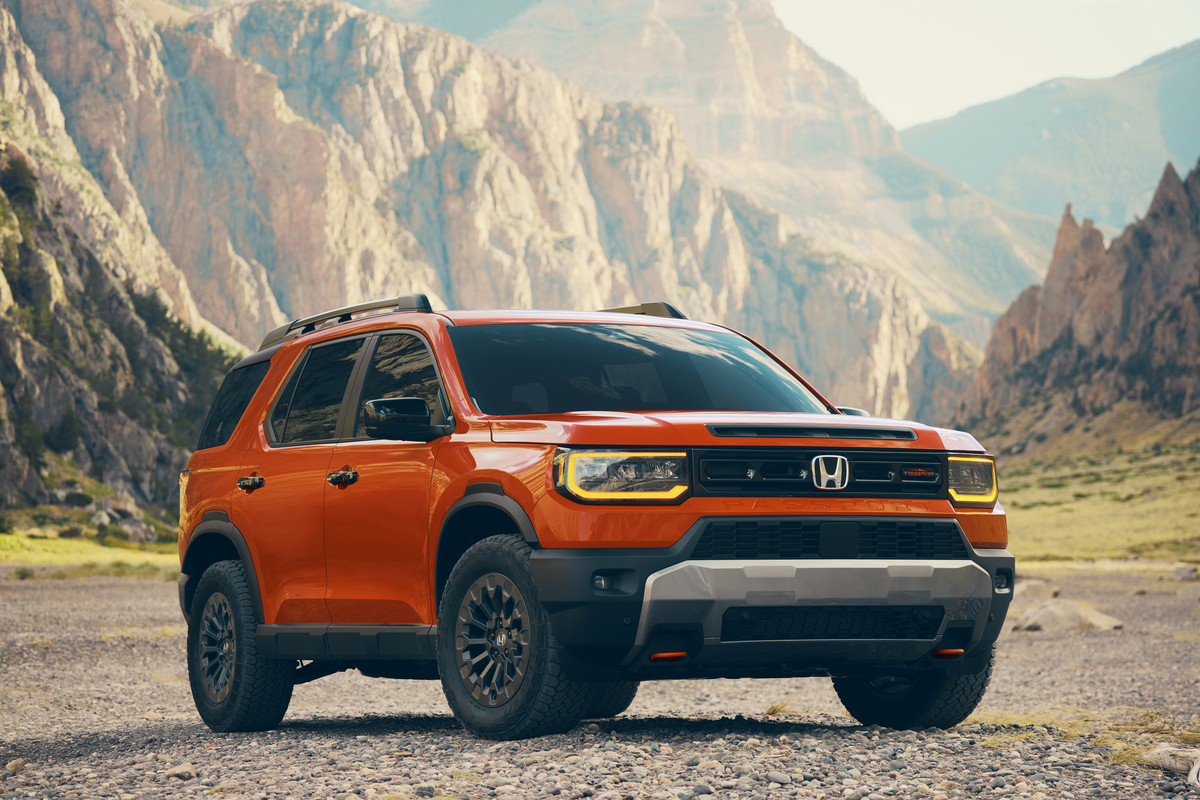
The all-new Honda Passport is hard to miss. With extra-large proportions (it has an especially long 113.6-inch wheelbase) and blocky dimensions, it adheres to the modern interpretation of a rugged SUV. While the outgoing Passport featured a sloped hood and a soft chin, the new model is nearly flat across the top, and the lower bumper ends abruptly, providing a great approach angle and a blunt nose. Bracket-shaped, amber running lights frame the upper grille, and a thin hood scoop (standard on all Passport trim levels) cuts across the front, just above the Honda “H” emblem.
Head-on, it’s hard to find fault with the new car’s looks. Wider and visually stronger, it more closely resembles its better-selling competitors, the Toyota 4Runner and Jeep Grand Cherokee, while still maintaining a specifically Honda look and feel.
The profile view is a bit more derivative. With a blacked-out D-pillar and a large, tinted rear-quarter window, Honda claims the design was inspired by a backpack. Channel your inner-art critic and you can see the inspiration, but it’s also easy to see shades of a pre-2024 Chevrolet Traverse or, even more so, a Land Rover Discovery.
Honda has included some fun features. The available rock sliders tuck under the lower sill, making them nearly invisible while maintaining the crossover’s breakover angle. Toward the rear of the roof, the panel directly above the rear-quarter window is finished with a scratch- and scuff-resistant material specifically designed to have equipment leaned against it. Of note, however, Honda suggested it would be perfect for leaning skis, but given the Passport’s height (a minimum of 73.1 inches, or just over 185 centimeters), those would have to be some impressively long skis.
At the rear, the blocky tailgate has a two-tone, colorblock design with a darkly tinted, rectilinear rear window. An off-silver rear bumper matches the front end, and an available trailer hitch has been designed to help protect it. All Passports come equipped with standard roof rails and 18-inch wheels.
Inside, customers won’t be greeted with a lot of flash or gimmicks. The Passport will be sold in three trim levels–RTL, TrailSport, and TrailSport Elite–with packages available for each. We sampled a Honda Passport TrailSport fitted with a lovely blend of synthetic leather and cloth upholstery and an all-genuine-leather TrailSport Elite. Although the materials were arguably better in the latter, we found the interior in TrailSport models more visually appealing.

Performance
Particularly in TrailSport trims, the 2026 Honda Passport strives to compete as aggressively off-road as it does on-road. With this goal in mind, Honda has engineered the new front and rear bumpers for improved approach and departure angles and better ground clearance, and added skid plates. Gone are the 20-inch wheels formerly fitted to the EX-L and Black Edition. In their place, 18-inch wheels for every trim of the 2026 Passport. The smaller wheel diameter allows for more sidewall, improving ride comfort and off-road traction. On the TrailSport Elite trim level, a multi-view mode with four camera angles (forward, reverse, and both sides) also proved very helpful in navigating trails.
Honda’s i-VTM4 all-wheel drive system (AWD) is also standard on every Passport, as are a selection of seven distinct drive modes. Normal, Econ, Snow, and Sand return from the previous generation model, but they’re joined by the new Sport, Trail, and Tow modes. However, there are no locking differentials, nor is there a low-range 4WD system. Towing capacity comes in at 5,000 pounds and a tow hitch, standard on the TrailSport and TrailSport Elite trim levels, is available on the base RTL trim.
Honda is also sticking with a naturally aspirated 3.5-liter V6 engine and horsepower jumps by only five, from 280 hp to 285. Although the 2026 Honda Passport’s engine is technically new–a dual overhead-cam unit replacing the older single-cam engine–it’s hard to spot any major differences on the surface. Torque remains the same at 262 pound-feet. The new Passport gets a 10-speed automatic transmission in place of the old 9-speed unit.
We tested the Passport in a wide range of environments, from meandering beach-side roads to busy highways, but it made the strongest impression on an off-road circuit boasting consistent elevation changes and variable terrain ranging from mud to dirt to sand. The V6 engine provides terrific power, which requires very little throttle input to access. Further, the Passport’s steering is outstanding for a vehicle of its size, demonstrating a satisfying and predictable weight at low speeds. As with the outgoing Passport, the transmission operated unobtrusively.
On our first drive on the highway, our TrailSport test vehicle’s all-terrain tires generated a noticeable amount of noise (the RTL comes with quieter all-season tires), but the cabin is otherwise well insulated from engine and wind noise.
Many competitors are pivoting toward smaller, turbocharged engines or hybrid powertrains. Likely because it’s built in the same factory as the V6-only Odyssey, Pilot, and Ridgeline, the Passport is sticking with a less-efficient V6 engine. Shoppers who want a lower-strung but still powerful engine in their SUV will appreciate that choice, but it’s worth noting that instead of demonstrating progress with increased power, the new Passport’s powertrain makes its gains by reducing emissions. Despite the cleaner engine, the Passport doesn’t see a major jump in fuel economy: The 2026 Passport should return an EPA-estimated 19 mpg city, 25 highway, 21 combined in RTL trim and 18/23/20 in TrailSport and TrailSport Elite trims. With an 18.5-gallon fuel tank, expect the Passport to deliver a maximum driving distance in the 450 mile range.

Form & function
A new 12.3-inch touchscreen brings the interior up to modern expectations, but otherwise there is very little future-forward thinking behind the Passport’s interface and center console. Every control is a physical button or knob. It’s a refreshing approach to a modern redesign; while competitors are increasingly relying on touch-capacitive hardware Honda recognizes that simplicity can be an equally deserving North Star.
The Passport is also a cargo space king. With 44 cubic feet of room behind the rear seat, it’s more capacious than any other vehicle in the midsize crossover segment, although the fact that it is a five-seater helps. Fold those seats down, and cargo capacity expands to 83.8 cubic feet, again a best-in-class figure. An available full-size spare tire has been designed to stand up against the driver’s side of the cargo hold, slotting into a compartment of the underfloor storage and secured against the left wall with straps. Even with this tire in place, the Passport still boasts class-leading cargo capacity and practicality.
Even with the massive trunk, the Passport also delivers best-in-class rear-seat legroom. Add in a complement of cubbies and cup holders, and this vehicle caters even more to the family road trip than it does the off-road romp. Up front, the story is the same. Headroom, legroom, and shoulder room abounds, and handy cubbies–including a helpful shelf ahead of the front passenger–provide storage space for all sorts of odds and ends.
TrailSport and TrailSport Elite trims both come standard with a panoramic moonroof, and the TrailSport Elite adds ventilated front seats for extra comfort. Honda will sell a number of post-production option packages, including the Adventure Package, which includes a rear cargo shelf that can be removed and used as a table–a fun callback to the early Honda CR-V’s removable folding table.

Technology
A 12.3-inch touchscreen display hosts Google Built-in and sits atop the dash. It’s pleasantly situated so the driver needn’t take their eyes far off the road when checking navigation, adjusting the radio, or handling the myriad other features offered in the 2026 Honda Passport.
Google Built-in is available on a number of cars today, and it’s increasingly common in General Motors and Honda vehicles. It offers Google Maps, Google Assistant, and other apps courtesy of the Google Play Store, all natively installed in the infotainment system. For many, it renders Apple CarPlay and Android Auto superfluous, and as such some General Motors vehicles offer it instead of those more common phone-projection systems. In the Honda Passport, however, the choice is yours: Google Built-in is ready and waiting for use, but if you prefer to use wireless Apple CarPlay or Android Auto, those are also included as standard equipment (a nice pairing with the standard wireless phone charger).
We found the Passport’s touchscreen easy to use and nice to look at. The colors are bright and, although resolution didn’t seem ultra-crisp in our test vehicle, we had no issue navigating through the various menus. We employed the built-in Google Maps as well as Google Maps via Android Auto on multiple trips; they’re ease-of-use and instructions are virtually identical.
In addition to the touchscreen operating system, the 2026 Honda Passport boasts some other tech upgrades. A Wi-Fi hotspot, four USB-C charging ports, and a 10.2-inch fully digital driver information display are all included on every trim level. Buy a TrailSport Elite trim and you’ll also enjoy a 12-speaker Bose stereo system and the TrailWatch camera system, which generates a birds-eye view of the car.

Safety
Honda equips every 2026 Passport with Honda Safety Sense, the company’s suite of advanced driver assistance systems (ADAS). These feature suites are increasingly common in the marketplace, and the Passport’s ADAS collection mirrors much of what you’ll get from the competition: automatic emergency braking, lane-departure warning and lane-keeping assist, blind-spot monitoring and rear cross-traffic alert, and adaptive cruise control. In addition to these features, the Passport also includes traffic-jam assist, traffic-sign recognition, and low-speed braking control, a feature specifically designed to apply the brakes when the Passport’s camera system identifies objects in the vehicle’s way.
Although these features are designed to reduce the chance of a collision, Honda also equips the Passport with eight standard airbags, just to be safe. The previous-generation Passport suffered from less-than-stellar crash test results and was not named a Top Safety Pick by the Insurance Institute for Highway Safety (IIHS), and it managed only four out of five stars in the front-impact and rollover tests performed by the National highway Traffic Safety Administration (NHTSA). Because of these discrepancies, we’ll need to wait for the two agencies to complete crash testing of the 2026 Passport before increasing our safety rating in this review.

Cost-effectiveness
The Passport gets a sizeable price hike for the 2026 model year, with its base specification increasing from $43,275 for a 2024 EX-L trim to $46,200 for a 2025 RTL trim, both instances including destination fees ($1,375 and $1,450, respectively).
Pricing for the TrailSport increases to $49,900, and the TrailSport Elite starts at $53,900. Each trim level can also be optioned with a Blackout package for an extra $1,200, and the RTL trim also has a towing package for an additional $700.
These numbers certainly make the Passport look overpriced; a 2025 Toyota 4Runner starts at nearly $5,000 less. However, the Passport comes well equipped, and the $55,100 MSRP for a TrailSport Elite Blackout is more than $10,000 less than a top-tier 4Runner Trailhunter trim. Against more soft-roading competitors, it’s roughly $10,000 more than a Nissan Pathfinder Rock Creek, and some $5,000 less than a Jeep Grand Cherokee Overland. You don’t get anything like the same level of space of equipment, but a base Ford Bronco starts at $37,995, while the Hyundai Santa Fe XRT—the first trim level with which AWD is standard—kicks off at $40,950. It’s also a bit of an anomaly when the Honda Pilot—which is admittedly less rugged—can seat eight and starts at $40,200.
In the off-roading space, Honda doesn’t have the brand equity with the Passport that Toyota does with the 4Runner, and without a body-on-frame construction, low-range 4WD, or locking diffs, it’s not likely to ever win over the most hardcore drivers. However, it’s a more comfortable and more practical option than the 4Runner, putting it more in line with a Rock Creek Nissan or a non-Trailhawk Jeep. Given that competition, the 2026 Honda Passport is a great vehicle but only decent value.


What owners say
Overall a great SUV! We’ve owned Hondas for years and this is the best one they have built and love the body style. It’s got plenty of room for our gear for the boat and kids.
July 24, 2025Trims & specs
Base MSRP N/A | Seating N/A |
Engine N/A | Cargo Capacity N/A |
Combined MPG N/A | Drivetrain N/A |
Base MSRP N/A | Seating N/A |
Engine N/A | Cargo Capacity N/A |
Combined MPG N/A | Drivetrain N/A |
Base MSRP $44,950 | Seating 5 |
Engine 3.5L 285 hp V6 | Cargo Capacity 44.0 cu ft |
Combined MPG 22 | Drivetrain AWD |
Base MSRP $52,650 | Seating 5 |
Engine 3.5L 285 hp V6 | Cargo Capacity 44.0 cu ft |
Combined MPG 20 | Drivetrain AWD |
Base MSRP $48,650 | Seating 5 |
Engine 3.5L 285 hp V6 | Cargo Capacity 44.0 cu ft |
Combined MPG 20 | Drivetrain AWD |
Base MSRP $53,850 | Seating 5 |
Engine 3.5L 285 hp V6 | Cargo Capacity 44.0 cu ft |
Combined MPG 20 | Drivetrain AWD |
Base MSRP $49,850 | Seating 5 |
Engine 3.5L 285 hp V6 | Cargo Capacity 44.0 cu ft |
Combined MPG 20 | Drivetrain AWD |
Base MSRP $45,650 | Seating 5 |
Engine 3.5L 285 hp V6 | Cargo Capacity 44.0 cu ft |
Combined MPG 22 | Drivetrain AWD |
Base MSRP $46,150 | Seating 5 |
Engine 3.5L 285 hp V6 | Cargo Capacity 44.0 cu ft |
Combined MPG 22 | Drivetrain AWD |


Pricing trends
MSRP range
$44,950 - $53,850
Current avg. market price
$46,584
Trending down by 0.9% this month
May 2026 - October 2026