2026 Dodge Charger Daytona Reviews, Pricing & Specs


Pros & cons
What we like
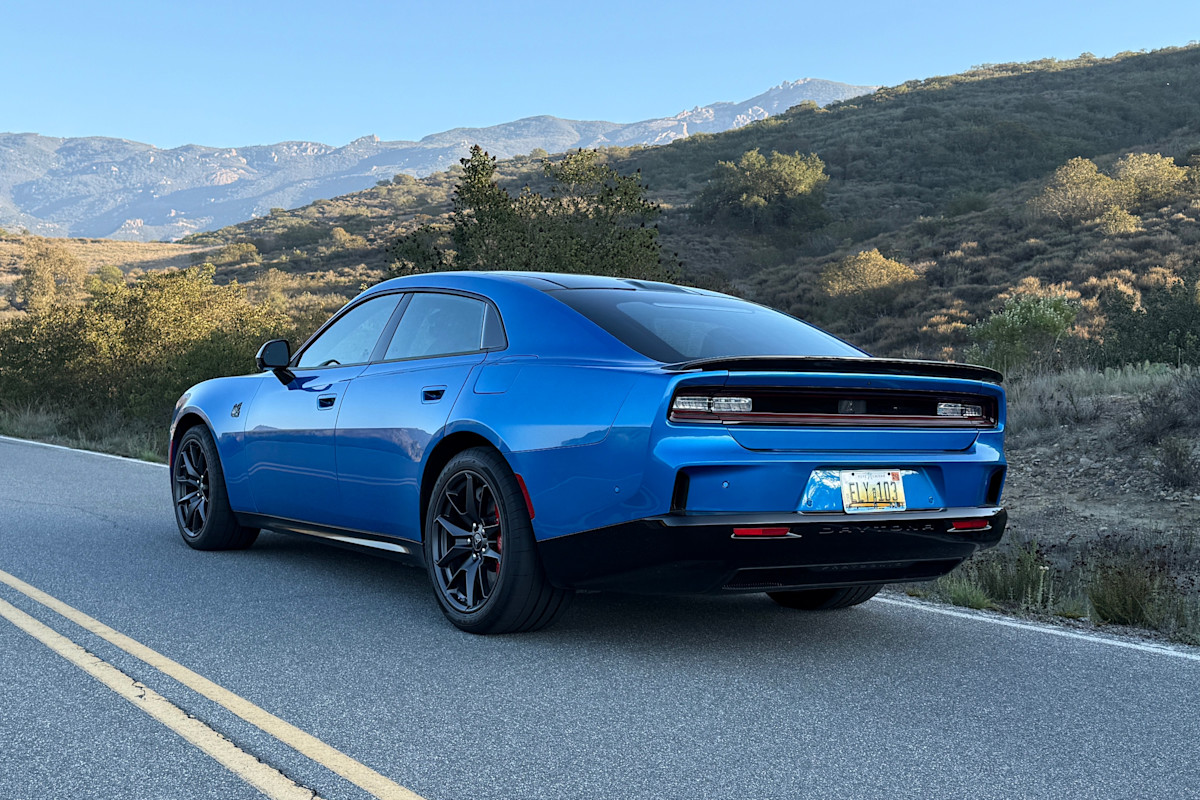
Stylish design
Fun to drive
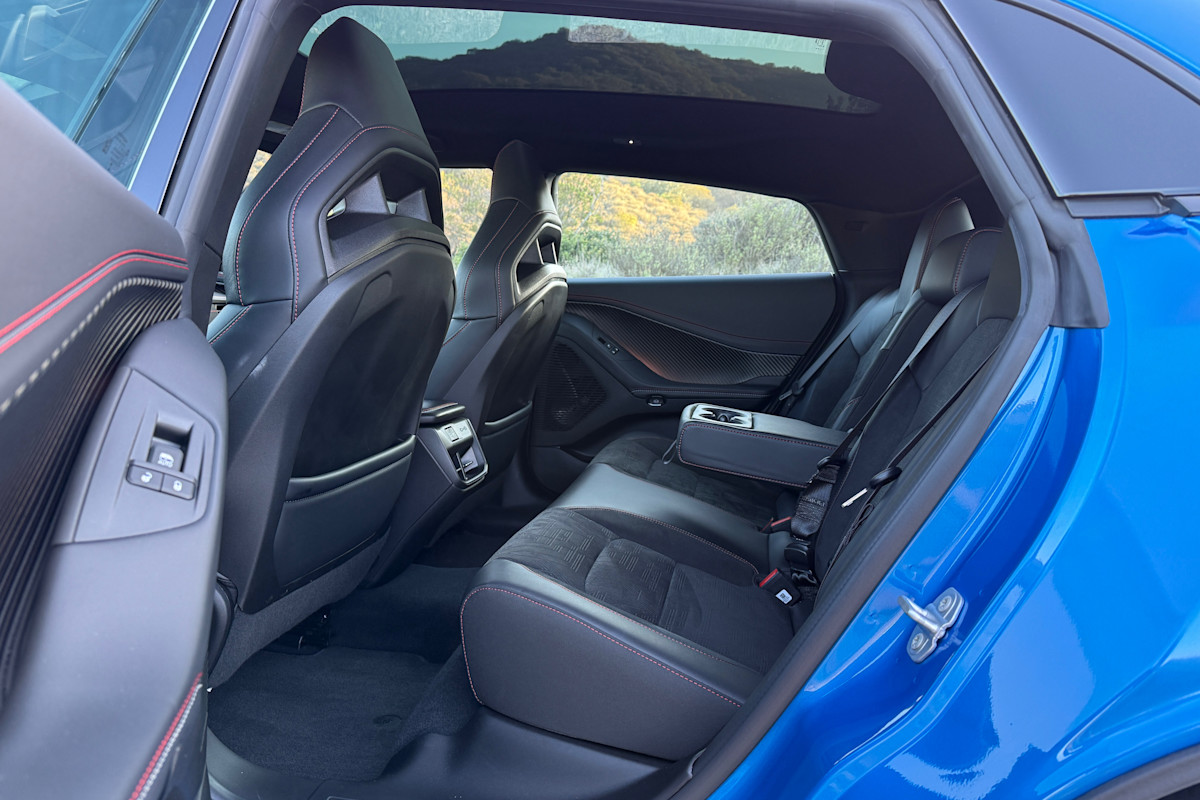
Spacious
What to consider
Poor visibility
Interior materials seem cheap
Sluggish touchscreen response
The CarGurus verdict
The 2026 Dodge Charger Daytona four-door makes a stronger case for itself than the two-door coupe.
Transforming an icon of internal-combustion muscle into an electric vehicle isn’t easy, especially when doing so pushes the price into luxury-car territory. Yet the Dodge Charger Daytona EV has successfully replicated the retro style and rippling muscle of its predecessor, drifting the car into the modern age. For 2026, Dodge introduces a new four-door model to the lineup, adding an extra dose of practicality to its extraordinary performance. A non-Daytona variant with a gasoline inline-six powertrain dubbed the Sixpack, also arrives for 2026. But we’ll focus on the EV for now.
Verdict: It might not sound like a traditional Charger, especially in Stealth mode, but if raw performance is what you want, the Daytona supplies a stunning amount of it. All it needs is better interior quality to help justify its high price tag.
out of 10 expert review
Look & feel
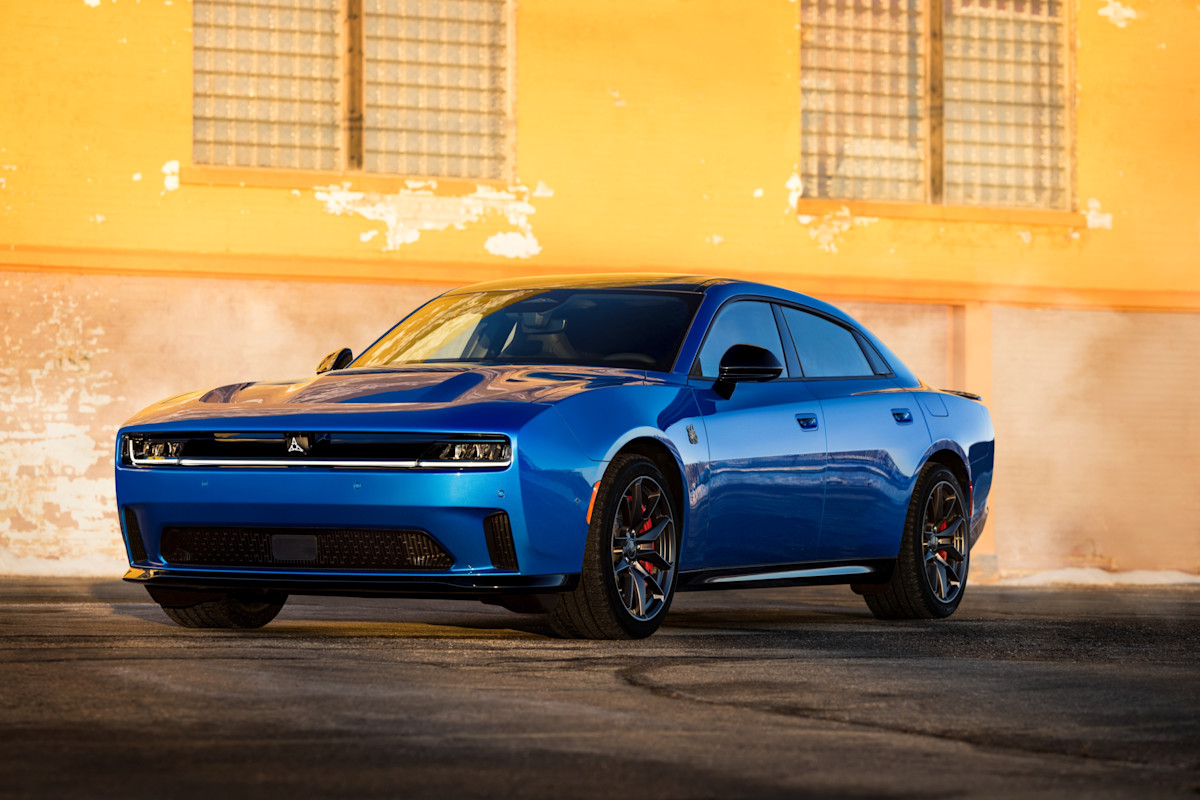
Picking up the retro design mantle from the old Dodge Challenger, the latest Charger looks terrific, especially when outfitted with our test car’s 20-inch Satin Carbon wheels, which are a part of the optional Track Package. The extra doors don’t alter the roofline, helping to preserve the 1968-inspired styling. The Charger four-door looks terrific from any angle.
In addition to the new four-door, the 2026 Charger Daytona lineup includes a two-door coupe. This year, both body styles are offered only in Scat Pack trim. The less powerful Daytona R/T is discontinued, and Dodge still hasn’t confirmed the rumored Banshee high-performance grade. Option packages include a Plus Group, Blacktop Package, Track Package, and Carbon & Suede Package. Pricing starts at $61,990 for the coupe, including the $1,995 destination charge. Add $2,000 for the four-door model.
Our Dodge Charger Daytona Scat Pack test car had all of those upgrades, plus Bludicrous paint, summer performance tires, and a Sun and Sound Package adding a panoramic glass roof and an 18-speaker Alpine premium sound system. The manufacturer’s suggested retail price (MSRP) came to $80,455.
Eighty grand for a Charger? Yep. But keep in mind, in 2023, a Charger SRT Hellcat without any options cost more than our well-equipped test car does today. Also, while the Hellcat’s supercharged 6.2-liter V8 engine supplied 47 more horsepower and 23 more pound-feet of torque, the Charger Daytona Scat Pack gets to 60 mph in 3.3 seconds, compared to 3.8 seconds for the Hellcat (as tested by Car and Driver).
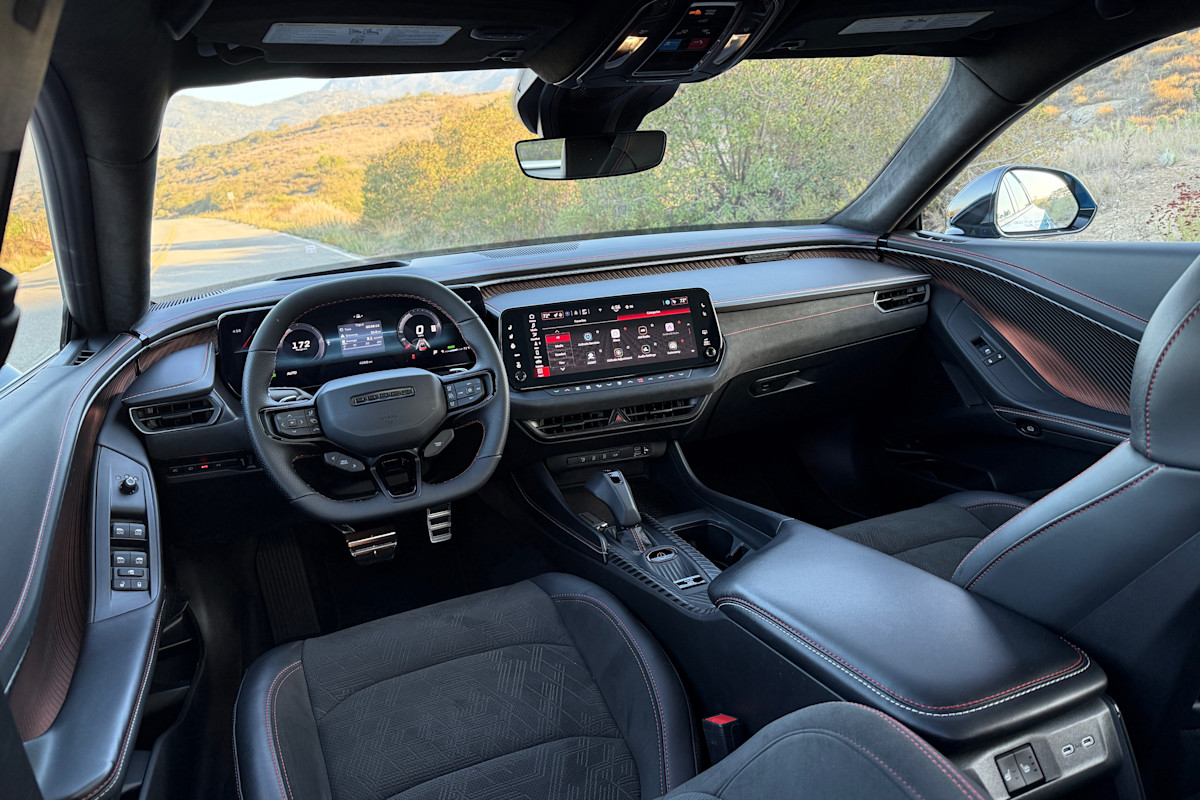
Like the old Charger, the new one’s interior seems cheaply outfitted for the price, but the Plus, Sun and Sound, and Carbon and Suede option packages help to hide it. More than anything else, it is the inexpensive-looking finishes in parts of the Charger Daytona’s cabin that might have you questioning the wisdom of spending Mercedes E450 money on one.
Still, the new Charger is a technological tour de force compared to the old one, with digital instrumentation and a widescreen implementation of the Uconnect 5 infotainment system. It’s upscale and futuristic, too, with lovely ambient lighting after dark.
Performance
Dodge equips the Charger Daytona with two 250-kilowatt electric motors, one in the front and one in the rear, to create an all-wheel-drive (AWD) system. Together, they make 630 hp and 627 lb-ft of torque, but if you press the Power Shot button on the steering wheel, you can access 670 hp.
A 100.5-kilowatt-hour battery pack (with a usable capacity of 93.9 kWh) is installed under the Charger’s floor and is compatible with 350-kW DC fast-charging stations. Using one of those, you can bring the battery from 20% to 80% in 24 minutes. At home, connected to an 11-kW AC charging station, that same situation requires 5.4 hours. You can also trickle-charge the car using the same outlet as your vacuum cleaner; we added about 15 miles of range overnight.
Multiple driving modes alter the Charger Daytona’s character. They include Eco, Auto, Sport, Track, Drag, and Wet/Snow. A Valet mode is also available, and drivers can access Drift, Donut, and Launch Control modes as well. Depending on the chosen driving mode, the Fratzonic Chambered Exhaust system—which produces fake engine and exhaust sounds—alters its tone, tenor, and volume. Our preference, and that of our family members, was to run silently in Stealth mode.
Our test car’s Track Package added several worthy upgrades, including an adaptive-damping performance suspension and Brembo ultra-high-performance brakes with red calipers. Dodge also swapped the all-season tires for staggered-width 305/35ZR20 front and 325/35ZR20 rear summer performance tires.
We’ve driven high-powered electric vehicles before, but the Charger’s explosive acceleration still took us by surprise, especially when threading holes in traffic. We didn’t even use Sport, Track, or Drag mode. We also didn't use the Power Shot setting or launch control during testing. Still, despite the stickier summer rubber, the front wheels scrabbled to retain traction during impromptu acceleration runs on a rural road.
Compared to the old Hellcats, the AWD system is a game-changer. Those supercharged, Hemi-powered, rear-drivers were as greasy in a straight line as the grill at a White Castle. You had to say a prayer before attempting to extract maximum velocity from one of those. The Charger Daytona is totally different. Point. Press. And hold on tight.
Some people might find that boring. We disagree. It’s intoxicating, and you can do it time and time and time again without much worry that you’re going to swap ends and embarrass yourself worse than a pimply-faced teenager leaving the local Cars ‘N Coffee in daddy’s Mustang GT. Better yet, in Stealth mode, you’re not announcing your driving style to any law enforcement officers within earshot.
The Daytona’s electric drivetrain pays dividends in the handling department, too. Though it weighs 5,828 pounds (1,234 pounds more than the old SRT Hellcat), much of that curb weight is located low in the chassis, giving it the ground-hugging, slot-car feel common to most EVs. Undoubtedly, the test car’s adaptive performance suspension and the grippy tires made their contributions, too, but in combination with AWD, this is a high-performance Charger that you can finesse instead of wrestle down a mountain road.
Admittedly, the steering, though nicely weighted, doesn’t offer much feel or feedback. Also, you can sense the car’s nearly three tons of weight shifting suddenly as you thread S-curves on undulating pavement. The Charger is wide, too, so navigating tight canyon roads susceptible to rockfall requires extra care.
The car’s size isn’t a liability in the suburbs, and we found it easy enough to park, in part thanks to its parking sensors and surround-view camera system. At higher boulevard speeds and on the freeway, a lot of wind and road noise enter the cabin. Imperfections won’t unsettle the heavy, sticky Charger, but it tends to trundle its way over extended sections of patched pavement without much grace.
Our test car had an EPA efficiency rating of 47 kWh per 100 miles (2.1 miles per kWh). Based on the Charger’s trip computer, we observed a substantially better result of 2.6 mi/kWh (36 kWh/100 mi) while driving in Auto mode. Given the usable battery rating of 93.9 kWh, that translates into an as-tested maximum range of 244 miles that’s slightly better than the official 223-mile rating.
Form & function
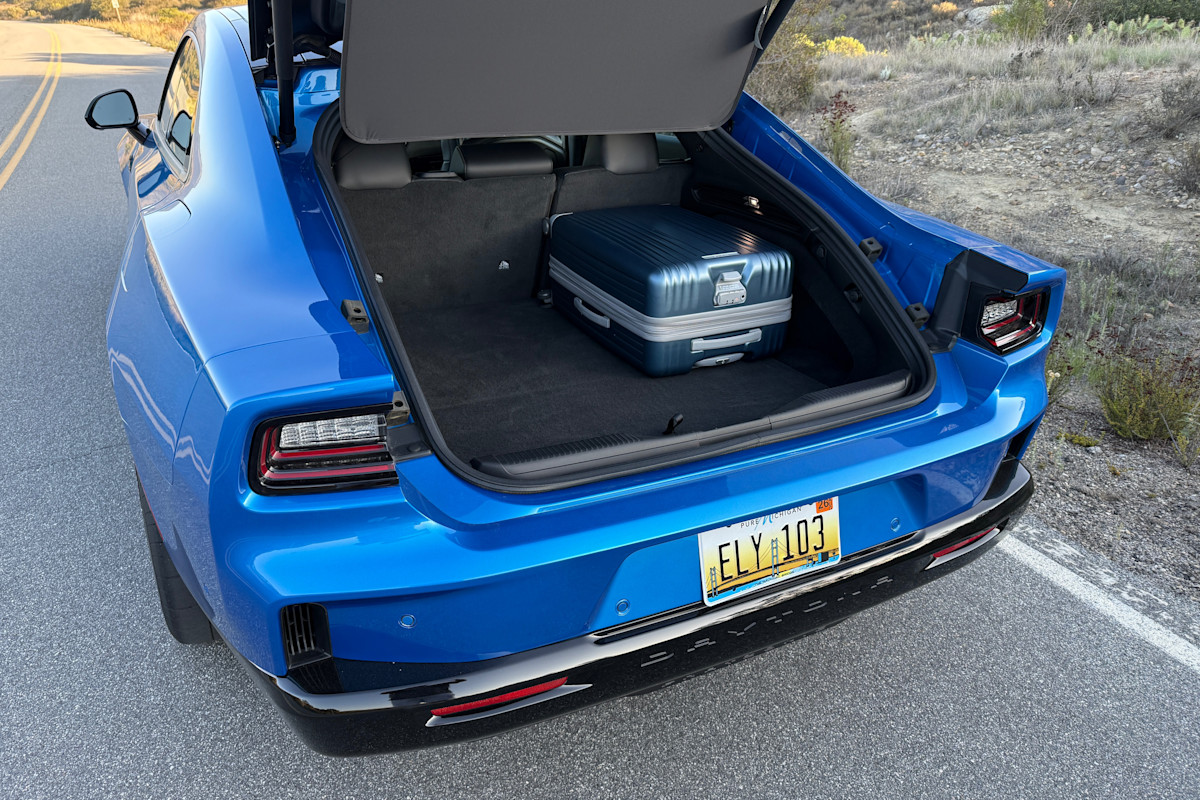
Not only does the Charger Daytona four-door look great, it’s got a hatchback design with a rear liftgate and folding back seats, so it offers plenty of modern functionality to go with its retro form.
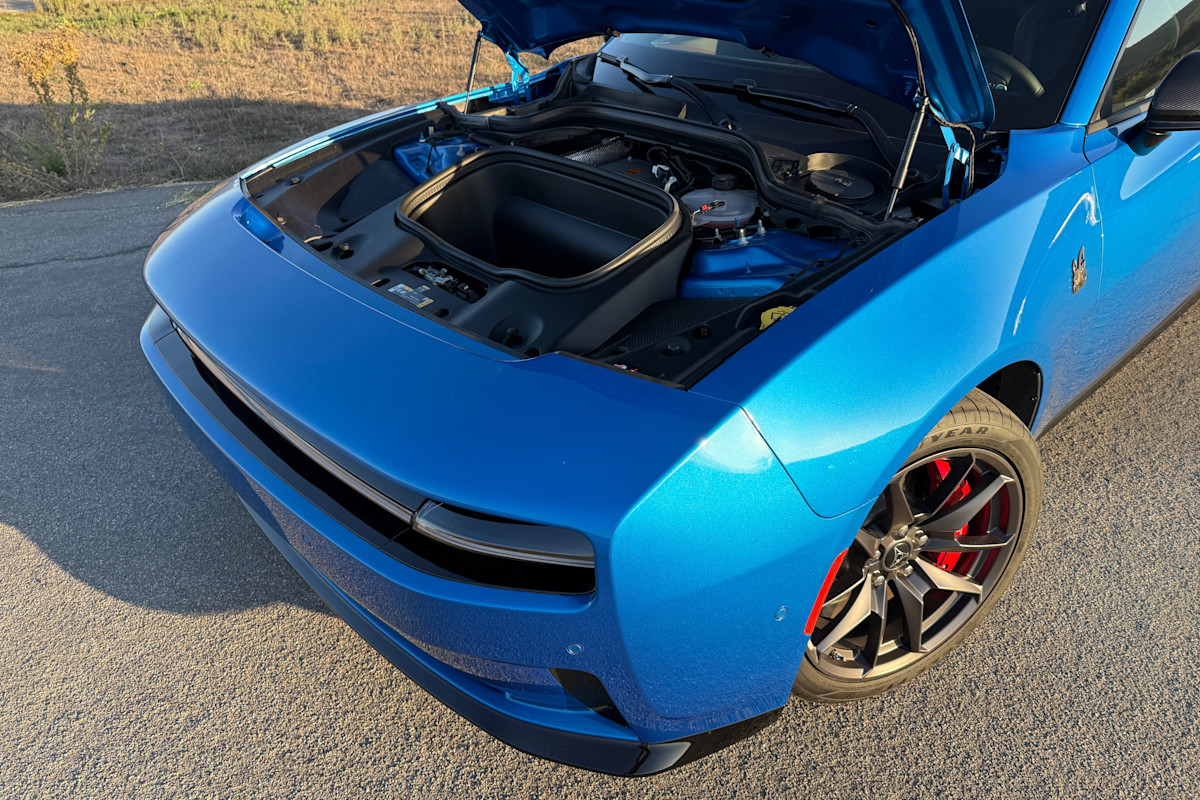
That liftgate is huge and opens tall, so be careful in garages with low ceilings. The liftover height is also somewhat tall, but the opening to the cargo area is generous. Dodge says you can stuff 22.7 cubic feet of luggage into the car, or 37.4 cubic feet if you fold the back seats flat. In addition, there is a small front trunk, or frunk. Dodge thoughtfully places the button to close it on the left panel in the cargo area, rather than up high on the liftgate.
The Charger four-door’s front doors are shorter than the two-door model’s, making the car easier to enter and exit when parked in a garage or lot space. As with the two-door, the four-door is remarkably roomy inside, and offers impressive stash space for smartphones, house keys, oversized beverages, and the like.
Though they appear to be robustly bolstered, the seats are relatively flat. As a result, you might feel you’re sitting on them instead of in them, and they don’t hold you snugly when exploring the car’s prodigious handling limits. Nevertheless, the heated, ventilated, 16-way power-adjustable front chairs proved comfortable during a two-hour drive.
Rear-seat passengers might find their accommodations even better. Generous leg room, excellent thigh support, and a proper backrest angle make the back seat a pleasant place to spend time. The test car’s panoramic glass sunroof simply added to the sensation of spaciousness, while the heated outboard rear seat cushions are likely to please people in colder weather.
Technology
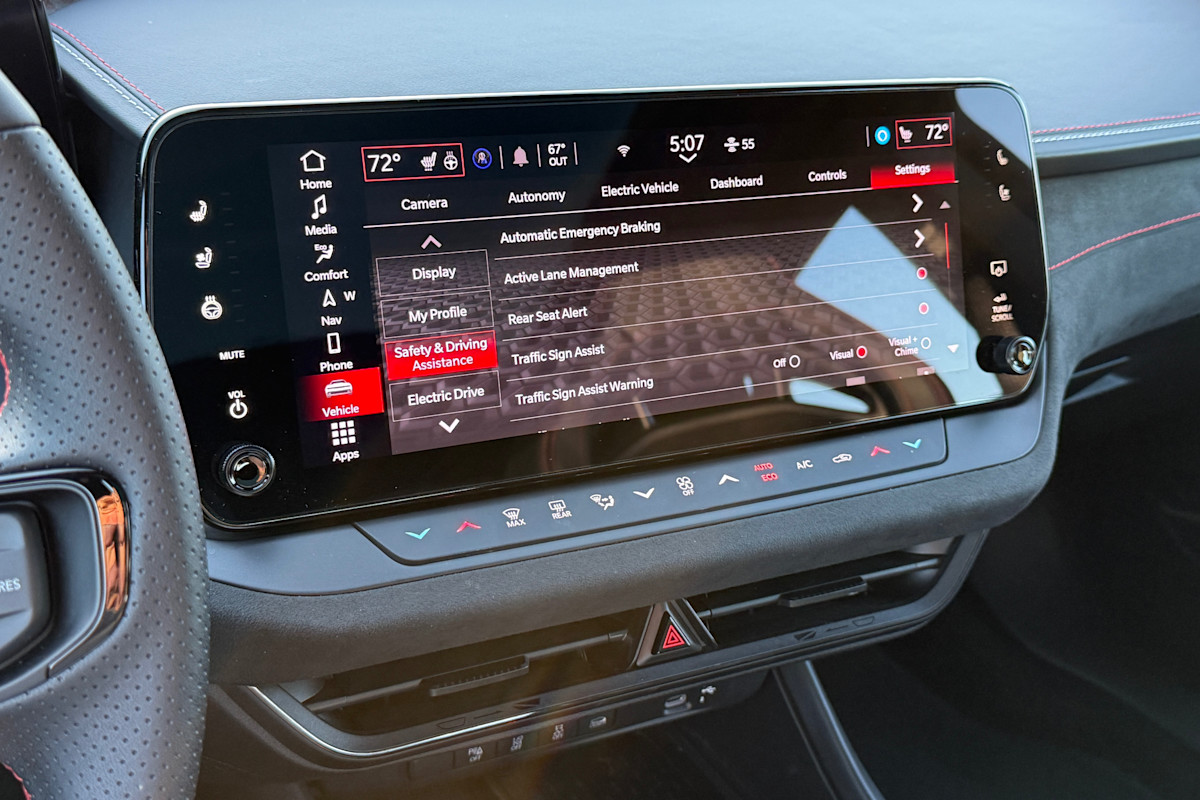
Dodge equips the Charger Daytona with a 16-inch digital instrumentation screen, a 12.3-inch Uconnect 5 touchscreen infotainment system, and a head-up display. They are graphically appealing and competitive technologies, equipped with performance-oriented features such as a Drive eXperience Recorder dashcam system, Performance Pages to track the car’s performance, and EV Pages to set charging schedules, find charging stations, and more.
The Uconnect infotainment system includes wireless Apple CarPlay, wireless Android Auto, Amazon Alexa integration, SiriusXM satellite radio, and Dodge Connect connected services with complimentary trial subscriptions. A wireless charging pad is tucked under the dashboard forward of the Charger’s pistol-grip shifter.
Wisely, Dodge provides volume and tuning knobs at the bottom corners of the touchscreen. Additionally, controls on the backs of the steering wheel spokes perform the same tasks and quickly become second nature. Owners can also choose from different screen layouts, customize tile contents, and arrange content as they wish. Quick-access buttons for seat heating, seat ventilation, and steering wheel heating live on the left side of the display.
Our test car’s Uconnect 5 system suffered occasional screen-loading delays and sluggishly responsive virtual buttons, which caused some frustration. However, the Charger’s voice recognition system worked better than in other Stellantis models equipped with Uconnect 5 that we’ve tested. It still can’t parse its data set only for hospitals when you tell the digital voice assistant that you need to go to one. Another issue was failure to detect the key fob even when it was parked in one of the cupholders.
In the previous-generation Charger, you could get a 19-speaker Harman Kardon audio system. The Charger Daytona offers an 18-speaker Alpine system as the premium option, which we don’t find to deliver enough fidelity across music genres. It delivers punchy bass, but also vibrates the speakers. And this is the optional system; a nine-speaker version is standard. At this price, the car deserves better.
Safety
Every Charger Daytona comes with a long list of standard driver-assistance systems. The only options are surround-view cameras and a blind-spot camera, both included in the available Plus Group option package.
What a new Dodge Charger doesn’t offer is a hands-free driving system. Instead, it has a hands-on-wheel version of Active Driving Assist, which uses the adaptive cruise control and lane-centering assist systems. In addition to those items, the safety features list includes: forward collision warning, automatic emergency braking, blind-spot monitoring, rear cross-traffic alert, and parking sensors to the front, side, and rear.
Overall, the Charger’s driver aids proved easy to use with intuitive controls, graphics, and audible alerts. Active Driving Assist worked well on a variety of roads and highways, but disengaged on the sharper curves of the Pacific Coast Highway and when two lanes converged into one and then back to two. In mixed traffic, the brakes occasionally bit too hard when someone cut into the gap ahead.
As of this writing, crash-test ratings from the National Highway Traffic Safety Administration (NHTSA) and the Insurance Institute for Highway Safety (IIHS) are unavailable.
Cost-effectiveness
Value is a perception as much as a reality. And the reality is that we live in a world where both an Audi S5 and a Ford Mustang Dark Horse Premium carry base prices of more than $71,000.
Why choose those two models to compare to the Dodge Charger Daytona? Well, Dodge calls it a muscle car, and the only other one in that category is the Mustang. Our test car, almost fully loaded, cost about $10,000 more than a Dark Horse. Call it the EV surcharge. But, in exchange, the Charger Daytona provides far more interior room, cargo space, and power. It is also quicker to 60 mph—Motor Trend needed 3.7 seconds to sling an automatic-transmission Dark Horse to that speed.
Like the Dodge, the Audi has four doors and a hatchback design offering added utility. The S5’s interior is fitted with superior materials, the technology is a touch more sophisticated, and its Bang & Olufsen audio system mops the floor with the Dodge’s cheesy, booming Alpine setup. But the quad-ringed car is cramped inside, just as loud on the highway, and comparatively devoid of personality. It needs a full second more to blast itself to 60 mph.
Let’s not forget about how the Charger Daytona compares to the old gas-powered Charger SRT Hellcats. The electric Daytona is faster, offers more grip, has better tech, features nicer materials, and provides added comfort and utility. All that for an as-tested price lower than the old Hellcat's starting MSRP. In that sense, the electric muscle car isn’t as overpriced as it seems. But if you remain unconvinced of this, you can always wait for the upcoming gasoline Charger Sixpack, which has a lower price while retaining performance that can match or beat the Audi S5 and Ford Mustang Dark Horse.
With all that said, there is a Mustang that can compete with the Charger Daytona—and at a lower price as well. It’s the electric Mach-E GT equipped with the Performance Upgrade option. Ford claims it matches the Dodge in the race to 60 mph, and the Mach-E has a four-door configuration with a rear liftback. Load it up with every option, including BlueCruise hands-free driving, and the Mach-E GT can save thousands compared to the Charger Daytona. We call that “Ford for thought.”
What owners say
Trims & specs
Base MSRP $61,995 | Seating 5 |
Engine 670 hp Electric | Cargo Capacity 22.7 cu ft |
Combined MPG 87 | Drivetrain AWD |
Base MSRP $64,990 | Seating 5 |
Engine 670 hp Electric | Cargo Capacity 22.7 cu ft |
Combined MPG 87 | Drivetrain AWD |
Base MSRP $66,990 | Seating 5 |
Engine 670 hp Electric | Cargo Capacity 22.7 cu ft |
Combined MPG 87 | Drivetrain AWD |
Base MSRP $59,995 | Seating 5 |
Engine 670 hp Electric | Cargo Capacity 22.7 cu ft |
Combined MPG 87 | Drivetrain AWD |
Base MSRP $61,595 | Seating N/A |
Engine 536 hp Electric | Cargo Capacity N/A |
Combined MPG 85 | Drivetrain AWD |
Base MSRP $66,590 | Seating N/A |
Engine N/A | Cargo Capacity N/A |
Combined MPG N/A | Drivetrain N/A |


Pricing trends
MSRP range
$59,995 - $66,990
Current avg. market price
$48,447
Trending down by 1.6% this month
May 2026 - November 2026