2026 Chevrolet Traverse Reviews, Pricing & Specs

Pros & cons
What we like
Spacious interior
Pleasant ride
Lots of safety equipment
What to consider
Gruff engine
Too big to handle well
Mediocre power
The CarGurus verdict
The 2026 Chevrolet Traverse substitutes for both minivans and full-size body-on-frame SUVs.
As a three-row crossover SUV, the Traverse has advantages over both minivans and full-size body-on-frame SUVs, but it also falls short in some ways. The same goes for the Traverse versus its competition. It rides better than full-size models but can’t tow as much and has a similar amount of space to a minivan but it's less accessible.
Verdict: The Traverse provides the space and ride quality that sets crossovers apart from body-on-frame SUVs, but it lacks some of the refinement of its rivals.
out of 10 expert review
Look & feel
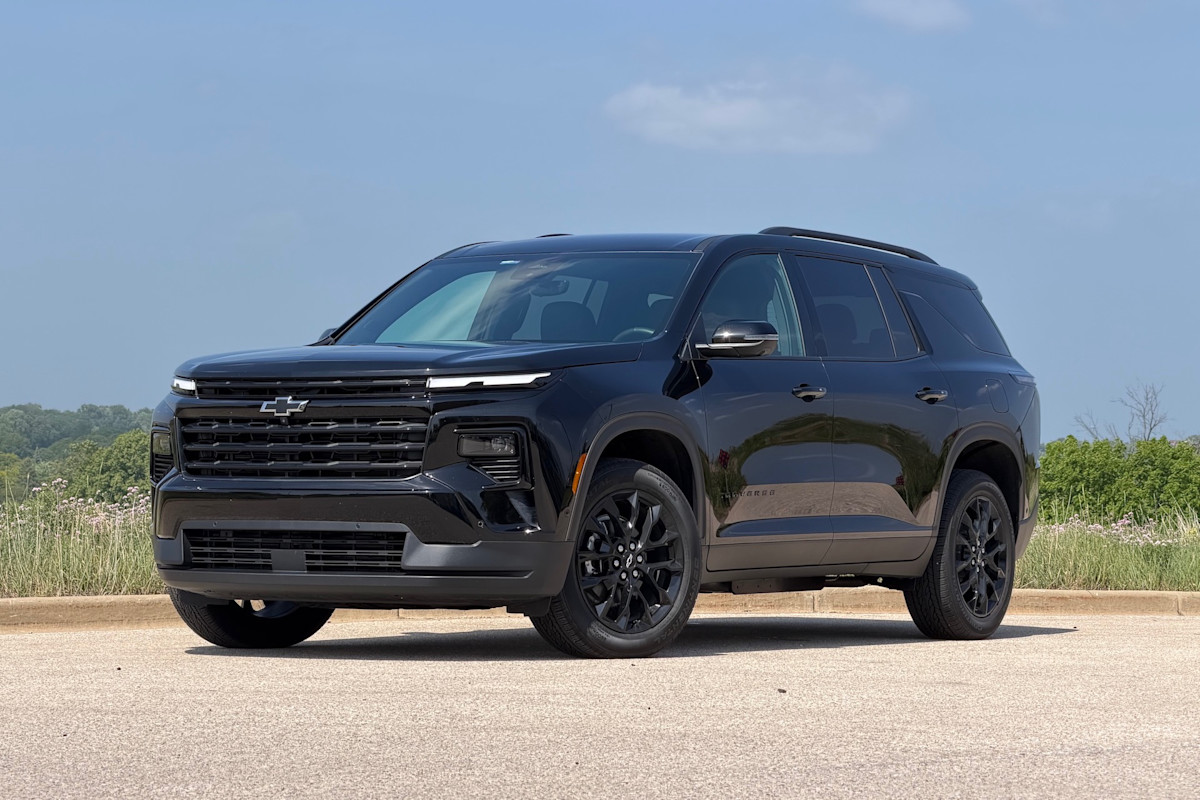
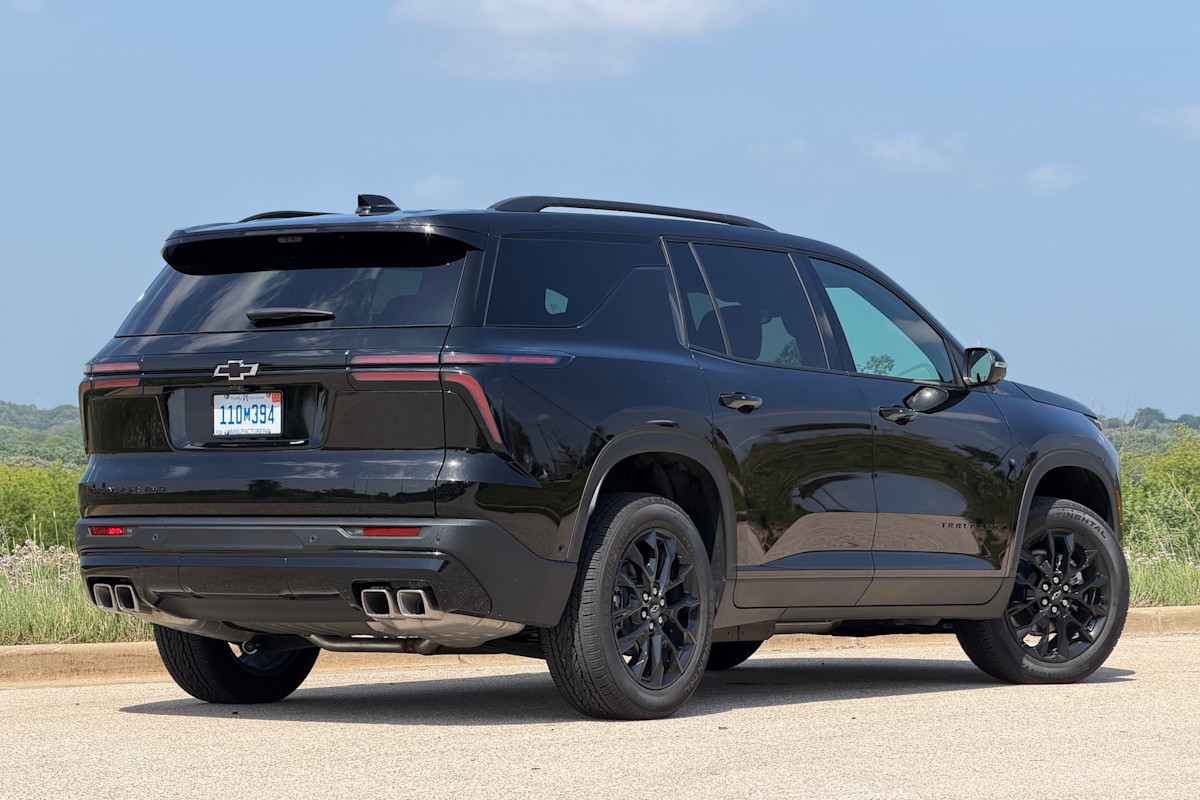
The Traverse looks like a mini Chevrolet Tahoe with an upright design, a high-set grille, and a macho stance. The nose takes on a similar look to its bigger brother, with eye-slit LED headlights and an air intake/fog light design that pokes into the grille. The sides have a similar clean, semi-rounded shape to the Tahoe's, highlighted by a forward-angled pillar behind the rear door, only the Traverse’s is blacked out at the top to create the look of a semi-floating roof. Both SUVs also have rounded wheel wells rather than the squared-off versions on Chevy’s pickup trucks, though the Tahoe lacks the Traverse's thin black flares.
The grille changes by model, alternating between chrome and black, and the Z71 trim stands out with its red front tow hooks and knobby all-terrain tires. Wheel sizes range from 18 to 22 inches. An available Midnight/Sport Edition blackens the emblems, grille, window moldings, badges, and wheels, and buyers can also opt for a dual-pane panoramic sunroof.
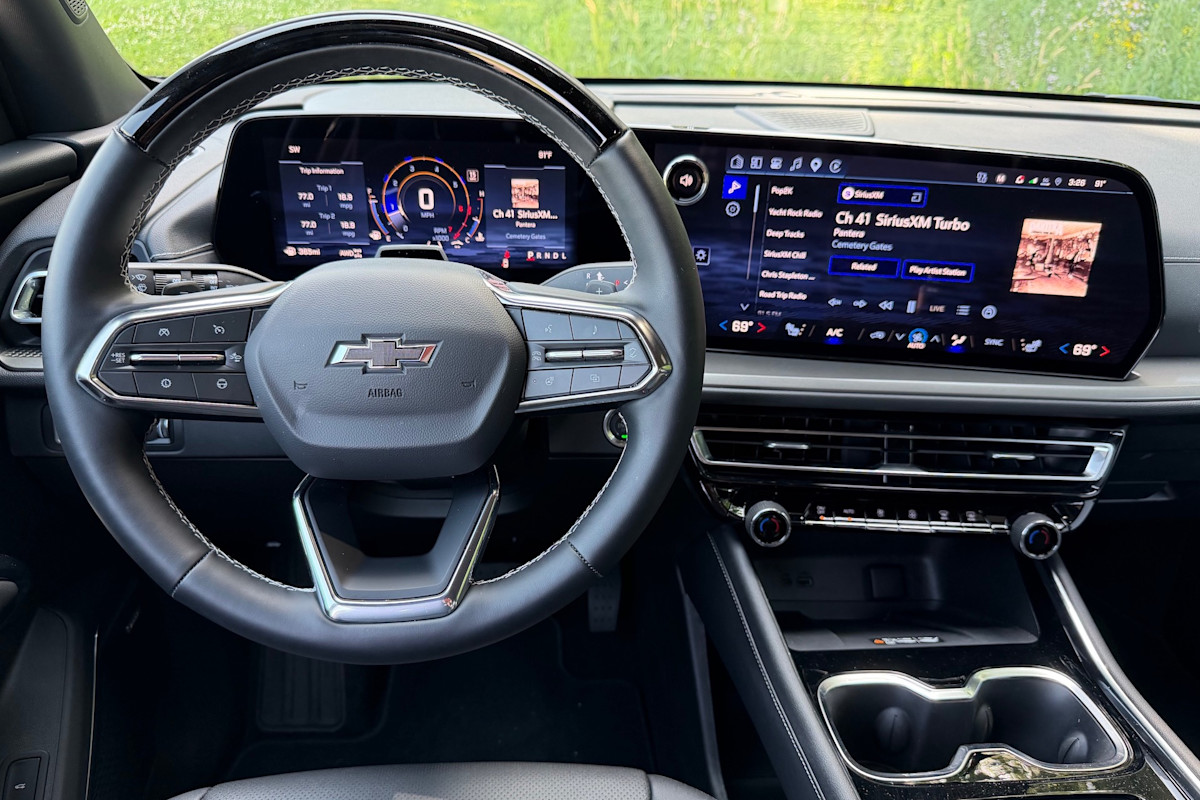
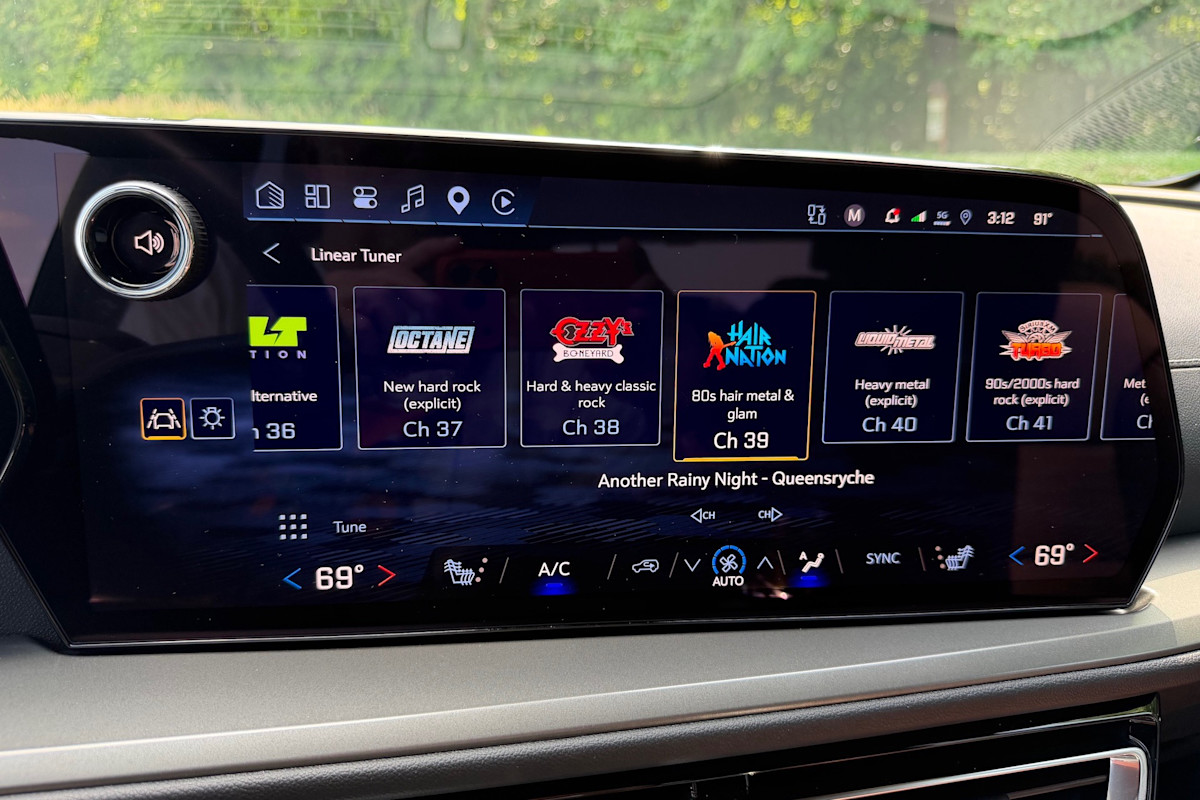
Inside, a 17.7-inch touchscreen dominates the dash and is supplemented by an 11-inch digital instrument cluster. With the shifter moved to a stalk on the steering wheel, the center console is wide and well laid out, thanks to open storage and a deep bin.
The interior materials are smart if not luxurious. Soft-touch surfaces adorn the door panels, dash face, and center console, some of them with contrasting stitching. The materials are well assembled and appropriate for the class, and the ambiance improves with the available leather. There are some hard plastics, but they don’t feel chintzy or dominate areas occupants are likely to touch.
The base LT trim is pretty well equipped with cloth upholstery, an eight-way power-adjustable driver’s seat, heated front seats, a heated steering wheel, tri-zone automatic climate control, and a hands-free power liftgate that opens automatically when it senses the key behind the vehicle. High Country trim levels and upwards improve comfort with a six-way power-adjustable front passenger seat, a power tilt/telescoping steering column, driver’s seat memory, leather upholstery, and heated rear seats.
Performance
The Traverse’s greatest advantage over the larger, heavier Tahoe is its road manners. With a car-like unibody architecture, it rides and handles better than the Tahoe, which is based on a truck-like body-on-frame platform. That doesn’t mean it’s overly agile, though, mostly because the Traverse is almost as big as the Tahoe and has a moderately elevated ride height typical of crossovers.
At 204.5 inches long and weighing in at 4,792 pounds with all-wheel drive (AWD), the Traverse’s handling is somewhat cumbersome but more controlled and agile than that of a body-on-frame vehicle such as the Tahoe. There is notable lean in corners, but the Traverse never feels tippy. Steering through the chunky wheel is light and direct, and the ride quality is generally good—bumps rarely disturb occupants—but gets somewhat busy on broken pavement. Still, it’s much smoother than the Tahoe.
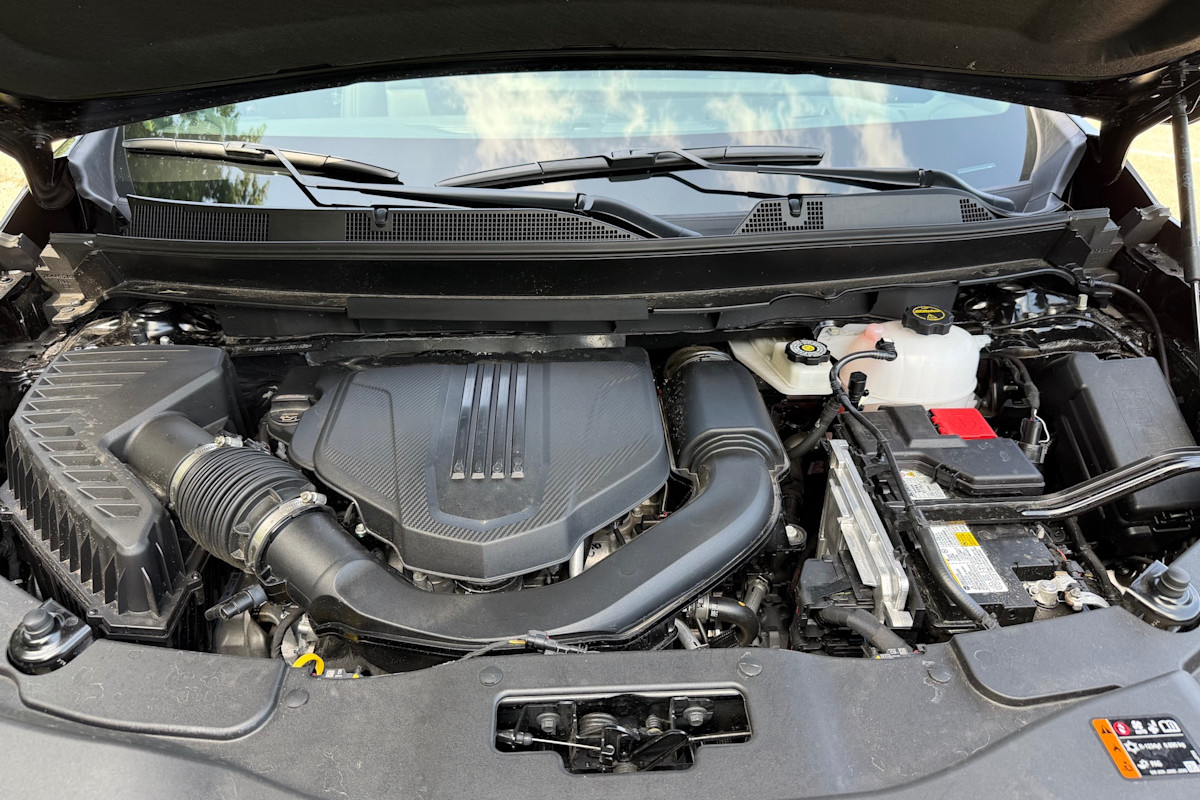
The powertrain is a mixed bag. Every Traverse is fitted with a 2.5-liter turbocharged four-cylinder engine that makes 328 horsepower and 326 pound-feet of torque. It’s paired with an eight-speed automatic transmission, and the power flows to the front wheels as standard or all four via the $2,000 AWD system. Towing capacity is 5,000 pounds, which is about average for the class but much less than the Dodge Durango's 8,700 pounds.
While the turbo-four has adequate power, the 0-60 mph time is around eight seconds, which is on the slow end of the spectrum these days. Still, it’s enough to get out in front of traffic, and freeway passing is possible if drivers are patient enough for the turbo to kick in and the transmission to downshift.
The biggest issue is engine noise—and it isn’t a pleasant sound. Chevrolet provides standard active noise cancellation, but it doesn’t seem to be very effective.
It would be easy to think that the Traverse doesn’t have AWD or drive modes, for that matter. Drivers must manually engage AWD via a button on the dash to the lower left of the steering wheel. This is a cheaper solution for Chevy than the numerous systems with automatic AWD that generally engage the second axle when needed, but we wouldn’t be surprised if many Traverse buyers pay for AWD and never activate it because they can’t find the button.
The drive mode button is next to the AWD button. It has Normal, Sport, Off-Road, Snow/Ice, and Tow/Haul modes, but drivers will use Normal and Sport most of the time. Sport only moderately perks up the throttle response, and the Traverse just isn't a sporty car in general. Off-Road helps the traction control system plow through loose surfaces, Snow/Ice uses the traction control for more grip on slippery surfaces, and Tow/Haul adjusts the transmission and engine for better towing.
Form & function
At almost seven inches shorter than a Tahoe, the Traverse has almost as much space for passengers but not as much for cargo. It comes standard with second-row captain’s chairs for seven-passenger seating, but an available second-row bench expands that to eight.
First-row occupants have more than enough room on comfortable seats with a good range of motion to create a natural seating position for most drivers. Storage for small items is excellent, thanks to a center console with a wireless charging pad at the front, two cupholders, an open area to stow daily detritus, and, especially, a large and deep covered bin with a tray at the top to separate commonly used items.
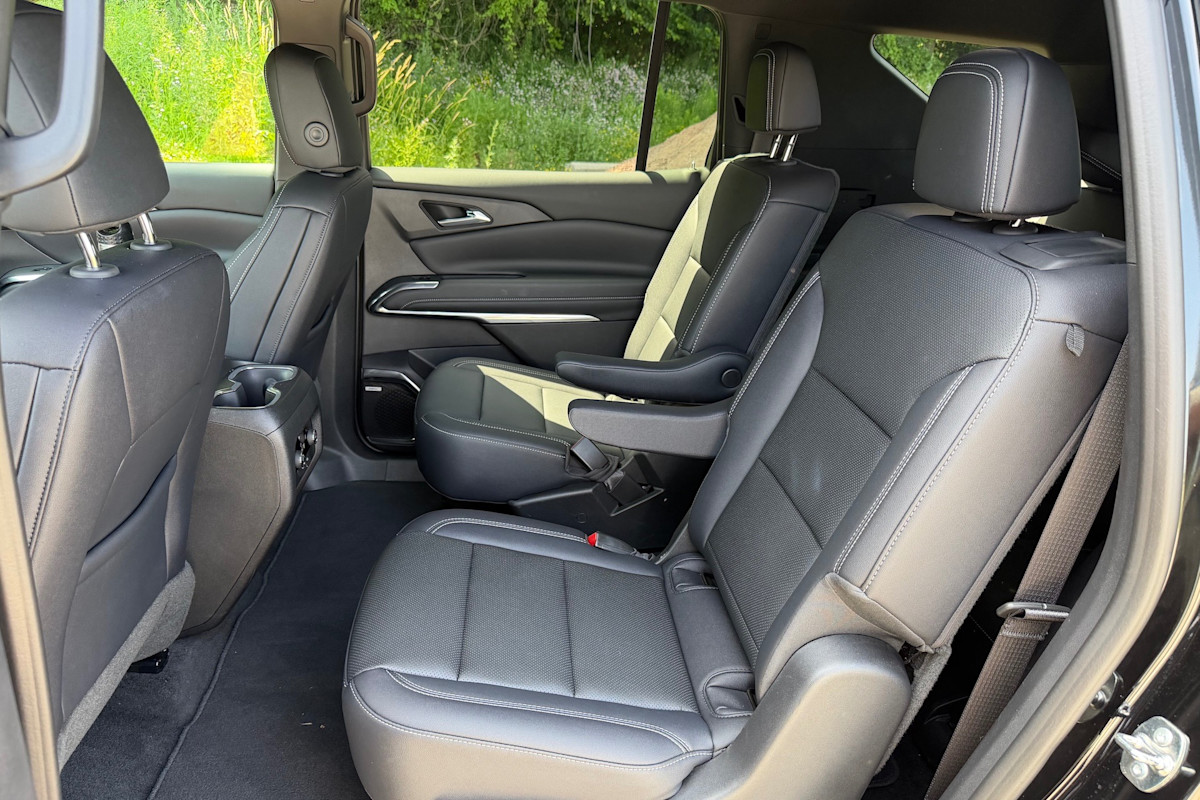
Second-row passengers have good space in all directions. Our LT tester came with captain’s chairs, which made the second row more comfortable for two, but the Traverse is wide enough to seat three across in relative comfort.
Three are supposed to fit in the third row, too, but they shouldn’t be adults. While headroom is very good, the seat bottom sits very low, causing a knees-up seating position with no thigh support. At 5'9", we were able to sit back there, but our knees were in contact with the second-row seatback due to a tight 32.1 inches of legroom.
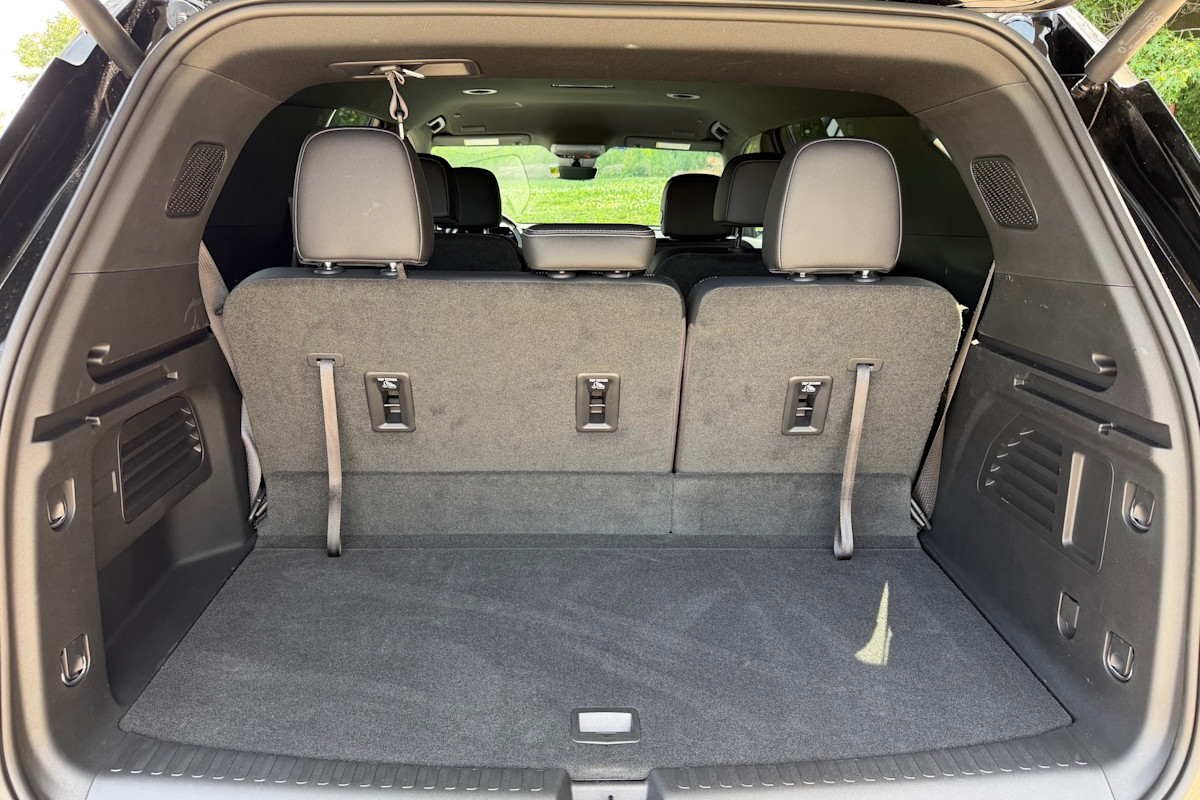
The second-row, passenger-side seat tilts and slides forward with the pull of a lever for access to the third row. The third-row seats fold by pulling straps on the seatback, and the same straps can be used to pull them back up. Higher trims have a power-folding third row.
Cargo space is generous, but not up to Tahoe or minivan dimensions. The Traverse has 22.9 cubic feet of space behind the third row, 56.6 behind the second row, and 98 behind the first row. That’s about 25 cubic feet less than a Tahoe and another 30 cubic feet less than a minivan, but it’s still plentiful. A flat load floor makes all that space even more usable.
Technology
The Traverse features excellent technology and comes standard with an 11-inch digital instrument cluster and a 17.7-inch infotainment touchscreen with Google built-in and wireless Apple CarPlay and Android Auto. With its plentiful real estate, the touchscreen is easy to reach and use, thanks also to large icons. Google Maps comes standard for navigation and provides access to Apple Music and Amazon Music. Some of the climate controls are separate, while others are included in the screen, but either way, they’re not difficult to access. The system reacts quickly to inputs and is generally intuitive.
The instrument cluster contains some selectable widgets, including the connected phone, the radio station or current entertainment, the navigation map, a visual depiction of the adaptive cruise control settings, or a simple screen with just speed and trip computer information.
Also standard is a satellite radio trial, wiring for a Wi-Fi hotspot, eight years of OnStar Basics, a wireless phone charger, and remote start. OnStar Basics can be controlled with voice commands and has built-in voice assistance, real-time traffic and navigation information, and automatic crash response. The base audio system has six speakers, but buyers can trade up for a better sounding 12-speaker Bose system.
Safety
The 2026 Chevrolet Traverse has a healthy set of standard safety features and offers a few more as options. The standard stuff includes forward-collision warning with pedestrian and cyclist detection and intersection assist, front and rear automatic emergency braking, adaptive cruise control, high-beam assist, rear cross-traffic alert, blind-spot monitors with steering assist, side bicycle alert, GM’s Safety Alert Seat that vibrates in the direction of a potential hazard, lane-departure warning, lane-keep assist, and rear parking sensors.
Our test car was also equipped with the Enhanced Driving package which, for $3,935, comes with three years of GM’s Super Cruise hands-free driver-assistance technology, automatic parking, a driver-attention monitor, and the Bose audio system. It also came with the $2,285 Driver Confidence package that adds a surround-view camera system, rear pedestrian alert, traffic-sign recognition, and a rear-camera mirror, among other convenience features.
The various systems all work as intended. The lane-keep assist keeps the vehicle in the center of its lane rather than bouncing from line to line. Super Cruise is the star, though. It can handle the controls on hundreds of thousands of miles of mapped highways across the country and Canada. It is one of the best hands-free systems on the market and can let drivers travel hands-free for hours at a time. The driver must pay attention, though, or it gives back control. It did well during our drive, but gave back control in some construction zones, and in one such zone, it would have sent us into a barrier had we not intervened. Hands-free driving is the future, but for now, drivers must pay attention and take control when these systems are overwhelmed.
The Traverse does well in crash tests with a little room for improvement. It earned a Top Safety Pick from the insurance-industry-backed IIHS, with top Good scores in the small overlap front and updated side impact crash tests. It also received Good scores for its headlights and vehicle-to-vehicle front crash prevention system. It got Acceptable ratings for its vehicle-to-pedestrian front crash prevention system and in the updated moderate front overlap crash test. Only the Acceptable rating in the updated moderate front overlap test prevented it from earning the top honor—Top Safety Pick+. The Traverse also earned the top five out of five stars from the government-run NHTSA for 2026.
Cost-effectiveness
Chevy offers the Traverse in LT, off-road-oriented Z71, and luxurious High Country and RS trims (the last one with black exterior trim). Our AWD LT trim started at $44,975 (it’s $2,000 less with FWD), including a $1,995 destination fee, and options brought the total to $53,240. By comparison, the Z71 starts at $50,895, the High Country at $57,095 and the RS at $57,395. AWD costs another $2,000 for those last two, but it’s standard on Z71.
FWD models have the economy advantage, as they’re rated at 20 mpg city, 27 mpg highway, and 23 mpg combined, while AWD reduces them to 20/24/21 mpg. That fuel economy wasn’t easy for us to achieve, as we averaged 20 mpg over 124 miles of mixed highway and city driving.
A good case can be made to go with the base Traverse LT and choose the all-weather confidence of AWD. It’s the most affordable model and comes with the features that make the Traverse appealing: lots of accessible space, excellent technology, and plenty of safety features. Moving up to higher trims or adding options brings more comfort, technology and safety features, and the Z71 trim adds some moderate off-road ability.
Few, if any, buyers will choose the Traverse as an off-roader. Our advice is to buy the most affordable Traverse that appeals, pick AWD, and remember to switch on the AWD system when necessary.
What owners say
Trims & specs
Base MSRP $57,100 | Seating 7 |
Engine 2.5L 328 hp I4 | Cargo Capacity 22.9 cu ft |
Combined MPG 22 | Drivetrain 4X4 |
Base MSRP $55,400 | Seating 7 |
Engine 2.5L 328 hp I4 | Cargo Capacity 22.9 cu ft |
Combined MPG 23 | Drivetrain FWD |
Base MSRP $57,400 | Seating 7 |
Engine N/A | Cargo Capacity 22.9 cu ft |
Combined MPG N/A | Drivetrain N/A |
Base MSRP $40,800 | Seating 8 |
Engine N/A | Cargo Capacity 22.9 cu ft |
Combined MPG N/A | Drivetrain N/A |
Base MSRP $42,800 | Seating 8 |
Engine 2.5L 328 hp I4 | Cargo Capacity 22.9 cu ft |
Combined MPG 22 | Drivetrain 4X4 |
Base MSRP $55,100 | Seating 7 |
Engine 2.5L 328 hp I4 | Cargo Capacity 22.9 cu ft |
Combined MPG 23 | Drivetrain FWD |
Base MSRP $48,900 | Seating 7 |
Engine 2.5L 328 hp I4 | Cargo Capacity 22.9 cu ft |
Combined MPG 22 | Drivetrain 4X4 |


Pricing trends
MSRP range
$40,800 - $57,400
Current avg. market price
$40,611
Trending down by 3.7% this month
May 2026 - November 2026


