2026 BMW iX Reviews, Pricing & Specs


Pros & cons
What we like
Rewarding driving dynamics
Premium interior materials
Impressive technology
What to consider
Potentially polarizing design
Advanced safety features are not standard
Unintuitive technology
The CarGurus verdict
The 2026 BMW iX relies on design to stand out among a growing number of luxury electric vehicles.
The BMW iX receives minor styling updates for the 2026 model year, along with a reworked lineup that includes a much more affordable entry-level model and a more widely available M Sport Package. But the big news is the improved battery technology, which adds modest gains in power and range. These changes improve an already-appealing midsize electric SUV, but are they enough?
Verdict: The dizzying pace of change in the electric vehicle segment is how a likable luxury SUV such as the iX can seem like yesterday’s news after just a few short years. The 2026 BMW iX is competitive with the Mercedes-Benz EQS SUV, but pales in comparison to the Lucid Gravity and the Rivian R1S.
out of 10 expert review
Look & feel
The 2026 BMW iX lineup includes the xDrive45, xDrive 60, and M70 xDrive. Prices range from $76,325 to $112,675, including the destination charge. All three model designations are new for 2026.
The iX xDrive45 is the entry-level model, shaving about $12,000 off the price of last year’s xDrive50. The mid-level model is the iX xDrive60, which replaces the xDrive50 and adds 20 more horsepower and 55 miles of range. At the top of the lineup is the iX M70 xDrive, which replaces the former M60 while gaining 40 hp and 18 miles of range.
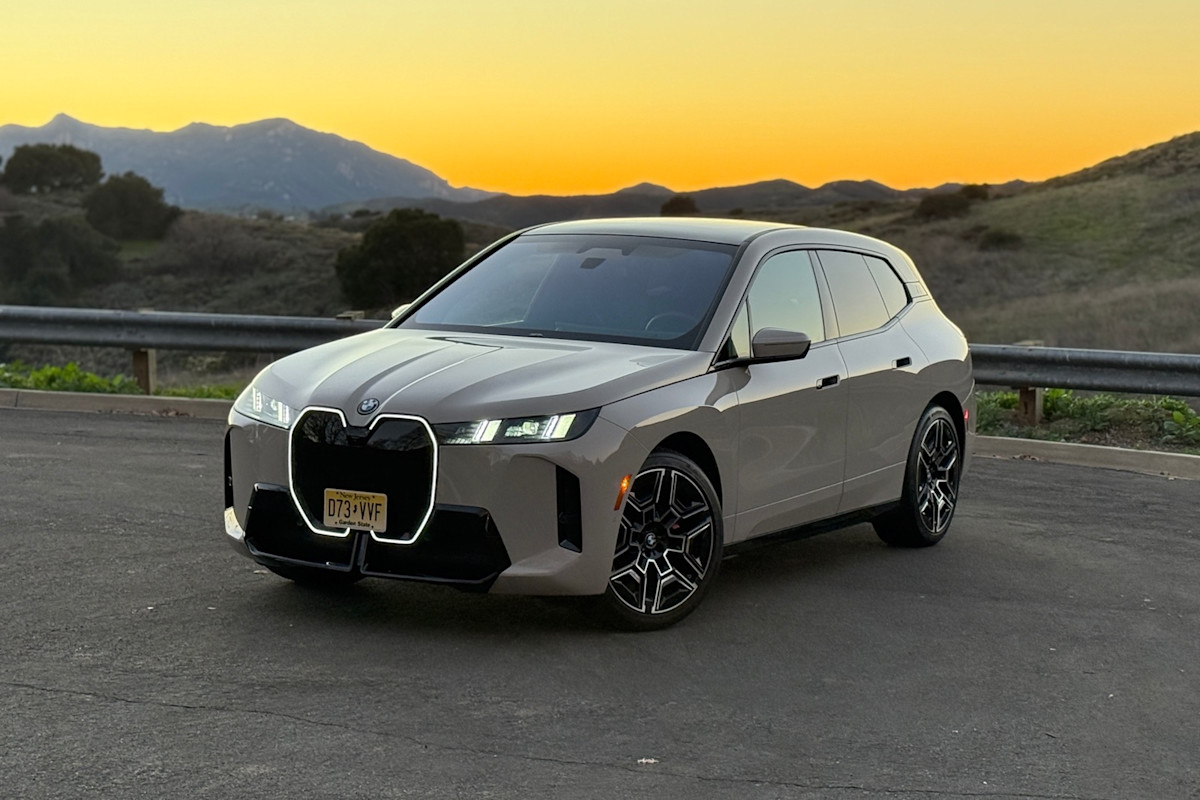
Glance at the 2026 BMW iX, and you might wonder what has changed. The controversial interpretation of BMW’s twin-kidney grille remains so, but is now equipped with a new pattern. Updated headlights, restyled lower portions of the front and rear bumpers, and revised wheel designs round out the (very subtle) styling changes. The more affordable versions of the iX are also available with the M Sport Package for the first time, and BMW offers five new paint colors, including Arctic Blue, Dune Grey, Carbon Black, BMW Individual Frozen Deep Grey, and Tanzanite Blue. A BMW Individual Exterior Line in Titanium Bronze is another new option.
Our test vehicle arrived in the xDrive45 spec. Featuring the new Dune Grey paint color, it was loaded with equipment, including 22-inch wheels, a panoramic sunroof, and multiple option packages, including the M Sport Package, M Sport Professional Package, Dynamic Handling Package, Executive Package, and Driving Assistance Professional Package. The manufacturer’s suggested retail price (MSRP) was $92,775, including the $1,175 destination charge.
From a styling standpoint, people either love or hate the BMW iX. Regardless of which camp you find yourself in, there’s no denying its design is what helps it to stand out and make a statement. Fortunately, once you open one of the doors and get inside, the iX is broadly agreeable in its layout and materials.
Our test vehicle’s M Sport Package dressed the interior with an Anthracite headliner, Dark Silver trim, M pedals, an M steering wheel, and high-gloss black trim. Though fabric was the dominant material, the cabin looked and felt high-quality, and the optional Panoramic Eclipsing Roof with electrochromic shading bathed occupants in natural light.
However, the doors sound loose and clunky when you close them, instead of robust, although the Executive Package’s soft-close doors eliminate that issue if you remember to use them. Also, people who rode with us after dark universally complained about the ambient lighting strips running along the tops of the door panels, saying the reflections on the window glass were distracting.

Performance
All iX models have a dual-motor, all-wheel-drive (AWD) powertrain. In our iX xDrive45 test car, the two electric motors deliver 402 horsepower and 516 pound-feet of torque, with a maximum driving range of 312 miles. Our test vehicle’s optional 22-inch wheels reduced the range to 279 miles. Depending on the model, the 2026 BMW iX provides an EPA-rated 283-364 miles of range with the smaller wheels. That’s a genuine improvement over the 284-309 miles of the 2025 iX lineup.
The battery has a net usable capacity of 100.1 kilowatt-hours, and charging speeds are reasonable considering its size. Recharge the iX at home using an 11-kilowatt Level 2 charger, and it can go from empty to full in 9.5 hours. In the xDrive45, DC fast charging can be done at 175 kW and takes 34 minutes to charge from 10-80%. The other iX models can fast charge at up to 195 kW.
All 2026 BMW iX models benefit from new silicon carbide semiconductors, optimized battery management systems, upgraded adaptive regenerative braking, and a standard heat pump that can now warm the battery more quickly in cold temperatures. The result is improved power output and better overall efficiency, including in cold weather. BMW also claims it has made subtle suspension and chassis modifications, and has taken steps to reduce friction while driving to extend the battery range.
According to BMW, our test vehicle could accelerate to 60 mph in 4.9 seconds, and it sure felt quick, especially from a standstill. As speeds climbed, the iX xDrive45 felt less energetic. We used the Personal driving mode during evaluations (the other choices are Sport, Efficient, and Silent). Teenagers riding in the iX liked the digitally rendered sound as the BMW accelerated, because it reminded them of a car from the video game Fortnite.
We started with a 55% battery charge and 159 miles of indicated range. After 72.8 miles of driving, the iX showed a 24% charge and 68 miles of indicated range, which suggests the BMW was less efficient than expected. However, we averaged 2.8 miles per kWh, or 35.7 kWh/100 miles. The official EPA rating with 22-inch wheels is 40 kWh/100 miles, so our result beat expectations. In city driving, we did even better, recording 3.1 mi/kWh (32 kWh/100 miles). That’s a significant improvement on the EPA estimate.
In urban and suburban driving, the iX feels rock-solid. Equipped with an adaptive air suspension as part of the Dynamic Handling Package, it responded stiffly to speed humps and bumps and the M Sport brakes proved a little grabby in traffic, making it harder to bring the iX to a smooth, unfettered halt. The test vehicle’s optional rear-wheel steering and excellent surround-view cameras made it easy to park in close quarters.
On the open road, the iX is remarkably quiet, mostly free of road, wind, and, of course, powertrain noise. It effortlessly soaks up the miles, but on some bridge transitions, it can suffer from a choppy ride. As we do when testing vehicles in Southern California, we ran the iX across the Santa Monica Mountains to assess its ride and handling qualities. We did not use Sport mode because it disengages the stability control system, but it didn’t seem to matter, because as equipped, our iX xDrive45 turned in a remarkable performance.
In typical driving situations, the somewhat stiff suspension effectively eliminates unwanted body motion and body roll on a mountain road. The steering is sharp and responsive, grip is outstanding, and the brakes are impervious to fade. Though the xDrive45 is the least powerful version of the iX, that matters little on a curvy ribbon of road, and this entry-level model was more than quick enough.
While extremely capable, the iX is also predictable. If you know a back road well, you know how the iX will behave in its twists and turns and over its lumps and bumps. Still, it isn’t as viscerally engaging to drive as a typical gas-powered BMW. There’s a layer that filters communication here, and while that’s disappointing to a driving enthusiast, most iX buyers won’t care one whit about it.

Form & function
Like many electric vehicles, the BMW iX is roomier inside than you might expect. An airy interior design helps, but so do the comfortable, oversized seats. This year, the M Sport Package adds new M Multi-Function seats to the cabin. They’re upholstered in Black with Atlas Gray microfiber, with perforated leather options, and include additional adjustments and more significant bolstering. Heating is standard; ventilation is optional. Though they’re comfortable, the robust side bolsters can interfere with seatbelt access when buckling up.
A two-tiered floating center console separates the front seats. The upper level includes the gear selector, infotainment system controls, and a storage bin underneath the center armrest. The lower level has a wireless smartphone charger, USB ports, and cupholders. Items on the lower level are awkwardly located and hard to access.
The back seat feels mounted too low relative to the side windows, but is otherwise comfortable. Generous headroom, legroom, and footroom, combined with supportive lower cushions, ensure passenger comfort underneath the panoramic roof. However, sit back there for a while, and you might adopt a splay-legged position.
Open the clamshell liftgate, and you’ll find a nicely finished and practical cargo area measuring 35.5 cubic feet. A storage well under the floor accommodates the portable charging cord and any items you’d prefer remain hidden, and there are hooks for grocery bags. A front trunk (frunk) is unavailable.
The back seat folds down in a 40/20/40 split, so you can carry long items such as skis while still seating two rear-seat passengers. Fold the back seat down, and the maximum cargo space measures 77.9 cubic feet.

Technology
The rectangular screen perched on the iX’s dashboard might lack modern wow factor, but we like the simple minimalism it represents. In our opinion, front passenger screens are overhyped, and the BMW Curved Display provides everything you need, including video streaming and in-car gaming via AirConsole (when the iX is parked).
When equipped with BMW Live Cockpit Professional, the iX features a head-up display and a cloud-based BMW Maps navigation system, both of which use Augmented View technology. Augmented View helpfully superimposes navigation directions on a camera view shown on the digital driver display or onto the road ahead via the head-up display.
With BMW Maps, long-distance route planning accounts for charging stops, and as you near one, checks whether chargers are available and can re-route if they're busy. Before you arrive, the iX automatically preconditions its battery to accept maximum charging as soon as you plug in.
The infotainment system is BMW iDrive 8.5 with QuickSelect. In addition to wireless Apple CarPlay and Android Auto, it offers access to SiriusXM satellite radio, Amazon Alexa, and the BMW ConnectedDrive Store for entertainment, personalization, and driver assistance software upgrades. BMW ID technology saves personalized settings for different drivers in the My BMW App and can greet them upon entry, as it loads their preferences.
The iX also features the BMW Intelligent Personal Assistant, but, during the evaluation, we received a few “no service connection” warnings on the center display, with a recommendation to use manual controls instead. This happened in suburban Los Angeles, where you would think establishing a service connection would be easy.
Furthermore, when the technology was working, it suffered a couple of problems we’ve noticed in other BMWs. For example, in response to saying “I need to go to a hospital,” the “intelligent” assistant listed two medical facilities in Mexico before offering directions to a local hospital located just 1.5 miles away. When we requested directions to “1600 Pennsylvania Avenue in Washington D.C.,” the assistant heard the query correctly as shown on the head-up display, but then tried to send us to 1600 Pigeon Hollow in Farmington, Idaho. When we requested directions to a charging station, the navigation map showed ChargePoint chargers that were obviously installed at local residential homes.
As you might have guessed by now, we used the wireless smartphone mirroring technology almost exclusively, and Apple CarPlay performed nearly flawlessly, as usual. Also, music streaming from Apple Music to the iX’s Harman Kardon audio system sounded great, though the optional Bowers & Wilkins Diamond Surround Sound system with 4D audio and 30 speakers is likely a sensational experience. Which is as it should be, considering its $3,400 price tag.

Safety
BMW equips every iX with Driving Assistant Plus, which includes forward collision warning, automatic emergency braking, adaptive cruise control, lane-departure warning, lane-keep assist, Steering Assistant (lane-centering assist), and a blind-spot monitor that can actively try to prevent an unsafe lane change.
In addition to those features, our test car’s optional Driving Assistance Professional Package equipped the iX with evasive steering assist, lane-change assist, automated parking assist, and Highway Assistant, a hands-free driving technology available at speeds up to 85 mph. According to BMW, Highway Assistant is complimentary for the first eight years of iX ownership. The window sticker for our test vehicle noted that Highway Assistant was available for a “limited term,” but it did not appear to be active in our test vehicle.
The Driving Assistance Professional Package also includes Parking Assistant Professional, with 360-degree view, panoramic view, and 3D view camera modes, Drive Recorder, and Anti-Theft Recorder. You can also control a parking maneuver from outside the SUV, using your smartphone. A Maneuver Assistant function can remember the path taken to enter a parking space and follow the same trajectory in reverse.
The standard Driving Assistant Plus collection of technologies worked well during our evaluation. In particular, the steering assist features feel natural to a driver, and when you need to override the automated inputs, it is seamless instead of a struggle. You never feel like you’re fighting with the technology. Instead, you're collaborating with it. Also, the steering wheel rim is touch-sensitive, so the system doesn’t constantly warn you to hold the wheel.

Cost-effectiveness
The pace of technological change is dizzying in the luxury EV space. What was revolutionary a few years ago is now common, and automakers who fail to keep up are left behind. For example, Audi quietly paused one of the BMW iX’s primary rivals, the Q8 E-tron, following a short run of 2025 models.
With the new 2026 iX xDrive45, BMW slots into the price point vacated by the Audi. Other German competitors, such as the Mercedes-Benz EQS SUV and the new Porsche Cayenne Electric, are now significantly more expensive to start. The Mercedes offers a third-row seat that the BMW lacks, while the Porsche should offer a more exciting driving experience.
Cadillac bookends the iX with two compelling alternatives: the Lyriq and the Vistiq. Both offer great looks, easy-to-use Super Cruise, competitive range, and compatibility with North American Charging Standard (NACS) chargers via an adapter.
If you’re willing to take a chance with a startup, the Lucid Gravity and the Rivian R1S are appealing alternatives to the BMW. Both offer impressive power, performance, range, and overall capability. Now old-school, the aged Tesla Model X is more expensive than the BMW iX, but includes complimentary charging and blistering acceleration.
Ultimately, the BMW iX is heavily reliant on its design and, now, its appealingly low base price to set it apart from this crowd. Since it isn’t a high-volume model, BMW can take risks with this SUV’s look and feel. It has crafted an electric vehicle with a bold, polarizing design, inside and out. If you like it, you’ll probably be happy owning it. And if you’re wondering if upgrading to the iX xDrive60 or iX M70 is worth it, we’d say no. Spend that money on xDrive45 upgrades and hang onto the rest.

What owners say
Trims & specs
Base MSRP $75,150 | Seating 5 |
Engine 402 hp Electric | Cargo Capacity 35.5 cu ft |
Combined MPG 94 | Drivetrain AWD |
Base MSRP $111,500 | Seating 5 |
Engine 650 hp Electric | Cargo Capacity 35.5 cu ft |
Combined MPG 80 | Drivetrain AWD |
Base MSRP $88,500 | Seating 5 |
Engine 536 hp Electric | Cargo Capacity 35.5 cu ft |
Combined MPG 97 | Drivetrain AWD |


Pricing trends
MSRP range
$75,150 - $111,500
Current avg. market price
$74,606
Trending down by 3.5% this month
May 2026 - November 2026


