2025 Dodge Charger Daytona Reviews, Pricing & Specs

Pros & cons
What we like
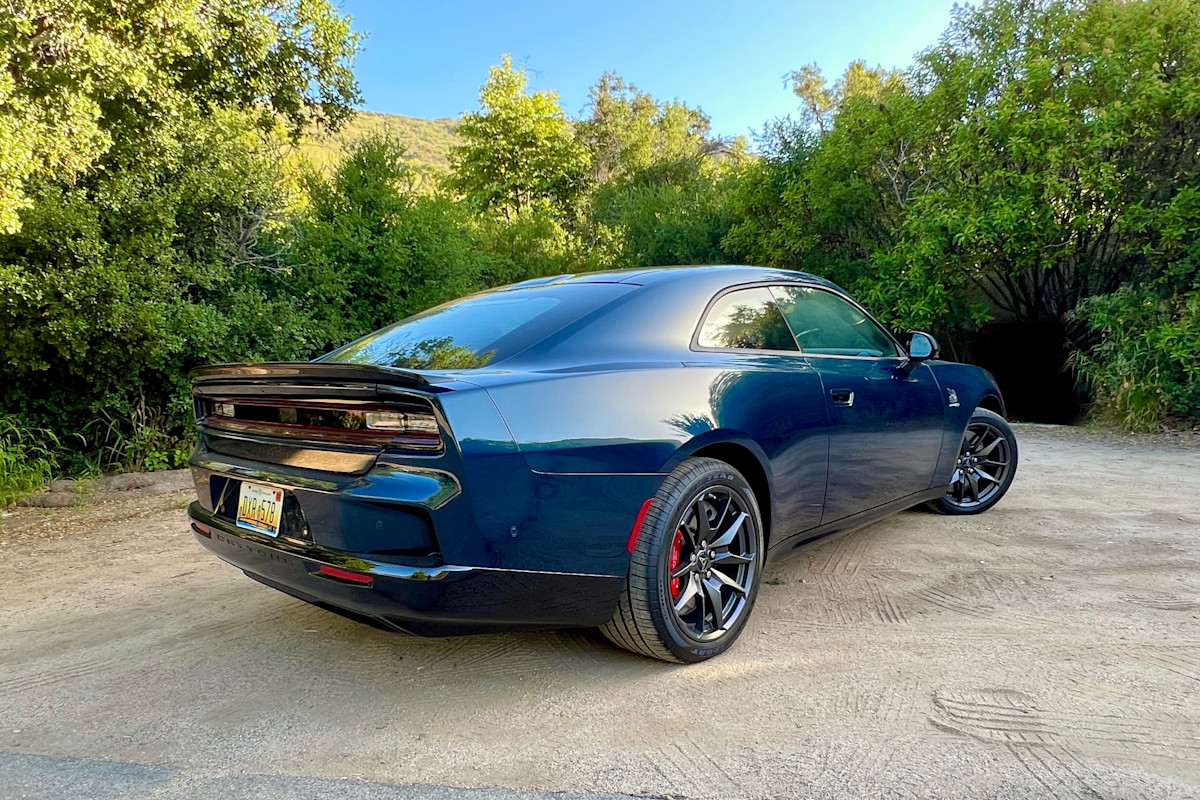
Stylish design
Fun to drive
Comfortable
What to consider
Interior materials feel cheap
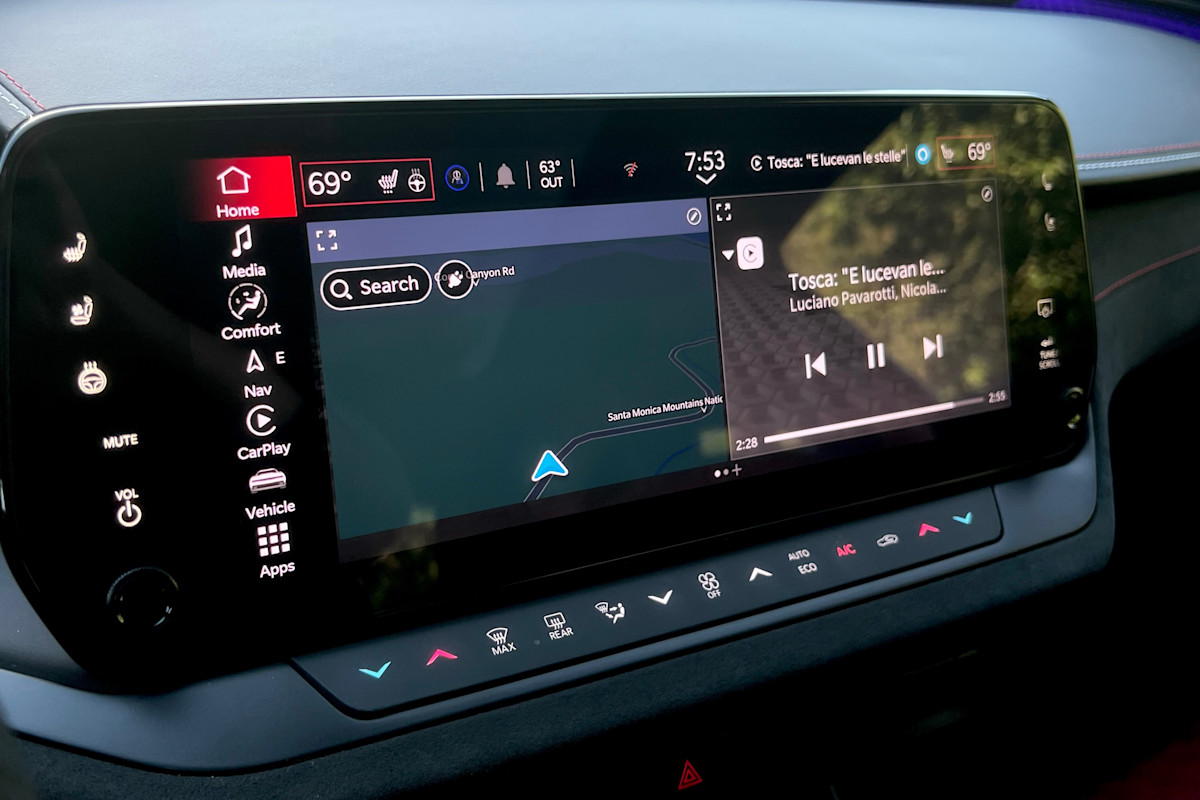
Sluggish touchscreen response
Stereo is lacking
The CarGurus verdict
Dodge's electric muscle car blends heritage and technology with some attitude.
The first true all-electric muscle car, the Dodge Charger Daytona is a sinister-looking coupe with all of the theater and fury of its gas-powered predecessor. It appeals to our primitive brain with instantaneous acceleration, lots of personality, and head-turning style, but its pricing and range have our analytical side questioning our sanity. Nevertheless, it's a guilty pleasure that we're proud to indulge in.
Verdict: Stylish and fun, but also pricey, the Dodge Charger Daytona EV is not a rational purchase decision.
out of 10 expert review
Look & feel
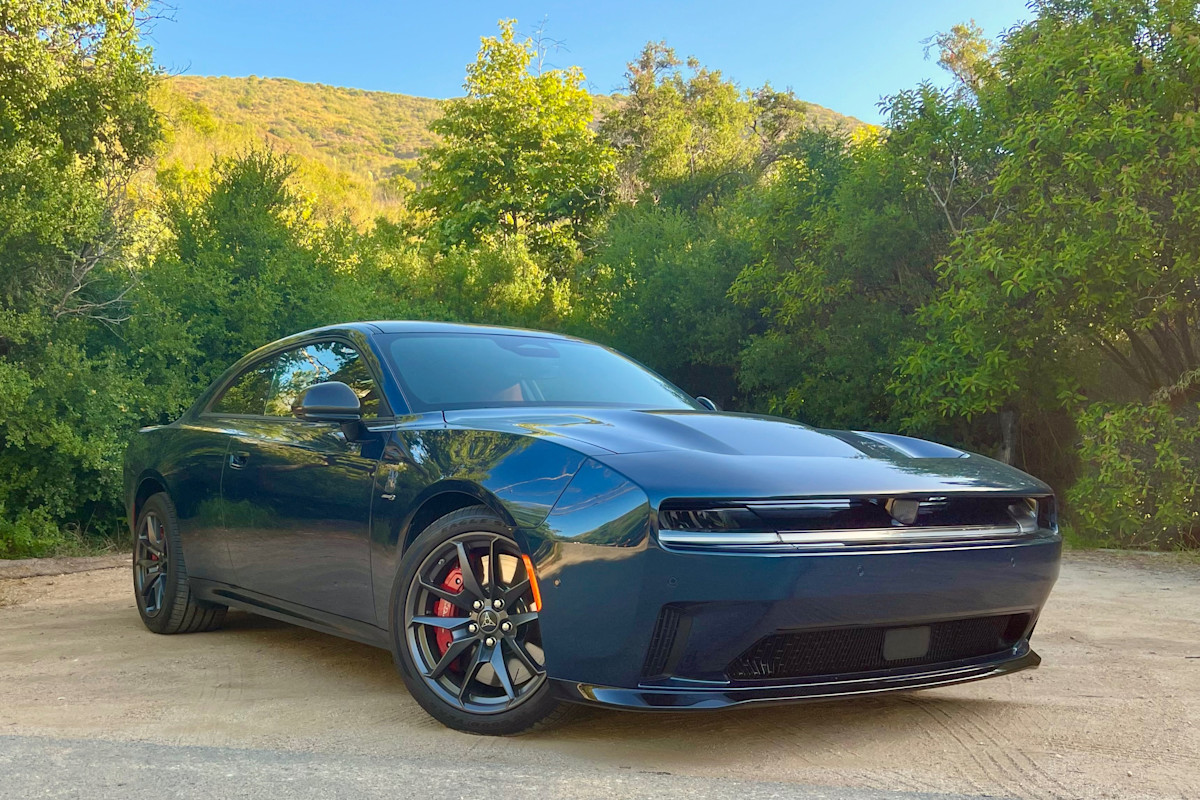
The eighth-generation Charger picks up where the previous Dodge Challenger left off, with retro styling superimposed onto current proportions. It draws inspiration from the 1970 Charger, which is considered by many to be one of the all-time best cinema "bad guy" cars thanks to the iconic movie Bullitt. The grille is narrower, though, and the headlights are hidden in the illuminated slot that spans the front fascia. The grille also channels the airflow over the hood, forming a unique wing-like spoiler that blends well with the entire front end.
Initially, the Charger is only offered as a two-door coupe instead of a four-door sedan, like the last generation, but the four-door sedan body style is on the way for the 2026 model year. Based on the Stellantis STLA Large architecture, this new Charger measures almost nine inches longer nose-to-tail than the previous Challenger, with five inches of that added to the wheelbase (the distance between the front and rear wheels). The Challenger was already an imposing coupe, though, so the Charger doesn't seem any larger in person.
Sharply-creased fenders enhance the Charger's broad-shouldered muscle-car appeal, yet exhibit some grace in the way the front and rear sections blend into each other down the sides of the car. Brawny side sculpting keeps the large expanses of unadorned bodywork from looking overly heavy, giving the Charger an appropriately strong road presence that is rare nowadays. Around the back, the 1970 Charger character comes screaming back with the wide taillight bar and squared-off styling cues. Overall, the exterior styling pays homage to its heritage, but it's not nearly as desperate or kitschy as something like a Ford Mustang or Mini Cooper. It looks just the way a muscle car should, whether it has an internal combustion engine or not.
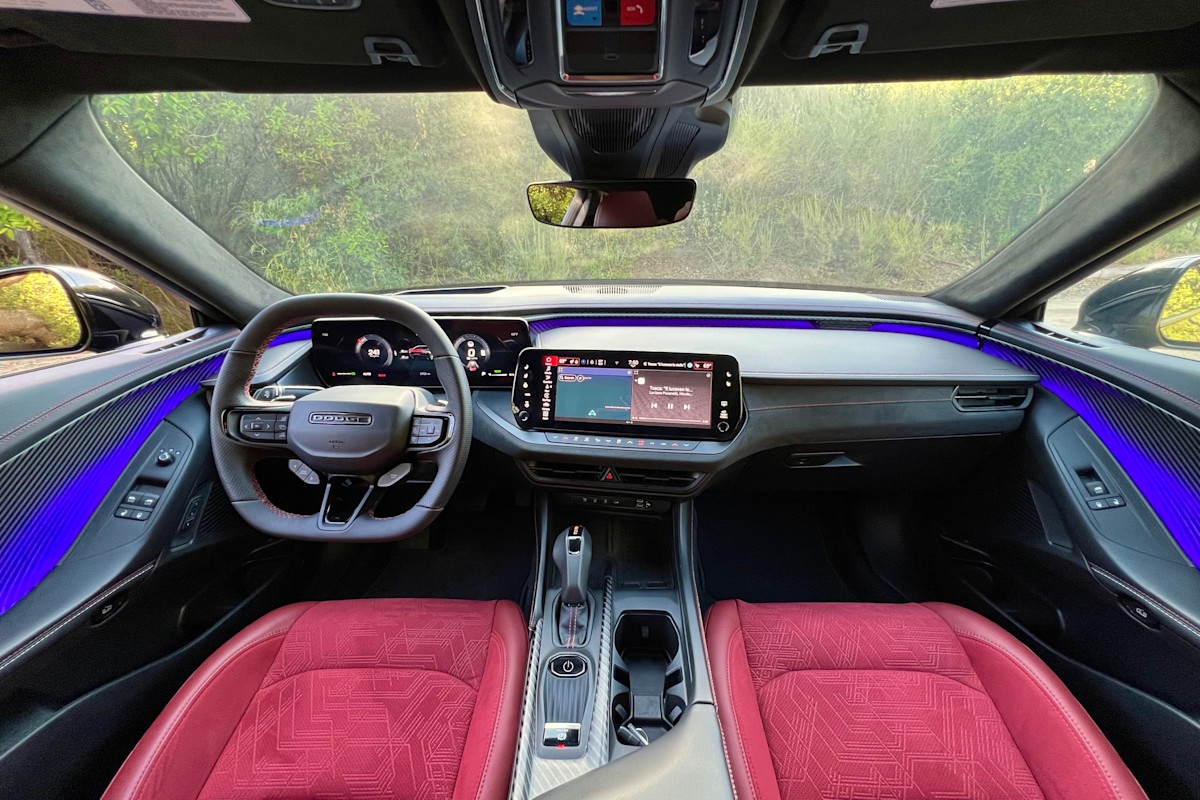
The Charger's interior is far less nostalgic, favoring modernity and technology instead. Large horizontal digital displays dominate the wide dashboard, with one playing the part of an instrument panel and the other a central infotainment touchscreen. Curving elements from the door panels gracefully continue across the top of the dash for a sporty design, and the steering wheel—which has flat top and bottom sections—further enhances that feel. The center console holds the gear selector which, with its 1970s-style angled pistol grip, is one of the few heritage nods.
Our test vehicle came equipped with the optional Carbon and Suede package which embellishes the cockpit with a faux suede headliner and dash trim, along with carbon fiber accents in the doors and center console. These are welcome additions that improve upon the Charger's otherwise plain plastic elements, as is the available interior ambient lighting that adds depth and colorful definition—especially at night. These upgrades also seem more substantial and sturdy than the basic plastic, which tends to emit some subtle creaks when driving on bumpy roads. Overall materials quality is good for a muscle car, but not one costing north of $80,000, like our test car.
Performance
At the time of writing, the 2025 Dodge Charger is offered in only all-electric Daytona form. The R/T (for road/track) base model comes with two electric motors, one powering each axle for all-wheel-drive (AWD). Combined, they produce 456 horsepower and 404 pound-feet of torque, which should get you from 0-60 mph in about 5 seconds, according to Dodge. It's the most efficient model in the lineup, with an EPA-estimated 308 miles of range from the 94-kWh battery pack in the floor.
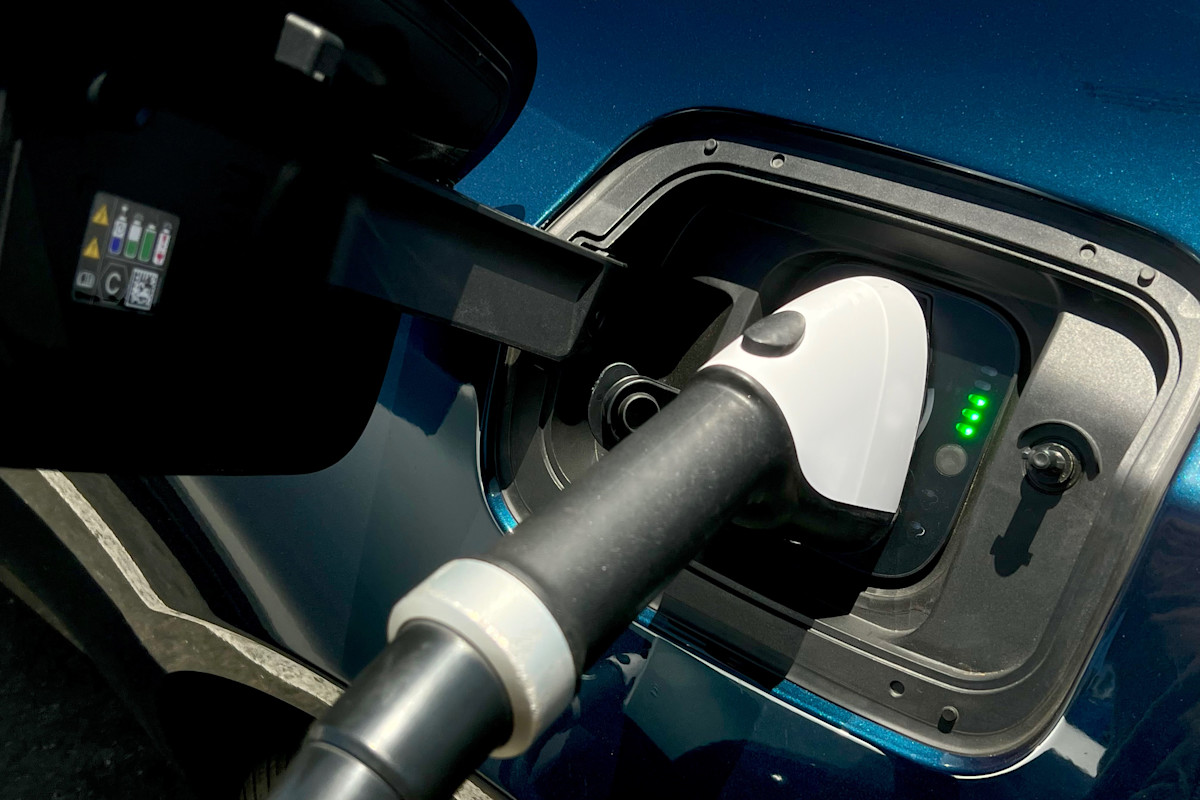
We evaluated the Dodge Charger Daytona Scat Pack, which adds some serious performance, increasing output to a maximum of 670 hp and 627 lb-ft when you hit the PowerShot button, which gives you a boost of about 80 hp for 15 seconds. That shortens acceleration time to 60 mph to only 3.2 seconds, and Dodge estimates a quarter-mile time of 11.5 seconds at 120 mph. Range is estimated at only 241 miles, and that drops to 216 miles if you opt for summer performance tires. Both the R/T and Scat Pack are capable of DC fast charging at rates up to 183 kW, which should replenish the battery from 20 to 80 percent in 27 minutes.
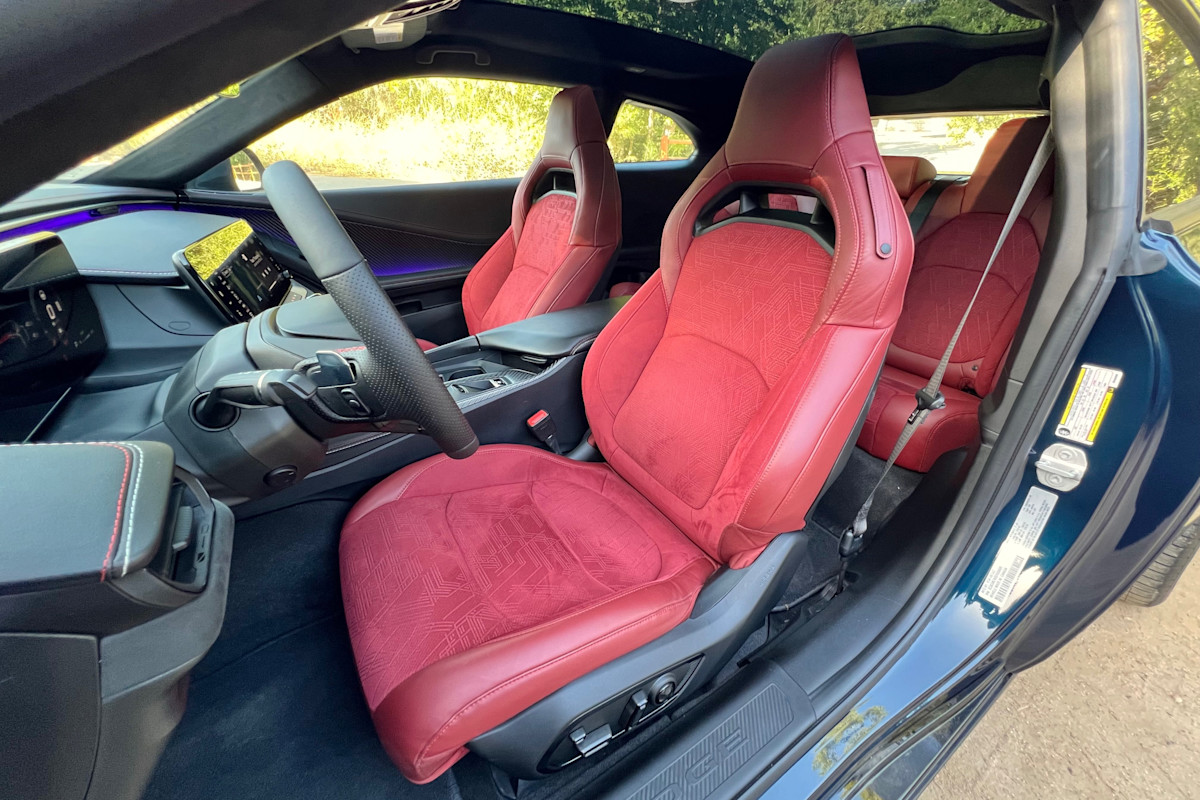
In addition to the power increase, the Scat Pack also benefits from larger 20-inch wheels, a sport-tuned suspension, Brembo brakes, additional drift and donut modes, a larger 16-inch digital instrument panel, and a head-up display. On top of that, our Charger came with the optional Track package that adds adaptive dampers, larger brakes, wider tires, a rear spoiler, synthetic-leather-and-suede seats, and an onboard camera recording system.
Despite AWD, the new Dodge Charger spins its tires under hard acceleration, with an addictive amount of tire squeal that is absent from other EVs and adds to the muscle car personality. Further adding to the soundtrack are the synthesized Fratzonic "engine" noises that are prevalent inside as well as from the outside. These sounds are likely going to split people into “love it” or “hate it” camps, though we'll admit they add to the overall experience, at least initially. After about 10 minutes, we grew tired of the sounds and opted to silence them in the settings menu.
One-pedal driving is possible once you select the highest amount of brake regeneration with the wheel-mounted shift paddles and disable slow-speed creep in the on-screen menus. We typically prefer one-pedal driving as it slightly reduces driving effort, but that's not the case here. The Charger comes to a rather abrupt halt, and when you set off, there's a noticeable clunk as if the motors need to overpower the brakes to get going. That initial launch also comes with a noticeable lurch off the line. We chose to simply disable slow-speed creep and keep regeneration at the maximum, which resulted in a smoother and more enjoyable drive.
Chargers and Challengers have historically been more at home cruising on a boulevard or laying down impressive times in a drag race than in corners, but this Charger Daytona Scat Pack is also appropriately athletic when it comes to handling. With a hefty curb weight of 6,000 pounds, it's not as agile as smaller and lighter sports cars, but it's thrilling nonetheless. You definitely feel the weight shifting around under hard braking and cornering, but the Charger remains predictable and planted. The adaptive dampers add a noticeable amount of firmness to the ride quality in Sport mode, and are comfortably cushy in their normal setting
From the driver's seat, you don't get a good feel for where the corners of the vehicle are, making maneuvering into small parking spots a bit stressful. It forces heavy reliance on the standard parking proximity sensors and the optional surround-view camera system.
Altogether, the Charger Daytona is an entertaining yet comfortable muscle car that stands out from the few electric vehicles that prioritize performance. Later in the year, we're told the lineup will expand to include the Charger Sixpack, which features a twin-turbocharged six-cylinder gasoline engine that will produce between 420 hp and 550 hp. A lower curb weight is expected as well, which should improve handling, but we'll have to judge for ourselves.
Form & function
The Dodge Challenger as much more accommodating than its Ford Mustang and Chevrolet Camaro rivals owing to its large size, and that’s also true of the new Charger coupe. There's an abundance of space for larger drivers with plenty of adjustment range to ensure occupants of any build will be able to find their preferred position. Also like the outgoing Challenger, a more compliant suspension tuning makes the Charger easier to live with on your daily commute or when logging a ton of miles on a road trip.
The back seats are especially roomy for the class and are able to comfortably hold an average-sized adult for extended periods. Accessing those seats is fairly easy for a coupe, thanks to the Charger's extraordinarily long doors. Unfortunately, those doors can be a hindrance in tight parking situations and require a lot of care to keep from dinging neighboring vehicles. The sensation of interior space is enhanced by the large panoramic sunroof, but that advantage is also accompanied by a rather large drawback. The glass roof lacks a sliding sunshade or electrochromic dimmer, leaving your head to slow-roast in the hot midday sun.
When it comes to personal-item storage, the Charger has adequate, but not generous space. You get moderately-sized cup holders and door pockets, and a center armrest bin to hold your stuff. There is also a rubberized tray for your smartphone, and with the optional Plus Group package, a wireless charging pad. That package also adds a frunk bin under the hood that is large enough to hold charging cables, but not much else.
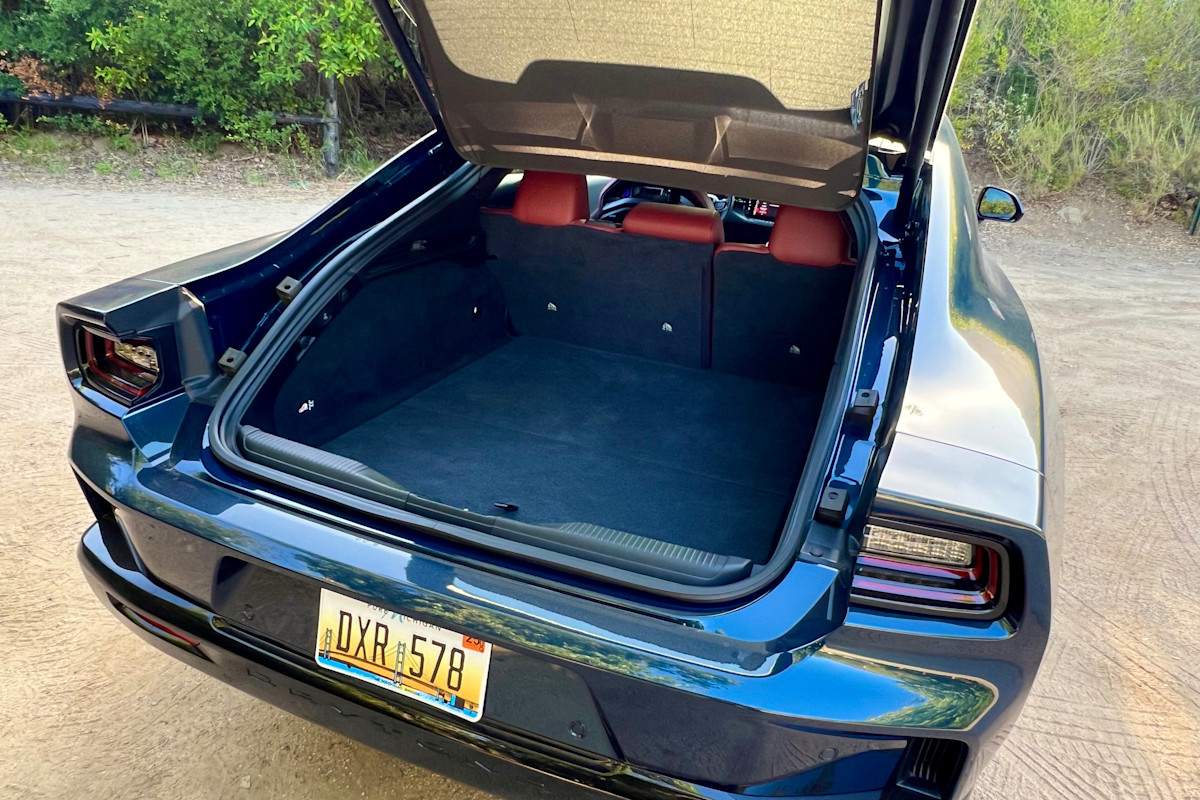
The rear hatch opens to reveal a large cargo area. Dodge specs it at 22.7 cubic feet, which is huge for a coupe of this type. That said, the section furthest back is height-limited. The typical paper grocery bag would get compressed to half its height if it were stowed closest to the rear bumper, along with all of its contents. The space increases the closer you get to the rear seatbacks and exceeds that of non-hatchback coupes. The Plus package adds a power-operated hatch to greatly reduce the effort needed to shut the hatch, and smartly places the button inside the cargo hold instead of forcing you to reach for one on the deployed trunk lid. The rear seatbacks can be folded flat to allow for longer and bulkier objects, but reaching the latch requires some fumbling around the headrests or crawling through the passenger compartment.
Technology
The entry-level Charger Daytona R/T comes standard with a 10.25-inch digital instrument panel and a 12.3-inch infotainment touchscreen. The Scat Pack or Plus package upgrades to a larger 16-inch touchscreen. The infotainment system is easy to use for basic functions, but some secondary features and adjustments will require you to dig around in the menus. It's not as intuitive as it could be, but after a little bit of time to get acclimated to the system, it gets easier. The system is also prone to some occasional delays between the moment you tap the screen and when it reacts. This didn't seem consistent within certain menus or features, though.
Wireless versions of Apple CarPlay and Android Auto are standard on all models, though a wireless charging pad is only offered with the Plus package. The standard audio system has nine speakers, but our Charger came with the optional Sun and Sound package that upgrades to 18-speaker Alpine premium audio. We liked the clarity in the higher tone registers, but found the bass lacking. That's a surprise, since most audio upgrades tend to overdo it with thumping bass. In this case, we were compelled to max-out the bass and that still wasn't quite enough for us to feel much.
Safety
As of this writing, crash-test results from the National Highway Traffic Safety Administration (NHTSA) and the Insurance Institute for Highway Safety (IIHS) have not yet been published. We'll update this review with scores if they become available.
Standard advanced safety features for all Charger Daytonas include: forward collision warning with automatic emergency braking, lane-keep assist, blind-spot monitoring with rear cross-traffic alert, adaptive cruise control, and parking proximity sensors for the front, side, and rear. Considering how wide the Charger feels from the driver's seat, the parking sensors are especially helpful, while the side sensors should keep you from putting curb rash on those beautiful wheels. The optional Plus package adds a head-up display and a 360-degree camera system.
The safety features all functioned as they should, with the exception of the adaptive cruise control. On the highway, it tended to wait uncomfortably long before it applied the brakes to adjust to slowing traffic, and when they were actuated, the initial braking was noticeably heavy and resulted in a significant lurch. This was the case with some of the longer selectable following distances, while shorter settings and denser traffic amplified the issue. This diminished our confidence in the system and had our foot hovering over the pedal just in case, reminding us of early adaptive cruise systems, which were generally lurchy and jumpy. When resuming cruise control from a stop, acceleration was delayed enough for vehicles to cut in front, and equally jumpy when the Charger did finally start moving.
Cost-effectiveness
The 2025 Dodge Charger Daytona R/T has a starting manufacturer's suggested retail price (MSRP) of $61,590 (including $1,995 in destination charges). That's an uncomfortably high price for a muscle car, though not outrageous for a performance-minded electric vehicle. Stepping up to the Scat Pack increases the price to $75,980, and with all of the options, our test vehicle rang in at $86,460. These prices far outpace the gas-only Ford Mustang, except for the race-ready $300,000-plus Mustang GTD.
Some of the sticker shock could be reduced when you look at operating costs. The EPA estimates that you’ll spend $800 to $1,000 on electricity annually, assuming an average 15,000 miles during that period. By contrast, the last-generation Dodge Challenger was estimated to cost between $2,000 and over $4,000 annually, and the current Ford Mustang is only a few hundred dollars less than that. It's also worth noting that Dodge often offers steep discounts on its products.
In many ways, the Charger Daytona family follows the same pattern as its Challenger forebear. The R/T is a solid pick for most drivers and has the best range. Muscle car fans who would have upgraded to a V8 in the past would be better served by the more powerful Scat Pack, and we wholeheartedly recommend adding the Performance package along with the Plus Group option.
The discontinuation of the Chevy Camaro leaves the Ford Mustang as the only remaining gas-powered muscle car. Among EVs, the alternatives are just as sparse. The BMW i4 is more affordable and precise on a fun road, but lacks the attitude of the electric Dodge Charger. The Polestar 2 has a similarly-restrained personality to the BMW, though Polestar has been known to offer some more extroverted special editions. Outside of these few choices, you'd have to spend a whole lot more to get a thrilling EV that isn't an SUV. The Audio e-tron GT and related Porsche Taycan, as well as the Lucid Air (especially in Sapphire trim) are all great to drive, but are priced in six-figure territory.
What owners say
Great value for the year make and model! Only thing that’s missing is the red leather seats.
June 30, 2026Trims & specs
Base MSRP $68,195 | Seating 5 |
Engine 670 hp Electric | Cargo Capacity 22.7 cu ft |
Combined MPG 89 | Drivetrain AWD |
Base MSRP $59,595 | Seating 5 |
Engine 496 hp Electric | Cargo Capacity 22.7 cu ft |
Combined MPG 98 | Drivetrain AWD |


Pricing trends
MSRP range
$59,595 - $68,195
Current avg. market price
$33,379
Trending down by 3.9% this month
May 2026 - November 2026


