2025 Lucid Gravity Reviews, Pricing & Specs
Write a review$94,900 to $94,900
Original MSRP
8
of 10
expert review
avg user rating
(0 reviews)
Pros
Great handling
Impressive electric range
Plenty of cargo space
Cons
Potentially polarizing design
Awkward touchscreen controls
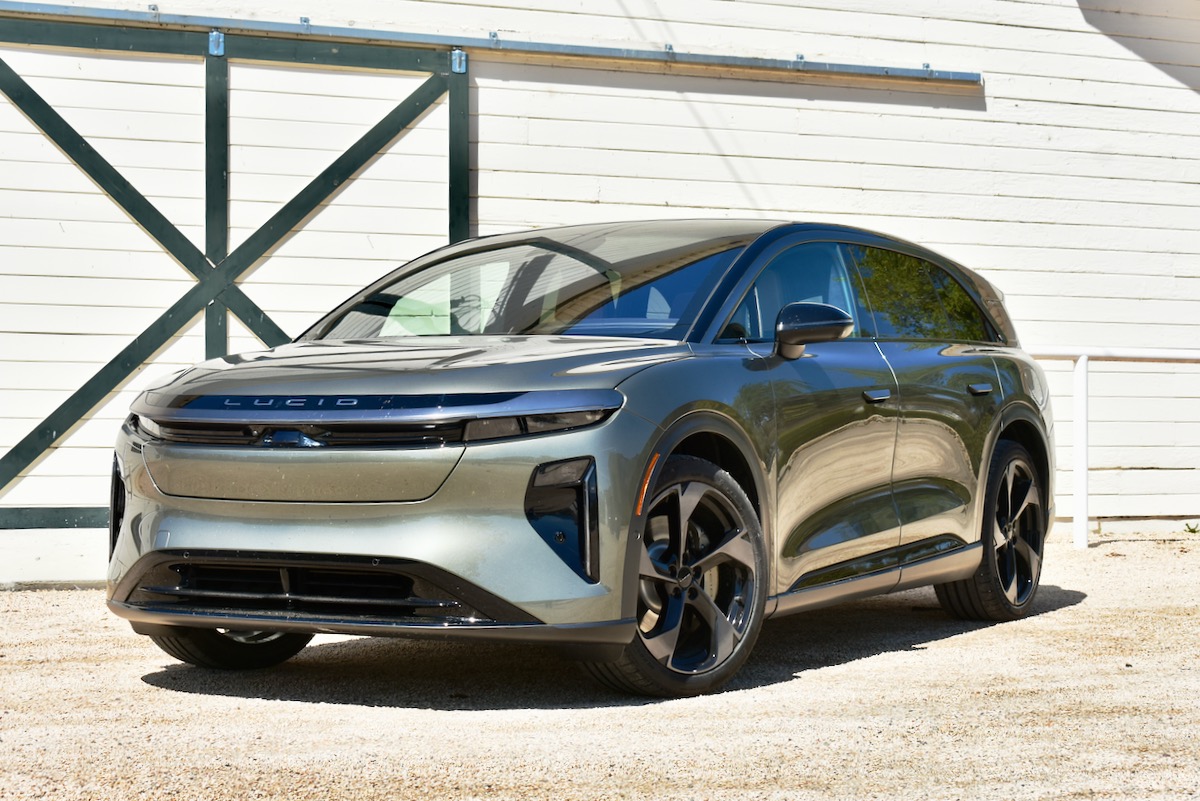
The follow-up to the Lucid Air features the same impressive engineering, but now with more space.
The 2025 Lucid Gravity is the second model and first SUV from electric-vehicle brand Lucid Motors. The Gravity is based on a modified version of the Lucid Air sedan platform, but with two-row, five-seat, and three-row, seven seat configurations that are likely to appeal a bigger market. However, that electric SUV segment is already populated with competition like the BMW iX, Cadillac Escalade IQ, Mercedes-Benz EQS SUV, Rivian R1S, and Volvo EX90, so Lucid must still establish itself.
Verdict: The Gravity takes a very different approach to the electric SUV mission brief—and it’s all the better for it.

The Gravity was designed first and foremost for minimal aerodynamic drag—always important to maximize EV range—giving it a unique look even among the varied styling of other EV SUVs.
Lucid took a different approach even compared to curvaceous Mercedes EQS SUV, another low-drag design. Where Mercedes included some more traditional SUV styling elements, like prominent shoulders that separate the lower body from the greenhouse, the Gravity has fairly flat sides, a short nose, and a fairly upright tailgate that give it a minivan-like appearance. It’s unclear if SUV buyers will accept that, but in engineering terms the shape is certainly effective. Lucid claims the Gravity has a drag coefficient of just 0.24—beating the already-slick Mercedes’ 0.25—and the wide door and rear hatch openings make accessing the interior easier.
That new shape is combined with carryover styling elements from the Air, including Lucid’s Micro Lens Array LED headlights, with many small lighting elements peeking out beneath a visor-like trim piece, and well-defined body corners that also help with aerodynamics. And also like the Air, Lucid offers blackout Stealth and (extra-cost) Platinum exterior trim packages, paired with a muted paint color palette. Our test car’s Aurora Green Metallic, which looks a bit like the shade of green used on early 2000s L.L. Bean Edition Subarus, is among the more vibrant choices.
Unlike most other SUVs, the Gravity is fitted with a staggered wheel-and-tire setup. The standard fitment is 20-inch front and 21-inch rear wheels, but 21-inch front/22-inch rear and 22-inch front/23-inch rear options are also available. The latter comes with summer tires, while all-seasons are fitted with the other two setups.
Like the exterior, the Gravity’s exterior eschews traditional SUV ruggedness. You won’t find any chunky switchgear here, just a minimalist dashboard (a touchscreen infotainment system handles most controls), curved display, and a canopy-style roof with an additional glass panel for the rear seats. Lucid offers four design themes—Mojave, Yosemite, Tahoe, and Ojai—inspired by its native California, although only the latter two are available with leather upholstery. Still, fit-and-finish was impressive for what is still a relatively new automaker.

The Lucid Gravity SUV launches in Grand Touring trim, with a dual-motor all-wheel drive (AWD) powertrain and 123-kWh battery pack. The two motors produce a combined 828 horsepower and 909 lb-ft of torque, which Lucid says will get the Gravity Grand Touring from zero to 60 mph in 3.4 seconds—supercar territory. That’s quicker than a BMW iX M60, Mercedes-Benz EQS 580 4Matic SUV, or Volvo EX90 Twin Motor Performance, but the base dual-motor Rivian R1S can match it with an optional software upgrade. What the truck-like Rivian can’t match is the Gravity’s sports-car-like handling.
Equipped with the optional Dynamic Handling Package, which adds rear-wheel steering and three-chamber adaptive air suspension (a less-sophisticated air suspension system is standard), plus the summer tires, our test car handled more like a sports sedan than a three-row SUV. Negotiating tight corners required much less steering input than some smaller SUVs, and without the nervousness and need for many small inputs that sometimes comes with such fast steering. This made it easy to place the Gravity on the road with precision and take a set through corners with confidence. The integration of the rear-wheel steering was also completely seamless, making the Gravity feel like a smaller vehicle.
Well-tuned steering was accompanied by well-tuned suspension on our test drive. The limits of grip were well above the limits of our courage, while body roll was virtually undetectable. Crucially for a luxurious family hauler, these handling-enhancing attributes didn’t come with a ride-quality penalty. That was doubly impressive considering the Gravity’s weight (the various configurations hover around 6,000 pounds) and the fact that our test car had the largest-available wheels. The only indication that we were driving a heavy SUV was the extra moment the Gravity needed to settle itself after some left-right transitions, but that wasn’t severe enough to really impact ride or handling.
We spent most of our day driving the Gravity with the regenerative braking on its high setting, which provided ample deceleration for most situations. One-pedal driving was possible even while bombing down twisty roads, and when we did need to use the brake pedal, it provided solid and consistent feel.
The only dynamic blemishes were steering that failed to relax sufficiently for highway cruising, requiring a bit more management to stay on a straight course, and little differentiation between the three main drive modes—Smooth, Swift, and Sprint. Lucid also provides a Terrain mode for when the pavement ends, and was eager to demonstrate that the Gravity has sufficient approach and departure angles to avoid scraping bumpers on steep inclines, but that’s not really what this road rocket of an SUV is about.

The Gravity certainly checks the “sport” box of “SUV,” but Lucid didn’t forget about the “utility” part. While the aerodynamic swept-back windshield and glass canopy make for less first- and second-row headroom than the boxier Volvo EX90, the Gravity has a clear advantage in both third-row headroom and legroom. The Lucid also offers more second-row legroom than the Volvo or the Mercedes EQS SUV.
Cargo space—21.3 cubic feet behind the last row of three-row models, 56.2 cubic feet behind the second row, and 106.2 cubic feet with all rear seats folded—is accessing through a clamshell power tailgate that creates a tall, wide aperture for loading and unloading items. With its air suspension lowered (height adjustability is standard), the Gravity also boasts a low lift-over height and low step-in height for occupants. That’s another artifact of the minivan-like design.
However, another aspect of that design is the location of the rood pillars, which are well forward of the driver’s seat across a deep dashboard. This can block the view ahead for some drivers while cornering; we found ourselves looking straight at the driver’s side pillar at times, and the tiny quarter window Lucid provides didn’t help. Unlike most minivans, the Gravity also has a high center console, which provides plenty of storage space for small items. Lucid also carved out some space for that in the deeply-scalloped door panels.
The Gravity also features an 8.1-cubic-foot frunk, with a wide opening that allows it to double as a bench. Lucid even sells tailor-made cushions for this purpose, and the hood makes a nice sunshade. The rear seats also fold completely flat, and the cabin is wide enough to accommodate an air mattress. Lucid assured us that a custom-designed one will soon be added to the Gravity accessory catalog.
With an optional towing package, the Gravity has a maximum towing capacity of 6,000 pounds. That’s a reasonable amount for a three-row SUV of this size, although shoppers expecting to tow large loads on a regular basis might want to step up to a Rivian R1S or Cadillac Escalade IQ. As with all electric cars, it’s important to remember that towing can cut range substantially, and that many public charging stations can’t accommodate a vehicle with a trailer.

Befitting a high-dollar EV from a new brand, the Gravity boasts an elaborate dashboard display. A curved 34-inch screen covers roughly two-thirds of the dash, with an 11-inch touchscreen below. Known as the Pilot Panel, it takes the place of most conventional dashboard controls, similar to the layout in the Lucid Air. However, the Gravity version is landscape-oriented, and Lucid substituted a square steering wheel to provide an unobstructed view of the main display.
The unusual wheel didn’t present any problems—mainly because of the Gravity’s aforementioned fast steering, which didn’t require much shuffling of the wheel—and did indeed provide a clear view of the display in front of it. The screen itself was also well-positioned. It was easy to keep both it and the road ahead in view at all times, and despite the lack of a hood there was minimal glare even on a very sunny day of driving.
The wheel also contains two large touchpads which, as in the Lucid Air, are responsible for adjusting the wheel and mirrors (once you’ve selected those settings on the Pilot Panel touchscreen). That’s not as inconvenient as it may sound, partly because you can save these settings for future use, partly because the touchpads have some degree of feedback. That’s not the case with the Pilot Panel, which makes using the sliders that handle temperature (four-zone automatic climate control is standard) a little trickier.
Also standard is digital key tech, which might be preferable because, unusually, the key fob must be “woken up” by shaking it if the car is left in park for a period of time. Wireless Apple CarPlay is standard as well (wireless Android Auto will be added at a later date), along with two USB-C ports for each row of seats and a 10-speaker audio system. A 22-speaker audio system with Dolby Atmos is optional, along with a head-up display and a 7-inch touchscreen for the second-row passengers.
Lucid also promises a couple of notable software-based features. Halo Secure is similar to Tesla’s Sentry Mode, while a Sanctuary feature uses the Gravity’s ambient lighting, audio system, and screens to create a calming ambience while parked.

The National Highway Traffic Safety Administration (NHTSA) and Insurance Institute for Highway Safety (IIHS) hadn’t released crash-test ratings for the Gravity at the time of publication, but Lucid did equip its first SUV with the expected array of driver aids.
The standard DreamDrive 2 suite of driver-assist features includes the basics, things like adaptive cruise control, lane keep assist, lane departure warning, forward collision warning, automatic emergency braking, blind spot monitoring, rear cross traffic alert, and traffic sign recognition.
Upgrading from DreamDrive 2 to DreamDrive Premium mainly nets more camera-based features. This package adds a surround-view camera system that includes a blind-spot camera view, as well as a See-Through Vehicle view that shows what’s directly underneath the Gravity. One further step up is DreamDrive Pro, which includes a hands-free highway driving system, remote automated parking, and traffic-light detection.

The Gravity's pricing structure currently sits at the upper end of the scale for an electric luxury SUV. The sole Lucid Gravity Grand Touring starts at $96,550 with the mandatory $1,650 destination charge, but many key features like the Dynamic Handling Package and DreamDrive Pro driver-assist suite are optional extras. An $81,550 Gravity Touring model is on the way, likely for the 2026 model year, and we wouldn’t be surprised to see an even less-expensive single motor rear-wheel drive (RWD) version in the future. For now, the Gravity Grand Touring justifies its higher pricing with an impressive combination of efficiency, excellent chassis tuning, and intelligent packaging.
Lucid estimates up to 450 miles of range for two-row models equipped with the smallest wheel fitment (20-inch front/21-inch rear). Three-row models are expected to get 437 miles out of a charge with the same wheels. With either of the larger wheel combinations, range drops to 407 miles for two-row models and 386 miles for two-row models. Still, that’s more than most other high-end electric SUVs. The Rivian R1S achieves 410 miles in some configurations, while the Cadillac Escalade IQ is estimated at 460 miles, albeit with a much larger battery pack.
The Gravity comes standard with a North American Charging Standard (NACS) port, allowing it to plug directly into Tesla Supercharger DC fast-charging stations, with maximum power rates of up to 400 kilowatts with 1,000-volt charging hardware and 225 kW with 500-volt hardware, corresponding to Tesla’s V4 and V3 Superchargers, respectively. At max power, Lucid estimates the ability to recover 200 miles of range in less than 12 minutes of charging. A Combined Charging Standard (CCS) adapter is available as well.
For those concerned about buying into a relatively new brand, note that Lucid also provides a four-year/50,000-mile new-vehicle warranty and eight-year/100,000-mile warranties for the powertrain and battery pack, which are comparable to other brands’ EV coverage.

User reviews for 2025 Lucid Gravity
Write a review2025 Lucid Gravity Pricing
Trims & specs
Air Conditioning
Automatic climate control front air conditioning · Dual front air conditioning zones · Rear air conditioning: with independent controls · Dual rear air conditioning zones
Airbags
Dual front airbags · Dual front knee airbags · Passenger airbag deactivation: occupant sensing deactivation · Front side airbags · Front side curtain airbags
Audio System
Antenna Type: element · Voice recognition audio system · Bluetooth auxiliary audio input · IHeartRadio internet radio · Internet radio app: Spotify · AM/FM radio · Total Number of Speakers: 10
Brakes
ABS: 4-wheel · Braking assist: hill start assist · Electronic parking brake: auto off · Front brake diameter: 15.4 · Front brake width: 1.5 · Front brakes: ventilated disc · Rear brake diameter: 15.3 · Rear brake width: 1.18 · Rear brakes: ventilated disc
Comfort Features
Armrests: rear center folding with storage and pass-thru · Center console trim: wood · Dash Trim: Leatherette · Dash trim: wood · Door sill trim: scuff plate · Door trim: leatherette · Floor Mat Material: carpet · Floor Material: carpet · Floor Mats: front · Interior accents: wood · Steering wheel trim: leatherette
Convenience Features
Adaptive stop and go cruise control: fully automated · Ambient lighting: color-adjustable · Assist handle: rear · Autonomous lane guidance: lane centering · Cargo area power outlet: 12V · Center console: front console with armrest and storage · Cruise control: adaptive · Cupholders: rear · Dimming rearview mirror: auto-dimming · Easy entry: power driver seat · Footwell lights: color-adjustable · Memorized settings: 2 driver · Multi-function remote: proximity entry system · One-touch windows: 4 · Power outlet(s): USB front · Power steering: speed-proportional · Power windows: lockout button · Reading lights: front · Steering wheel: power tilt and telescopic · Steering wheel mounted controls: multi-function screen controls · Storage: accessory hook · Universal garage door opener: Homelink · Vanity mirrors: dual illuminating
Driver Seat
Adjustable lumbar support: 4-way power · Power adjustments: 12
Drivetrain
4WD Type: full time · Axle ratio: 8.73
Engine
Battery: AGM · EV battery capacity: 123 kWh · EV on-board charger rating: 19.2 kW · Electric Motor Battery Type: lithium ion · Electric Motor HP: 828 · Electric Motor Power Output (Kilowatts): 617 · Electric Motor Torque: 909 · Electric charge cord: autoswitching 110V/240V · Electric motor charger: DC fast charging · Electric motor charger connector: Tesla (SAE J3400) · Electric motor charging time (240V): 9.5 hours · Electric motor miles per charge: 450
Exterior Features
Body side moldings: black · Door handle color: body-color · Fender lip moldings: black · Front bumper color: black accents · Grille color: black · Mirror color: black · Paint: contrast roof · Rear bumper color: black · Rear trunk/liftgate: liftgate · Rocker panel color: black · Window trim: black
Headrests
Front headrests: integrated · Number of front headrests: 2 · Number of rear headrests: 3
In Car Entertainment
Connected in-car apps: Google POIs · Infotainment screen size: 12.6 in. · Integrated dashboard screen size: 34 in. · Smartphone integration: wireless Apple CarPlay
Instrumentation
Fuel economy display: range · Warnings and reminders: low battery
Lights
Daytime running lights: LED · Exterior entry lights: puddle lamps · Headlights: Auto on/off · Rear fog lights: auto-off · Tail and brake lights: LED
Mirrors
Exterior mirrors: heated
Passenger Seat
Power adjustments: 12
Rear Seats
Type: 60-40 split bench
Roof
Moonroof / Sunroof: electrochromic dimmable glass · Sunroof: panoramic
Safety
Automatic emergency braking: rear · Camera system: rearview · Child seat anchors: LATCH system · Cross Traffic Alert: front · Crumple zones: front · Dash camera: side recording · Impact sensor: door unlock · Parking sensors: front · Pre-Collision Warning System: vibrating steering wheel · Pre-collision warning system: pedestrian detection · Rear pre-collision warning system: pedestrian detection · Rearview monitor: in dash
Seatbelts
Emergency locking retractors: front · Front seatbelts: 3-point · Seatbelt force limiters: front · Seatbelt pretensioners: front and rear · Seatbelt warning sensor: driver and passenger · Second row seatbelts: 3-point
Seats
Driver seat power adjustments: reclining · Front seat type: bucket · Passenger seat power adjustments: height · Rear headrests: adjustable · Rear seat folding: power · Rear seat manual adjustments: reclining · Upholstery: leatherette
Spare Tire
Kit: inflator kit
Steering
Steering ratio: 13.0 · Turns lock-to-lock: 2.2
Suspension
Driver Adjustable Suspension: height · Front Shock Type: gas shock absorbers · Front Spring Type: pneumatic springs · Front Suspension Classification: independent · Front Suspension Type: strut · Leveling: self leveling suspension · Rear Shock Type: gas shock absorbers · Rear Spring Type: pneumatic springs · Rear Suspension Classification: independent · Rear Suspension Type: multi-link · Stabilizer bar(s): front · Suspension control: electronic
Telematics
Electronic messaging assistance: with voice recognition · Navigation system: with voice recognition · Phone: voice activated · Phone wireless data link: Bluetooth · Smart device app function: horn/light operation · Wifi: connection only
Tires
Type: all season
Tires and Rims
Wheels: painted aluminum
Windows
Front wipers: rain sensing · Laminated glass: infrared-reflecting · Liftgate window: fixed · Power windows: with safety reverse · Rear wiper: with washer

