2024 Polestar 2 Reviews, Pricing & Specs

Pros & cons
What we like
Stylish design
Impressive electric range
Fun to drive
What to consider
Advanced safety features are not standard
Poor ergonomic design
Poor value for money
The CarGurus verdict
Polestar’s sole model gets some significant updates for 2024.
Polestar is one of the newest brands in the automotive firmament, but it still has a connection to an established automaker.
The Polestar name originally belonged to an independent motorsports and tuning company focused on modifying Volvos. It was eventually acquired by the Swedish automaker, and for a short time became its performance sub-brand, similar to Mercedes-AMG or BMW M. Volvo then decided to reassign the Polestar name to a new brand focused on electric vehicles. Launched for the 2021 model year, the Polestar 2 was the new brand’s first volume model, following the limited-edition Polestar 1 plug-in hybrid.
Polestar has other EVs planned, but for now the 2 remains its sole offering. The 2024 Polestar 2 gets some notable upgrades, including a range boost, revised styling, and some powertrain changes. All of that helps keep the 2 fresh in the face of competition like the Tesla Model 3 and Hyundai Ioniq 6.
Polestar keeps its lineup simple. Buyers can choose between Long Range Single Motor and Long Range Dual Motor configurations. We sampled the single-motor Polestar 2 for this review.
out of 10 expert review
Look & feel
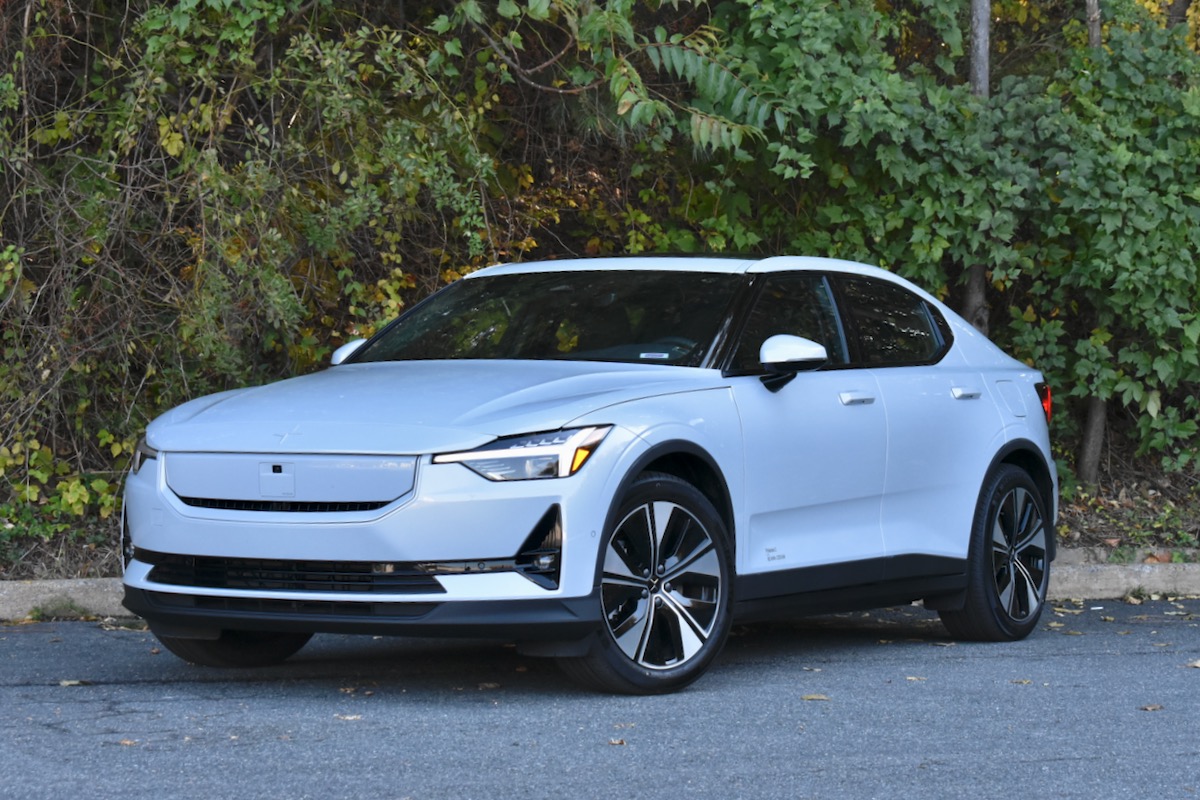
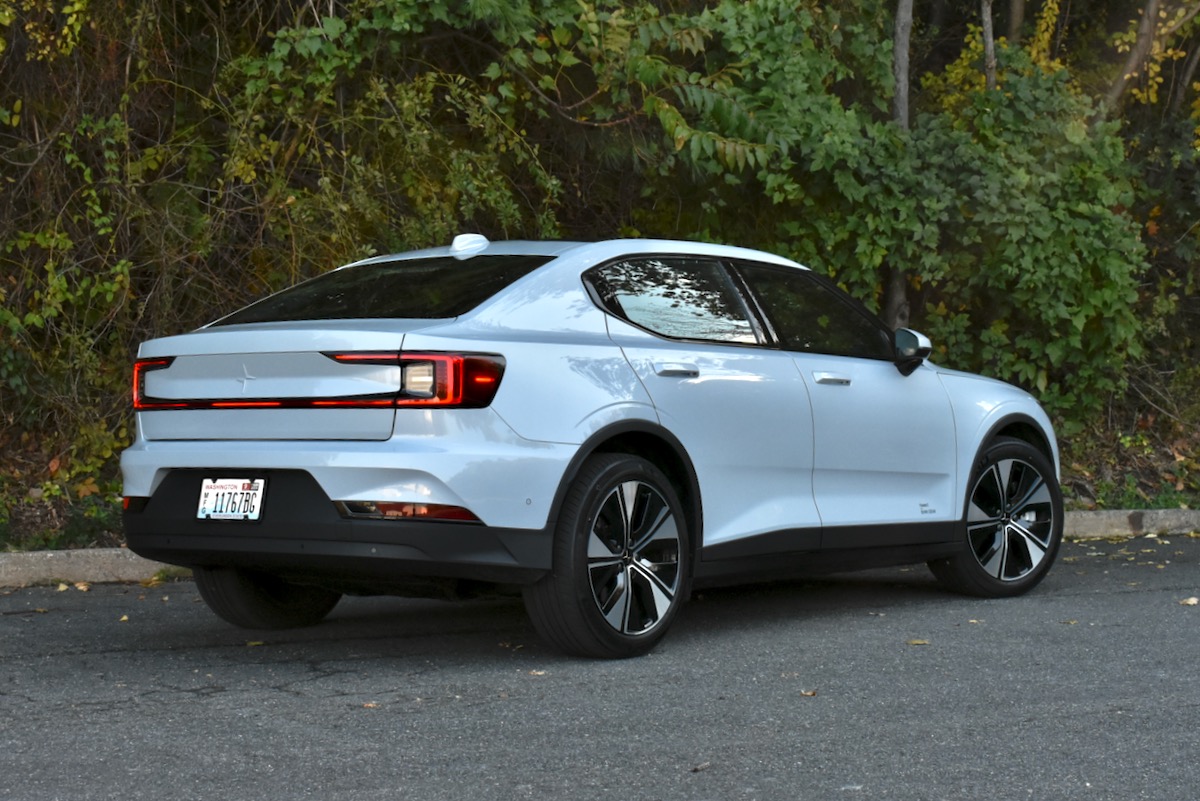
The Polestar 2 stands out, and not just because it’s one of the few EVs on sale that isn’t an SUV. It has the silhouette of a sedan—with a distinct rear deck that looks like a trunk lid—but is in fact a hatchback. It also features a raised ride height and fender flares for a slightly more rugged look than the Tesla Model 3 or Hyundai Ioniq 6. The Polestar’s lack of curves also makes for quite a contrast with those EVs.
The styling still has some Volvo ingredients, including the parent brand’s trademark “Thor’s Hammer” headlights. But for 2024 the Volvo-like grille has been erased. There’s now just a blank space between the headlights that Polestar has dubbed the “SmartZone.” It’s meant to highlight the sensors for the car’s driver-assist systems, but it also emphasizes that this is an EV.
For 2024, the 20-inch forged alloy wheels available with the optional Performance Pack also get a new design in line with the wheels of the forthcoming Polestar 3, the automaker’s first SUV (due to start deliveries in the 2024 calendar year, the 3 aims for even greater design divergence from Volvo). The standard 19-inch wheels can also be equipped with Michelin all-season tires for 2024.
The Polestar 2 shares the Compact Modular Architecture (CMA) platform with the Volvo XC40 Recharge and C40 Recharge crossover SUVs. CMA is not a dedicated EV platform, although only the XC40 is sold with a combustion engine.
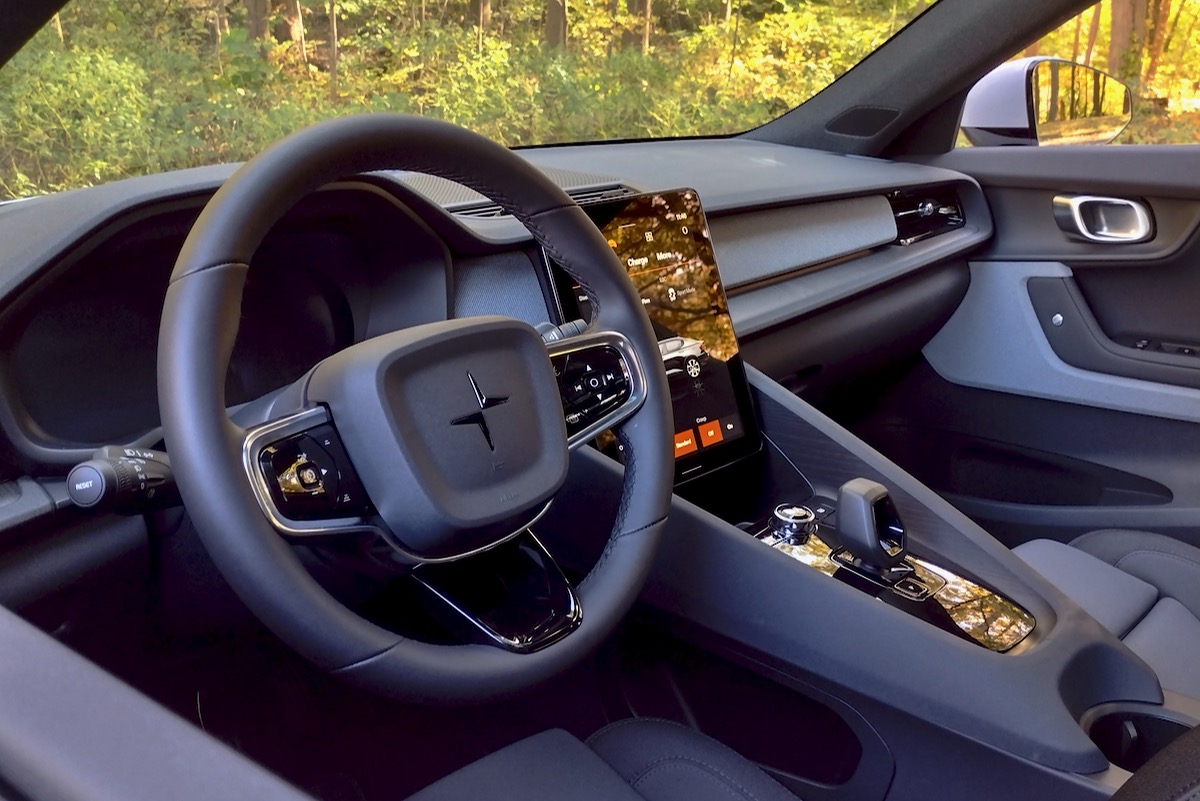
The interior is fairly similar to the XC40 and C40 as well. The portrait-oriented touchscreen, vertical air vents, and lack of extraneous details are common among the three models. It’s an aesthetically pleasing theme no matter which of the three models you’re sitting in. Our test car had a premium feel, but mostly because of the fit and finish, not the materials themselves. Polestar purposely makes cloth seats standard because they’re vegan (Nappa leather upholstery is also available), but there was also lots of plastic, including glare-inducing piano-black trim on the center console.
Performance
Polestar made a change for 2024 that guarantees the 2 automotive trivia immortality: Single-motor models switch from front-wheel drive (FWD) to rear-wheel drive (RWD). They also get a larger 82-kilowatt-hour battery pack and more power. Output from the electric motor is now 299 horsepower and 362 pound-feet of torque, up from 231 hp and 243 lb-ft before. Polestar says the 2024 Long Range Single Motor will do zero to 60 mph in 5.9 seconds and reach a top speed of 127 mph, improvements over the 7.0 seconds and 100 mph of the previous single-motor model.
The Long Range Dual Motor, which adds a front motor for all-wheel drive (AWD) keeps the old 78-kWh battery pack, but it now makes 421 hp and 546 lb-ft of torque in standard form. Those are increases of 13 hp and 59 lb-ft, and result in a 0.1-second improvement in zero to 60 mph acceleration, to 4.3 seconds. Top speed is unchanged at 127 mph.
The dual-motor Polestar 2 is also available with a Performance Pack that boosts output to 455 hp. That’s less than this option added for 2023, but the 2024 model is still slightly quicker, accelerating to 60 mph from a standstill in 4.1 seconds. And the Performance Pack isn’t just about power. It also adds Brembo brakes and Öhlins manually-adjustable dampers. The latter aren’t as convenient as the adaptive dampers available in some cars, but past experience has shown that they make a big difference in handling.
We drove the single-motor Polestar 2 this time, which can’t be equipped with the Performance Pack. Even with the standard suspension, though, the single-motor version was a delight to drive. Like other EVs, the Polestar’s heavy battery pack can be a bit of a buzzkill, making it feel a bit more sluggish when changing direction than comparable internal-combustion cars. But the rear-drive layout of the 2024 single-motor model helps a bit, allowing for a bit more rotation, which makes the car a bit more eager to turn into corners. This dynamic is why car enthusiasts are always proclaiming the superiority of RWD over FWD.
While it’s definitely on the sporty side, the Polestar 2 isn’t impossible to live with as a daily driver. The handling-focused suspension doesn’t punish occupants over less-than-smooth pavement, and wind and tire noise were minimal even at highway speeds. Buyers looking for an even softer ride can also consider the Polestar’s Volvo platform-mates.
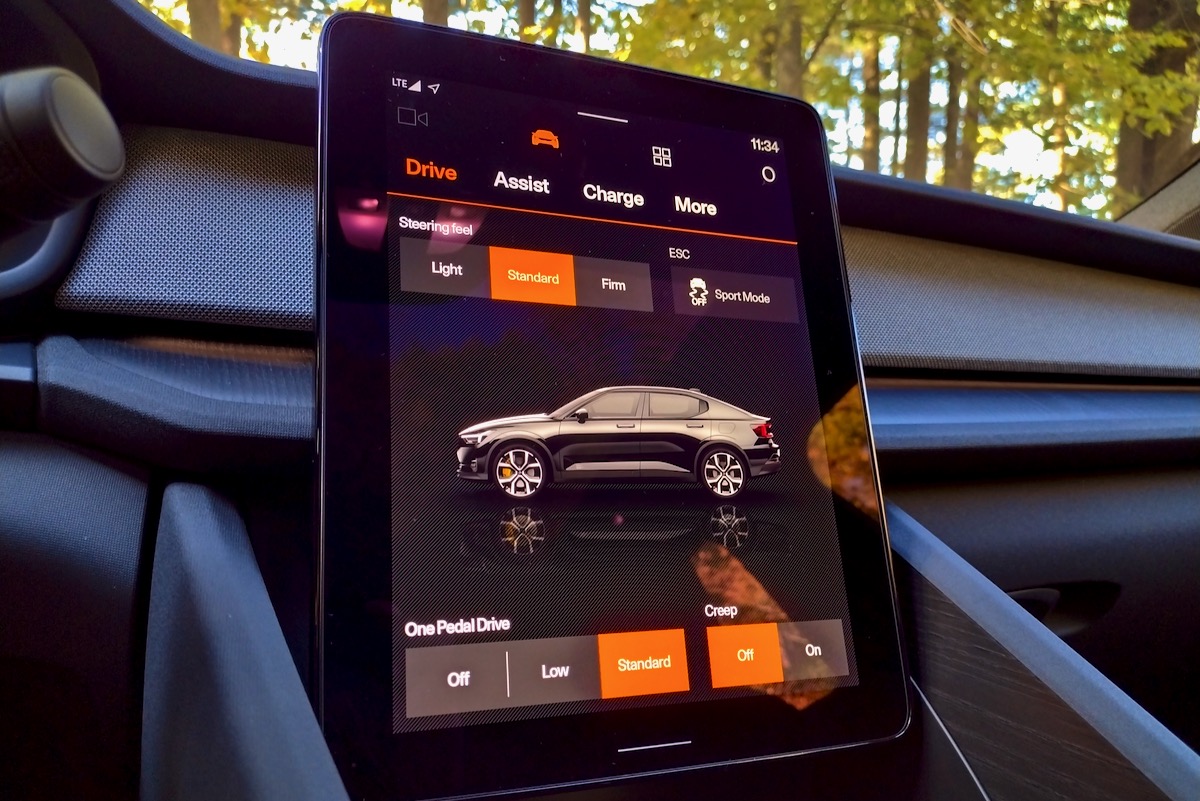
Polestar includes multiple settings for regenerative braking, ranging from no regeneration to a fully one-pedal-driving mode. Adjusting the level of regen requires going into a touchscreen menu, where you’ll also find drive modes and a setting for steering weight. That’s a bit annoying, but at least one-pedal mode lives up to its name. It requires only minimal use of the brake pedal in normal driving, and can even bring the car to a full stop in some circumstances.
Form & function
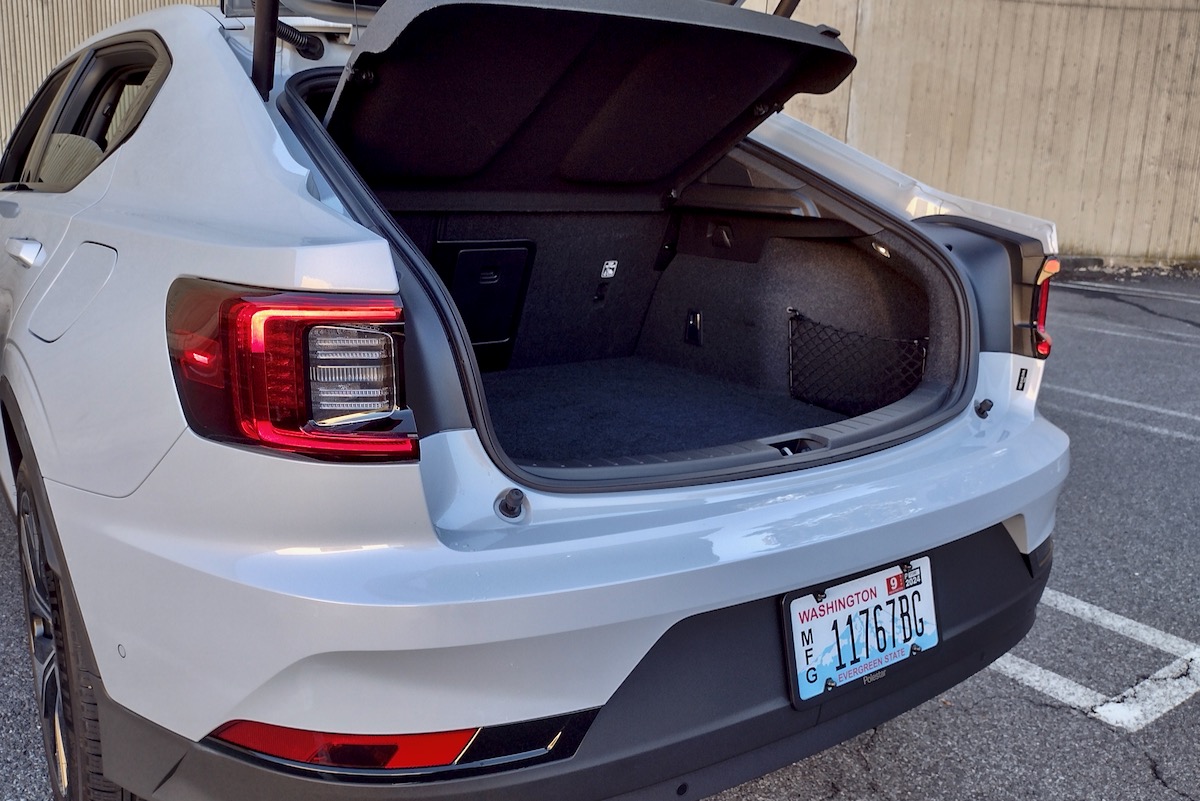
The Polestar 2 is effectively a high-end compact car. Its rear hatch helps make the most of the 2’s small footprint, however, affording 14.1 cubic feet of cargo space with the rear seats up and 38.7 cubic feet with the second-row seats folded. That gives the Polestar more cargo space than a Hyundai Ioniq 6, and the rear hatch creates a wide aperture that makes loading and unloading cargo easier as well.
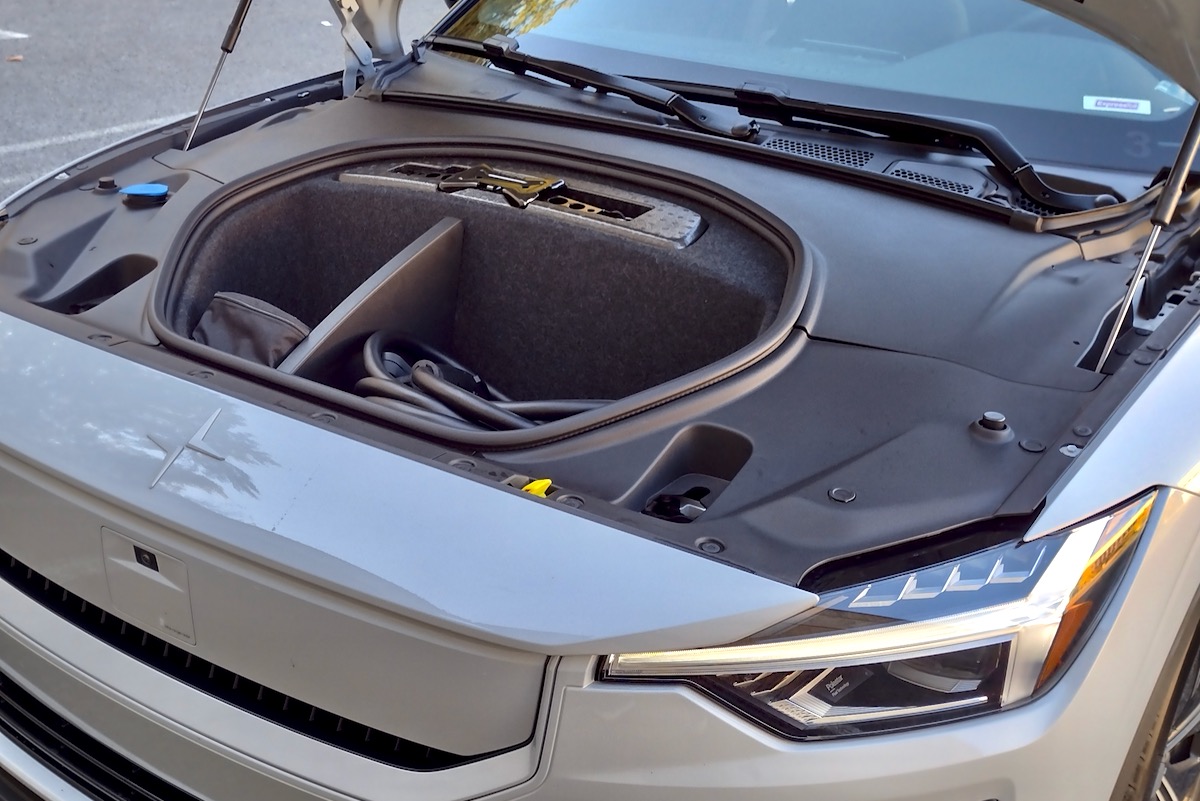
However, the Tesla Model 3 offers still more cargo space at 19.8 cubic feet with the back seats in place and 22.9 cubic feet with the second row folded. The Tesla has a usable frunk, while the Polestar’s is basically just a storage compartment for the charge cable.
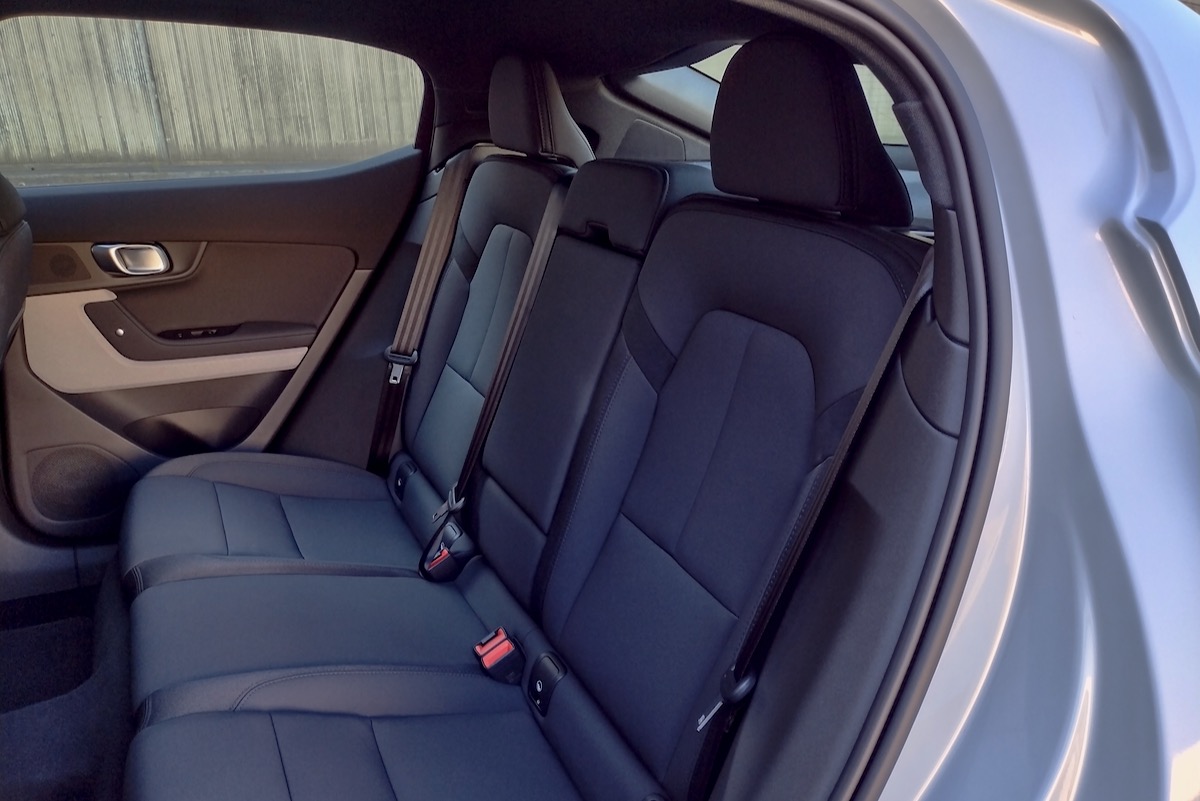
Polestar doesn’t publish full interior measurements, but it’s fair to say the 2 is not a family car. Subjectively, the rear seats a have decent amount of legroom. But passengers’ heads will block the view out the fairly small back window. The first row is divided by a high center console which, along with the fairly high belt line, gives the cabin a somewhat bunker-like feel.
Large cavities in the door panels provide useful storage space, and there are small pockets on the sides of the center console. However, designers only had room for one cupholder in the usual position. A second cupholder is located inside the center console storage bin, so can use it for beverage or small-item storage, but not both.
Technology
The infotainment system mostly carries over for 2024. The Polestar 2 comes standard with an 11.2-inch touchscreen running an Android-based operating system that includes Google Built-in apps. Google Maps navigation, Google Assistant voice control, and the Google Play app store are the default, although wireless Apple CarPlay is included for users who prefer that company’s interface.
A 12.3-inch digital instrument cluster is included as well, with a map view that allows drivers to use the touchscreen for other things. That’s important, because the Polestar 2 is very screen-centric. As mentioned above, you have to navigate to a settings menu to change vehicle parameters like drive modes and regenerative braking. Climate control is on the screen as well. All of this didn’t seem like a big deal at first, but after a few days with the car frustration levels grew.
So while the on-screen interface is one of the best, with nice looking graphics and a layout that makes it fairly easy to find what you’re looking for, the overall user experience is lacking. Some functions are just better left to analog controls. More buttons and knobs (Polestar did include a volume knob, at least) might ruin the sleek, minimalist design of the dashboard, but it would make things a lot easier for the drive.
Safety
Despite being on sale since the 2021 model year, the Polestar 2 hasn’t been tested by the Insurance Institute for Highway Safety (IIHS). The National Highway Traffic Safety Administration (NHTSA) did give the Polestar a five-star overall safety rating, however. That includes five stars in each individual NHTSA crash-test category as well.
Standard driver-assist features include lane keep assist lane departure warning, forward collision warning, and automatic emergency braking. For 2024, blind spot monitoring, cross traffic alert, park assist, and a 360-degree camera system are now standard as well.
The optional Pilot Pack (standard on AWD models) adds adaptive cruise control and Volvo’s Pilot Assist highway-driving system, which can keep the vehicle centered in its lane while maintaining a set speed and a safe distance from a vehicle in front. This system still requires drivers to keep their hands on the wheel and eyes on the road at all times, however.
Cost-effectiveness
For 2024, the single-motor Polestar 2 gets a major range boost from its larger battery pack. It’s now EPA-rated at a maximum 320 miles with the standard 19-inch wheels, compared to 270 miles of range last year. Single-motor models with the optional 20-inch wheels are rated at 302 miles. Dual-motor variants have the same pack as before, but get a 16-mile range increase, to 260 miles, with 19-inch wheels. The 20-inch wheels decrease range to 266 miles, while the Performance Pack further erodes range to 247 miles. An available heat pump should help maintain range in colder weather.
Polestar says the Long Range Single Motor base model can DC fast charge at up to 205 kilowatts and complete a 10% to 80% charge in 28 minutes. The numbers for the Long Range Dual Motor version are 155 kW and 34 minutes for a 10% to 80% charge. An 11-kW AC onboard charger is standard on all models and can fully charge the battery in eight hours using a 240-volt Level 2 AC charging station.
Polestar offers a four-year, 50,000-mile, limited warranty and eight-year, 100,000-mile, battery warranty that guarantees the battery will retain at least 70% of its original capacity during the warranty period.
Pricing starts at $51,300 (including a mandatory $1,400 destination charge) for the base Long Range Single Motor model. Long Range Dual Motor models start at $55,700 with destination. Our Long Range Single Motor test car had the Plus Pack—which adds a Harman Kardon audio system, heat pump, panoramic roof, power adjustable front seats, a heated steering wheel, and a power tailgate—as well as the Pilot Pack driver-assistance package. Those additions, along with metallic paint, brought the as-tested price to $56,750 with destination.
The Polestar 2 is a very nice car, but at that price it’s hard to justify. A stylish design and polished driving experience are counterbalanced by a relative lack of standard equipment and similar range and charging performance to less-expensive electric cars like the Tesla Model 3 and Hyundai Ioniq 6. The Polestar seemed more impressive when it launched, but at that time the Tesla was more expensive and the Hyundai hadn’t even been revealed. It shows how fast the EV market is growing.
What owners say
Trims & specs
Base MSRP $49,900 | Seating 5 |
Engine 299 hp Electric | Cargo Capacity 14.4 cu ft |
Combined MPG 116 | Drivetrain RWD |
Base MSRP $55,300 | Seating 5 |
Engine 421 hp Electric | Cargo Capacity 14.4 cu ft |
Combined MPG 107 | Drivetrain AWD |


Pricing trends
MSRP range
$49,900 - $55,300
Current avg. market price
$24,640
Trending down by 5.6% this month
May 2026 - November 2026