2024 MINI Countryman Reviews, Pricing & Specs

Pros & cons
What we like
Stylish design
Fun to drive
Easy-to-use technology
What to consider
Underwhelming base engine
Not much cargo space
Lacks expected safety features
The CarGurus verdict
Mini is about to redesign the Countryman crossover SUV, but for now, we get one last dash in the current Countryman.
The new Countryman arrives next year and we know at least one version of the 2025 Countryman will be electric, if not all of them. In the meantime, the 2024 Mini Countryman enters its eighth year in second-generation spec. The base Cooper model comes only in Classic trim this year, the Signature trim package adds a standard navigation system, and the Cooper SE plug-in hybrid is more appealing thanks to a lower-priced base version and more standard features in the top-of-the-line Iconic trim package.
out of 10 expert review
Look & feel
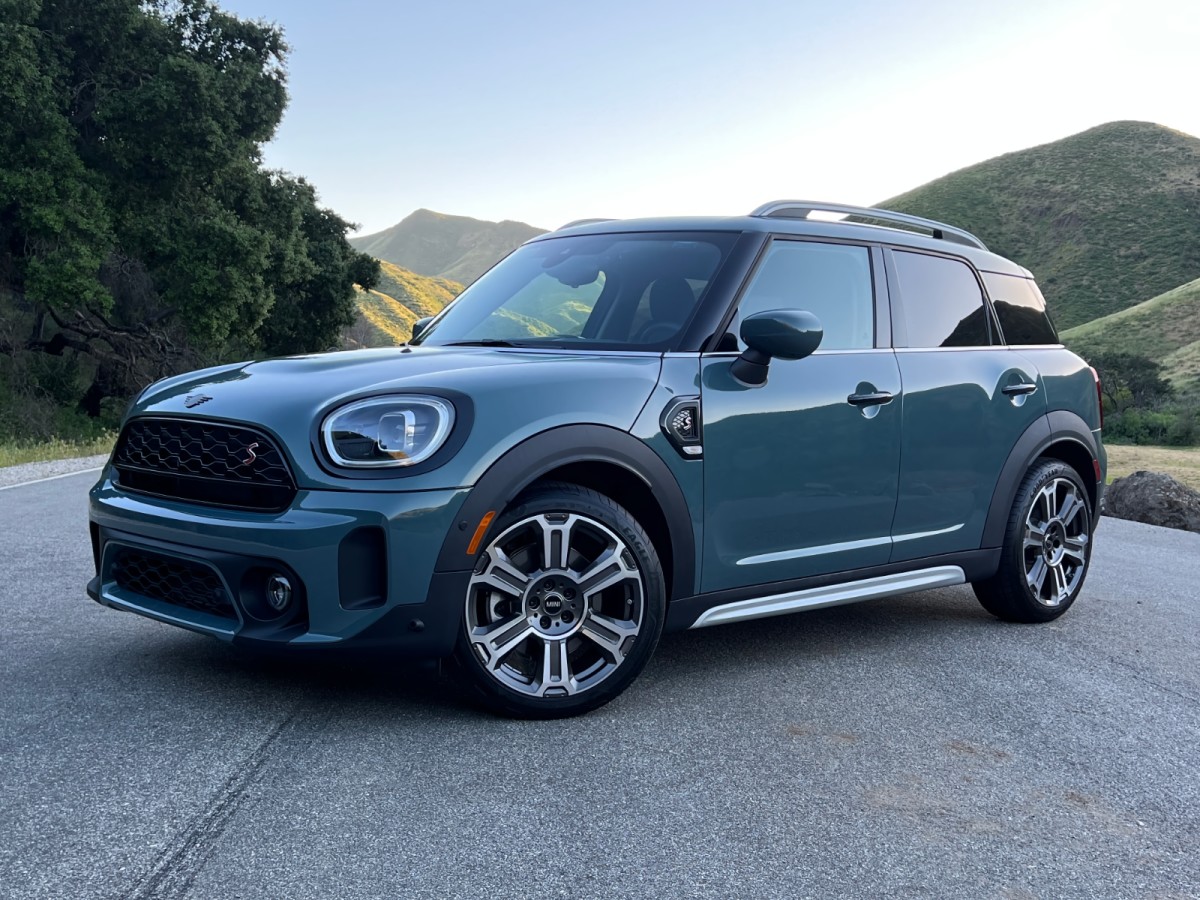
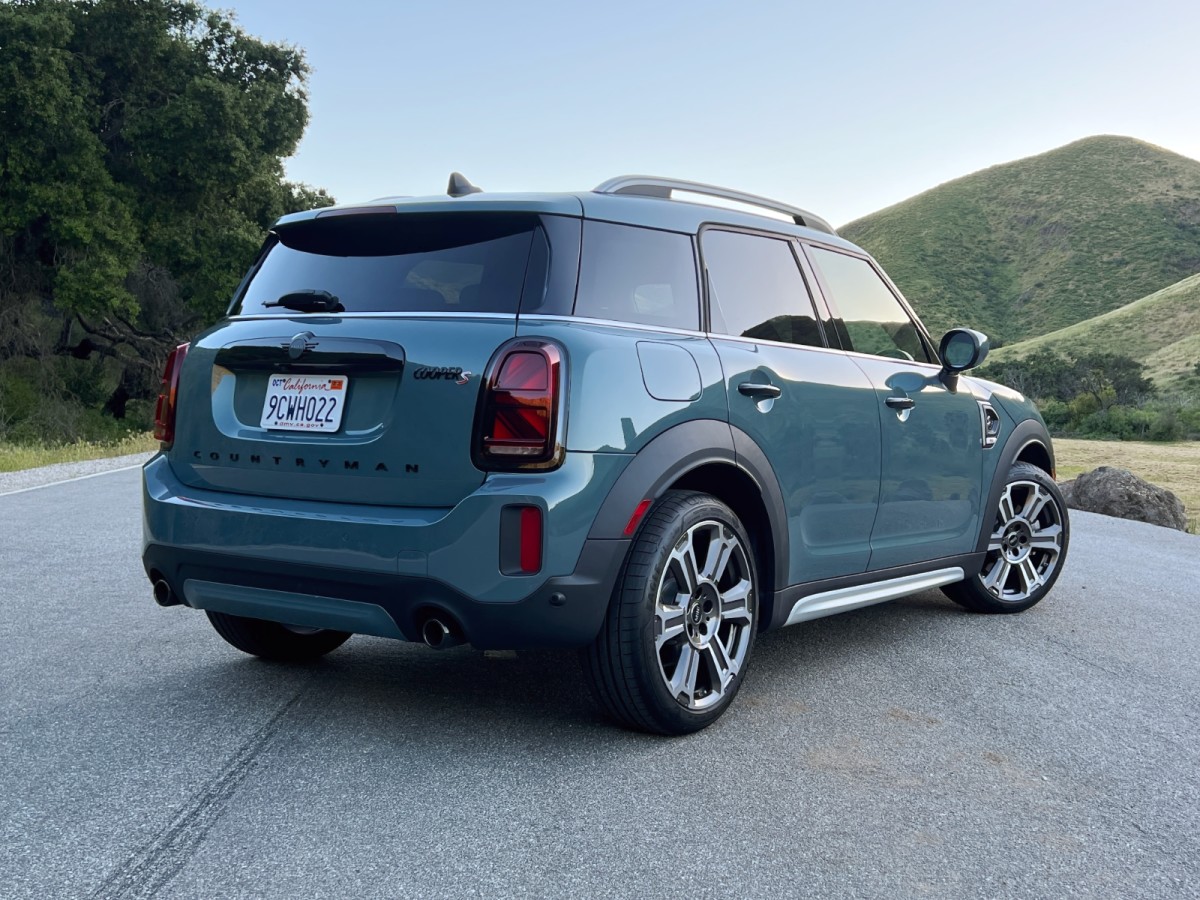
Like all Minis, the Countryman doesn’t take itself too seriously. It wears classic Mini styling cues, has an erect wraparound windshield design, features a floating roof that looks like a bimini top, and loudly and proudly declares its British heritage with Union Jack tail lights. You can dress a Countryman in numerous paint, roof, and mirror cap paint treatments, and select from multiple wheel designs. Strangely, dark tinted rear privacy glass is an option instead of standard equipment.
The 2024 Countryman lineup includes Cooper, Cooper S, Cooper SE, and John Cooper Works model designations, each pertaining to the drivetrain. Coopers have an underpowered turbocharged three-cylinder engine. Cooper S and John Cooper Works versions use a turbocharged four-cylinder engine in two different states of tune. The Cooper SE is a plug-in hybrid electric vehicle offering 18 miles of electric driving range with it’s electric motor before reverting to gas-electric hybrid operation and returning 29 mpg in combined driving.
Once you choose a model, you must select a trim package. They include Classic, Signature, and Iconic, and availability depends on which version of the Countryman you choose. Mini also frequently rolls out special-edition versions with unique paint, wheel, interior, and equipment combinations.
Our test car arrived in Cooper S specification with the Iconic trim package, dark-tinted privacy glass, an adaptive damping suspension, and 19-inch wheels wrapped in summer performance tires. The manufacturer’s suggested retail price (MSRP) came to $41,945, including the $995 destination charge.
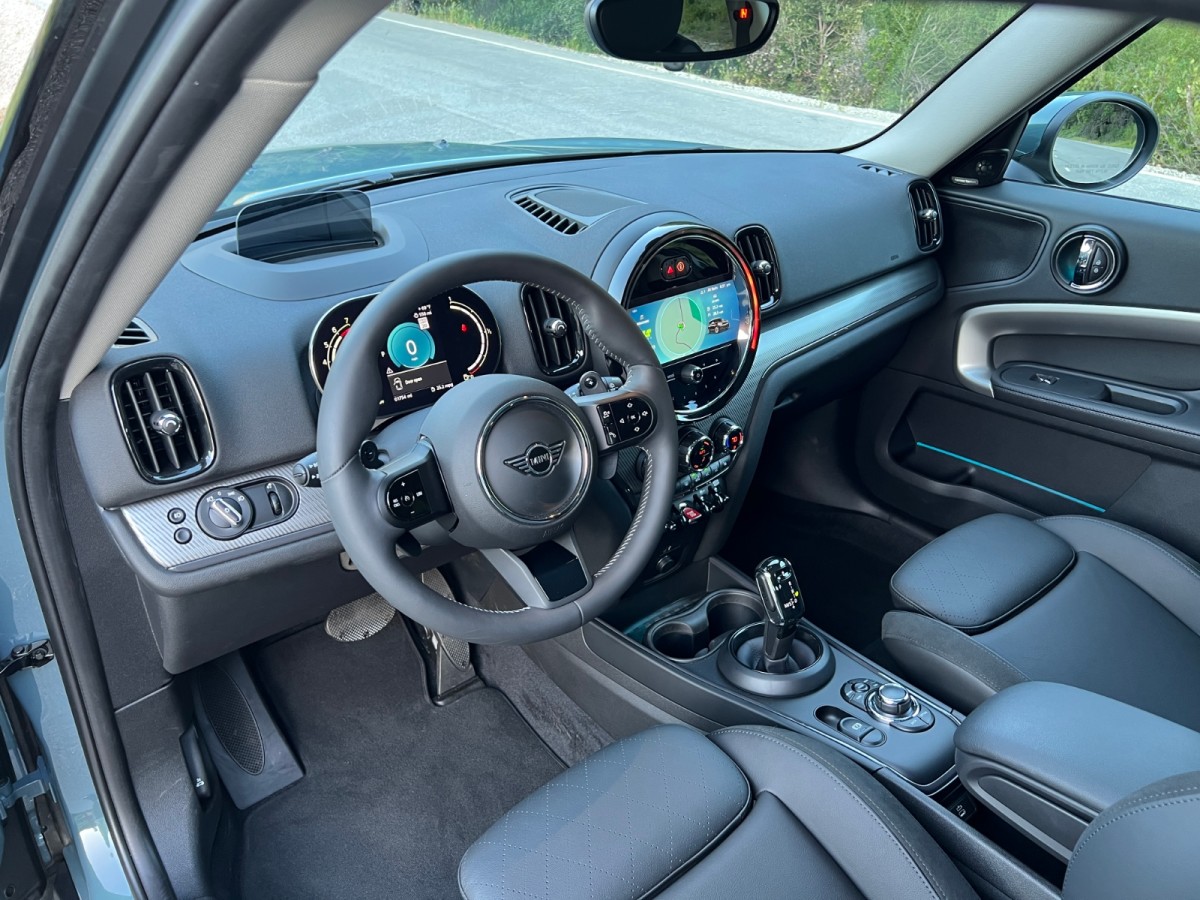
Iconic trim equips the Countryman with premium leather, power-adjustable front seats, a head-up display, wireless smartphone charging, a semi-autonomous parking system, a power tailgate, and more ways to customize the SUV’s look and feel. However, like other Countryman models, it has digital instrumentation, an 8.8-inch touchscreen infotainment system, and plenty of classic Mini character in the design, layout, and switchgear. Plus, our test car had a dual-panel moonroof that let plenty of natural light into the cabin.
If nothing else, looking at and sitting in a 2024 Mini Countryman is a singular experience. And since most small SUVs are blandly interchangeable, the Mini’s jaunty styling and retro interior design are refreshingly unmistakable.
Performance
Since the Cooper is weak and slow and the Cooper SE supplies unremarkable electric range and only a slight gain in fuel efficiency, we think the Cooper S and, if speed is your need, the John Cooper Works are the Countryman models to consider.
The John Cooper Works isn’t messing around. It has a turbocharged 2.0-liter four-cylinder powertrain whipping up 301 horsepower and 331 pound-feet of torque, and an eight-speed sport automatic transmission powering all four wheels. Mini claims a Countryman JCW zooms to 60 mph in 4.9 seconds.
So, if you want to go fast in addition to having fun, get the JCW.
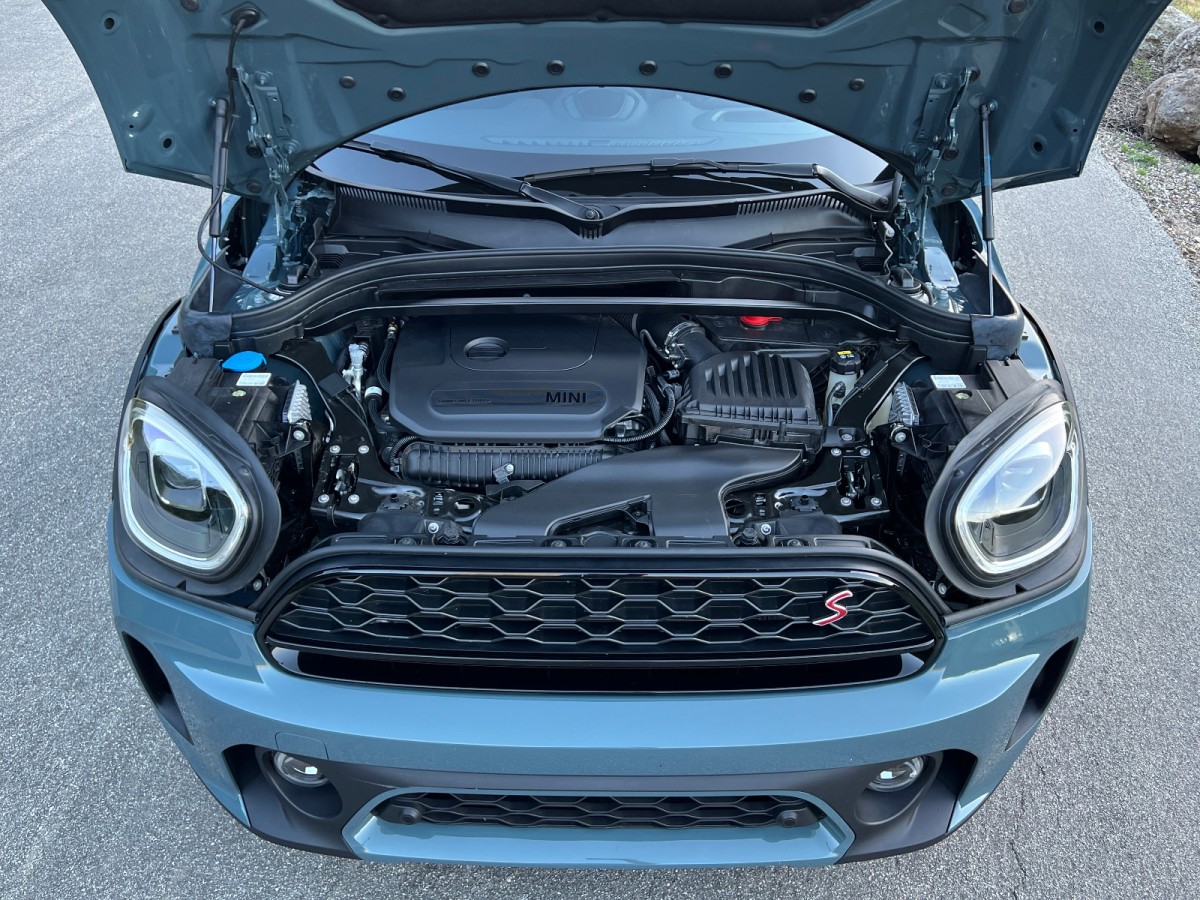
For most people, the Mini Cooper S Countryman will be perfect. It also uses a turbocharged 2.0-liter four-cylinder, but here the engine makes 189 hp and 206 lb-ft of torque. With front-wheel drive (FWD), you get a seven-speed dual-clutch automatic (DCT), with the halting behavior typical of a DCT. Choose the optional ALL4 all-wheel-drive (AWD), and the Cooper S rocks an eight-speed sport automatic just like the JCW.
The Cooper S is quick enough, with Mini claiming it will scoot to 60 mph in 7.2 seconds (7.1 sec. with ALL4, despite its additional 205 pounds of curb weight). The peak torque arrives at just 1,350 rpm, so this version of the Countryman feels zippy and athletic during the daily drive.
Commuting, errand-running, and school shuttling is where the Countryman shines brightest. You won’t wish to venture too far off-road in this Mini, and though our Cooper S test car had summer performance tires and an adaptive damping suspension, it wasn’t an engaging canyon carver.
Oh sure, it can put some serious distance on most small SUVs when the road ahead turns twisty, and you quickly learn its dynamic weak spots and acclimate to them to develop a rewarding driving rhythm, but for speedy driving you’ll want the JCW or to grab a road-hugging Mini Clubman Cooper S or JCW while you still can.
One reason you might want to get a small SUV is for better gas mileage, and our test vehicle carried an EPA fuel economy rating of 28 mpg in combined driving. Unfortunately, we averaged 25.4 mpg on our mountainous Southern California testing loop, driving the Countryman in Mid and Sport modes. Perhaps the available Green mode would have improved upon that result.
Form & function
Step into the Countryman, and you’ll find room for four adults and just enough of their luggage to accommodate a week-long road trip. With its Iconic trim package, our test vehicle had dual-zone automatic climate control, premium leather upholstery, power-adjustable heated front seats, and a thick-rimmed heated steering wheel.
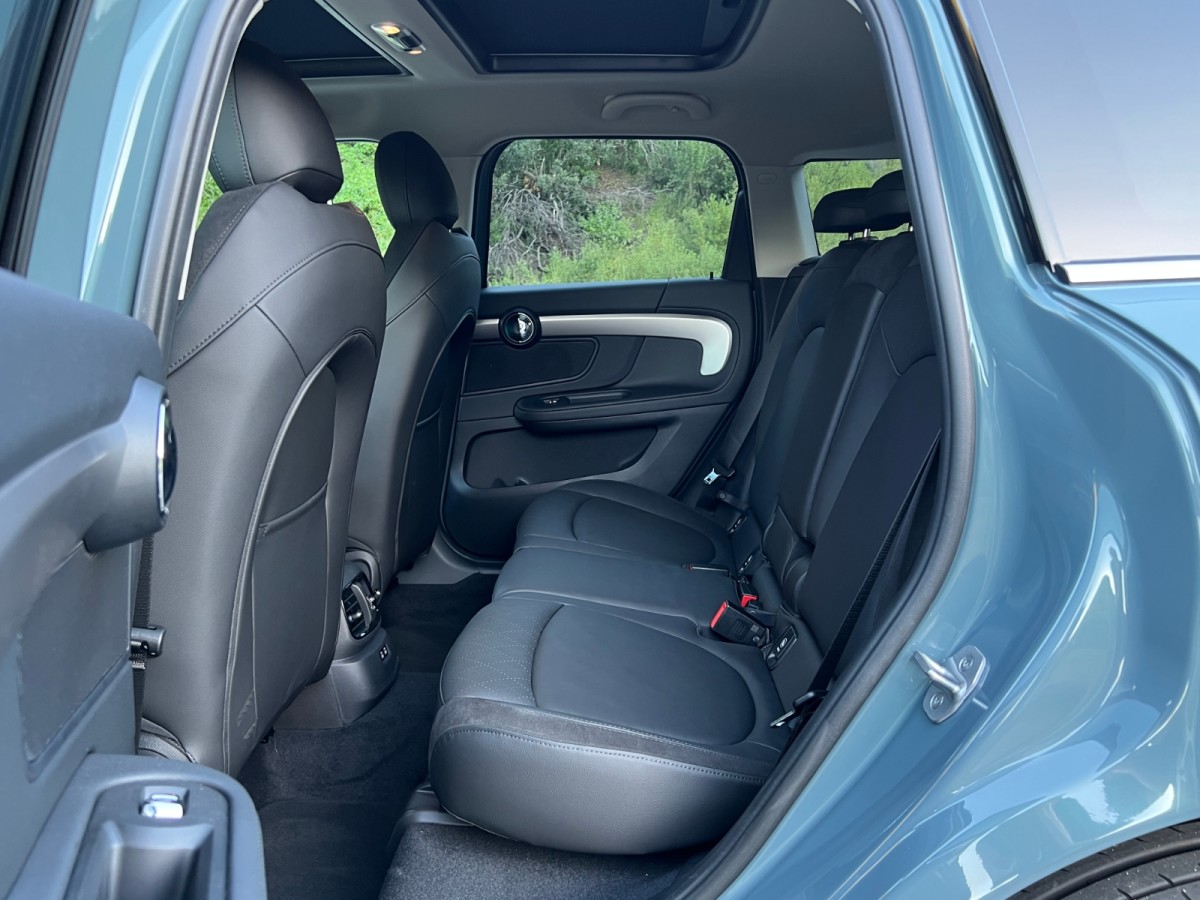
You sit up straight in the Mini Countryman, on small but supportive and comfortable seats, and the steering wheel is a delight to grip. Though the SUV contains seatbelts for five people, four will be happier inside the Countryman. We found enough legroom in the rear seat for lanky limbs and plenty of foot room for large feet, but squeezing a fifth person in appears impossible unless all three rear riders are children.
Outward visibility is excellent, and the Mini’s tidy dimensions make it easy to park. A surround-view camera and a rear cross-traffic alert system would help, but Mini doesn’t offer those technologies on the Countryman. Instead, you get parking sensors, a reversing camera, and an available automated parking assistance system that isn’t worth the trouble.
Mini provides reasonable interior storage given the Countryman’s size, but the test vehicle’s smartphone charging pad, located underneath the center armrest, completely blocked access to the tray beneath it. Lift the armrest up and you’ll find a larger open storage area.
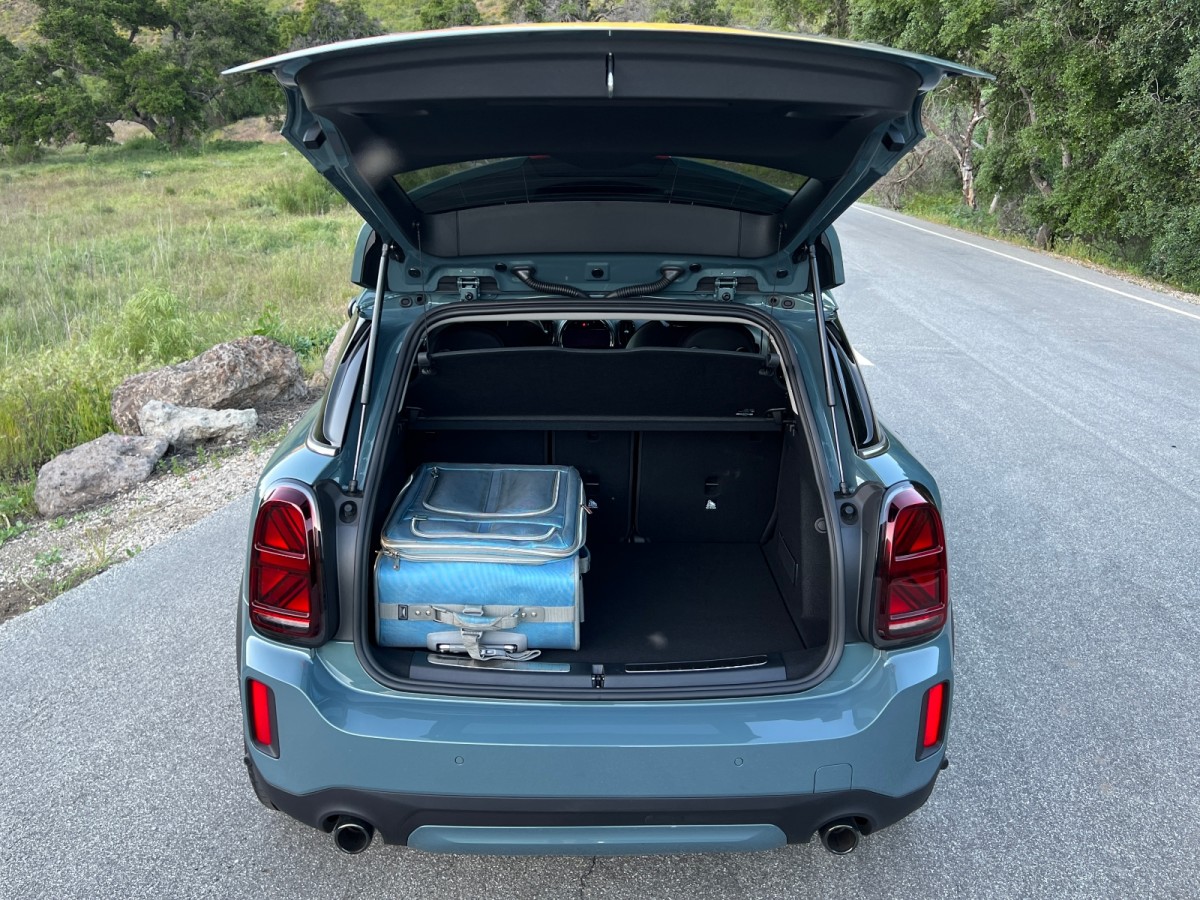
Cargo measurements are small even by class standards. Mini says the Countryman holds 17.6 cubic feet of luggage behind the back seat, and that seems accurate. Two full-size suitcases fit side by side, if you lay them flat. Remove the cargo cover, and you can stack more luggage into the car.
A 40/20/40-split folding back seat design allows you to carry longer items without tossing either rear passenger out. Fold the seat down and the Countryman supplies 47.6 cubic feet of cargo space. Keep in mind that the Cooper SE PHEV model’s measurements are slightly smaller.
Technology
A Mini Countryman isn’t a technology powerhouse, but what it does have is useful. In addition to a small digital instrumentation display perched on the steering column where Mini once located motorcycle-style gauges in a pod, our test vehicle had a head-up display (HUD) projecting information on a small screen. Though it is mounted only inches higher than the digital instrumentation, we found the HUD useful.
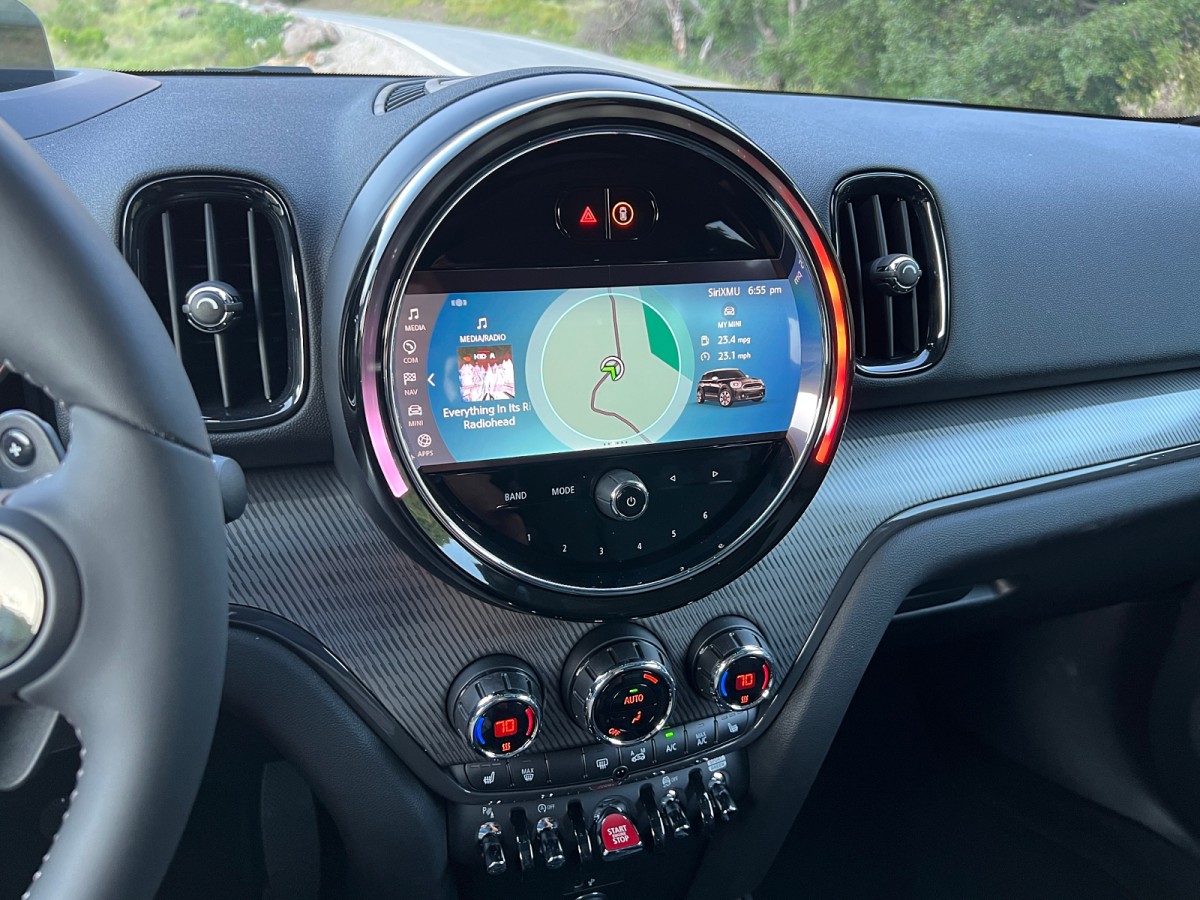
In the middle of the dashboard, within a round housing that recalls the large, analog, center-mounted speedometers of Mini models past, you’ll find an 8.8-inch touchscreen infotainment system. Since BMW owns Mini, the infotainment system uses a version of its parent company’s iDrive technology, and includes five ways to interact with it.
First, there is the touchscreen. Second, Mini provides volume and tuning controls just below the screen. Third, there are controls on the steering wheel. Fourth, a control knob and buttons for the screen live on the center console. Fifth, a voice-recognition system allows you to issue spoken commands.
That approach might sound like a recipe for confusion, but we find that we use all of these methods to interact with the Mini Connected infotainment system. Not only that, once you’ve acclimated to the system and user interface, it is surprisingly easy to navigate and use. Furthermore, the voice-recognition system accurately responded to all of our testing commands. However, the system lacks Android Auto smartphone connectivity, providing only Apple CarPlay.
With Iconic trim, a 12-speaker Harman Kardon premium sound system is standard. It sounds great, and is likely a significant improvement over the Countryman’s standard six-speaker system.
Safety
If the Countryman hints at its age with the omission of Android Auto, it shows off its AARP membership card when it comes to advanced driving assistance systems (ADAS). There are few of them available, though we realize that some people might consider that a feature and not a bug.
Every Countryman has something called Active Driving Assistant. It equips the SUV with forward-collision warning, pedestrian detection, automatic emergency braking, lane-departure warning, and automatic high-beam headlights. The Countryman also has rear parking sensors and an emergency SOS call button to get help if necessary, and you can pay extra for adaptive cruise control if you get the Signature or Iconic trim.
Otherwise, you’re pretty much on your own. So, that means you don’t get blind-spot monitoring, rear cross-traffic alert, lane-keeping assist, lane-centering assist, or a surround-view camera system.
Since our test vehicle did not have the optional adaptive cruise control, the only thing we could safely assess was the lane-departure warning system. It provides a subtle vibration through the steering wheel, which is our preference.
As far as crash-test ratings go, only the Insurance Institute for Highway Safety (IIHS) provides any guidance. In addition, because the IIHS rolled out some new testing procedures, that guidance is incomplete. However, in the crashworthiness evaluations the IIHS has performed, the Countryman earns the highest rating of Good.
Cost-effectiveness
Theoretically, if you’re shopping for a small crossover SUV, you probably want to save money. And if you have enough cash to upgrade from a mass-market brand to a luxury marque, you’re probably seeking some status, too.
So, where does that leave the Mini Countryman, which can cost as much as an entry-luxury crossover but is substantially more expensive than mass-market models? Well, it places the Countryman in what is commonly called “premium” territory.
Premium is where Buick and GMC live, serving as a layer between Chevrolet and Cadillac. That’s also where Jeep and Mazda want to play. You could also include Acura and Infiniti within Premiumville’s city limits, though they would argue in favor of a gerrymander into Luxuryland.
Considering the small SUV alternatives from any of those brands (if they exist at all), the Mini Countryman looks pretty good. It uses BMW engineering and technology, boasts plenty of personality, offers numerous ways to customize to your preferences, and is rousing good fun to drive as long as you’re not trying to channel your inner Tanner Foust.
Plus, it comes with three years and 36,000 miles of complimentary scheduled maintenance, a sweetener that some rivals fail to add to their recipes.
But none of this comes cheaply, and with a Mini Countryman you’ll pay a premium for premium.
What owners say
Amazing in every way, including performance, comfort, looks, interior, features, and fuel economy, compared to the new design, there is no comparison!
January 24, 2026I liked the milage which is low for the car year. I don’t like the over priced sticker even if it is slightly.
May 8, 2025Has all the standard and luxury features with sporting driving characteristics. This MINI model is highly rated in Consumer Reports.
April 23, 2024Trims & specs
Base MSRP N/A | Seating 5 |
Engine N/A | Cargo Capacity 17.6 cu ft |
Combined MPG N/A | Drivetrain N/A |
Base MSRP N/A | Seating 5 |
Engine N/A | Cargo Capacity 17.6 cu ft |
Combined MPG N/A | Drivetrain N/A |
Base MSRP $35,000 | Seating 5 |
Engine 2.0L 189 hp I4 | Cargo Capacity 17.6 cu ft |
Combined MPG 27 | Drivetrain AWD |
Base MSRP $32,650 | Seating 5 |
Engine 1.5L 134 hp I3 | Cargo Capacity 17.6 cu ft |
Combined MPG 29 | Drivetrain FWD |
Base MSRP $32,900 | Seating 5 |
Engine 2.0L 189 hp I4 | Cargo Capacity 17.6 cu ft |
Combined MPG 28 | Drivetrain FWD |
Base MSRP $43,800 | Seating 5 |
Engine 2.0L 301 hp I4 | Cargo Capacity 17.6 cu ft |
Combined MPG 27 | Drivetrain AWD |
Base MSRP $34,150 | Seating 5 |
Engine 1.5L 134 hp I3 | Cargo Capacity 17.6 cu ft |
Combined MPG 27 | Drivetrain AWD |


Pricing trends
MSRP range
$32,650 - $43,800
Current avg. market price
$28,908
Trending down by 1.1% this month
May 2026 - November 2026


