2024 Hyundai Sonata Hybrid Reviews, Pricing & Specs


Pros & cons
What we like
Standard advanced safety features
Standard wireless Apple CarPlay and Android Auto
Real automatic transmission
What to consider
All-wheel drive not available
Expert review
Styling and tech updates enhance this fuel-efficient midsize sedan.
It’s easy to discount the value of a family sedan with so many crossovers on the road. But the fact is that this body style makes a lot of sense for a lot of families. The more manageable and maneuverable the vehicle, the better for teaching budding young drivers. Lighter weight also translates to better fuel economy, not to be sneered at when there are mouths to feed and tuitions to pay. And your typical midsize sedan is plenty spacious for four.
Fortunately, automakers have not forgotten about the venerable family sedan, keeping one another on their toes with updates, and it’s consumers who stand to benefit from that sort of healthy competition. Now, it’s the 2024 Hyundai Sonata’s turn for a mid-generation refresh.
Verdict: We already liked the Sonata Hybrid, and this refresh only improves it. The styling update and generous standard feature set make it a compelling choice, and the real automatic transmission is a virtually unique selling point.
out of 10 expert review
Look & feel
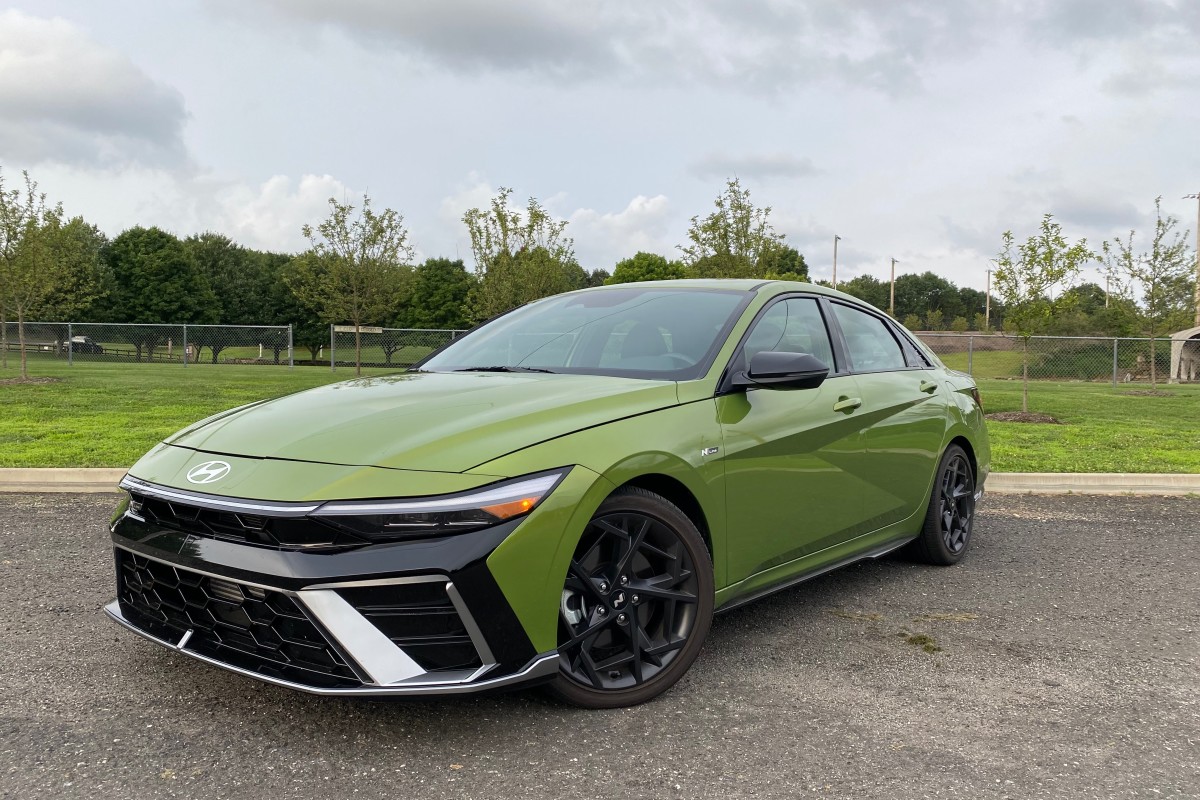
The 2024 Sonata Hybrid gets significant styling updates where it counts. The streamlined front fascia is crowned with a single slim lightbar Hyundai terms the “seamless horizon lamp,” which gives the sedan a distinctly modern flair. The badge has moved above the grille while the headlights now live independently, well below it. Family resemblance to the distinctive Hyundai Ioniq 6 is clear in this new look, though the Sonata dodged some of the more polarizing elements of that singular EV. The Sonata’s rear end already featured a lightbar, but it now bears more resemblance to the all-new Hyundai Santa Fe, forming a wide “H” shape with the taillights as the stems. A sporty black spoiler-esque trunk lid is also new.
From the side, however, the 2024 Sonata looks very similar to the 2023 model. If the profile has changed, it’s not obvious. Our Limited-trim test car had 17-inch wheels. We liked its fashionable enamel gray color, which Hyundai calls “Transmission Blue,” and we especially liked that the color could be selected without increasing the overall price. In fact, the only extra-cost color for 2024 is “Serenity White” (almost as though Hyundai has decided to penalize boring paint choices).
The Sonata’s seats do not appear to have changed from 2023, but the dash has. The vents now flow all the way across, and the padded portion of the center console now extends far enough forward that it is separated into two pieces when the lid is open. The gear shifter has been moved to the steering column, and, perhaps most salient, the steering wheel is redesigned. It’s now a T-shape with a slender rim and the italicized “H” logo replaced by a bar with four dots spelling out “H” in Morse code. Three interior color schemes are available. Our test car’s interior was basic black. There’s also a light gray option, close enough to white to feel like a risky choice to us, and our favorite is a tan and charcoal combo.
Performance
The big news for the 2024 Sonata is its newly available all-wheel drive (AWD) system. It’s the first time Hyundai has offered the HTRAC AWD system on the Sonata, but it’s limited to the gas version. The Sonata Hybrid remains front-wheel-drive (FWD) only.
Total system output from the 2024 Sonata Hybrid’s 2.0-liter, inline four-cylinder engine and electric motor is 192 horsepower, which is routed through a true six-speed automatic transmission. Most hybrids use a continuously variable transmission (CVT) for fuel-economy purposes, but the Sonata Hybrid is still EPA-rated for 47 mpg combined, and we appreciated the additional control afforded by its automatic transmission. The paddles mounted on the steering wheel manage regenerative braking levels in Eco mode, but in Sport mode, they allow the driver to shift gears. We found that we could use engine braking to compound deceleration and limit our use of the brake pedal, which was grabbier than we’d have liked it to be in a family sedan. Strategic Sonata Hybrid owners might use this to limit brake wear as well.
Touchy brakes aside, we liked the steering feel and found the handling to be appropriate. We also liked the configurable driver-information display, which with a little fiddling allowed us to view the tachometer and the hybrid system’s power flow simultaneously. In a week with the car, the novelty of accelerating at 0 RPM had yet to wear off.
Form & function
The first thing we do when we get into a new car is adjust the driver’s seat to our driving position. This not-tall reviewer liked that the Sonata Hybrid allowed the seat to be cranked all the way up for exceptional visibility but was shocked to actually brush the ceiling. Is this indicative of poor head room in the Sonata? It turns out that the answer is no: With the Limited trim’s panoramic moonroof, the 2024 Sonata Hybrid has 37.8 inches of front-seat head room. (It would be 40 without the moonroof.) That’s on par with–in fact, slightly above–the Honda Accord Hybrid and the Toyota Camry hybrid, and just two tenths of an inch below the Nissan Altima. What that tells us is that the Sonata provides competitive space, along with outstanding flexibility to make use of it.
Rear-seat headroom is equally competitive, clocking in at 37.4 inches with the moonroof or 38.4 inches without it. When it comes to legroom specs, the Sonata strongly prioritizes the front row, which gets 46.1 inches, while the rear-seat passengers get 34.8. The Altima does something similar. It’s more balanced in the Camry, which gives the front row 4 more inches, and in the Accord, which puts both in the low 40s.
We liked that the seats in our Limited-trim test car were both heated and ventilated, and we really appreciated the slimmer rim of the steering wheel. We’ve noticed many automakers opting for beefy steering wheels, presumably equating that to sportiness, but we found this more comfortable in practice. One thing that really stood out is the trunk close button. We’re not sure it’s entirely necessary in a sedan, but it’s neat to have an extra convenience feature.
Technology
One of our favorite features in the 2024 Sonata Hybrid was the selectable functionality of the driver’s side front USB-C port. At the press of a button, it can be changed from data-transmitting to charging-only or back again, an exceptionally handy feature for anyone planning to make use of the wireless Apple CarPlay or Android Auto that are now available on every trim. All too often we’ve seen infotainment systems with wireless smartphone projection capability confounded by competing handshakes from physical connections. This simple feature effectively solves for a major frustration.
Every Sonata Hybrid now sports the curved display, previously seen in the likes of the Ioniq 5 and the new Santa Fe, which combines the infotainment touchscreen and driver-information display into a single panel. Hard controls are few and far between, but dedicated real estate for climate control and media functions remains with haptic “buttons.” We liked that the grouping is logical and intuitive, making it easy to locate temperature versus volume adjusters even when the vehicle was new to us.
Though both the Sonata Hybrid SEL and the Limited come with the crisp and quick curved display, only the Limited gets navigation, natural language voice-recognition, and a 12-speaker Bose premium audio system. A six-speaker sound system is standard, along with HD Radio, Sirius XM, and two rear-seat USB charging ports. A wireless charging pad is also standard for the Sonata Hybrid.
Safety
Blind-spot collision warning with rear cross-traffic collision-avoidance assist is standard on the 2024 Sonata Hybrid, but only the Limited trim level gets the turn-signal-activated blind-spot-view monitor. The surround-view monitor is also a top-trim exclusive. However, all trims get forward collision-avoidance assist, safe exit warning and assist, lane-following and lane-keep assist, adaptive cruise control with stop and go functionality, automatic emergency braking, and rear occupant alert.
Further advanced driver-assistance and safety features unique to the Limited trim include Hyundai’s Highway Driving Assist system, which controls acceleration, braking and lane centering during highway cruises, and Remote Smart Parking Assist, which lets the driver use buttons on the key fob to maneuver the vehicle into a tight spot from outside the car.
We really like the way Hyundai treats safety and driver-assistance features in its infotainment system. They are easy to find, easy to turn on and off, and accompanied by self-explanatory graphics that make each feature’s function very clear.
Cost-effectiveness
The 2024 Hyundai Sonata Hybrid starts at $31,950 for the SEL trim (including the $1,150 destination fee). In a trim-to-trim comparison, this represents a $3,300 premium over its gas-only counterpart. The EPA rates the FWD-only Sonata Hybrid at 44 mpg city, 51 mpg highway, and 47 mpg combined, meaning it can go about 20 miles further for every gallon than the non-hybrid Sonata. It does have a smaller fuel tank, with a 13.2-gallon capacity compared to the base Sonata’s 15.9, but its superior fuel efficiency will give it an extra 150 miles of range and make its less-frequent fill-ups more cost-effective. If that’s the comparison you’re shopping, we think the Sonata Hybrid is a no-brainer, well worth the extra cost up front.
If you’re considering the competition as well, the Sonata Hybrid’s base price falls somewhere in the middle of the pack. It’s more expensive than the now-hybrid-only 2025 Toyota Camry, which starts at the bottom of the trim ladder at $29,495. However, it’s less expensive than the 2024 Honda Accord Hybrid, because Honda has opted to limit its hybrid powertrain to its higher trims, giving it an entry point of $33,990. The Hyundai Sonata Hybrid Limited trim we tested carries a $38,350 MSRP. All three of these hybrid midsize sedans are now fresh off facelifts or full redesigns, making for a competitive segment. Savvy shoppers will want to get clear on personal priorities and carefully compare features lists before making a decision.

What owners say
Just got my cheeks on the 2024 Hyundai Sonata Hybrid, and I’m loving it. The gas mileage is insane, I’m getting around 50 mpg! The switch between electric and gas is so smooth, you barely notice it. Inside, it’s super comfy and spacious. The tech is easy to use, and the infotainment system works great with my phone. Get the limited trim if you like music, if not the SEL is cheaper and lighter and probably just so ever more efficient. Surprisingly, it’s got a nice bit of kick when you need it. Overall, it’s a great mix of efficiency, style, and practicality. Definitely worth checking out if you’re in the market for a hybrid.
July 20, 2024These features are great I had the 2022 Sonata Hybrid great car but there is a different feel to the suspension compared to the 2022 Sonata Hybrid Hyundai did a great job with the 2024 Sonata Hybrid and gets better gas mileage compared to the 2022 Sonata Hybrid
April 8, 2024The dashboard infotainment layout is really nice and has the bells and whistles of a luxury vehicle at a affordable price.
August 14, 2024Trims & specs
Base MSRP $30,800 | Seating 5 |
Engine 2.0L 192 hp I4 Hybrid | Cargo Capacity 16.0 cu ft |
Combined MPG 47 | Drivetrain FWD |
Base MSRP $37,200 | Seating 5 |
Engine 2.0L 192 hp I4 Hybrid | Cargo Capacity 16.0 cu ft |
Combined MPG 47 | Drivetrain FWD |


Pricing trends
MSRP range
$30,800 - $37,200
Current avg. market price
$25,947
Trending down by 0.9% this month
May 2026 - October 2026