2023 Mitsubishi Outlander Hybrid Plug-in Reviews, Pricing & Specs



Pros & cons
What we like
38 miles of all-electric range
Standard all-wheel drive
Public fast-charging capability
What to consider
Nearly unusable third row
Loud electric powertrain
Fast charging requires uncommon ChaDeMo plug
Expert review
Mitsubishi, an oft-forgotten forerunner of plug-in hybrid technology, looks eager to steal customers from Kia and Toyota.
Now in its second generation, the Mitsubishi Outlander PHEV is a compelling package. It offers good tech and safety features courtesy of its corporate parent Nissan, and its pricing is in line with the brand’s value-driven mandate. If you’re in the market for a three-row crossover SUV and want to explore your plug-in hybrid options, we can’t fault you for looking closely at the Outlander. After testing an Outlander PHEV in SEL trim, we loved its all-electric driving range but were unimpressed by the roly-poly driving experience, and we would reserve third-row vacancies for only our worst enemies.
out of 10 expert review
Look & feel
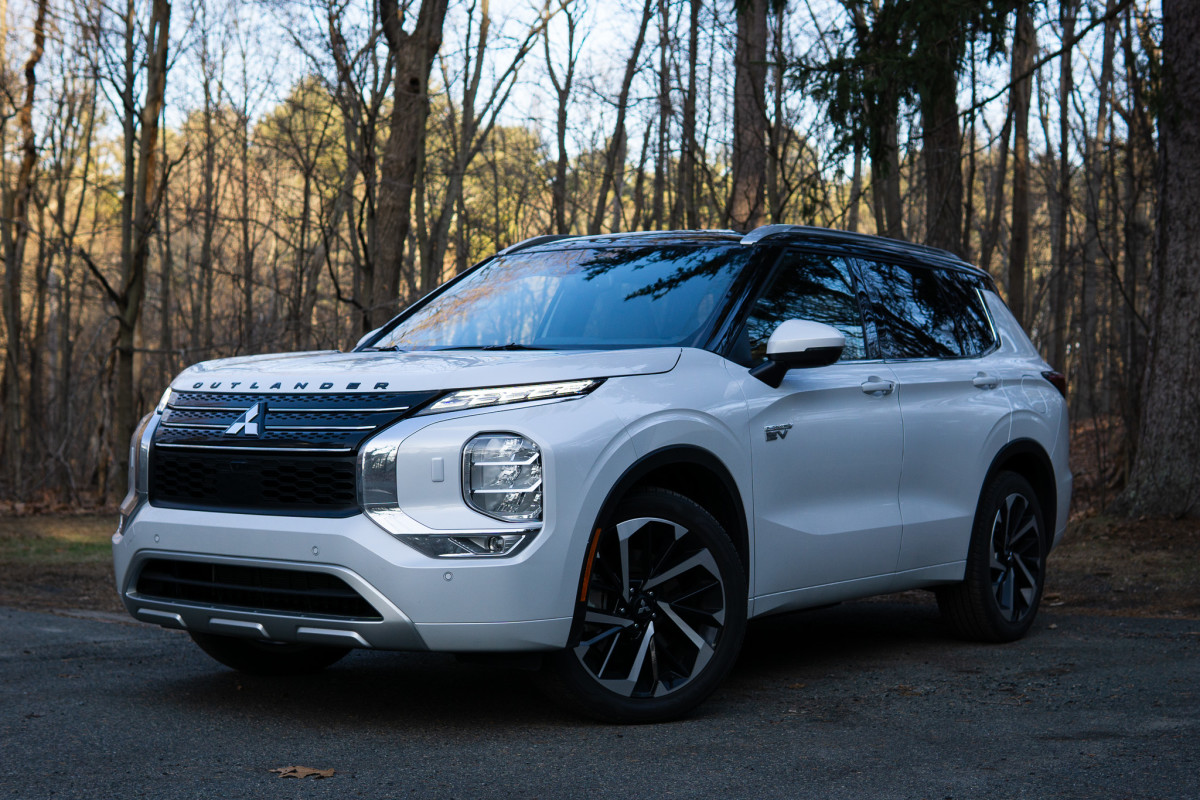
Take a look at a 2023 Mitsubishi Outlander, and you’re likely to have a strong opinion, but whether that opinion is good or bad will depend on your personal preferences. Mitsubishi has made a handsome car with nice proportions and a strong silhouette, but its exterior styling is undeniably busy.
The front end, in particular, is a mess of shapes and angles. Squarish headlights flank a six-sided, multi-dimensional grille that resembles a bulging trapezoid more than a traditional hexagon. The grille is bookended by two outward-facing bracket designs, which Mitsubishi calls its “Dynamic Shield.” They’re two shiny chrome bits and, against our test car’s white paint, they made the whole affair look like it came from the 2004 science fiction film, iRobot. Maybe Mitsubishi’s design is just forward-thinking; Will Smith lives in the year 2035 in that one. Regardless, we don’t feel confident that this design will hold up well over the next twelve years.
Focusing on what Mitsubishi has done right, our test car’s two-tone paint job looked fabulous. The black roof over the white diamond paint job ($995 option) makes the Outlander stand out in a parking lot.
Similarly, the Outlander’s profile has strong lines. Unfortunately, that profile view is marred by the huge Plug-in Hybrid EV badge that sits just below each side-view mirror. At the rear, things are back to being undeniably handsome. A squared-off rear window, overhanging roof spoiler, and strong character lines running horizontally across the back combine for a great visual stance. Even the Mitsubishi logo looks nice—it’s neatly placed and shines proudly on this model.
The Outlander’s interior is impressive in top trim, and it’s good in base trim, too. Fit and finish surpass what you’d find in older Mitsubishis, no doubt due to the new influence Nissan has had on the brand, although the quality of the materials still feels a bit less impressive than what you’ll find in a top-of-the-range Kia Sorento. Still, our SEL trim had an attractive two-tone interior with a tan upholstery panel along the dash and each door, plus diamond-pattern quilted leather upholstery on the seats.
The steering wheel is a comfortable four-spoke design that smartly houses necessary functions without appearing too cluttered. Between the front seats, a lever-style shifter sits ahead of a rotary controller for drive modes, all surrounded by real aluminum trim. Lower-tier trim levels replace the aluminum with piano black plastic. A mix of knobs and buttons complement the increasingly common touchscreen controls. All in all, the Outlander’s interior feels pleasantly familiar.
Performance
Accelerate, and the Mitsubishi Outlander PHEV feels delightfully quick. The crossover’s 20-kilowatt-hour (kWh) battery powers two electric motors. A front-mounted motor makes 114 horsepower (up from 80 hp in the previous-generation Outlander PHEV), while the rear motor adds 134 hp. Add in the Outlander’s 2.4-liter four-cylinder engine and its 131 hp and 144 pound-feet of torque, and the total system output is 248 hp and 332 lb-ft. No wonder it feels quick from a stop.
The Outlander PHEV’s steering is also nice. It’s tight with little play when moving off-center. However, the crossover demonstrates significant body roll in corners, no doubt due to the added weight of its large battery pack.
If you’re considering an Outlander PHEV, it’s likely because the idea of all-electric motoring appeals to you. In this regard, Mitsubishi delivers. The PHEV should deliver 38 miles of all-electric range, after which you can expect 25 mpg city, 27 highway, and 26 combined when operating on the gas engine alone. Drive around with a full battery, and the EPA’s combined fuel economy estimate comes in at 64 MPGe. If you want more all-electric driving range from a three-row crossover, you’ll need to spend quite a bit more money. The Land Rover Range Rover P440e is the only option that can cover more miles on the battery (48). The more competitively priced Kia Sorento PHEV does 32 miles. If you can live with two rows, consider the Toyota RAV4 Prime—that one does 42 miles of EV range.
You can choose to drive the Outlander PHEV in EV, Normal, Save, or Charge modes. The former employs only the electric motor, while Normal mode adopts a mix of gas and electric power to move the Outlander efficiently. Save mode lets you chose to use only the gas motor, saving the battery, while Charge mode uses the energy from the gas engine to juice up the battery. Charge mode is a nice option to have but ultimately defeats the purpose of a PHEV, as it’s easily the most inefficient way to charge the battery.
We were disappointed by how noisy the engine sounded, but we were shocked by how loud the electric motor system was. This is not a silent EV cruiser, and you won’t sneak up on anyone.
Driving in Normal mode, the Outlander PHEV showed no issues with acceleration or highway cruising speeds. In EV-only mode, we seemed to run out of steam on a long uphill, and we had to nervously switch from EV to Normal as we saw the speedometer drop from 65 to 45 miles per hour. Truthfully, this makes the Outlander PHEV’s 38 miles of electric-only range a bit misleading. That figure should be reachable when you’re driving around town, sure, but don’t expect to get 38 trouble-free miles out of an Outlander PHEV on the highway, particularly in hill country.
On a positive note, the Outlander PHEV’s regenerative braking has five settings, plus the “innovative pedal” mode, which comes darn close to full one-pedal driving. The Outlander PHEV will still creep along at roughly 3 mph, meaning you’ll need to be ready with the brakes even when the innovative pedal mode is engaged. And if you don’t like regenerative braking, you’ll be pleased to learn that it’s nearly imperceptible in level 1. Granted, with regenerative braking off, the pedal feel is squishy and pedal travel is long. We expect you may want to keep it engaged.
Every Outlander PHEV comes with all-wheel drive (AWD), specifically Mitsubishi’s Super All-Wheel Control (S-AWC) traction and stability system. It’s a silly name but a good AWD system. The dual electric motors can deliver specific degrees of power based on which wheel needs it; this is not a symmetrical system you’ll find in a Subaru. It’s also more powerful than the eAWD system in the RAV4, as the Outlander’s rear motor delivers 134 horsepower, compared with the Toyota’s 53.
The Outlander supports normal 120- and 240-volt charging. A 240-volt plug should bring the car’s battery from zero to full in 6.5 hours. Mitsubishi also offers fast charging, but it’s not all it’s cracked up to be. First, it takes 38 minutes to get to 80 percent—certainly faster than charging at home, but it’s still less than a mile of range per minute. Don’t confuse this with the fast charging found on more advanced full EVs like the Hyundai Ioniq 5; that EV will do nearly 200 miles of range in only 18 minutes.
Further, the fast-charger port is a ChaDeMo connection, which is far less common than CCS or Supercharger plugs. All that said, the Outlander PHEV is one of the only vehicles on sale that even offers quick-charging capability. Buy a RAV4 Prime or a Kia Sorento PHEV, and your only options are to charge at 120 or 240 volts.
Form & function
The 2023 Mitsubishi Outlander PHEV has ample leg and headroom in the first and second rows. Add in nice materials and soft touchpoints, and this is a comfortable and welcoming car to drive.
Yes, the Outlander is a three-row SUV, and it’s a plug-in hybrid. Priced at $41,385 including a $1,345 destination fee and a currently mandatory $195 “Welcome” package that includes things like floor mats and a touch-up-paint pen, that makes this by far the most affordable three-row PHEV on the market.
However, this vehicle is largely based on a Nissan Rogue, and there’s a reason Nissan doesn’t sell the Rogue with a third row in the United States. The rearmost seat of the Outlander is worse than a penalty box. It is a dungeon, cramped and claustrophobic with a ceiling that perpetually feels as if it is caving in upon you. With most vehicles that boast a snug third row of seats, we’d recommend that they be used for children only. Put a child in the third row of an Outlander PHEV, and we’d recommend calling child protective services.
Instead, you should fold the rear seat into the Outlander’s floor and consider it a two-row crossover. Behind the second row, the Outlander PHEV offers a maximum of 30.8 cubic feet of cargo space. Fold that down and you have 66.2 cubic feet, assuming you skip the sunroof. (With the sunroof, that figure drops to 64.1 cubic feet.) Keep the third row in position, and the Outlander PHEV offers 12.8 cubic feet. That figure is competitive with the Kia Sorento PHEV but falls behind more expensive competitors.
We appreciate that the second row features a 40/20/40 split-fold function, rather than the more common 60/40. This is great if you need to bring four people and a pair of skis on your next adventure.
Technology
Drive a new Nissan Rogue and you’ll have a strong idea of what the tech in a new Outlander PHEV feels like. All Outlanders above the base ES trim receive a 9-inch color touchscreen, although the majority of graphics are in black and white. On the 9-inch unit, wireless Apple CarPlay is included, although Android Auto still requires a wire. Otherwise, you get HD Satellite Radio, Bluetooth connectivity, and a navigation system. It’s all the features we’ve come to expect in a family crossover.
There’s also a nice mix of USB-C and USB-A ports, and our test car’s SEL Premium Package included a heated steering wheel, a power panoramic sunroof, a 10.8-inch head-up display, and a 9-speaker Bose premium audio system. Also, to our delight, it included massaging seats for the driver and front passenger.
The 12.3-inch driver information display looks awesome. Crisp and clear and easy to navigate, it’s a technological highlight of this car.
Safety
The National Highway Traffic Safety Administration (NHTSA) hasn’t rated the 2023 Outlander PHEV yet, but Insurance Institute for Highway Safety (IIHS) gave it Superior ratings for front-crash prevention in vehicle-to-vehicle and vehicle-to-pedestrian scenarios.
Surely, the Outlander PHEV is equipped with an impressive array of standard safety features, too.
Automatic emergency braking with pedestrian detection, automatic high beams, blind-spot warning with lane-change assist, a driver attention monitor, hill-start assist, lane-departure warning, rear automatic emergency braking, rear cross-traffic alert, and rear parking sensors are all included as standard equipment. That is quite an exhaustive list, but there’s more available to those willing to open their wallet for an SE or SEL trim Outlander.
MI-Pilot comes on these higher two trims. This is the Mitsubishi re-skin of Nissan’s Pro-Pilot driver assistance system, which pairs adaptive cruise control with lane-keeping assist to provide good hands-free, brain-on driving assistance. Primarily, it’s great to see this tech available at this price point (the SE starts at $42,145 plus destination).
Cost-effectiveness
The 2023 Mitsubishi Outlander PHEV carries a starting MSRP of $39,845, which jumps up $1,345 with destination, and another $195 with the mysterious “Welcome” package.
That’s an absolute bargain next to the Kia Sorento PHEV, which starts at $51,315 (including a $1,325 destination fee). It’s also less than the two-row RAV4 Prime, which starts at $43,675 (including a $1,335 destination charge).
But overall, the Outlander PHEV feels like it’s taken a bit of the Spirit Airlines business model and applied it to the automotive marketplace. No, the Outlander PHEV isn’t quite as comfortable or impressive as the Sorento, but it is by far the most cost-effective way to get into a three-row crossover with a plug. And even if you opt to use it as a two-row crossover, it still undercuts the price of that segment’s leader. If you want snacks and Wi-Fi, you fly Delta. If you want to save money, you fly Spirit.

What owners say
Love all the features of the vehicle at a good price.
April 19, 2024Trims & specs
Base MSRP $45,445 | Seating 7 |
Engine 2.4L 248 hp I4 Hybrid | Cargo Capacity 12.8 cu ft |
Combined MPG 26 | Drivetrain AWD |
Base MSRP $42,145 | Seating 7 |
Engine 2.4L 248 hp I4 Hybrid | Cargo Capacity 12.8 cu ft |
Combined MPG 64 | Drivetrain AWD |
Base MSRP N/A | Seating N/A |
Engine N/A | Cargo Capacity N/A |
Combined MPG N/A | Drivetrain N/A |
Base MSRP $49,995 | Seating 7 |
Engine 2.4L 248 hp I4 Hybrid | Cargo Capacity 12.8 cu ft |
Combined MPG 64 | Drivetrain AWD |
Base MSRP $39,845 | Seating 7 |
Engine 2.4L 248 hp I4 Hybrid | Cargo Capacity 12.8 cu ft |
Combined MPG 64 | Drivetrain AWD |
Base MSRP N/A | Seating N/A |
Engine N/A | Cargo Capacity N/A |
Combined MPG N/A | Drivetrain N/A |
Base MSRP $44,145 | Seating 7 |
Engine 2.4L 248 hp I4 Hybrid | Cargo Capacity 12.8 cu ft |
Combined MPG 64 | Drivetrain AWD |


Pricing trends
MSRP range
$39,845 - $49,995
Current avg. market price
$26,988
Trending down by 1.7% this month
May 2026 - October 2026