2023 Land Rover Range Rover Sport Reviews, Pricing & Specs



Pros & cons
What we like
Stylish design
Powerful engine
Excellent off-road capability
What to consider
Underwhelming handling
Cramped back seat
Frustrating technology
The CarGurus verdict
By definition, in comparison to a standard Range Rover, the redesigned 2023 Land Rover Range Rover Sport should be sportier to view, sit within, and drive.
In reality, it achieves two of those objectives, but despite Land Rover’s best efforts, the new 2023 Range Rover Sport poses no threat to Audi, BMW, or Mercedes-Benz when it comes to on-road driving dynamics. Off-road, it feels unstoppable. But when was the last time you saw a Range Rover Sport off-road?
out of 10 expert review
Look & feel
Read through Land Rover’s descriptions of the Range Rover Sport’s design, and you will repeatedly encounter the words “modernist” and “reductive.” Those are fancy words for clean and simple, and that’s not how the nouveau-riche prefer their luxury SUVs, thank you very much.
Unfortunately for people who wish to draw maximum attention to themselves, Land Rover offers little more than a Firenze Red paint color and a set of diamond-turned, multi-spoke 23-inch wheels to make the Range Rover Sport flashy from the factory. However, it is reasonable to expect a performance-tuned SVR will join the lineup in the future, equipped with a loud twin-turbocharged V8, more vivid paint colors, and exterior details that demand: “Hey, look at me!”
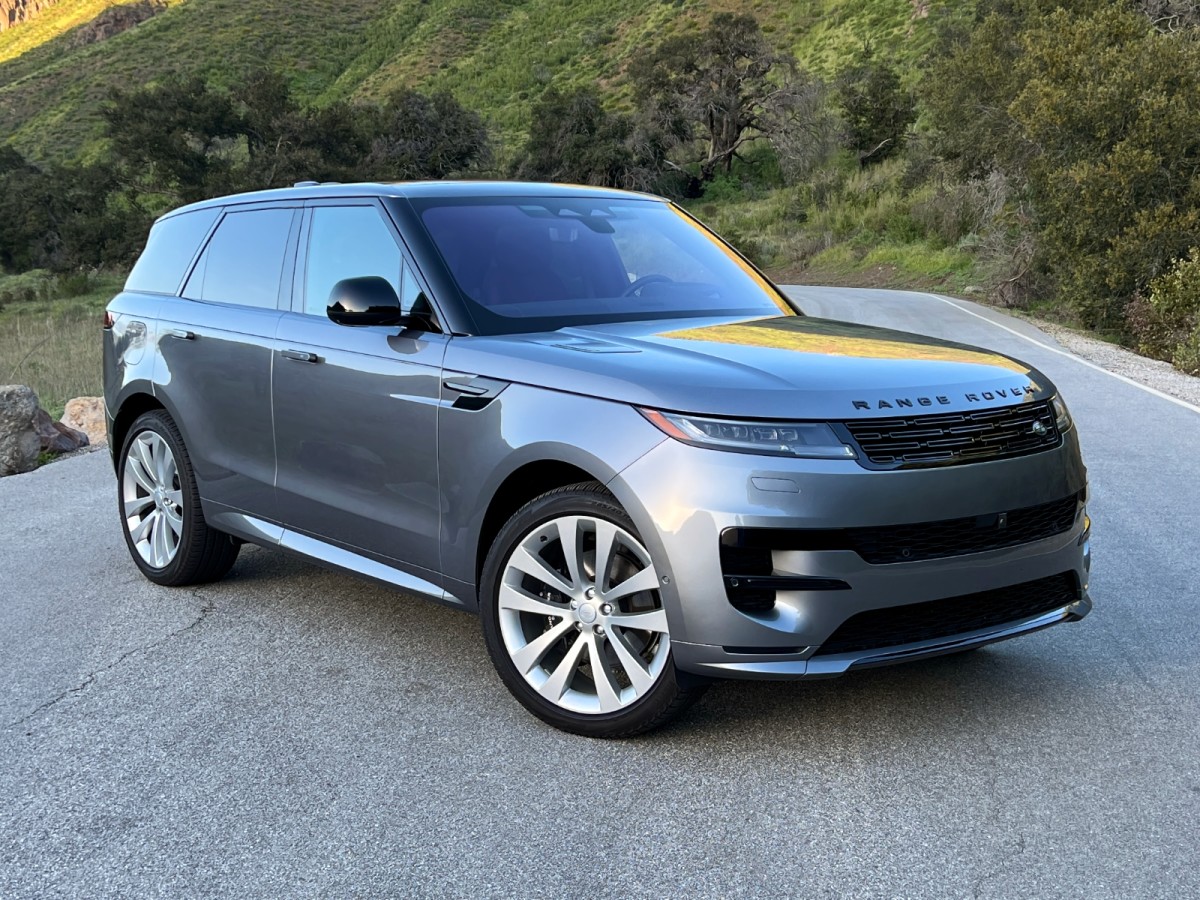
Our test vehicle arrived in subdued Eiger Gray paint with beautiful silver 23-inch wheels and a subtle Black Exterior Pack. It looked terrific, even without the optional black-painted roof. Inside, it featured a Deep Garnet over Ebony theme paired with aluminum and shiny black trim, oozing understated luxury.
As of this writing, Land Rover sells the Range Rover Sport in SE P360, SE Dynamic P400, and Autobiography P440e specification. In addition to the extra-cost paint, Black Exterior Pack, 23-inch wheels, and leather, the SE Dynamic P400 test vehicle had heated and ventilated front seats, heated rear seats, a Cold Climate Pack, a Technology Pack, and a full-size spare tire. Those upgrades brought the manufacturer’s suggested retail price (MSRP) to $98,420, including the $1,475 destination charge.
Highlights of the new Range Rover Sport’s design include premium LED headlights in the slimmest design ever for a Land Rover, flush-mounted door handles that deploy when the SUV senses your presence, and taillights marking the first use of surface LED technology on a production vehicle. In addition, the Range Rover Sport boasts excellent aerodynamics, with a coefficient of drag measuring 0.29.
Inside, the Range Rover Sport has a luxurious, high-tech appearance, and Land Rover points to the use of Ultrafabrics within the cabin, which is a sustainable material. Baby steps. What most people will notice is the decadently smooth, supple, and perforated Windsor leather upholstery that fills the cabin with its intoxicating fragrance.

Performance
Land Rover says the Range Rover Sport has two missions: Refinement and comfort, and driver-focused engagement. It completes one of them, but only partially.
The company’s challenge, of course, is creating a Range Rover Sport that can go almost anywhere at any time while simultaneously proving enjoyable to drive on a winding mountain road. Usually, the engineering requirements of each goal are diametrically opposed to one another. In other words, vehicles that can travel well off the beaten path are typically terrible to hustle through a series of S-curves.
To its credit, Land Rover makes a valiant attempt to successfully execute a dual automotive personality with the new Range Rover Sport. But if you have no plans to purposely put one of its massive wheels and perfectly dressed tires off of the pavement, you’re buying this Land Rover for its looks and image alone.
Let’s set the stage. Land Rover offers a turbocharged 3.0-liter inline six-cylinder engine in the SE and SE Dynamic. It features mild-hybrid technology, but is tuned to make more power in the SE Dynamic model, where it boasts 395 horsepower and 406 pound-feet of torque. In the lower-priced Range Rover Sport SE P360, the engine supplies 355 hp and 369 lb-ft of torque.
In addition, a plug-in hybrid electric vehicle (PHEV) drivetrain is available. It is exclusive to and standard in the Range Rover Sport Autobiography P440e, where it supplies 434 hp and 406 lb-ft while supplying an estimated 51 miles of electric driving range.
Land Rover also offered a 523-hp twin-turbo 4.4-liter V8 engine for selected early-build 2023 Range Rover Sport P530 models, including the sold-out P530 First Edition and extremely limited production Deer Valley Edition. However, the V8 is reportedly off the menu for the time being. Expect it to return in a Range Rover Sport SVR, if Land Rover elects to resurrect it.
In 2024, as part of Land Rover’s well publicized move away from internal combustion engines, a fully-electric version of the Range Rover Sport arrives.
Our test vehicle’s 395-hp inline-six provided plenty of oomph, and Land Rover’s claim that the SUV can accelerate to 60 mph in 5.4 seconds feels credible. It drives all four of the Range Rover Sport’s wheels through an eight-speed automatic transmission and an Intelligent All-Wheel Drive system, and Land Rover rates the SUV to tow 7,716 pounds. So, go ahead and make plans to hook up that Airstream.
The new Range Rover Sport is more fuel efficient than you might expect. According to the EPA, the P400 drivetrain should get 21 mpg in combined driving. We averaged 22.3 mpg on our evaluation route, and during a drive from the Los Angeles suburbs to Santa Barbara, the SUV returned fuel economy of 25.1 mpg. With a heavy foot in city driving, yes, the Range Rover Sport swills fuel like a drunk uncle does whiskey at a family gathering. But would you expect otherwise?
Moving on, Land Rover says the Range Rover Sport sits on a new vehicle architecture providing a 35-percent increase in torsional stiffness. In addition, it has a standard adaptive damping air suspension that adjusts up to 500 times per second to reduce unwanted body movement while maximizing both ride comfort and competent handling.
Land Rover also fortifies the Range Rover Sport with a new Dynamic driving mode, cornering brake control, brake-induced torque vectoring, and roll stability control. The First Edition also had four-wheel steering and a Dynamic Response Pro active electronic roll control system. Both will likely become available on other versions of the Range Rover Sport in 2024.
According to Land Rover, the 2023 Range Rover Sport offers “the most precise and composed” driving dynamics in the model’s history. Yes, that is true. In cities, the SE Dynamic P400 effortlessly accelerates away from intersections and whips around corners on its massive Pirelli Scorpion Zero tires. Over broken and undulating surfaces, you’ll marvel at how well the suspension and other techno-wizardry eradicates unwanted body motion. And on the highway at speed, the Range Rover Sport is remarkably silent inside, even for a luxury SUV.
However, the Range Rover Sport doesn’t challenge similarly priced, sport-tuned SUVs from Audi, BMW, and Mercedes-Benz when the road ahead starts to twist and turn. It feels tall and heavy, the steering lacks involvement, and without Dynamic Response Pro there is still too much roll in tighter curves.
In addition, while driving up the Dennison Grade east of Ojai, California, with the Range Rover Sport in Dynamic mode, we experienced plenty of lash and clunking from the drivetrain, coupled with what we surmise was stability control activation. These traits kept speeds down. However, on those 23s and with that torquey inline-six, it should have been able to run up that hill faster than Kate Bush’s resurgent popularity.
Off-road, the Range Rover Sport feels invincible. First, you’d never dare tackle the terrain we did in an Audi SQ7, BMW X5 M60i, or Mercedes-AMG GLE 53. Second, when traversing deep ruts, the technologically advanced suspension eliminates the pounding and jarring that can beat you up on similar surfaces in other SUVs.
Ground clearance with the air suspension set to its maximum height is 11.1 inches, and the approach, breakover, and departure angles measure 29.7, 26.9, and 30 degrees, respectively. In addition, the Range Rover Sport boasts a 35.4-inch wading depth, which is exceptionally good. Standard tech includes Terrain Response that automatically adjusts vehicle settings to the type of surface, All Terrain Progress Control (APC) off-road cruise control, and both hill start and hill descent control systems.
Though tempted, we avoided the numerous mud puddles and pits that had formed on trails after the recent Southern California rainstorms. While we have confidence in the Range Rover Sport’s off-roading capability, you just never know how deep and gooey such things are. And even Land Rovers aren’t unstoppable if you decide to put yourself into an unknown situation.

Form & function
With this redesign, Land Rover preserves what it calls the Range Rover Command Driving Position. Translated, that’s the tall, airy feel you get when you’re behind the steering wheel. The low dashboard, relatively upright windshield angle, and thin roof pillars all contribute to this sensation.
You can program the Range Rover Sport’s air suspension to kneel for easier entry and exit, and it helps people who are shorter in stature to access and depart the cabin. Once the driver and front passenger are aboard, they’ll find comfortable front chairs with adjustable inboard arm rests that serve no discernable purpose considering the center console armrest is wide and comfortable to use.
Our test vehicle had buttery smooth, exceptionally supple Windsor leather that smelled terrific, coupled with 20-way power-adjustable front seats with heating and ventilation. A massage feature is available, as are soft-closing doors and a heated steering wheel. You can also upgrade to a Cabin Air Purification Pro system with PM2.5 interior air purification capability.
The Range Rover Sport’s rear seat is less hospitable. Though Land Rover reports the redesigned SUV has more legroom and knee clearance than before, it remains tight for people with longer legs. Worse, the front seatback panels are hard and unfriendly to knees and shins. Narrow door openings impede entry and exit, and if the rear door jambs and sills are dirty, so will be your passengers’ clothing.
The back seat is deeply bucketed and provides excellent thigh and lumbar support. However, the seatback angle remains too reclined even in its most upright position, which forces a slouched posture. Manual side sunshades cover the entire window, and rear occupants get their own air conditioning vents and power ports. Our test vehicle also had heated outboard rear cushions.
Storage space within the cabin is decent, but the tray under the center console is too shallow to be of use and the bin under the center armrest is deep but not wide, so it will be easy to lose things in it. Land Rover hides a second deep bin underneath the sliding cupholder tray.
Around the back, a power liftgate rises to reveal a 31.9 cubic-foot cargo area. You can fit full-size suitcases stowed on their sides as long as you remove the cargo cover, and controls in the trunk lower the air suspension for easier loading and power the 40/20/40-split back seat down for added room. Maximum cargo space measures 53 cubic feet.
Our test vehicle’s full-size spare lived under the cargo floor, so there wasn’t any storage space in that location. However, Land Rover provides a handy contraption with integrated straps to help prevent smaller items from rolling around in the cargo hold, and you also get netted pockets on the sides of the cargo area and hooks on which you can hang items.

Technology
Every Range Rover Sport has a 13.7-inch digital instrumentation display and a 13.1-inch touchscreen infotainment system that provides haptic feedback when using the virtual controls. Wireless Apple CarPlay and Android Auto, Amazon Alexa compatibility, SiriusXM satellite radio, and an Online Pack with connected services are standard. If you want Wi-Fi access, it requires an extra-cost data plan.
Generally speaking, both screens are intuitive to reference and use, and Land Rover says the Pivi Pro infotainment platform can learn your habits and personalize your user experience over time. However, during a week of driving, we regularly found this technology confusing, frustrating, and irritating. Too often it is difficult to find a feature, remember how to access a feature, or determine why a feature is functioning as it is.
For example, the SUV arrived with its automatic driver exit assist feature turned on. Unfortunately, it lowers the seat and moves it back in its track, and that puts the center roof pillar in the way when you want to slide out of the SUV. But did the Seats menu within the Pivi Pro system help us to find the way to turn this feature off? No.
Unfortunately, you cannot use the SUV’s native digital assistant to request help with turning off the seat exit system or, apparently, much else. During the evaluation, we roused the assistant and tried to find a Starbucks.
Us: “Hey Land Rover.”
Robotic voice: “How can I help you?”
Us: “Find the nearest Starbucks.”
Robotic voice: “Where do you want to go?”
Us: “Starbucks”
Robotic voice: “I couldn’t find an intersection for N Moorpark Road Starboard. You can say ‘I’m finished’ to set the location, or ‘Change’ followed by the address item you want to edit.”
Say what now?
We tried on four separate occasions to get the system to direct us to a nearby Starbucks, and each time we got different responses from the tech. At no time did the tech accurately respond with directions to a Starbucks, which aren’t hard to find. Seemingly, the only thing it could accurately understand was the word “Cancel.
We tried a few of our other standard prompts, such as finding a Chipotle and a local hospital, but Pivi Pro flunked those tests, too, so we gave up. In a redesigned 2023 model-year vehicle, and especially one that caters to a clientele that is accustomed to being catered to, this represents a significant failure of the technology to behave in the expected manner.
Of course, you could always try the Alexa integration. To activate Alexa, you must log-in to your Amazon account, and then rouse the intelligent digital assistant by saying “Alexa” or tapping the Alexa button on the touchscreen. Alternatively, you can run Apple CarPlay or Android Auto, and deal with Siri and Google Assistant.
On positive notes, the Range Rover Sport offers impressive Meridian audio systems with up to 29 speakers and 1,430 watts of power, and a next-generation Active Noise Cancellation system filters out road and tire noise. In the Dynamic driving mode, it also enhances the sound of the powertrain.
In addition, Land Rover tucks a wireless smartphone charging pad under the infotainment screen, but it can be hard to dig your device out of there.

Safety
Land Rover installs numerous advanced driving assistance systems in the Range Rover Sport. The list includes forward-collision warning, automatic emergency braking, blind-spot monitoring, rear cross-traffic alert, lane-departure warning, and lane-keeping assist.
In addition, the SUV has automatic high-beam headlights, a driver monitoring system, front and rear parking sensors, and a surround-view camera system with Land Rover’s ClearSight Ground View camera. Wade Sensing is standard, too, and it can help you with water crossings while driving off-road.
Remote Park Assist is also available for this SUV. With this autonomous driving tech, the Range Rover Sport will park itself while you direct the SUV while standing outside of it and using a smartphone app.
Our evaluation focuses on the adaptive cruise control with steering assist, which helps to center the SUV in the lane of travel. We found the adaptive cruise control slow to respond when vehicles ahead cleared the lane, such as when they took an exit ramp or moved to a different lane. In addition, the adaptive cruise control was not as smooth as expected when performing its adaptive function to maintain a consistent, safe following distance to traffic ahead.
The Range Rover Sport’s steering assist technology was dissatisfactory. Especially when traveling around freeway curves and bends, the driver often wrestles with it to override its inputs because it isn’t particularly trustworthy.
Making matters worse, in the Los Angeles area, freeway curves that should contain lanes painted as consistent arcs frequently do not. Instead, they may tighten or straighten mid-curve, which is maddening enough without introducing semi-autonomous driving assist functionality to the challenge.
Predictably, just like human drivers in the same situation, the Range Rover Sport’s steering assist performs poorly when the painted lane lines are wonky, and drivers will feel like they need to muscle the steering to override the technology.

Cost-effectiveness
With a base starting price in the mid-$80,000 range, the 2023 Land Rover Range Rover Sport is a cost-effective choice in a five-passenger SUV only if you’re planning to head far off paved surfaces.
Other five-seat luxury SUVs that can tackle equally challenging terrain include the Nissan Patrol-based Infiniti QX80, the more affordable but downright ancient Toyota 4Runner-based Lexus GX, the larger and more expensive Toyota Land Cruiser-based Lexus LX, and the legendary but overpriced Mercedes-Benz G-Class.
We’d rather drive a Range Rover Sport than any of those rivals.
However, if you’re not going to take this Land Rover off-road and you’re looking for something fun to drive on pavement, there are more dynamic choices from Audi, BMW, and Mercedes-Benz. However, none of them can match the Range Rover Sport for gorgeous exterior styling.
No, we haven’t forgotten about the Range Rover Sport’s impressive PHEV powertrain with an estimated 51 miles of electric range. Keep this version of the SUV charged up, and you’ll save plenty of money on gas. And if saving money on gas isn’t cost-effective, what is?
Unfortunately, Land Rover offers the PHEV only with Autobiography trim, so it costs at least $30,000 more than a BMW X5 xDrive50e. And while the BMW travels only 40 miles on electricity before the gas engine turns on, it remains the better bargain.
But let’s be honest. If you wanted a cost-effective luxury SUV, you wouldn’t be reading a review of a 2023 Land Rover Range Rover Sport, would you?
So if you love the way the Range Rover Sport looks or you genuinely need its off-roading capability, then get one and drive it without regrets. Don’t worry, eventually you’ll come to terms with the tech. Or Land Rover will issue an over-the-air update that makes it easier to use.

What owners say
Most beautiful car I’ve ever had in my entire life. New module is fantastic
November 29, 2022Trims & specs
Base MSRP $90,800 | Seating 5 |
Engine N/A | Cargo Capacity 31.9 cu ft |
Combined MPG N/A | Drivetrain N/A |
Base MSRP $104,200 | Seating 5 |
Engine 3.0L 434 hp I6 Hybrid | Cargo Capacity 31.9 cu ft |
Combined MPG 51 | Drivetrain AWD |
Base MSRP $83,700 | Seating 5 |
Engine N/A | Cargo Capacity 31.9 cu ft |
Combined MPG N/A | Drivetrain N/A |
Base MSRP $121,500 | Seating 5 |
Engine 4.4L 523 hp V8 | Cargo Capacity 31.9 cu ft |
Combined MPG 18 | Drivetrain AWD |
Base MSRP N/A | Seating N/A |
Engine N/A | Cargo Capacity N/A |
Combined MPG N/A | Drivetrain N/A |
Base MSRP $165,000 | Seating 5 |
Engine N/A | Cargo Capacity 31.9 cu ft |
Combined MPG N/A | Drivetrain N/A |


Pricing trends
MSRP range
$83,000 - $165,000
Current avg. market price
$60,537
Trending down by 2.9% this month
May 2026 - November 2026


