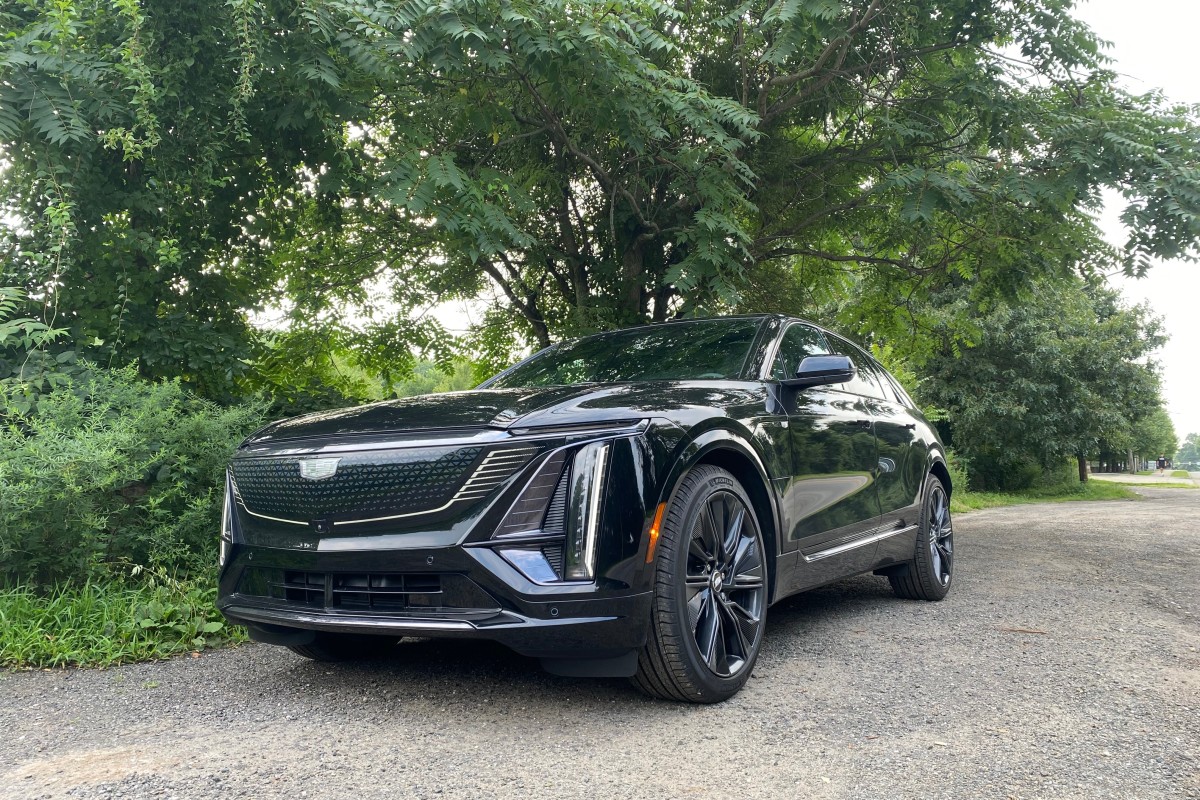
2023 Cadillac Escalade Reviews, Pricing & Specs


Pros & cons
What we like
Impressive technology
Impressive stereo
Plenty of cargo space
What to consider
Poor fuel economy
Interior materials feel cheap
Underwhelming base engine
Expert review
Cadillac's stylish full-size luxury SUV excels in utility and technology.
The ultimate shuttle is a new Cadillac Escalade, preferably in black with the shiniest chrome wheels. Many SUVs are more luxurious and some even quadruple the Escalade’s $80,000 starting price, yet none have the physical presence or the street cred that comes with a Cadillac truck. European brands do not make full-size luxury SUVs like this. They come close, but for sheer interior space and towing capacity, American brands dominate the segment. The Escalade was redesigned for the 2021 model year and carries over to 2023 mostly unchanged. That means it still boasts the industry’s best hands-free driving system, the sharpest screens, and the most stereo speakers.
out of 10 expert review
Look & feel
An Escalade towers nearly six-and-a-half feet above the ground. It requires between 18 and 19 feet of length to park anywhere. It is a motorized cargo container—with three rows of leather seats and more computers than the command center of an actual port. And this is just the standard Escalade we’re talking about. The Escalade ESV is 15 inches longer than the standard version, with the majority of those inches stretching the wheelbase.
Any Escalade, or the Chevrolet Tahoe/Suburban and GMC Yukon/Yukon XL that share its three-ton body, is meant for show. You’re either a pop musician, an overzealous parent, a wannabe federal agent, or a boater with a big family. Everyone sees you and your oversized truck coming straight at them, which is why Cadillac’s website tagline for the Escalade says “Never stop arriving.” Everyone else thinks, “Please don’t hit us.”
For a box designed to ship eight people and all their stuff, the latest Escalade looks athletic and trim, relatively speaking. Cadillac tricks us by pairing thin LED taillights, headlights, and running lights that visually narrow the vehicle’s girth. Yes, the mirrors stick out like Dumbo and the driver oversees a helm as long as a Zamboni’s, but it could be worse. Our Escalade in Sport Platinum trim darkens the chrome bits on the grille, bumpers, windows, and sills, which also helps mask the Escalade’s mass. Nothing is too flat or too creased, either. Cadillac places a handful of horizontal leading lines on the Escalade’s side profile, adds a few contours to the front end to achieve some semblance of aerodynamics, and that’s it. This is a handsome SUV because it wears its plus-size dimensions with pride. That’s why people buy one.
Six trims all come with 22-inch wheels and three-foot-high taillights that play an elaborate lighting sequence when unlocking the vehicle (including an illuminated Cadillac badge on the back of the dashboard that’s visible through the windshield). There are three grille designs, though we prefer the black honeycomb mesh on the Sport trims versus the star-studded effect on the Luxury trims or the Platinum’s toothy face. Spotting the new Escalade V-Series requires advance knowledge of the quad exhaust tips, red brake calipers, and the open lower grille. Else, it’s as stealthy as the Sport Platinum.
The interior looks rich in the first row. A curved, leather-edged array of screens spans 38 inches across the dashboard, which features seven choices of wood trim with the finest inlays we’ve seen outside a Rolls-Royce. The base Luxury has leatherette upholstery, but every other trim offers an array of single- and two-tone leather combinations with tasteful details, like how the hundreds of perforations in the seat inserts are sized and spaced to form an elaborate checker pattern. Certain Escalade trims have a thick, wool-like fabric in the lower sections of the dash and doors. Treats like these remind you this is a Cadillac.
Unfortunately, the allure fades whenever you reach for the heated seat controls, the shifter, the infotainment knob, the sunroof, or sit in the second or third rows. Those parts are straight out of cheaper GM vehicles and unbecoming of a Cadillac costing $100,000 as-tested. The seats, while very pretty, are the same unsupportive, flat chairs found in Chevy Silverado pickups. There’s nothing of note in the back rows except a pair of optional screens for the rear entertainment. You don’t get the center console included for rear-seat passengers in other luxury vehicles. The richest and fanciest part of the Escalade is restricted to the driver’s space, which is a shame when there’s seven more seats which deserve more—if not an equal—luxury treatment.
Cadillac knows it’s coming up short. The 2023 Lyriq blends the Escalade’s screens into a fresher cabin that feels crafted only for Cadillac. Every switch and touch point in that vehicle, including the air vent knobs, are unique to the brand. This is what the Escalade needs, and it’s not too late for Cadillac to deliver.
Performance
As enjoyable as it is to roll up in a chauffeured Escalade, driving one is also a pleasant experience. Little pleasure comes from the standard 6.2-liter gasoline V8 engine, which does not multiply the vehicle’s speed at the rate that its rumbly muscle-car sound would suggest. It’s fine for gentle cruising, where the V8 smartly shuts off up to six cylinders, even under a mild load. That lets the Escalade, in standard length with optional four-wheel drive (4WD), see a combined 16 mpg (roughly equivalent to turbo six-cylinder engines in the Jeep Grand Wagoneer and Lincoln Navigator).
The V8’s 420 horsepower and 460 pound-feet of torque are plenty for towing (up to 8200 pounds on the rear-wheel drive (RWD) model), but in passing situations, the big ‘Slade feels just as heavy as it is. The 10-speed automatic transmission responds well enough, and yet in Sport mode the entire powertrain is just begging you to please call the whole thing off. Competitors like the Grand Wagoneer, Navigator, and Infiniti QX80 are more sprightly and eager to run.
Enter the Cadillac Escalade-V, which addresses the acceleration issue by dropping in a supercharged Corvette V8 with 682 hp and 653 lb-ft of torque. It’s the only Escalade with front brakes (with six-piston Brembo calipers) that are appropriately sized for the vehicle’s weight—every other Escalade has a set of rotors that look alarmingly puny. The V-Series’ output does seem like overkill, though; somewhere between its 682 hp and the standard V8’s 420 hp seems more appropriate. Further details can be found in our full Cadillac Escalade-V Test Drive Review.
Cadillac also offers an optional 3.0-liter turbodiesel V6, which we tested—and genuinely liked—in a 2022 model. The engine’s torque matches the regular V8’s but arrives immediately and smoothly, which compensates for the diesel’s low revs and 277 hp. Fuel economy is also better than the old Escalade Hybrid from 2009, at a combined 22 mpg with 4WD.
That 4WD system is more rudimentary that what you’ll find in conventional SUVs but is common in the full-size luxury SUV market. Since they’re based on truck platforms, these vehicles use true 4WD with a center differential that locks the engine’s torque 50:50 front to rear. The driver has to select 4H (high) to engage the front axle, which results in binding (the skipping, uncomfortable feeling of the wheels locking) at low speeds on pavement. Automatic 4WD systems compensate for that behavior by constantly varying the torque split. There’s an “auto” mode on the Escalade, but all it does is engage 4H when the rear wheels slip—which at that point, with traction already lost, is too late. The solution, like old off-roaders know, is to engage 4H manually before you enter a low-traction surface. A low-range (4L) is available when the path gets rough.
The Escalade’s finest parts are its magnetic dampers, which reduce body roll to almost zero, and its superbly tuned steering that tracks accurately, with quick turn-in. Those elements, combined with an air suspension that’s optional on the Sport Platinum and Premium Luxury Platinum trims, make the Escalade nimbler and more maneuverable than many big SUVs. While the ride is serene—though it can jounce and get unsettled over rough pavement—wind noise is subjectively loud at highway speeds. In this manner, the Escalade feels more like an open-bed pickup truck than a luxury SUV.
Form & function
The Escalade has the most space-efficient interior of any large SUV, period. We’re talking 25 cubic feet behind the third row, 73 cubic feet behind the second row, and a whopping 121 cubic feet with both rows down. That’s roomier than a long-wheelbase Lincoln Navigator L. The Jeep Grand Wagoneer L doesn’t top the Escalade ESV, which maxes out at 143 cubic feet (and 41 cubic feet and 94 cubic feet behind the third and second rows, respectively). This is a packaging marvel, with generous headroom and legroom in every row, including the third row, which has so much space due to an independent rear suspension that doesn’t intrude upward into the cabin like the previous-gen Escalade’s live axle. It’s one thing to look big. It’s another thing to actually fit six adults in complete comfort without any shoulder rubbing. No luxury SUV comes close to an Escalade’s passenger and cargo space.
Beyond the sheer room, the controls are simple to use. Twist a dial on the console and the main menu appears as a carousel of icons. Move a hand toward the touchscreen and the carousel fades into a tiled array of icons. It’s smart, it’s simple, and it’s fast. The multiple gauge layouts are accessible by a mini touchscreen on the driver’s side, and again, they’re not overdone. A row of climate controls, shortcut buttons on the console, and easy-to-read menus take the stress out of driving.
An optional front console refrigerator has two temperature settings—it can chill and freeze drinks. Our only gripe was a 12-volt power outlet that was far out of reach—buried under the dashboard in the passenger footwell—but there are plenty of USB ports at the ready. Power-retractable side steps are a major help for access, and the steps can be extended with the doors closed so you can reach the roof (for cleaning or tying down cargo). The air suspension can lower the truck when parked to ease loading and unloading of cargo as well. Plus, the tailgate has a separate glass window that’s great for dogs. We only wish the second-row seats were powered like the third row.
Technology
The Escalade brings many automotive tech firsts, among them a huge span of OLED screens across the dash that are among the sharpest and clearest in the industry. A front camera displays a high-res feed of the road across the instrument panel and overlays directional arrows and street names when the navigation is active. This is so much better than how Mercedes or BMW show their augmented reality on the main touchscreen; the Escalade puts this immediately in the driver’s field of view.
Then there’s Super Cruise, a $2,500 option that is the best hands-free highway driving system out there—better than Tesla, which despite its capability (and Full Self-Driving branding) is not yet a real hands-free system. Super Cruise also uses infrared eye-tracking cameras to make sure the driver is looking ahead. Those cameras can track eye movement even if the driver is wearing sunglasses. If the system perceives distraction, it flashes a bright red warning on the steering wheel rim, chimes go off, and if nothing happens, the system locks out all functionality until the driver pulls over and restarts.
Super Cruise works on more than 200,000 miles of marked U.S. highways and requires no driver intervention except for initiating a lane change with the turn signal stalk (the vehicle then proceeds to change lanes by itself). It cannot stop at stop signs or navigate cities, however. It will also disable itself in certain situations, such as if the sensors are blocked by dirt, but the driver is immediately alerted. It’s not foolproof, but the technology is legit and it’s very good.
Cadillac was the first automaker to offer night vision more than 20 years ago, and the Escalade builds on that with a pedestrian-detection display on the instrument panel that overlays people in yellow boxes. Then there are the frivolous things, like the 36-speaker AKG audio system with speakers in the front headrests, in the headliner, and everywhere else. Listen enough and you may never attend a live concert again. The front seats massage in five different ways, the rear-seat entertainment system can stream Hulu and other apps, and the LED headlights are very bright.
Safety
The 2023 Escalade earned four out of five stars from the National Highway Traffic Safety Administration (NHTSA) due to a lower four-star rating for front-passenger protection in a frontal crash test, and a three-star rating for rollover resistance. The Escalade got five stars in all other NHTSA crash tests. It hasn’t received safety ratings from the Insurance Institute for Highway Safety (IIHS), though.
Forward automatic emergency braking with pedestrian detection, a Safety Alert seat that vibrates to warn the driver of possible danger, rear parking sensors, and a rear seat reminder are standard. Reverse emergency braking is optional, and in our testing, it stopped the vehicle erroneously when there was no object while reversing out of a driveway. Blind-spot monitoring, rear cross-traffic alert, lane-departure warning, adaptive cruise control, and Super Cruise are all optional as well.
Cost-effectiveness
The 2023 Escalade starts at $79,795 and comes in five trims, not including the Escalade-V. From the bottom, they are Luxury, Premium Luxury, Premium Luxury Platinum, Sport, and Sport Platinum. Our Escalade Sport Platinum 4WD cost $114,915 with destination, which is pretty typical of what most Escalade buyers will likely pay. The V-Series, meanwhile, is more than $150,000.
This pricing matches the Grand Wagoneer and Navigator, which are the only two full-size SUVs that compete directly with the Escalade. At this price, many European SUVs—such as the Mercedes-Benz GLS, BMW X7, or Land Rover Range Rover—may be more enticing, though they’re comparably small next to an Escalade and don’t match its high level of technology. For space and curb appeal, an Escalade will do just fine.

What owners say
"Overall, drivers love the 2023 Cadillac Escalade for its luxury, elegant design, and comfortable ride. They appreciate the stylish interior and the absence of accidents. However, some have expressed frustration over the lack of power adjustable foot pedals, which can create discomfort for shorter drivers."
Great features. Only model I'm interested in. A little pricey.
January 12, 2026Luxury and big car, my dream car, comfortable and convenient to take anywhere
May 8, 2026The Escalade is amazing but it has one major issue. GM decided in 2018 to do away with power adjustable foot pedals. This move eliminated any GM product from our shopping list. My partner is 5’3” and I’m 6’4”. This makes the airbag too close to her, which is dangerous. And, it makes it uncomfortable for her. Change this and we’ll come back!!
May 13, 2024What owners say
Great features. Only model I'm interested in. A little pricey.
January 12, 2026Luxury and big car, my dream car, comfortable and convenient to take anywhere
May 8, 2026The Escalade is amazing but it has one major issue. GM decided in 2018 to do away with power adjustable foot pedals. This move eliminated any GM product from our shopping list. My partner is 5’3” and I’m 6’4”. This makes the airbag too close to her, which is dangerous. And, it makes it uncomfortable for her. Change this and we’ll come back!!
May 13, 2024Exactly what i was looking for.intricately stitched seating.tricolor interior.immaculate.zero issues
May 28, 2024Love It ❤️. Very Elegant and Stylish. No accidents is a plus
May 22, 2024Trims & specs
Base MSRP $91,095 | Seating 8 |
Engine 6.2L 420 hp V8 | Cargo Capacity 25.5 cu ft |
Combined MPG 16 | Drivetrain 4X4 |
Base MSRP $88,095 | Seating 8 |
Engine 6.2L 420 hp V8 | Cargo Capacity 25.5 cu ft |
Combined MPG 16 | Drivetrain RWD |
Base MSRP $108,595 | Seating 8 |
Engine 6.2L 420 hp V8 | Cargo Capacity 25.5 cu ft |
Combined MPG 16 | Drivetrain 4X4 |
Base MSRP $105,595 | Seating 8 |
Engine 6.2L 420 hp V8 | Cargo Capacity 25.5 cu ft |
Combined MPG 16 | Drivetrain RWD |
Base MSRP $91,095 | Seating 8 |
Engine 6.2L 420 hp V8 | Cargo Capacity 25.5 cu ft |
Combined MPG 16 | Drivetrain RWD |
Base MSRP $82,295 | Seating 8 |
Engine 6.2L 420 hp V8 | Cargo Capacity 25.5 cu ft |
Combined MPG 16 | Drivetrain 4X4 |
Base MSRP $79,295 | Seating 8 |
Engine 6.2L 420 hp V8 | Cargo Capacity 25.5 cu ft |
Combined MPG 16 | Drivetrain RWD |
Base MSRP $94,095 | Seating 8 |
Engine 6.2L 420 hp V8 | Cargo Capacity 25.5 cu ft |
Combined MPG 16 | Drivetrain 4X4 |
Base MSRP $108,595 | Seating 8 |
Engine 6.2L 420 hp V8 | Cargo Capacity 25.5 cu ft |
Combined MPG 16 | Drivetrain 4X4 |
Base MSRP $105,595 | Seating 8 |
Engine 6.2L 420 hp V8 | Cargo Capacity 25.5 cu ft |
Combined MPG 16 | Drivetrain RWD |


Pricing trends
MSRP range
$79,295 - $108,595
Current avg. market price
$65,754
Trending down by 1.7% this month
May 2026 - October 2026