2022 Nissan Pathfinder Reviews, Pricing & Specs
Write a reviewPros
Stylish
Plenty of Cargo Space
Comfortable
Cons
Poor fuel economy
Unimpressive technology

The 2022 Pathfinder redefines what it means to be Nissan’s midsize SUV.
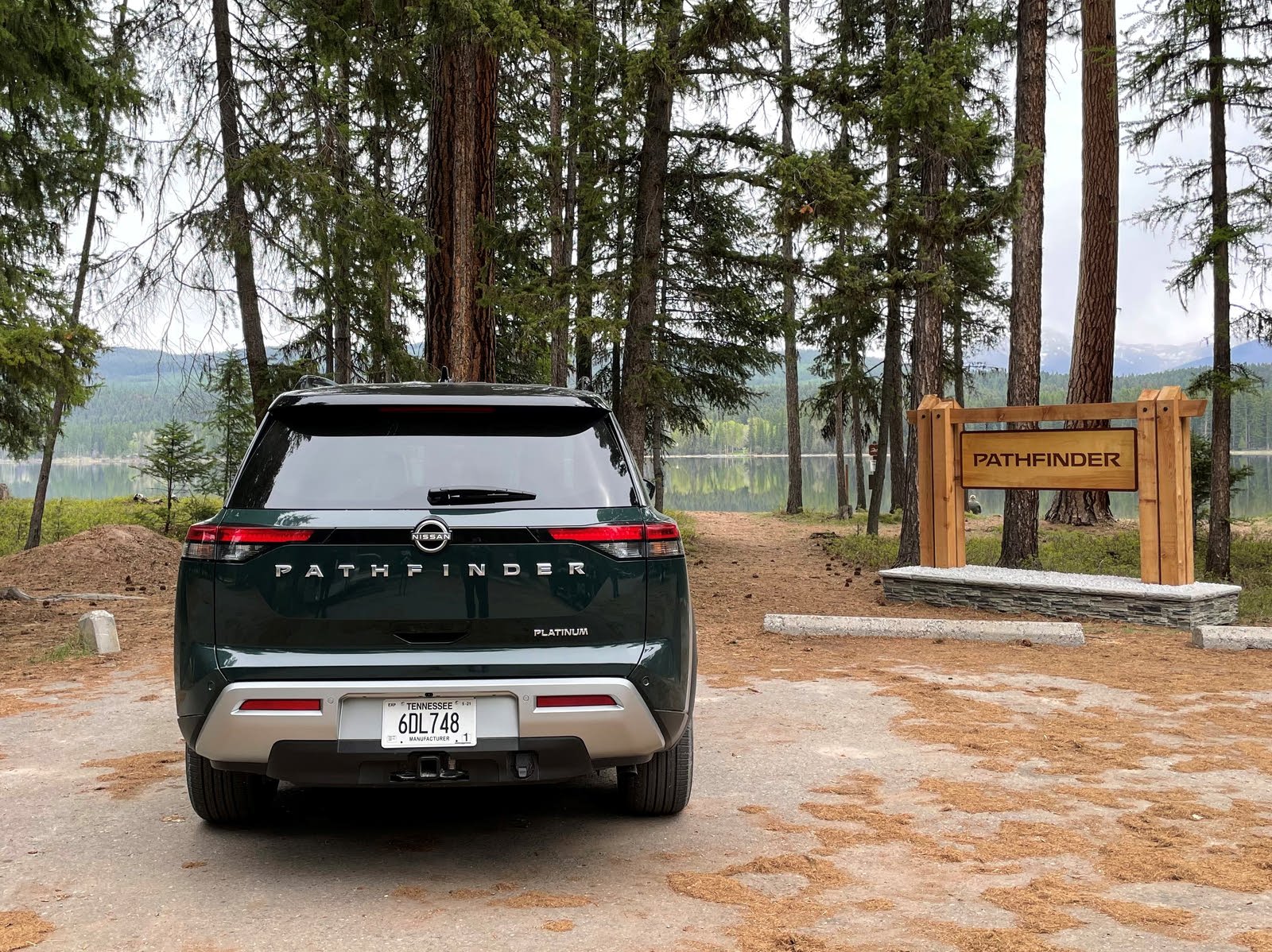
The fifth-generation 2022 Nissan Pathfinder takes design cues all around from the new era of the Japanese automaker’s SUV design. Up front is a new take on the company’s signature V-motion grille, which matches that on the Rogue and Armada. The new Nissan logo sits on the model’s three-slot grille, designed to pay homage to the first-generation Pathfinder. LED headlights flank the grille while slim LED daytime running lights make eyebrows, leading the eye onward to the bulky, slated C-pillar which is another play on the original Pathfinder’s design. Nissan offers the 2022 Pathfinder in a total of 14 paint jobs and color combinations. A black roof, which creeps down onto that C-pillar is available.
The car’s side panels and hood give the SUV a far beefier look than the fourth-generation Pathfinder, more on-trend with the design of the Kia Telluride than the Toyota Highlander. With these looks, in combination with sleek, thin taillights that wrap around the large liftgate, which is accented by bold, gate-wide badging feature the vehicle’s nameplate, Nissan has achieved the more robust aesthetic it sought with the vehicle.
Nissan has made the new Pathfinder 0.6 inches wider with a track that is 1.2 inches wider giving it a planted look on the roadway. The vehicle is 0.2 inches higher and 0.8 inches shorter end-to-end despite having far more legroom than the previous generation.
The design changes have been meant to position the vehicle in buyer’s minds as being more capable and rugged than it has been in its immediate past. It works. The Pathfinder comes in four trim levels: S, SV, SL, and Platinum. All grades get body-color door handles, chrome badging, and a chrome grille. Rear, rear-quarter, and liftgate windows feature privacy glass. Speed-sensitive wipers are standard on all but the Platinum grade, which gets standard intermittent wipers. Buyers can add a panoramic moonroof and roof rack (both standard on SV and higher).
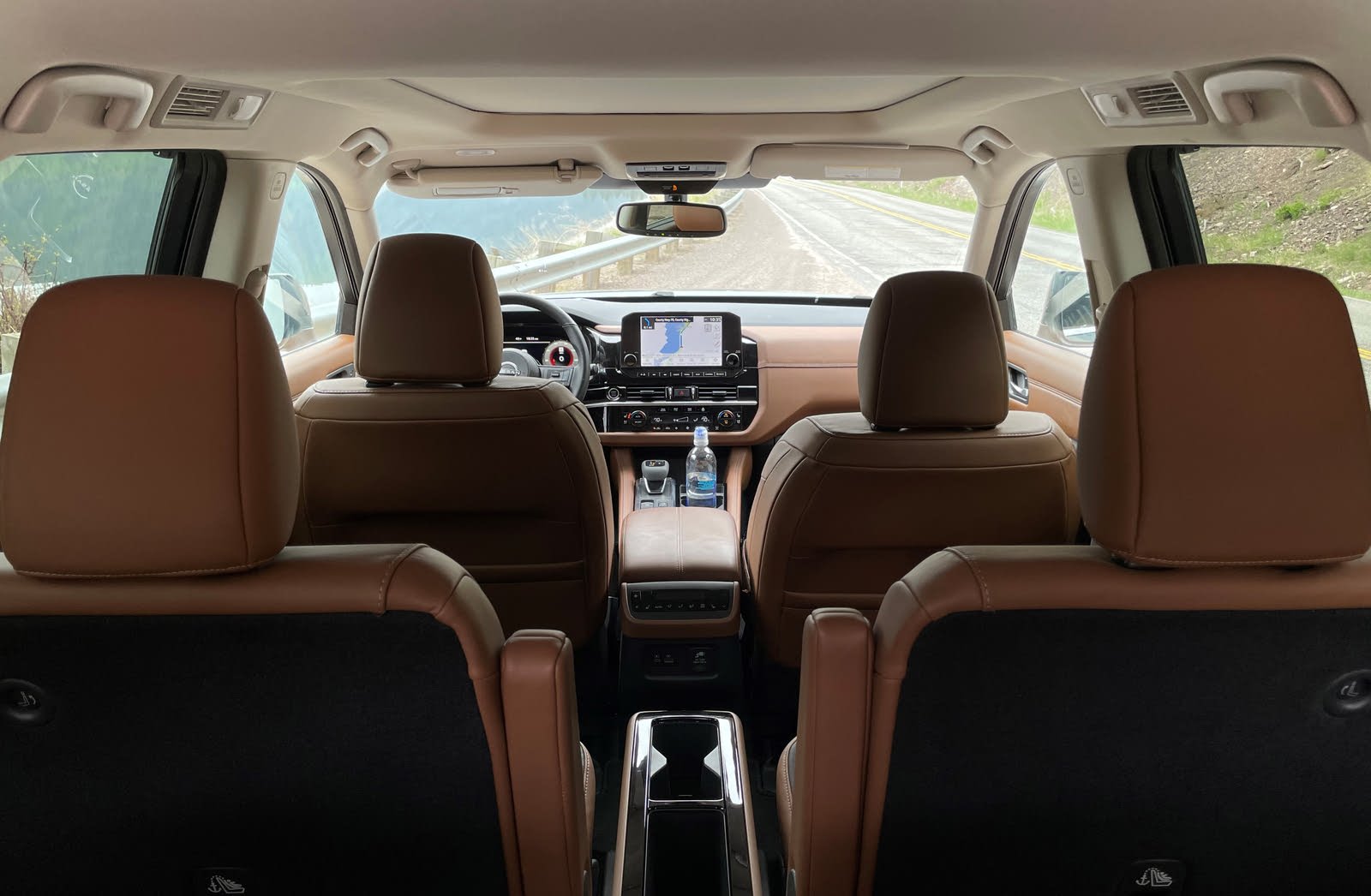
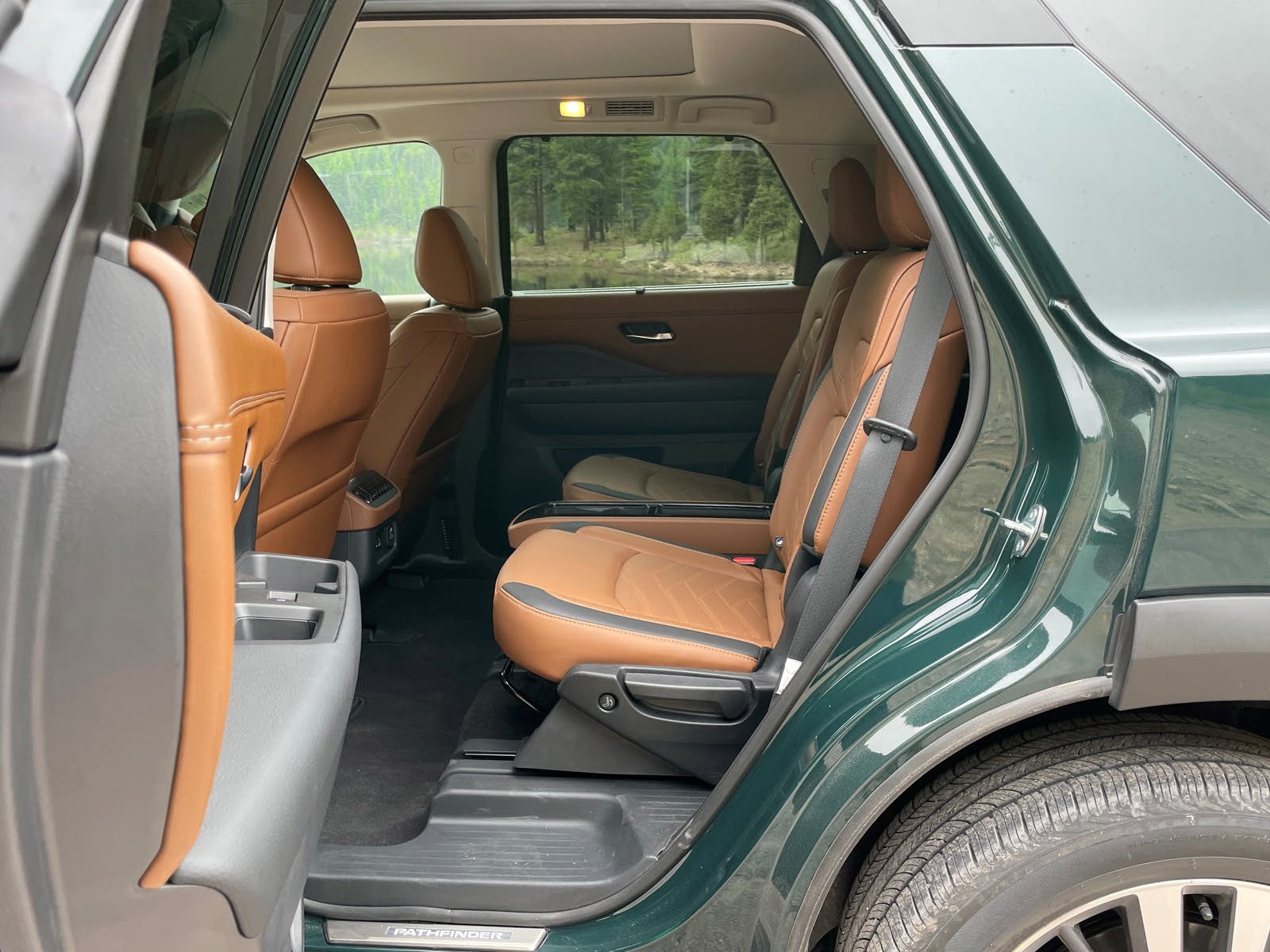
Pathfinder features standard eight-passenger seating in all but the Platinum trim, where second-row captain’s chairs are standard (bringing the passenger maximum down to seven). Pathfinder SL and SV buyers can opt for those seats. Cloth upholstery is standard on S and SV grades while semi-aniline leather-appointed seats in the first and second row come on SL and Platinum grades (they’re also quilted on Pathfinder Platinum).
Nissan doesn’t make the Pathfinder with an available Midnight Edition package—at least not yet. The automaker says that, though it’s not an option at introduction, Nissan sells all the requisite components separately and dealers can install them to give the SUV a Midnight Edition-esque look.
The overall aesthetic of the interior is equal to or more upscale in its highest trims than the midsize SUV’s closest competition—the Highlander, Honda Pilot, Ford Explorer, Hyundai Palisade, and Telluride.

Nissan didn’t change the engine in the Pathfinder from one generation to the next. The 3.5-liter V6 engine is plenty powerful, though some alternative-fuels enthusiasts might be disappointed to find out that the automaker isn’t introducing a hybrid, plug-in hybrid, or electric model option just yet. The V6 gets 284 horsepower and 259 lb-ft of torque (unchanged for 2022).
The engine is paired with Nissan’s new nine-speed automatic transmission. Sourced from ZF, the new transmission replaces Nissan's old continuously variable transmission (CVT) is paired with an electronic shift-by-wire drive selector and paddle shifters. The transmission is smooth rising and lowering through the gears.
Nissan offers the SUV in front-wheel-drive (FWD) and all-wheel-drive (AWD) configurations. FWD models get a five-position drive mode selector while AWD Pathfinders come with seven drive and terrain modes to choose from.
Hill-start assist is standard and hill descent control comes only on AWD models.
The 2022 Nissan Pathfinder with FWD gets an EPA-estimated fuel economy of 21 mpg in the city, 26 mpg on the highway, and 23 mpg combined. Opting for AWD ups the miles per gallon by one on the highway, but maintains the 23 mpg combined. Buyers who get the fully-equipped Pathfinder Platinum with AWD get just 20 mpg in the city, 25 mpg on the highway, and 22 mpg combined. Nissan has installed a new capless fuel filler on the model.
The Pathfinder isn’t built on entirely new architecture but Nissan has made substantial improvements to the existing platform and equipment. The suspension setup allows for a stable ride with the Pathfinder able to absorb most of the road’s imperfections.
Steering is reasonably connected and on-par with what buyers will expect from a family hauler. The tight turning radius, which is far better than that of the Highlander, Pilot, Explorer, Telluride, and Palisade, makes the Pathfinder easy to park and steer on city streets and off-road trails.
Nissan has given the Pathfinder a 6,000-pound maximum towing capacity. The unibody SUV is available with a Class II tow hitch and trailer harness (standard in the Platinum grade). Seven-inch pre-wiring is standard on all models. The transmission struggles to find the right spot at speed but removing your foot from the gas for a brief second allows it to recalibrate into the correct position and bring down the RPMs. Stabilizing trailer sway control technology makes towing as stable with the Pathfinder as it is with the Subaru Ascent, if not more stable.

The Pathfinder’s interior comfort starts with the quietness of its compartment. Carpeting, doors, and floors have had their ability to transmit sound from the road reduced. The noises that come with highway driving, including engine noise that permeate the interior have been decreased thanks to improved insulation, front-row acoustic laminated glass, door-mounted outside mirrors, and thicker second-row glass.
When it came to designing the family hauler, Nissan put flexibility in focus, recognizing that families use their Pathfinder for a variety of tests, not just getting groceries and the school run. Loading and unloading people and goods was an important part of the design process. The rear door Intelligent Key, wide-opening doors, optional second-row captains chairs, and the ability to put three car seats across the second-row bench seat (or just one in the middle) were requests made by customer focus groups that have come to fruition in the new model. Additional new features include the ability to have a maximum of five car seats installed at once, best-in-class front-seat legroom, and five inches more hip room for third-row passengers.
One of the most thoughtful innovations is the EZ Flex Latch and Glide second-row seat technology. Second-row outboard seats have a button that can be pressed to electronically unlock the second-row latching mechanism. It also allows the seat to be pushed and tilted forward for easy third-row access. A duplicate of that button is on the back of those seats, allowing third-row passengers to get themselves out of their seats when the vehicle is parked with the simple press of a button. The one-touch operation is far ahead of mechanisms used by other automakers, and it is quite simply a genius solution that works with or without a forward-facing car seat installed.
The car’s second-row center console is another one of those things that makes so much sense that you wonder why no other automaker has done it in a midsize crossover. The console is removable by flipping a panel at the front of the console then releasing the hold mechanism to pull it out f place with one hand. The console then easily stores in the SUV’s rear under-floor cargo space.
Speaking of center consoles, the one up front isn’t too shabby either. A new 13.4 liters of storage space is available, thanks to the electric shifter. That’s more than double the amount traditionally held by a center console.
Behind the SUV’s third row of seats is 16.6 cubic feet of cargo space. That’s enough to fit four golf bags, a 120-quart cooler, or six suitcases. With the second row up and the third row folded flat, 45.0 cubic feet of storage area is available. When the second and third rows are folded flat, there are 80.5 cubic feet of cargo space.
Flush rear cargo space sides make it easy to load in a four-foot-wide piece of plywood without having to bend or tilt it. Under the rear floor is 54 liters of cargo space with a self-supporting hinge that keeps the cover up while you load, or while you transport oversized groceries or plants that require the stabilizing effects the space offers.
Nissan brags that you can fit three adults across the 60/40 split-folding rear seat of its Pathfinder, and it’s not wrong. However, for them to be comfortable you’ll only want to put passengers of average size or smaller back there.
Front and second-row seats offer abundant space and are comfortable even on long trips. Heated seats are standard on all models above base and Pathfinder Platinum buyers also get ventilated seats. A six-way manually adjustable driver’s seat is standard, but an upgrade to an eight-way power-adjustable driver’s seat with lumbar support is available. The front passenger seat is four-way manually adjustable on Pathfinder S and SV, and four-way power-adjustable on Pathfinder SL and Platinum.
Tri-zone automatic climate control is standard and second-row passengers have access to their own set of controls. There are 16 cup and bottle holders in the Pathfinder. The front doors of the SUV are able to accommodate plus-sized bottles.
A manual-closing liftgate is standard on Pathfinder S and SV while a power liftgate is optional on SV and standard on SL and Platinum models. A motion-activated power liftgate is standard on Pathfinder Platinum.

Nissan has loaded the Pathfinder up with fresh technology that isn’t so advanced that it will confuse or annoy drivers, but it definitely serves the purpose it’s designed for. The best part is that buyers don’t have to get the Platinum trim level to enjoy most of the tech.
The list of standard features is long. It includes a six-speaker audio system, 8-inch infotainment touchscreen, Siri Eyes Free, Google Assistant Voice Recognition, Android Auto, Apple CarPlay, voice recognition, Bluetooth, satellite radio, hands-free text messaging, a 7-inch digital driver-information display, two 12-volt DC power outlets, two USB ports (Type-A and Type-C), and two second-row USB ports (Type-A and Type-C). Talk about a wealth of equipment!
On Pathfinder S, SV, and SL models the speedometer, tachometer, coolant temperature, and fuel level are analog while the odometer and clock are digital. Opting for the Pathfinder Platinum gets drivers a fully digital 12.3-inch instrument panel and head-up display.
A 13-speaker Bose Premium Audio system is available on Pathfinder SL and standard on the Platinum grade. Upper trim levels get a standard 9-inch infotainment touch screen, a wireless charging pad, wireless Apple CarPlay, door-to-door connected navigation, up to two additional USB ports (Type-A), HomeLink, an auto-dimming rearview mirror, and NissanConnect Services.
Nissan Safety Shield 360, a suite of safety technology, is standard on every Pathfinder. It includes automatic emergency braking with pedestrian detection, blind-spot monitoring, rear cross-traffic alert, lane departure warning, high-beam assist, and rear automatic braking. A driver alertness monitor, rear door alert, and forward-collision warning are also standard.
A rearview camera is standard. Upper trim level buyers get a surround-view monitor. Ten airbags are standard, but the top-of-the-line Pathfinder Platinum gets 11.
Neither the Insurance Institute for Highway Safety (IIHS) nor the National Highway Traffic Safety Administration (NHTSA) have crash-tested the Pathfinder.
The 2022 Nissan Pathfinder starts at $33,410 for the S trim level with FWD. Opting for AWD in the base model ups the starting price to $35,310. The Pathfinder SV is $36,200 and $38,100 for FWD and AWD models, respectively. Opting for Pathfinder SL drives the price tag to $39,590 for FWD and $41,490 for AWD. The top-tier Pathfinder Platinum costs $46,190 for FWD drive and $48,090 for AWD. Each model carries a $1,150 destination charge that is not included in those prices.
Nissan offers the Pathfinder with two packages. The SV Premium Package ($2,170) includes a panoramic moonroof, power Liftgate, receiver hitch with a 6,000-pound towing capacity, second-row captain’s chairs, and a second-row removable console. The SL Premium Package $2,900) adds all the SV Premium Package Content plus heated rear seats, a wireless charging pad, and the Bose Premium Audio system.
Nissan will offer 35 accessories for the Pathfinder, up from 25 that were available on the last-gen model.
Pricing is competitive with other midsize, three-row SUVs. Nissan is quick to point out that its Pathfinder has much more standard and available features than its aging competition. The Pathfinder isn’t available with a digital dashboard nor wireless Apple CarPlay or USB Type-C ports. The same is true for the Telluride, which also lacks hill-descent control and a surround-view monitor. Ford doesn’t sell the Explorer with an available head-up display, and the Pathfinder tows more than the Explorer. Honda’s aging Pilot has fallen far behind the competition and is missing all of this equipment except hill descent control, and most of Pathfinder’s safety tech lineup.

User reviews for 2022 Nissan Pathfinder
Write a review2022 Nissan Pathfinder Pricing
Trims & specs
Air Conditioning
Automatic climate control front air conditioning · Dual front air conditioning zones · Automatic climate control rear air conditioning · Single rear air conditioning zones
Airbags
Dual front airbags · Dual front knee airbags · Passenger airbag deactivation: occupant sensing deactivation · Front side airbags · Front side curtain airbags
Audio System
Antenna Type: mast · Voice recognition audio system · Auxiliary audio input: jack · Single disc in-Dash CD · HD radio · Satellite Radio: SiriusXM · Total Number of Speakers: 6
Brakes
ABS: 4-wheel · Braking assist: hill start assist · Front brake diameter: 13.8 · Front brake width: 1.18 · Front brakes: ventilated disc · Rear brake diameter: 13.0 · Rear brake width: .63 · Rear brakes: ventilated disc
Comfort Features
Armrests: rear center folding with storage · Floor Material: carpet · Shift knob trim: urethane · Steering wheel trim: urethane
Convenience Features
Assist handle: front · Cargo area power outlet: 12V · Center console: front console with armrest and storage · Cupholders: rear · Easy entry: manual rear seat · Multi-function remote: proximity entry system · One-touch windows: 2 · Power outlet(s): 12V front · Power steering: speed-proportional · Power windows: lockout button · Reading lights: front · Steering wheel: tilt and telescopic · Steering wheel mounted controls: cruise controls · Storage: sunglasses holder · Vanity mirrors: dual illuminating
Driver Seat
Manual adjustments: 6
Drivetrain
Axle ratio: 4.33
Engine
Alternator: 150 amps · Battery: maintenance-free
Exterior Features
Door handle color: body-color · Front bumper color: body-color · Grille color: black · Mirror color: body-color · Rear bumper color: black · Rear spoiler: roofline spoiler · Rear spoiler color: body-color · Rear trunk/liftgate: liftgate · Window trim: black
Headrests
Front headrests: adjustable · Number of front headrests: 2 · Number of rear headrests: 3 · Number of third row headrests: 2
In Car Entertainment
Infotainment: NissanConnect · Infotainment screen size: 8 in.
Instrumentation
Fuel economy display: MPG · Instrument cluster screen size: 7 in. · Warnings and reminders: low fuel level
Lights
Daytime running lights: LED · Headlights: Auto on/off · Tail and brake lights: LED
Mirrors
Exterior mirrors: integrated turn signals · Inside rearview mirror: manual day/night
Passenger Seat
Manual Adjustments: 4
Rear Seats
Type: 60-40 split bench
Safety
Automatic emergency braking: front · Camera system: rearview · Child seat anchors: LATCH system · Cross Traffic Alert: rear · Crumple zones: rear · Parking sensors: rear · Pre-Collision Warning System: audible warning · Rearview monitor: in dash
Seatbelts
Emergency locking retractors: front and rear · Front seatbelts: 3-point · Seatbelt force limiters: front · Seatbelt pretensioners: front · Seatbelt warning sensor: driver and passenger · Second row seatbelts: 3-point · Third row seatbelts: 3-point
Seats
Driver seat manual adjustments: height · Front seat type: bucket · Passenger seat manual adjustments: reclining · Rear headrests: adjustable · Rear seat folding: flat · Rear seat manual adjustments: reclining · Third row headrests: adjustable · Third row seat folding: split · Upholstery: cloth
Security
Power door locks: anti-lockout
Spare Tire
Mount Location: underbody · Size: temporary
Spare Wheel
Rim Type: steel
Stability and Traction
Traction control: with trailer stability control
Steering
Steering ratio: 16.0 · Turns lock-to-lock: 2.8
Suspension
Front Arm Type: lower control arms · Front Shock Type: twin-tube gas shock absorbers · Front Spring Type: coil springs · Front Stabilizer Bar: diameter 29 mm · Front Suspension Classification: independent · Front Suspension Type: MacPherson struts · Rear Shock Type: twin-tube gas shock absorbers · Rear Spring Type: coil springs · Rear Stabilizer Bar: diameter 28 mm · Rear Suspension Classification: independent · Rear Suspension Type: multi-link
Telematics
Electronic messaging assistance: with read function · Phone: voice activated · Phone wireless data link: Bluetooth
Third Row Seat
Type: 40-60 split bench
Tires
Type: all season
Tires and Rims
Wheel type: aluminum alloy
Towing and Hauling
Trailer hitch: Class II
Windows
Front wipers: speed sensitive · Liftgate window: fixed · Power windows: with safety reverse · Rear wiper: with washer
Air Conditioning
Automatic climate control front air conditioning · Dual front air conditioning zones · Rear air conditioning: with independent controls · Single rear air conditioning zones
Airbags
Dual front airbags · Dual front knee airbags · Passenger airbag deactivation: occupant sensing deactivation · Front side airbags · Front side curtain airbags
Audio System
Antenna Type: element · Voice recognition audio system · Bluetooth auxiliary audio input · Single disc in-Dash CD · Touch screen display radio · Satellite Radio: SiriusXM · Total Number of Speakers: 6
Brakes
ABS: 4-wheel · Braking assist: hill start assist · Front brake diameter: 13.8 · Front brake width: 1.18 · Front brakes: ventilated disc · Rear brake diameter: 13.0 · Rear brake width: .63 · Rear brakes: ventilated disc
Comfort Features
Armrests: rear center folding with storage · Floor Material: carpet · Shift knob trim: urethane · Steering wheel trim: urethane
Convenience Features
Assist handle: rear · Cargo area power outlet: 12V · Center console: front console with armrest and storage · Cupholders: front, rear and third row · Easy entry: manual rear seat · Multi-function remote: keyless entry with panic alarm · One-touch windows: 2 · Power outlet(s): USB-C rear · Power steering: electric · Power windows: lockout button · Reading lights: front · Steering wheel: tilt and telescopic · Steering wheel mounted controls: cruise controls · Storage: cargo tie-down anchors and hooks · Vanity mirrors: dual illuminating
Driver Seat
Manual adjustments: 6
Drivetrain
4WD Type: on demand · Axle ratio: 4.33
Engine
Alternator: 150 amps · Battery: maintenance-free
Exterior Features
Door handle color: body-color · Front bumper color: body-color · Grille color: black · Mirror color: body-color · Rear bumper color: black · Rear spoiler: roofline spoiler · Rear spoiler color: body-color · Rear trunk/liftgate: liftgate · Window trim: black
Headrests
Front headrests: adjustable · Number of front headrests: 2 · Number of rear headrests: 3 · Number of third row headrests: 2
In Car Entertainment
Infotainment: Android Auto ready · Infotainment screen size: 8 in.
Instrumentation
Fuel economy display: MPG · Instrument cluster screen size: 7 in. · Warnings and reminders: lamp failure
Lights
Daytime running lights: LED · Headlights: auto delay off · Tail and brake lights: LED
Mirrors
Exterior mirrors: manual folding · Inside rearview mirror: manual day/night
Passenger Seat
Manual Adjustments: 4
Rear Seats
Type: 60-40 split bench
Safety
Automatic emergency braking: front pedestrian · Camera system: rearview · Child seat anchors: LATCH system · Cross Traffic Alert: rear · Crumple zones: rear · Parking sensors: rear · Pre-Collision Warning System: visual warning · Rearview monitor: in dash
Seatbelts
Emergency locking retractors: front · Front seatbelts: 3-point · Seatbelt force limiters: front · Seatbelt pretensioners: front · Seatbelt warning sensor: driver and passenger · Second row seatbelts: 3-point · Third row seatbelts: 3-point
Seats
Driver seat manual adjustments: reclining · Front seat type: bucket · Passenger seat manual adjustments: reclining · Rear headrests: adjustable · Rear seat folding: flat · Rear seat manual adjustments: reclining · Third row headrests: adjustable · Third row seat folding: fold flat into floor · Upholstery: cloth
Security
Power door locks: anti-lockout
Spare Tire
Mount Location: underbody · Size: temporary
Spare Wheel
Rim Type: steel
Stability and Traction
Traction control: with trailer stability control
Steering
Steering ratio: 16.0 · Turns lock-to-lock: 2.8
Suspension
Front Arm Type: lower control arms · Front Shock Type: twin-tube gas shock absorbers · Front Spring Type: coil springs · Front Stabilizer Bar: diameter 29 mm · Front Suspension Classification: independent · Front Suspension Type: MacPherson struts · Rear Shock Type: twin-tube gas shock absorbers · Rear Spring Type: coil springs · Rear Stabilizer Bar: diameter 28 mm · Rear Suspension Classification: independent · Rear Suspension Type: multi-link
Telematics
Electronic messaging assistance: with voice recognition · Phone: voice activated · Phone wireless data link: Bluetooth
Third Row Seat
Type: 40-60 split bench
Tires
Type: all season
Tires and Rims
Wheel type: aluminum alloy
Towing and Hauling
Trailer hitch: Class II
Windows
Front wipers: speed sensitive · Liftgate window: fixed · Power windows: with safety reverse · Rear wiper: intermittent
Air Conditioning
Automatic climate control front air conditioning · Dual front air conditioning zones · Rear air conditioning: with independent controls · Single rear air conditioning zones
Airbags
Dual front airbags · Dual front knee airbags · Passenger airbag deactivation: occupant sensing deactivation · Front side airbags · Rear side curtain airbags
Audio System
Antenna Type: diversity · Voice recognition audio system · USB auxiliary audio input · Single disc in-Dash CD · HD radio · Satellite Radio: SiriusXM · Total Number of Speakers: 6
Brakes
ABS: 4-wheel · Braking assist: hill start assist · Front brake diameter: 13.8 · Front brake width: 1.18 · Front brakes: ventilated disc · Rear brake diameter: 13.0 · Rear brake width: .63 · Rear brakes: ventilated disc
Comfort Features
Armrests: rear center with cupholders · Floor Material: carpet · Shift knob trim: leather · Steering wheel trim: leather
Convenience Features
Adaptive stop and go cruise control: semi-automatic · Assist handle: front · Autonomous lane guidance: lane centering · Cargo area power outlet: 12V · Center console: dual level · Cruise control: adaptive · Cupholders: rear · Easy entry: manual rear seat · Multi-function remote: keyless entry with panic alarm · One-touch windows: 2 · Power outlet(s): 12V front · Power steering: electric · Power windows: lockout button · Reading lights: rear · Steering wheel: tilt and telescopic · Steering wheel mounted controls: paddle shifter · Storage: accessory hook · Vanity mirrors: dual illuminating
Driver Seat
Adjustable lumbar support: power · Power adjustments: 10
Drivetrain
Axle ratio: 4.33
Engine
Alternator: 150 amps · Battery: maintenance-free
Exterior Features
Door handle color: body-color · Front bumper color: body-color · Grille color: chrome surround · Mirror color: body-color · Rear bumper color: black · Rear spoiler: roofline spoiler · Rear spoiler color: body-color · Rear trunk/liftgate: liftgate · Window trim: black
Headrests
Front headrests: adjustable · Number of front headrests: 2 · Number of rear headrests: 3 · Number of third row headrests: 2
In Car Entertainment
Infotainment: NissanConnect · Infotainment screen size: 8 in.
Instrumentation
Fuel economy display: MPG · Instrument cluster screen size: 7 in. · Warnings and reminders: maintenance reminder
Lights
Daytime running lights: LED · Headlights: LED · Tail and brake lights: LED
Mirrors
Exterior mirrors: power · Inside rearview mirror: manual day/night
Passenger Seat
Manual Adjustments: 4
Rear Seats
Type: 60-40 split bench
Roof
Roof rails: black
Safety
Automatic emergency braking: front · Camera system: rearview · Child seat anchors: LATCH system · Cross Traffic Alert: rear · Crumple zones: front · Impact sensor: alert system · Parking sensors: rear · Pre-Collision Warning System: visual warning · Rearview monitor: in dash
Seatbelts
Emergency locking retractors: front and rear · Front seatbelts: 3-point · Seatbelt force limiters: front · Seatbelt pretensioners: front · Seatbelt warning sensor: driver and passenger · Second row seatbelts: 3-point · Third row seatbelts: 3-point
Seats
Driver seat power adjustments: reclining · Front seat type: bucket · Passenger seat manual adjustments: reclining · Rear headrests: adjustable · Rear seat folding: flat · Rear seat manual adjustments: reclining · Third row headrests: adjustable · Third row seat folding: split · Upholstery: cloth
Security
Power door locks: anti-lockout
Spare Tire
Mount Location: underbody · Size: temporary
Spare Wheel
Rim Type: steel
Stability and Traction
Traction control: with trailer stability control
Steering
Steering ratio: 16.0 · Turns lock-to-lock: 2.8
Suspension
Front Arm Type: lower control arms · Front Shock Type: twin-tube gas shock absorbers · Front Spring Type: coil springs · Front Stabilizer Bar: diameter 29 mm · Front Suspension Classification: independent · Front Suspension Type: MacPherson struts · Rear Shock Type: twin-tube gas shock absorbers · Rear Spring Type: coil springs · Rear Stabilizer Bar: diameter 28 mm · Rear Suspension Classification: independent · Rear Suspension Type: multi-link
Telematics
Driver assistance app: roadside assistance · Electronic messaging assistance: with read function · Phone: voice activated · Phone wireless data link: Bluetooth · Smart device app compatibility: NissanConnect · Smart device app function: engine start
Third Row Seat
Type: 40-60 split bench
Tires
Type: all season
Tires and Rims
Wheel type: aluminum alloy
Towing and Hauling
Trailer hitch: Class II
Windows
Front wipers: speed sensitive · Liftgate window: fixed · Power windows: with safety reverse · Rear wiper: intermittent
Air Conditioning
Automatic climate control front air conditioning · Dual front air conditioning zones · Rear air conditioning: with independent controls · Single rear air conditioning zones
Airbags
Dual front airbags · Dual front knee airbags · Passenger airbag deactivation: occupant sensing deactivation · Rear side airbags · Rear side curtain airbags
Audio System
Antenna Type: diversity · Voice recognition audio system · Bluetooth auxiliary audio input · Single disc in-Dash CD · AM/FM radio · Satellite Radio: SiriusXM · Total Number of Speakers: 6
Brakes
ABS: 4-wheel · Braking assist: hill start assist · Front brake diameter: 13.8 · Front brake width: 1.18 · Front brakes: ventilated disc · Rear brake diameter: 13.0 · Rear brake width: .63 · Rear brakes: ventilated disc
Comfort Features
Armrests: rear center folding with storage · Floor Material: carpet · Shift knob trim: leather · Steering wheel trim: leather
Convenience Features
Adaptive stop and go cruise control: semi-automatic · Assist handle: front · Autonomous lane guidance: lane centering · Cargo area power outlet: 12V · Center console: dual level · Cruise control: adaptive · Cupholders: rear · Easy entry: manual rear seat · Multi-function remote: proximity entry system · One-touch windows: 2 · Power outlet(s): USB front · Power steering: speed-proportional · Power windows: lockout button · Reading lights: front · Steering wheel: tilt and telescopic · Steering wheel mounted controls: paddle shifter · Storage: door pockets · Vanity mirrors: dual illuminating
Driver Seat
Adjustable lumbar support: power · Power adjustments: 10
Drivetrain
4WD Type: on demand · Axle ratio: 4.33
Engine
Alternator: 150 amps · Battery: maintenance-free
Exterior Features
Door handle color: body-color · Front bumper color: body-color · Grille color: chrome surround · Mirror color: body-color · Rear bumper color: black · Rear spoiler: roofline spoiler · Rear spoiler color: body-color · Rear trunk/liftgate: liftgate · Window trim: black
Headrests
Front headrests: adjustable · Number of front headrests: 2 · Number of rear headrests: 3 · Number of third row headrests: 2
In Car Entertainment
Infotainment: NissanConnect · Infotainment screen size: 8 in.
Instrumentation
Fuel economy display: range · Instrument cluster screen size: 7 in. · Warnings and reminders: maintenance reminder
Lights
Daytime running lights: LED · Headlights: wiper activated · Tail and brake lights: LED
Mirrors
Exterior mirrors: integrated turn signals · Inside rearview mirror: manual day/night
Passenger Seat
Manual Adjustments: 4
Rear Seats
Type: 60-40 split bench
Roof
Roof rails: black
Safety
Automatic emergency braking: rear · Camera system: rearview · Child seat anchors: LATCH system · Cross Traffic Alert: rear · Crumple zones: front · Impact sensor: alert system · Parking sensors: rear · Pre-Collision Warning System: visual warning · Rearview monitor: in dash
Seatbelts
Emergency locking retractors: front · Front seatbelts: 3-point · Seatbelt force limiters: front · Seatbelt pretensioners: front · Seatbelt warning sensor: driver and passenger · Second row seatbelts: 3-point · Third row seatbelts: 3-point
Seats
Driver seat power adjustments: reclining · Front seat type: bucket · Passenger seat manual adjustments: reclining · Rear headrests: adjustable · Rear seat folding: flat · Rear seat manual adjustments: reclining · Third row headrests: adjustable · Third row seat folding: split · Upholstery: cloth
Security
Power door locks: anti-lockout
Spare Tire
Mount Location: underbody · Size: temporary
Spare Wheel
Rim Type: steel
Stability and Traction
Traction control: with trailer stability control
Steering
Steering ratio: 16.0 · Turns lock-to-lock: 2.8
Suspension
Front Arm Type: lower control arms · Front Shock Type: twin-tube gas shock absorbers · Front Spring Type: coil springs · Front Stabilizer Bar: diameter 29 mm · Front Suspension Classification: independent · Front Suspension Type: MacPherson struts · Rear Shock Type: twin-tube gas shock absorbers · Rear Spring Type: coil springs · Rear Stabilizer Bar: diameter 28 mm · Rear Suspension Classification: independent · Rear Suspension Type: multi-link
Telematics
Driver assistance app: roadside assistance · Electronic messaging assistance: with read function · Phone: voice activated · Phone wireless data link: Bluetooth · Smart device app compatibility: NissanConnect · Smart device app function: vehicle location
Third Row Seat
Type: 40-60 split bench
Tires
Type: all season
Tires and Rims
Wheel type: aluminum alloy
Towing and Hauling
Trailer hitch: Class II
Windows
Front wipers: variable intermittent · Liftgate window: fixed · Power windows: with safety reverse · Rear wiper: with washer
Air Conditioning
Automatic climate control front air conditioning · Dual front air conditioning zones · Rear air conditioning: with independent controls · Single rear air conditioning zones
Airbags
Dual front airbags · Dual front knee airbags · Passenger airbag deactivation: occupant sensing deactivation · Front side airbags · Third row side curtain airbags
Audio System
Antenna Type: element · Voice recognition audio system · Bluetooth auxiliary audio input · Single disc in-Dash CD · Touch screen display radio · Satellite Radio: SiriusXM · Total Number of Speakers: 6
Brakes
ABS: 4-wheel · Braking assist: hill start assist · Front brake diameter: 13.8 · Front brake width: 1.18 · Front brakes: ventilated disc · Rear brake diameter: 13.0 · Rear brake width: .63 · Rear brakes: ventilated disc
Comfort Features
Armrests: rear center with cupholders · Door trim: leather · Floor Material: carpet · Shift knob trim: leather · Steering wheel trim: leather
Convenience Features
Adaptive stop and go cruise control: fully automated · Assist handle: rear · Autonomous lane guidance: lane centering · Cargo area power outlet: 12V · Center console: dual level · Cruise control: adaptive · Cupholders: rear · Dimming rearview mirror: auto-dimming · Easy entry: manual rear seat · Memorized settings: liftgate · Multi-function remote: proximity entry system · One-touch windows: 2 · Power outlet(s): USB-C rear · Power steering: electric · Power windows: lockout button · Reading lights: front · Steering wheel: tilt and telescopic · Steering wheel mounted controls: audio · Storage: accessory hook · Sunshade: rear window · Universal garage door opener: Homelink · Vanity mirrors: dual illuminating
Driver Seat
Adjustable lumbar support: power · Power adjustments: 10
Drivetrain
Axle ratio: 4.33
Engine
Alternator: 150 amps · Battery: maintenance-free
Exterior Features
Door handle color: body-color · Front bumper color: body-color · Grille color: chrome surround · Mirror color: body-color · Rear bumper color: body-color · Rear spoiler: roofline spoiler · Rear spoiler color: body-color · Rear trunk/liftgate: power operated · Window trim: black
Headrests
Front headrests: adjustable · Number of front headrests: 2 · Number of rear headrests: 3 · Number of third row headrests: 2
In Car Entertainment
Connected in-car apps: SiriusXM Travel Link · Infotainment: Android Auto ready · Infotainment screen size: 9 in. · Smartphone integration: wireless Apple CarPlay
Instrumentation
Fuel economy display: range · Instrument cluster screen size: 7 in. · Warnings and reminders: coolant temperature warning
Lights
Daytime running lights: LED · Front fog lights: LED · Headlights: Auto on/off · Tail and brake lights: LED
Mirrors
Exterior mirrors: integrated turn signals
Passenger Seat
Adjustable lumbar support: power · Power adjustments: 10
Rear Seats
Type: 60-40 split bench
Roof
Roof rails: silver
Safety
Automatic emergency braking: front pedestrian · Camera system: surround view · Child seat anchors: LATCH system · Cross Traffic Alert: rear · Crumple zones: rear · Impact sensor: post-collision safety system · Parking sensors: front · Pre-Collision Warning System: audible warning · Rearview monitor: in dash
Seatbelts
Emergency locking retractors: front · Front seatbelts: 3-point · Seatbelt force limiters: front · Seatbelt pretensioners: front · Seatbelt warning sensor: driver and passenger · Second row seatbelts: 3-point · Third row seatbelts: 3-point
Seats
Driver seat power adjustments: height · Front seat type: bucket · Passenger seat power adjustments: height · Rear headrests: adjustable · Rear seat folding: flat · Rear seat manual adjustments: reclining · Third row headrests: adjustable · Third row seat folding: split · Upholstery: leatherette
Security
Power door locks: anti-lockout
Spare Tire
Mount Location: underbody · Size: temporary
Spare Wheel
Rim Type: steel
Stability and Traction
Traction control: with trailer stability control
Steering
Steering ratio: 16.0 · Turns lock-to-lock: 2.8
Suspension
Front Arm Type: lower control arms · Front Shock Type: twin-tube gas shock absorbers · Front Spring Type: coil springs · Front Stabilizer Bar: diameter 29 mm · Front Suspension Classification: independent · Front Suspension Type: MacPherson struts · Rear Shock Type: twin-tube gas shock absorbers · Rear Spring Type: coil springs · Rear Stabilizer Bar: diameter 28 mm · Rear Suspension Classification: independent · Rear Suspension Type: multi-link
Telematics
Driver assistance app: roadside assistance · Electronic messaging assistance: with voice recognition · Navigation system: with voice recognition · Phone: voice activated · Phone wireless data link: Bluetooth · Smart device app compatibility: NissanConnect · Smart device app function: engine start
Third Row Seat
Type: 40-60 split bench
Tires
Type: all season
Tires and Rims
Wheel type: aluminum alloy
Towing and Hauling
Trailer hitch: Class II
Windows
Front wipers: speed sensitive · Liftgate window: fixed · Power windows: with safety reverse · Rear wiper: with washer
Air Conditioning
Automatic climate control front air conditioning · Dual front air conditioning zones · Rear air conditioning: with independent controls · Single rear air conditioning zones
Airbags
Dual front airbags · Dual front knee airbags · Passenger airbag deactivation: occupant sensing deactivation · Rear side airbags · Rear side curtain airbags
Audio System
Antenna Type: diversity · Voice recognition audio system · Bluetooth auxiliary audio input · Single disc in-Dash CD · Touch screen display radio · Satellite Radio: SiriusXM · Total Number of Speakers: 6
Brakes
ABS: 4-wheel · Braking assist: hill start assist · Front brake diameter: 13.8 · Front brake width: 1.18 · Front brakes: ventilated disc · Rear brake diameter: 13.0 · Rear brake width: .63 · Rear brakes: ventilated disc
Comfort Features
Armrests: rear center folding with storage · Door trim: leather · Floor Material: carpet · Shift knob trim: leather · Steering wheel trim: leather
Convenience Features
Adaptive stop and go cruise control: fully automated · Assist handle: rear · Autonomous lane guidance: lane centering · Cargo area power outlet: 12V · Center console: front console with armrest and storage · Cruise control: adaptive · Cupholders: front, rear and third row · Dimming rearview mirror: auto-dimming · Easy entry: manual rear seat · Memorized settings: liftgate · Multi-function remote: keyless entry with panic alarm · One-touch windows: 2 · Power outlet(s): USB third row · Power steering: electric · Power windows: lockout button · Reading lights: rear · Steering wheel: tilt and telescopic · Steering wheel mounted controls: paddle shifter · Storage: cargo tie-down anchors and hooks · Sunshade: rear window · Universal garage door opener: Homelink · Vanity mirrors: dual illuminating
Driver Seat
Adjustable lumbar support: power · Power adjustments: 10
Drivetrain
4WD Type: on demand · Axle ratio: 4.33
Engine
Alternator: 150 amps · Battery: maintenance-free
Exterior Features
Door handle color: body-color · Front bumper color: body-color · Grille color: chrome surround · Mirror color: body-color · Rear bumper color: body-color · Rear spoiler: roofline spoiler · Rear spoiler color: body-color · Rear trunk/liftgate: liftgate · Window trim: black
Headrests
Front headrests: adjustable · Number of front headrests: 2 · Number of rear headrests: 3 · Number of third row headrests: 2
In Car Entertainment
Connected in-car apps: SiriusXM Travel Link · Infotainment: Android Auto ready · Infotainment screen size: 9 in. · Smartphone integration: wireless Apple CarPlay
Instrumentation
Fuel economy display: range · Instrument cluster screen size: 7 in. · Warnings and reminders: lamp failure
Lights
Daytime running lights: LED · Front fog lights: LED · Headlights: LED · Tail and brake lights: LED
Mirrors
Exterior mirrors: heated
Passenger Seat
Adjustable lumbar support: power · Power adjustments: 10
Rear Seats
Type: 60-40 split bench
Roof
Roof rails: silver
Safety
Automatic emergency braking: rear · Camera system: surround view · Child seat anchors: LATCH system · Cross Traffic Alert: rear · Crumple zones: rear · Impact sensor: alert system · Parking sensors: front · Pre-Collision Warning System: visual warning · Rearview monitor: in dash
Seatbelts
Emergency locking retractors: front and rear · Front seatbelts: 3-point · Seatbelt force limiters: front · Seatbelt pretensioners: front · Seatbelt warning sensor: driver and passenger · Second row seatbelts: 3-point · Third row seatbelts: 3-point
Seats
Driver seat power adjustments: reclining · Front seat type: bucket · Passenger seat power adjustments: reclining · Rear headrests: adjustable · Rear seat folding: flat · Rear seat manual adjustments: reclining · Third row headrests: adjustable · Third row seat folding: fold flat into floor · Upholstery: leatherette
Security
Power door locks: anti-lockout
Spare Tire
Mount Location: underbody · Size: temporary
Spare Wheel
Rim Type: steel
Stability and Traction
Traction control: with trailer stability control
Steering
Steering ratio: 16.0 · Turns lock-to-lock: 2.8
Suspension
Front Arm Type: lower control arms · Front Shock Type: twin-tube gas shock absorbers · Front Spring Type: coil springs · Front Stabilizer Bar: diameter 29 mm · Front Suspension Classification: independent · Front Suspension Type: MacPherson struts · Rear Shock Type: twin-tube gas shock absorbers · Rear Spring Type: coil springs · Rear Stabilizer Bar: diameter 28 mm · Rear Suspension Classification: independent · Rear Suspension Type: multi-link
Telematics
Driver assistance app: roadside assistance · Electronic messaging assistance: with read function · Navigation system: touch screen display · Phone: voice activated · Phone wireless data link: Bluetooth · Smart device app compatibility: NissanConnect · Smart device app function: horn/light operation
Third Row Seat
Type: 40-60 split bench
Tires
Type: all season
Tires and Rims
Wheel type: aluminum alloy
Towing and Hauling
Trailer hitch: Class II
Windows
Front wipers: speed sensitive · Liftgate window: fixed · Power windows: with safety reverse · Rear wiper: with washer
Air Conditioning
Automatic climate control front air conditioning · Dual front air conditioning zones · Automatic climate control rear air conditioning · Single rear air conditioning zones
Airbags
Dual front airbags · Dual front knee airbags · Passenger airbag deactivation: occupant sensing deactivation · Rear side airbags · Rear side curtain airbags
Audio System
Antenna Type: diversity · Voice recognition audio system · Bluetooth auxiliary audio input · Premium Brand: Bose · AM/FM radio · Satellite Radio: SiriusXM · 2 subwoofers · Total Number of Speakers: 11
Brakes
ABS: 4-wheel · Braking assist: hill start assist · Front brake diameter: 13.8 · Front brake width: 1.18 · Front brakes: ventilated disc · Rear brake diameter: 13.0 · Rear brake width: .63 · Rear brakes: ventilated disc
Comfort Features
Armrests: rear center with cupholders · Center console trim: leather · Door sill trim: stainless steel · Door trim: leather · Floor Material: carpet · Shift knob trim: leather · Steering wheel trim: leather
Convenience Features
Adaptive stop and go cruise control: fully automated · Assist handle: front · Autonomous lane guidance: lane centering · Cargo area power outlet: 12V · Center console: dual level · Cruise control: adaptive · Cupholders: front, rear and third row · Dimming rearview mirror: auto-dimming · Easy entry: manual rear seat · Memorized settings: steering wheel · Multi-function remote: proximity entry system · One-touch windows: 2 · Power outlet(s): USB third row · Power steering: speed-proportional · Power windows: lockout button · Reading lights: rear · Rear power outlet: 115V · Steering wheel: power tilt and telescopic · Steering wheel mounted controls: audio · Storage: front seatback · Sunshade: rear window · Universal garage door opener: Homelink · Vanity mirrors: dual illuminating
Driver Seat
Adjustable lumbar support: power · Power adjustments: 10
Drivetrain
Axle ratio: 4.33
Engine
Alternator: 150 amps · Battery: maintenance-free
Exterior Features
Door handle color: body-color · Front bumper color: body-color · Grille color: black · Mirror color: body-color · Rear bumper color: body-color · Rear spoiler: roofline spoiler · Rear spoiler color: body-color · Rear trunk/liftgate: sensor-activated · Window trim: black
Headrests
Front headrests: adjustable · Number of front headrests: 2 · Number of rear headrests: 2 · Number of third row headrests: 2
In Car Entertainment
Connected in-car apps: SiriusXM Travel Link · Infotainment: NissanConnect · Infotainment screen size: 9 in. · Smartphone integration: wireless Apple CarPlay
Instrumentation
Fuel economy display: MPG · Instrument cluster screen size: 12.3 in. · Warnings and reminders: lamp failure
Lights
Daytime running lights: LED · Front fog lights: LED · Headlights: LED · Tail and brake lights: LED
Mirrors
Exterior mirrors: power folding
Passenger Seat
Power adjustments: 4
Rear Seats
Type: captains chairs
Roof
Moonroof: one-touch open/close · Moonroof / Sunroof: power sunshade · Roof rails: silver
Safety
Automatic emergency braking: rear · Camera system: surround view · Child seat anchors: LATCH system · Cross Traffic Alert: rear · Crumple zones: front · Impact sensor: post-collision safety system · Parking sensors: rear · Pre-Collision Warning System: audible warning · Rearview monitor: in dash
Seatbelts
Emergency locking retractors: front and rear · Front seatbelts: 3-point · Seatbelt force limiters: front · Seatbelt pretensioners: front · Seatbelt warning sensor: driver and passenger · Second row seatbelts: 3-point · Third row seatbelts: 3-point
Seats
Driver seat power adjustments: reclining · Front seat type: bucket · Passenger seat power adjustments: reclining · Rear headrests: adjustable · Third row headrests: adjustable · Third row seat folding: fold flat into floor · Upholstery: semi-aniline leather
Security
Power door locks: anti-lockout
Spare Tire
Mount Location: underbody · Size: temporary
Spare Wheel
Rim Type: steel
Stability and Traction
Traction control: with trailer stability control
Steering
Steering ratio: 16.0 · Turns lock-to-lock: 2.8
Suspension
Front Arm Type: lower control arms · Front Shock Type: twin-tube gas shock absorbers · Front Spring Type: coil springs · Front Stabilizer Bar: diameter 29 mm · Front Suspension Classification: independent · Front Suspension Type: MacPherson struts · Rear Shock Type: twin-tube gas shock absorbers · Rear Spring Type: coil springs · Rear Stabilizer Bar: diameter 28 mm · Rear Suspension Classification: independent · Rear Suspension Type: multi-link
Telematics
Driver assistance app: roadside assistance · Electronic messaging assistance: with read function · Navigation system: touch screen display · Phone: voice activated · Phone wireless data link: Bluetooth · Smart device app compatibility: NissanConnect · Smart device app function: lock operation
Third Row Seat
Type: 40-60 split bench
Tires
Type: all season
Tires and Rims
Wheel type: aluminum alloy
Towing and Hauling
Trailer hitch: Class III · Trailer wiring: 7-pin
Windows
Front wipers: variable intermittent · Liftgate window: fixed · Power windows: with safety reverse · Rear wiper: intermittent
Air Conditioning
Automatic climate control front air conditioning · Dual front air conditioning zones · Rear air conditioning: with independent controls · Single rear air conditioning zones
Airbags
Dual front airbags · Dual front knee airbags · Passenger airbag deactivation: occupant sensing deactivation · Front side airbags · Rear side curtain airbags
Audio System
Antenna Type: diversity · Voice recognition audio system · Auxiliary audio input: jack · Premium Brand: Bose · HD radio · Satellite Radio: SiriusXM · 2 subwoofers · Total Number of Speakers: 11
Brakes
ABS: 4-wheel · Braking assist: hill start assist · Front brake diameter: 13.8 · Front brake width: 1.18 · Front brakes: ventilated disc · Rear brake diameter: 13.0 · Rear brake width: .63 · Rear brakes: ventilated disc
Comfort Features
Armrests: rear center with cupholders · Center console trim: leather · Door sill trim: stainless steel · Door trim: leather · Floor Material: carpet · Shift knob trim: leather · Steering wheel trim: leather
Convenience Features
Adaptive stop and go cruise control: fully automated · Assist handle: front · Autonomous lane guidance: lane centering · Cargo area power outlet: 12V · Center console: dual level · Cruise control: adaptive · Cupholders: front · Dimming rearview mirror: auto-dimming · Easy entry: manual rear seat · Memorized settings: side mirrors · Multi-function remote: keyless entry with panic alarm · One-touch windows: 2 · Power outlet(s): 12V front · Power steering: electric · Power windows: lockout button · Reading lights: front · Rear power outlet: 115V · Steering wheel: power tilt and telescopic · Steering wheel mounted controls: phone · Storage: cargo tie-down anchors and hooks · Sunshade: rear window · Universal garage door opener: Homelink · Vanity mirrors: dual illuminating
Driver Seat
Adjustable lumbar support: power · Power adjustments: 10
Drivetrain
4WD Type: on demand · Axle ratio: 4.33
Engine
Alternator: 150 amps · Battery: maintenance-free
Exterior Features
Door handle color: body-color · Front bumper color: body-color · Grille color: chrome surround · Mirror color: body-color · Rear bumper color: body-color · Rear spoiler: roofline spoiler · Rear spoiler color: body-color · Rear trunk/liftgate: liftgate · Window trim: black
Headrests
Front headrests: adjustable · Number of front headrests: 2 · Number of rear headrests: 2 · Number of third row headrests: 2
In Car Entertainment
Connected in-car apps: SiriusXM Travel Link · Infotainment: NissanConnect · Infotainment screen size: 9 in. · Smartphone integration: wireless Apple CarPlay
Instrumentation
Fuel economy display: range · Instrument cluster screen size: 12.3 in. · Warnings and reminders: coolant temperature warning
Lights
Daytime running lights: LED · Front fog lights: LED · Headlights: automatic high beam dimmer · Tail and brake lights: LED
Mirrors
Exterior mirrors: power folding
Passenger Seat
Power adjustments: 4
Rear Seats
Type: captains chairs
Roof
Moonroof: anti-trapping feature · Moonroof / Sunroof: power sunshade · Roof rails: silver
Safety
Automatic emergency braking: rear · Camera system: surround view · Child seat anchors: LATCH system · Cross Traffic Alert: rear · Crumple zones: front · Impact sensor: alert system · Parking sensors: rear · Pre-Collision Warning System: audible warning · Rearview monitor: in dash
Seatbelts
Emergency locking retractors: front · Front seatbelts: 3-point · Seatbelt force limiters: front · Seatbelt pretensioners: front · Seatbelt warning sensor: driver and passenger · Second row seatbelts: 3-point · Third row seatbelts: 3-point
Seats
Driver seat power adjustments: reclining · Front seat type: bucket · Passenger seat power adjustments: reclining · Rear headrests: adjustable · Third row headrests: adjustable · Third row seat folding: fold flat into floor · Upholstery: semi-aniline leather
Security
Power door locks: anti-lockout
Spare Tire
Mount Location: underbody · Size: temporary
Spare Wheel
Rim Type: steel
Stability and Traction
Traction control: with trailer stability control
Steering
Steering ratio: 16.0 · Turns lock-to-lock: 2.8
Suspension
Front Arm Type: lower control arms · Front Shock Type: twin-tube gas shock absorbers · Front Spring Type: coil springs · Front Stabilizer Bar: diameter 29 mm · Front Suspension Classification: independent · Front Suspension Type: MacPherson struts · Rear Shock Type: twin-tube gas shock absorbers · Rear Spring Type: coil springs · Rear Stabilizer Bar: diameter 28 mm · Rear Suspension Classification: independent · Rear Suspension Type: multi-link
Telematics
Driver assistance app: roadside assistance · Electronic messaging assistance: with voice recognition · Navigation system: touch screen display · Phone: voice activated · Phone wireless data link: Bluetooth · Smart device app compatibility: NissanConnect · Smart device app function: engine start
Third Row Seat
Type: 40-60 split bench
Tires
Type: all season
Tires and Rims
Wheel type: aluminum alloy
Towing and Hauling
Trailer hitch: Class III · Trailer wiring: 7-pin
Windows
Front wipers: rain sensing · Liftgate window: fixed · Power windows: with safety reverse · Rear wiper: intermittent

