2022 Mercedes-Benz GLS Reviews, Pricing & Specs



Pros & cons
What we like
Stylish design
Powerful engine
Spacious
What to consider
Poor ride quality
Advanced safety features are not standard
Poor ergonomic design
Expert review
Mercedes’ flagship SUV is big on both luxury and utility.
The 2022 Mercedes-Benz GLS-Class sits at the top of the automaker’s luxury SUV range. The three-row GLS is the biggest SUV Mercedes offers, and the “S” in its names signifies its status as the SUV equivalent of Mercedes’ flagship S-Class sedan.
The SUV that’s now known as the GLS was launched for the 2007 model year as the GL-Class, when Mercedes decided it needed a bigger, more luxurious SUV to sit above the M-Class in its lineup. The GL-Class and M-Class were rebadged GLS-Class and GLE-Class, respectively, in 2014 when Mercedes introduced a new naming scheme across its lineup.
The current version of the GLS was introduced for the 2020 model year, and represents the model’s third generation. It’s aimed at other full-size luxury SUVs, including the BMW X7, Cadillac Escalade, Infiniti QX80, Land Rover Range Rover, Lincoln Navigator, and Lexus LX.
Mercedes withdrew most of its V8 models from the United States for the 2022 model year, leaving only the base six-cylinder GLS 450 4Matic model. The automaker is expected to begin resuming dealer orders for V8 models as you read this, though, so the GLS 580 4Matic, AMG GLS 63, and Maybach GLS 600 4Matic models should return to showrooms soon. Because it was the only version available at the time, we tested a GLS 450 for this review.
out of 10 expert review
Look & feel
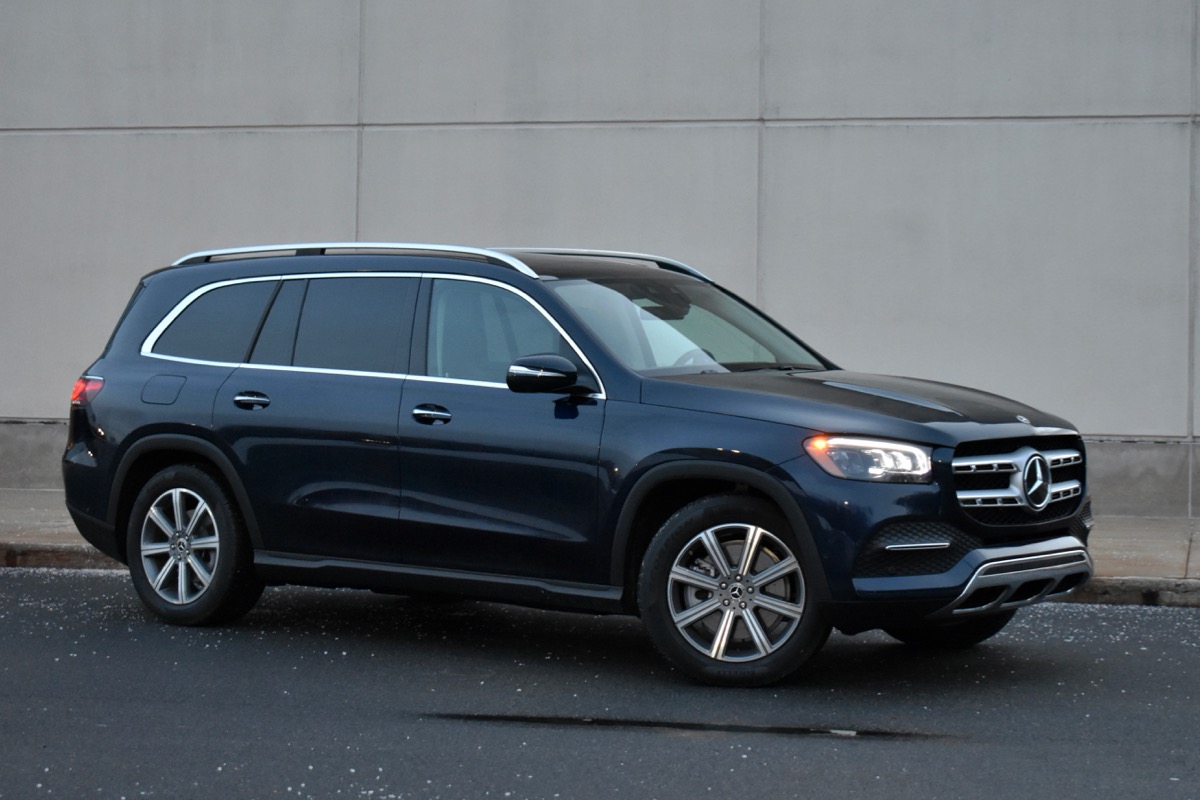
In base GLS 450 form, that makes for a more subtle, less flashy look than the chrome-laden Cadillac Escalade, Land Rover Range Rover, or Lincoln Navigator. Mercedes was also confident enough to avoid a gaudy grille like protruding proboscises of the BMW X7 or Lexus LX.
However, with other GLS models expected to return to showrooms soon, new car buyers will soon have the option for a bit more visual drama. The AMG GLS 63 performance model gets flared wheel arches, a more muscular grille and front bumper, prominent rectangular exhaust tips, and AMG-specific 21-inch wheels. The Maybach version gets chrome everywhere, including the grille, window trim, and front-bumper mesh. It also gets a more traditional-looking hood ornament and power running boards, and is available with massive 23-inch wheels.
Similarly, the Maybach model is available with added luxuries like reclining rear seats, while the AMG version gets a more performance-oriented interior, with stainless steel trim and heavily bolstered Nappa leather seats. Mercedes’ Air Balance Package perfume spritzer is also on the options list.
Our test car had a fairly basic interior by GLS standards, but it still looked pretty nice. It didn’t have reclining seats, but the (non-Nappa) leather upholstery, panoramic roof, and ambient lighting made the interior feel properly luxurious. We also liked some of the details, such as the intricate speaker grilles for the audio system, and the use of rectangular air vents, a more rugged touch in line with an SUV interior.
As with most other Mercedes models, the GLS also gets a digital instrument cluster and infotainment touchscreen housed together under one piece of glass. But we think this is the best integration of this hardware so far, thanks to an upright dashboard that frames the screens nicely.
Overall, the GLS 450’s interior felt appropriate for a luxury SUV. While perhaps too subdued for the nouveau riche (especially with our test car’s all-black trim), it felt high quality without being fragile. We could easily imagine ourselves surveying a country estate from behind the GLS’ three-spoke steering wheel.

Performance
The GLS 450 has a 3.0-liter turbocharged inline six-cylinder engine and nine-speed automatic transmission, assisted by Mercedes’ EQ Boost mild-hybrid system. The gasoline engine produces 362 horsepower and 369 pound-feet of torque, and an electric motor can add 21 hp and 184 lb-ft of torque in short bursts. The electric motor also serves as the starter, allowing for a more aggressive engine start/stop system, and powers most accessories, reducing the engine’s workload.
Mercedes is also expected to resume production of the GLS 580 4Matic, AMG GLS 63, and Maybach GLS 600 4Matic, all of which uses a 4.0-liter twin-turbo V8, which produces up to 603 hp in the high-performance AMG version. All GLS models get standard 4Matic all-wheel drive (AWD), with a performance-tuned drivetrain for the AMG GLS 63.
We didn’t miss the V8 at all. The six-cylinder engine provided more than enough muscle to move this big SUV, and the electric assist was blended in nicely. Like the BMW X7 and the latest Range Rover, the GLS 450 also uses an inline-six rather than the more common V6. Owing to better balance, inline-sixes are inherently smoother than V6 engines, making them a perfect fit for luxury vehicles.
However, we were left wishing for a bit more luxury-car refinement from the suspension. The GLS gets standard air suspension, which can raise and lower the ride height and negate impacts from even the gnarliest potholes. But our test car exhibited poor body control, bouncing over bumps and leaning disconcertingly in corners. We weren’t expecting a sports car, but this was simply too much motion to be truly comfortable.
Mercedes quotes a 7,700-pound maximum towing capacity for the GLS 450. That should provide plenty of capability, but some other big luxury SUVs offer more. The Lexus LX, for example can tow up to 8,000 pounds, while the Lincoln Navigator has an 8,700-pound towing capacity in certain configurations.

Form & function
The GLS comes standard in a seven-seat configuration with a 60/40 split-folding second-row bench seat and two third-row seats. An optional six-seat version ditches the second-row bench for individual captain’s chairs.
Second-row seats can slide forward and fold for access to the third row, while the standard bench seat can slide fore and aft as one piece, increasing legroom by 3.4 inches, according to Mercedes. Thanks to a fairly long wheelbase, second-row legroom is the best among full-size luxury SUVs, and the GLS is competitive in other measurements.
The GLS offers 17.4 cubic feet of cargo space with all seats in place, and 84.7 cubic feet with the second and third rows folded. As these specs show, leaving the rear seats in place really eats into cargo space, but that’s the case with all three-row vehicles. Cargo space expands to 42.7 cubic feet with the third row folded, but that increases to 48.7 cubic feet if you slide the second-row seats all the way forward.
Cargo space is a bit behind the larger Cadillac Escalade and Lincoln Navigator, which use platforms from full-size pickup trucks. Mercedes makes loading and unloading cargo easy, though, with one-touch power-folding second-row and third-row seats and a power tailgate. The GLS’ air suspension can also lower, which makes it easier to get things into the cargo area.
Overall, the GLS is well equipped to move people and stuff, but we did find a few small ergonomic issues. We liked the way the touchscreen/instrument cluster display combination looked, but the touchscreen was too far away to reach easily. The center console had grab handles with no obvious purpose. And while Mercedes included clever two-piece sun visors with forward and side-facing elements, they weren’t big enough to actually block the sun.

Technology
The standard Mercedes-Benz User Experience (MBUX) infotainment system includes a 12.3-inch touchscreen, 12.3-inch digital instrument cluster, Bluetooth, Apple CarPlay/Android Auto connectivity, navigation, SiriusXM satellite radio, and natural-language voice recognition. A 13-speaker Burmester audio system is standard as well, while a head-up display is optional.
Mercedes gives users lots of choices, including voice recognition, to a touchpad controller, small touchpads on the steering wheel, and the touchscreen itself. We found the voice recognition system, which responds to the prompt “Hey Mercedes,” to be the easiest. Mercedes’ system understands normal speech better than most, and it means you don’t have to take your eyes off the road or your hands off the wheel.
It also means avoiding the cumbersome touchpad controller. Designed primarily for scrolling through menus, we found it to be too sensitive to use easily. It was much more difficult than the rotary controllers used by some other automakers for similar tasks.
Both the touchscreen and instrument cluster had good-looking graphics, although it’s worth noting that Mercedes hasn’t given the GLS the augmented-reality navigation feature available in the latest S-Class sedan, which projects arrows showing you where to turn. Bizarrely, the embedded navigation system also suggested a route that would have added an hour to a trip for no apparent reason. We haven’t encountered this problem in other Mercedes vehicles, but it certainly drained our confidence in the GLS’ navigation system.

Safety
Standard safety features include forward collision warning, automatic emergency braking, a driver-attention monitor, automatic high beams, blind-spot monitoring (which can also warn if it’s unsafe to open a door when parked), a surround-view camera system, Crosswind Assist (corrects for wind buffeting), parking assist, and Pre Safe, which tightens the seat belts, closes the windows and sunroof, and adjusts seats in anticipation of a rollover. The audio system also emits a “pink noise” engineered to protect the ears from loud noises during a collision.
Despite that long list of features, Mercedes still leaves a lot on the table. You’ll have to pay extra for adaptive cruise control, lane-keep assist, and second-row side airbags, as well, as Mercedes’ more advanced driver-assistance features. Some of these optional features include Active Steering Assist automated lane centering, Evasive Steering Assist, Active Lane Change Assist, Trailer Stability Assist, Active Blind Spot Assist (which pulls the car back into its lane if another vehicle is detected), and Active Emergency Stop Assist (slows the car to a stop if the driver becomes unresponsive).
Crash-test ratings from the Insurance Institute for Highway Safety (IIHS) and National Highway Traffic Safety Administration (NHTSA) weren’t available at the time of publication.

Cost-effectiveness
EPA fuel-economy ratings for the Mercedes-Benz GLS 450 4Matic are 20 mpg combined (18 mpg city, 24 mpg highway). Despite the mild-hybrid system, this is still a big, heavy, boxy vehicle, so these fairly poor fuel-economy ratings aren’t too surprising. You’re not going to do any better with other large SUVs.
Ratings for the V8 models aren’t available because Mercedes initially withheld them from the U.S. For reference the 2021 GLS 580 4Matic was rated at 18 mpg combined, while the AMG and Maybach versions were both rated at 16 mpg combined.
Mercedes offers a four-year, 50,000-mile, basic warranty and four-year, 50,000-mile, powertrain warranty.
Pricing starts at $78,900, including a mandatory $1,050 destination charge. Our test car had a few options, including leather upholstery, second-row side airbags, heated/cooled front cupholders, a heated steering wheel, panoramic roof, massaging front seats, a head-up display, five-zone climate control, heated rear seats, and soft-close doors. That brought the as-tested MSRP to $87,660.
The GLS 450 does come fairly well-equipped. Most of the optional features listed above don’t fundamentally change the driving experience; more relevant features like AWD, air suspension, and a surround-view camera system are standard. However, Mercedes also makes buyers pay extra for some key features—such as leather seating and adaptive cruise control—that should be standard on a flagship SUV.
Overall, though, the GLS is a solid luxury SUV. It’s not as pretentious as the somewhat gimmicky BMW X7, and has more manageable packaging than the behemoth Cadillac Escalade, Infiniti QX80, and Lincoln Navigator. However, new versions of the Lexus LX and Range Rover are hitting showrooms, both with greater off-road capability than the GLS and a big dose of luxury. So Mercedes may soon have to fight to keep its place in the full-size luxury SUV pecking order.


What owners say
This is an amazing vehicle. It has comfort and class plus power. Love it!
August 23, 2022Major improvement over prior models … driver assist substantially better
June 7, 2022Cool looking, Mercedes quality, spacious, comfortable, excellent performance and dependable.
July 20, 2023Trims & specs
Base MSRP $101,250 | Seating 7 |
Engine 4.0L 483 hp V8 | Cargo Capacity 17.4 cu ft |
Combined MPG 18 | Drivetrain AWD |
Base MSRP $135,400 | Seating 7 |
Engine N/A | Cargo Capacity 17.4 cu ft |
Combined MPG N/A | Drivetrain N/A |
Base MSRP $77,850 | Seating 7 |
Engine 3.0L 362 hp I6 | Cargo Capacity 17.4 cu ft |
Combined MPG 21 | Drivetrain AWD |
Base MSRP $165,100 | Seating 5 |
Engine 4.0L 550 hp V8 | Cargo Capacity 18.4 cu ft |
Combined MPG 17 | Drivetrain AWD |


Pricing trends
MSRP range
$77,850 - $165,100
Current avg. market price
$45,820
Trending down by 1.4% this month
May 2026 - November 2026


