2022 Mazda MX-30 Reviews, Pricing & Specs
Write a reviewPros
Standard advanced safety features
Great handling
Cons
Unimpressive electric range
Cramped back seat
Potentially polarizing design
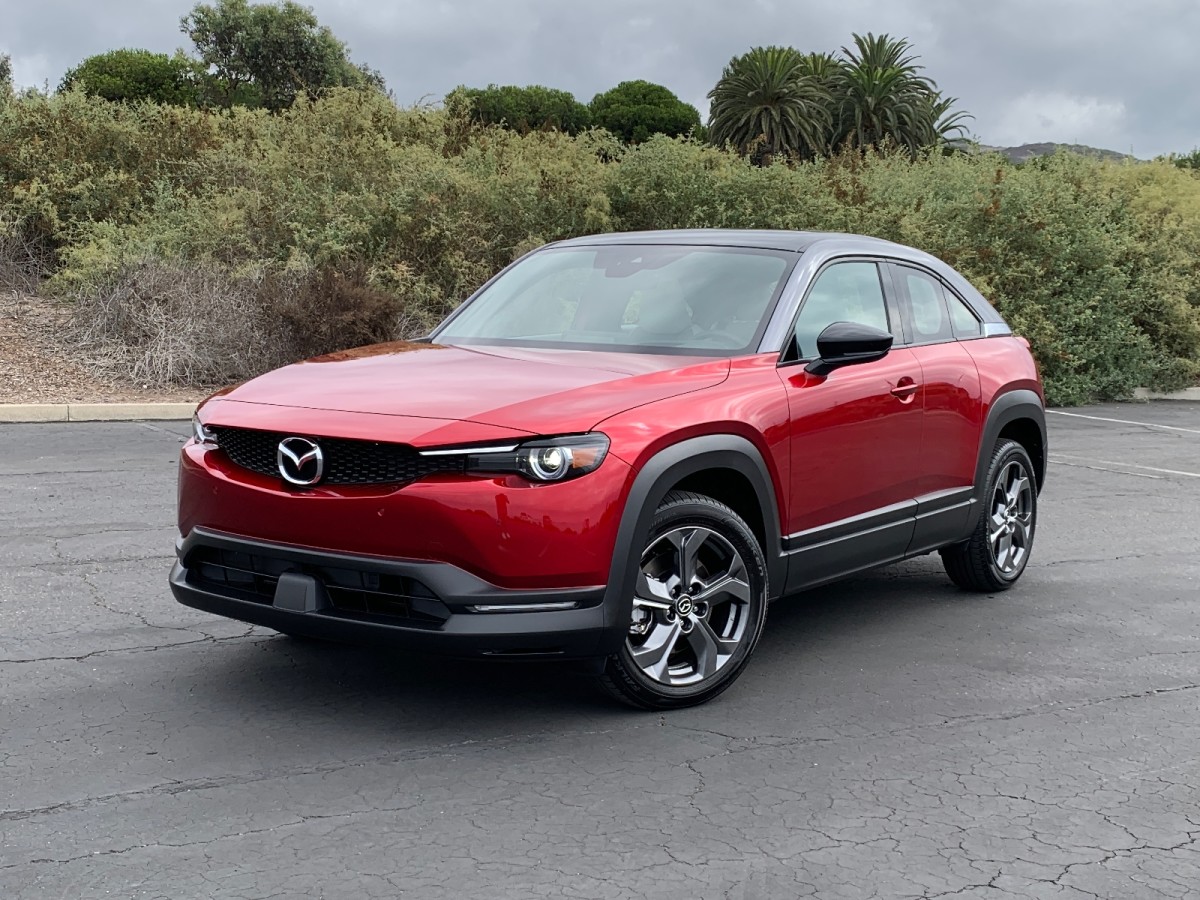
Fun but flawed, the 2022 Mazda MX-30 EV is the automaker’s first, tentative step on its path to electrification.

Mazda bases the new 2022 MX-30 on the same platform it uses for the Mazda Mazda3 and the Mazda CX-30. There are several reasons for this, but the main one is that the Japanese automaker’s scalable EV architecture won’t be ready until 2025. In the meantime, Mazda needs to start electrifying its lineup using existing platforms.
The MX-30 EV shown here is one of two versions of the front-drive crossover that Mazda is bringing to the U.S. market. It goes on sale in California on October 14, 2021. The other is a plug-in hybrid version with a rotary engine range extender that Mazda will offer nationwide for the 2023 model year, while also expanding availability of the MX-30 EV.
Built to house various powertrains across global markets, the MX-30’s body style and proportions are perplexing. It’s got a fastback-style rear hatch with a roofline that looks like a coupe's, freestyle doors reminiscent of Mazda’s defunct RX-8 sports car, the excessive body cladding used on the CX-30, a narrow grille, and rather plain design forms in comparison to other Mazdas. The MX-30 looks better in person than it does in photos, but it’s not instantly attractive like other Mazdas are.
Open a door, and all is once again right with the world. Mazda uses recycled PET bottles, recycled thread, and cork for elements of the MX-30’s interior, but the end result is stylish, appealing, and upscale. Just know that the freestyle doors are a hassle when trying to load and unload passengers in tight parking situations.
Overall, the interior layout is reminscent of the Mazda CX-30's, but the center console is unique to the MX-30. Aside from its cork trim, it has a digital climate control panel flanked by physical buttons for primary controls, a control pod with a shifter and Mazda Connect infotainment controls, and a pair of cupholders. Underneath, a large cork-lined tray offers storage. Secondary climate functions, such as those for the heated seats and steering wheel, are on the digital climate panel, seemingly in refutation of Mazda’s claim that touchscreens are too distracting to drivers.
Prices are appealing, especially when you factor in the $7,500 federal income tax credit, $1,500 state of California rebate, and a $500 credit with Chargepoint for use at public charging stations or to install a Level 2 charger at home. The Mazda MX-30 Elite Access Loaner Program is available for the first three years of ownership, providing 10 days of complimentary access to other Mazda models at your local dealership (similar to Toyota's program for Mirai owners). That way, when you have a long way to go and a short time to get there, you can use something other than your MX-30 EV.
The MX-30 EV has a base price of $33,470, plus a destination charge of $1,175. A Premium Plus package adds $3,010 to the price and equips the MX-30 EV with upgraded driving assistance and safety features, a nicer-looking wheel finish, more infotainment functions, a premium sound system, and more.
Our MX-30 EV Premium Plus had extra-cost paint and a navigation system, bringing the total price to $39,100 including destination fees but excluding available tax, rebate, and Chargepoint incentives. Apply all available credits, and our loaded MX-30 EV slips under the $30,000 mark.

Considering the lustrous quality of the MX-30 EV’s paint, the upscale interior, and the generous list of infotainment and safety technology features, that price is a genuine bargain.
But…
You can only travel about 100 miles on a full charge. That’s the compromise you make in exchange for the appealing price tag.
Mazda knows this is a limitation, which is why it plans to market the MX-30 EV as a stylish and affordable EV for urban and suburban use. The target customer is someone who has a predictable commute during the week and will use the MX-30 for local errand runs and nearby adventures on the weekends.
According to Mazda, the average American commutes about 30 miles each day. Add another 30 miles for lunch outings and other detours like a child’s soccer game, and if our experience is any indication, the MX-30 EV easily accommodates that lifestyle. We started our drive in Orange County, California with 99 miles of indicated range, traveled from Irvine to Laguna Beach, up the coast to Newport, and across the county to the mountains and back to Irvine with plenty of charge to spare. Our route put 62 miles on the MX-30 EV, and we had 42 miles left in the battery.
Mazda says it takes a little under 14 hours to recharge a nearly empty battery when using a standard household power outlet. If you use half the battery charge every day, and plug it in every night, the MX-30 EV will always be fully charged in the morning.
Alternatively, use your Chargepoint credit to upgrade to a Level 2 home charging station, and you can recharge the crossover in under three hours. That same time applies to a public charging station. Pull up to a 50-kW DC fast charger, and you’ll go from 20% capacity to 80% capacity in 36 minutes.
Mazda has crammed as much battery power as possible into the front-wheel drive MX-30’s platform. It has 35.5 kWh of capacity, which juices an electric motor making 143 horsepower (107 kW) and 200 pound-feet of torque (270 Nm). Acceleration is brisk, but you’re not going to want to challenge the Tesla Model 3 in the next lane over, let alone a Chevrolet Bolt EV (which compares favorably with 200 hp and 266 lb-ft of torque).
Outright acceleration is not the MX-30 EV’s talent. Rather, you’ll derive pleasure from its traditional Mazda driving dynamics. Like other EVs, the MX-30 benefits from a lower center of gravity and improved weight distribution. But a new electronic version of Mazda’s G-Vectoring Control (e-GVC), combined with the automaker’s sharp attention to tuning detail and adherence to “minimum jerk theory,” contributes to the MX-30 EV’s smooth, swift, and sophisticated ride and handling qualities.
Though you can still sense the battery pack's added 683 pounds, the MX-30 EV mostly avoids the choppy ride that often accompanies an electric propulsion system.
Furthermore, the e-GVC system’s imperceptible weight transfer activities result in genuinely athletic back-road driving characteristics. Mazda also says that the MX-30 EV’s steering is more responsive compared to a gas-powered CX-30, thanks to a stiffer vehicle structure and a weight distribution ratio that puts 60% of the crossover’s heft on the rear wheels (in the CX-30, 60% is over the front wheels).
Mazda uses a brake-by-wire system in the MX-30 EV. This eliminates the traditional mechanical connection between the brake pedal and the braking system in favor of electronic sensors and actuators. Sometimes, this results in artificial and dissatisfying pedal feel, but based on our experience in the MX-30 EV, Mazda got this detail right. You can’t tell the difference.
The MX-30 EV does not offer true one-pedal driving capability. However, there are five stages of regenerative braking, ranging from almost none to plenty. Use the paddles on the steering wheel to select the strongest setting, and you can bring the MX-30 EV down to 3 mph, but not to a complete stop. The brake lights will illuminate depending on deceleration g-force.
During our drive, the Mazda MX-30 EV’s acceleration, passing power, ride, and handling were more than just adequate. This is an enjoyable EV to drive, as long as outright speed isn't what you seek. The only downside is that you can only drive it 100 miles before you need to charge it up.
But it's got a nicer interior than any Chevy Bolt EV or Nissan Leaf, that’s for sure.

If you’re parked in a typical lot with other vehicles on either side, using the MX-30’s freestyle doors is a real hassle. They open clamshell-style, a design that isn’t conducive to tight parking situations. Access to the back seat is restrictive, too, and if you load people from the driver’s side, you’ll need to power the seat forward and wait. The front passenger’s seat has manual adjustment.
Sit up front, and the Mazda MX-30 feels airy and spacious. Sit in the back, however, and if you’re an adult, you’ll feel cramped. The seat itself is comfortable, but legroom is limited, so if the front-seat occupants are tall, the rear-seat occupants had better be small. The MX-30 doesn’t have rear air vents or USB charging ports, either. But the rear seatbacks are padded and friendly to knees and shins.
Storage space is good, but it isn’t always readily accessible. From the driver’s seat, it’s hard to see the cork-lined tray under the center console control pod. If you don’t need to use the cupholders, close the cork-surfaced lids and use the resulting tray as a place for your smartphone. Rear passengers can use small bins molded into the rear door panels for their storage needs.
Open the MX-30 EV’s hatchback-style trunk, and you’ll find a 21 cubic-foot cargo hold that expands further, thanks to a 60/40-split folding rear seat.

Mazda equips the new MX-30 with the latest version of Mazda Connect, the automaker’s infotainment technology. It pairs an 8.8-inch static display screen with controls on the center console and steering wheel. A touchscreen is not available, and natural voice recognition technology is also unavailable, unless you’re connected to the wired Apple CarPlay or wired Android Auto smartphone mirroring systems.
Modeled after the infotainment system designs that first appeared to tremendous criticism in German luxury cars two decades ago, Mazda Connect has a steep learning curve. In order to minimize interaction with it, MX-30 owners should be sure to select preferred settings sooner than later.
Also, while you can adjust the stereo volume using a dedicated knob on the center console or buttons on the steering wheel, there isn’t a corresponding solution for changing radio stations. In our experience, this forces you to push and twist the Mazda Connect control knob too many times in order to access your list of favorite stations. And when you do, it always defaults to the first station on the list instead of the station you’re currently enjoying.
While Mazda Connect’s lack of a touchscreen, a useful voice recognition system, or the simple and logical interface of a modern BMW iDrive system are cause for frustration, the available 12-speaker Bose Centerpoint 2 premium sound system is cause for celebration. It’s included with the Premium Plus package, along with satellite radio.
Mazda Connected Services and a MyMazda smartphone app are also standard in the MX-30 EV. Complimentary for three years, they allow the EV’s owner to pre-heat or pre-cool the cabin before driving, remotely access the locks, remotely start and stop vehicle charging, set up automatic 911 emergency calling, and enjoy a short free trial of Wi-Fi hotspot access before you’ll need to pay extra.
Get the available navigation system, and the map display will show nearby charging stations. You can even check station availability through the smartphone app and send directions to the MX-30 EV’s navigation system via the app.
Our test vehicle also had a helpful head-up display that showed plenty of information, including visual warnings of lane departures and other vehicles in the blind spots, the speed limit on a particular section of road, and more. Test-drive day was cloudy, so we did not assess it for visibility when the driver wears polarized sunglasses.

Mazda equips every MX-30 EV with i-ActiveSense, the automaker’s collection of advanced driving assistance systems (ADAS).
The roster includes now-expected features like forward-collision warning, automatic emergency braking, lane-keeping assistance, and blind-spot warning systems. Adaptive cruise control with stop-and-go capability is also standard, along with automatic high-beam headlights.
More uncommon, an adaptive front lighting system is standard, along with rain-sensing wipers, rear cross-traffic warning with automatic braking, and a panic button on the key fob.
Add the Premium Plus package, and the MX-30 EV adds an active Blind Spot Assist system and a front cross-traffic alert system. Both features are new to Mazda and debut on the MX-30 EV. Additionally, the Premium Plus model has a driver monitoring system, a surround-view camera system, and front parking sensors to complement the standard rear parking sensors.
Yeah, so, lots of safety equipment. But, how well does this stuff work?
During our driving, we sampled as many of the ADAS features as we safely could, and they worked well. In particular, the subtle steering wheel vibration indicating a lane departure is effective instead of irritating, and the adaptive cruise control works just as smoothly as the MX-30 drives. Similarly, the front cross-traffic warning system is noticeable, but its audible alert doesn’t jolt a driver into a state of panic. Essentially, i-ActiveSense works in the background and encourages rather than discourages its use.
As this review is published, crash-test ratings for the new MX-30 EV are unavailable.

You can, in theory, park a new Mazda MX-30 EV in your driveway for as little as $25,645. This assumes you live in California, qualify for that state’s $1,500 EV rebate, and will owe at least $7,500 on your federal income taxes in order to claim the full credit.
Add $500 in free charging plus any negotiated discounts during the purchase and take into consideration that you’ll save plenty because you’ll no longer visit gas stations and oil change shops, and this is a mighty affordable electric vehicle. Better yet, it doesn’t look or feel cheap, inside or out.
However, competitors like the MINI Cooper SE have better EPA range estimates, and some, like the Hyundai Kona Electric and Kia Niro EV, have more than double the range. Unless you live a predictable life or you’re a member of the newly minted work-from-home club, the Mazda MX-30 EV likely works best as a second vehicle and not as a primary mode of transportation. Charge it up each night using a standard power outlet, and it will serve you well as a daily driver.

User reviews for 2022 Mazda MX-30
Write a review2022 Mazda MX-30 Pricing
Trims & specs
Air Conditioning
Sun sensor climate control front air conditioning · Single front air conditioning zones
Airbags
Dual front airbags · Dual front knee airbags · Passenger airbag deactivation: occupant sensing deactivation · Rear side airbags · Front side curtain airbags
Audio System
Antenna Type: mast · Voice recognition audio system · USB auxiliary audio input · Pandora internet radio · AM/FM radio · Total Number of Speakers: 8
Brakes
ABS: 4-wheel · Braking assist: hill start assist · Electronic parking brake: auto off · Front brake diameter: 12.8 · Front brakes: ventilated disc · Rear brake diameter: 11.9 · Rear brakes: ventilated disc
Comfort Features
Armrests: rear center with cupholders · Floor Mat Material: carpet · Floor Material: carpet · Floor Mats: front · Shift knob trim: leather · Steering wheel trim: leather
Convenience Features
Adaptive stop and go cruise control: semi-automatic · Assist handle: rear · Center console: front console with armrest and storage · Cruise control: adaptive · Cupholders: rear · Dimming rearview mirror: auto-dimming · Memorized settings: driver seat · Multi-function remote: keyless entry · One-touch windows: 4 · Power outlet(s): 12V front · Power steering: speed-proportional · Power windows: lockout button · Reading lights: front · Steering wheel: tilt and telescopic · Steering wheel mounted controls: audio · Storage: front seatback · Vanity mirrors: dual illuminating
Driver Seat
Adjustable lumbar support: 4-way power · Power adjustments: 8
Drivetrain
Axle ratio: 9.99
Engine
EV battery capacity: 35.5 kWh · Electric Charge Cord: 120 volt · Electric Motor Battery Type: lithium ion · Electric Motor HP: 143 · Electric Motor Power Output (Kilowatts): 107 · Electric Motor Torque: 200 · Electric motor charger: DC fast charging · Electric motor charger connector: SAE Combo CCS · Electric motor charging time (120V): 14 hours · Electric motor charging time (240V): 5.3 hours · Electric motor miles per charge: 100
Exterior Features
Door handle color: body-color · Fender lip moldings: black · Front bumper color: body-color · Grille color: black · Mirror color: black · Rear bumper color: body-color · Rear spoiler: roofline spoiler · Rear spoiler color: black · Rear trunk/liftgate: liftgate · Rocker panel color: black · Side door type: dual rear-hinged access · Window trim: black
Headrests
Front headrests: adjustable · Number of front headrests: 2 · Number of rear headrests: 3
In Car Entertainment
Connected in-car apps: Google search · Infotainment: Android Auto ready · Infotainment screen size: 7 in.
Instrumentation
Fuel economy display: range · Instrument cluster screen size: 8.8 in. · Warnings and reminders: lamp failure
Lights
Daytime running lights: LED · Exterior entry lights: security approach lamps · Headlights: Auto on/off · Tail and brake lights: LED
Mirrors
Exterior mirrors: integrated turn signals
Passenger Seat
Manual Adjustments: 4
Rear Seats
Type: 60-40 split bench
Roof
Moonroof: anti-trapping feature
Safety
Automatic emergency braking: front · Camera system: rearview · Child seat anchors: LATCH system · Cross Traffic Alert: rear · Crumple zones: front · Impact absorbing seats: dual front · Impact sensor: door unlock · Parking sensors: rear · Pre-Collision Warning System: visual warning · Pre-collision warning system: pedestrian detection · Rearview monitor: in dash
Seatbelts
Emergency locking retractors: front and rear · Front seatbelts: 3-point · Seatbelt force limiters: front · Seatbelt pretensioners: front · Seatbelt warning sensor: driver and passenger · Second row seatbelts: 3-point
Seats
Driver seat power adjustments: height · Front seat type: bucket · Passenger seat manual adjustments: height · Rear headrests: adjustable · Rear seat folding: split · Upholstery: leatherette · Upholstery accents: cloth
Spare Tire
Mount Location: inside · Size: temporary
Spare Wheel
Rim Type: steel
Suspension
Front Arm Type: lower control arms · Front Shock Type: twin-tube gas shock absorbers · Front Spring Type: coil springs · Front Suspension Classification: independent · Front Suspension Type: MacPherson struts · Rear Shock Type: twin-tube gas shock absorbers · Rear Spring Type: coil springs · Rear Suspension Classification: semi-independent · Rear Suspension Type: torsion bar · Stabilizer bar(s): front
Telematics
Driver assistance app: roadside assistance · Electronic messaging assistance: with read function · Navigation system: with voice recognition · Phone: voice activated · Phone wireless data link: Bluetooth · Smart device app compatibility: MyMazda · Smart device app function: maintenance status
Tires
Type: all season
Tires and Rims
Wheels: painted aluminum
Windows
Front wipers: rain sensing · Liftgate window: fixed · Power windows: with safety reverse · Rear wiper: with washer
Air Conditioning
Automatic climate control front air conditioning · Single front air conditioning zones
Airbags
Dual front airbags · Dual front knee airbags · Passenger airbag deactivation: occupant sensing deactivation · Front side airbags · Front side curtain airbags
Audio System
Antenna Type: diversity · Voice recognition audio system · Bluetooth auxiliary audio input · Pandora internet radio · Premium Brand: Bose · HD radio · Satellite Radio: SiriusXM · 1 subwoofer · Total Number of Speakers: 11
Brakes
ABS: 4-wheel · Braking assist: hill start assist · Electronic parking brake: auto off · Front brake diameter: 12.8 · Front brakes: ventilated disc · Rear brake diameter: 11.9 · Rear brakes: ventilated disc
Comfort Features
Armrests: rear center with cupholders · Floor Mat Material: carpet · Floor Material: carpet · Floor Mats: front · Shift knob trim: leather · Steering wheel trim: leather
Convenience Features
Adaptive stop and go cruise control: semi-automatic · Assist handle: rear · Center console: front console with armrest and storage · Cruise control: adaptive · Cupholders: rear · Dimming rearview mirror: auto-dimming · Memorized settings: side mirrors · Multi-function remote: proximity entry system · One-touch windows: 4 · Power outlet(s): USB front · Power steering: electric · Power windows: lockout button · Reading lights: front · Steering wheel: tilt and telescopic · Steering wheel mounted controls: audio · Storage: door pockets · Universal garage door opener: Homelink · Vanity mirrors: dual illuminating
Driver Seat
Adjustable lumbar support: 4-way power · Power adjustments: 8
Drivetrain
Axle ratio: 9.99
Engine
EV battery capacity: 35.5 kWh · Electric Charge Cord: 120 volt · Electric Motor Battery Type: lithium ion · Electric Motor HP: 143 · Electric Motor Power Output (Kilowatts): 107 · Electric Motor Torque: 200 · Electric motor charger: DC fast charging · Electric motor charger connector: SAE Combo CCS · Electric motor charging time (120V): 14 hours · Electric motor charging time (240V): 5.3 hours · Electric motor miles per charge: 100
Exterior Features
Door handle color: body-color · Fender lip moldings: black · Front bumper color: body-color · Grille color: chrome surround · Mirror color: black · Rear bumper color: body-color · Rear spoiler: roofline spoiler · Rear spoiler color: black · Rear trunk/liftgate: liftgate · Rocker panel color: black · Side door type: dual rear-hinged access · Window trim: black
Headrests
Front headrests: adjustable · Number of front headrests: 2 · Number of rear headrests: 3
In Car Entertainment
Connected in-car apps: Google POIs · Infotainment: Android Auto ready · Infotainment screen size: 7 in.
Instrumentation
Fuel economy display: range · Instrument cluster screen size: 8.8 in. · Warnings and reminders: maintenance reminder
Lights
Daytime running lights: LED · Exterior entry lights: security approach lamps · Headlights: auto delay off · Tail and brake lights: LED
Mirrors
Exterior mirrors: driver side auto-dimming
Passenger Seat
Manual Adjustments: 4
Rear Seats
Type: 60-40 split bench
Roof
Moonroof: power glass
Safety
Automatic emergency braking: front pedestrian · Camera system: surround view · Child seat anchors: LATCH system · Cross Traffic Alert: front · Crumple zones: rear · Impact absorbing seats: dual front · Impact sensor: alert system · Parking sensors: front · Pre-Collision Warning System: audible warning · Pre-collision warning system: pedestrian detection · Rearview monitor: in dash
Seatbelts
Emergency locking retractors: front · Front seatbelts: 3-point · Seatbelt force limiters: front · Seatbelt pretensioners: front · Seatbelt warning sensor: driver and passenger · Second row seatbelts: 3-point
Seats
Driver seat power adjustments: height · Front seat type: bucket · Passenger seat manual adjustments: height · Rear headrests: adjustable · Rear seat folding: one-touch fold flat · Upholstery: leatherette · Upholstery accents: cloth
Security
Power door locks: anti-lockout
Spare Tire
Mount Location: inside · Size: temporary
Spare Wheel
Rim Type: steel
Suspension
Front Arm Type: lower control arms · Front Shock Type: twin-tube gas shock absorbers · Front Spring Type: coil springs · Front Suspension Classification: independent · Front Suspension Type: MacPherson struts · Rear Shock Type: twin-tube gas shock absorbers · Rear Spring Type: coil springs · Rear Suspension Classification: semi-independent · Rear Suspension Type: torsion bar · Stabilizer bar(s): front
Telematics
Driver assistance app: roadside assistance · Electronic messaging assistance: with voice recognition · Navigation system: with voice recognition · Phone: voice activated · Phone wireless data link: Bluetooth · Smart device app compatibility: MyMazda · Smart device app function: send destination to vehicle
Tires
Type: all season
Tires and Rims
Wheels: painted aluminum
Windows
Front wipers: rain sensing · Liftgate window: fixed · Power windows: with safety reverse · Rear wiper: intermittent

