2021 BMW M3 Reviews, Pricing & Specs




Pros & cons
What we like
Powerful engine
Manual transmission available
Fun to drive
What to consider
Poor ride quality
Poor fuel economy
Not much cargo space
The CarGurus verdict
Docile when you need it to be and ferocious when you want it to be, the 2021 BMW M3 Competition is multiple cars in one.
Anyone who tells you BMW doesn’t make authentic driver’s cars anymore hasn’t ripped down a favorite back road or circled a race track in the redesigned 2021 BMW M3. Granted, modern BMWs are not as analog as they once were, but name a vehicle that is. Yearning for yesteryear is pointless, and the luxury performance-sedan playing field remains as level as ever. On it, the new BMW M3 performs like a star running back, especially in Competition specification.
out of 10 expert review
Look & feel
Right off the bat, let’s address the elephant in the room: that grille. Not everyone is a fan. And it looks awful with a United States license plate sitting in the middle of it like Bugs Bunny’s front teeth. But we will admit that, with time, the front-end styling grows on you.
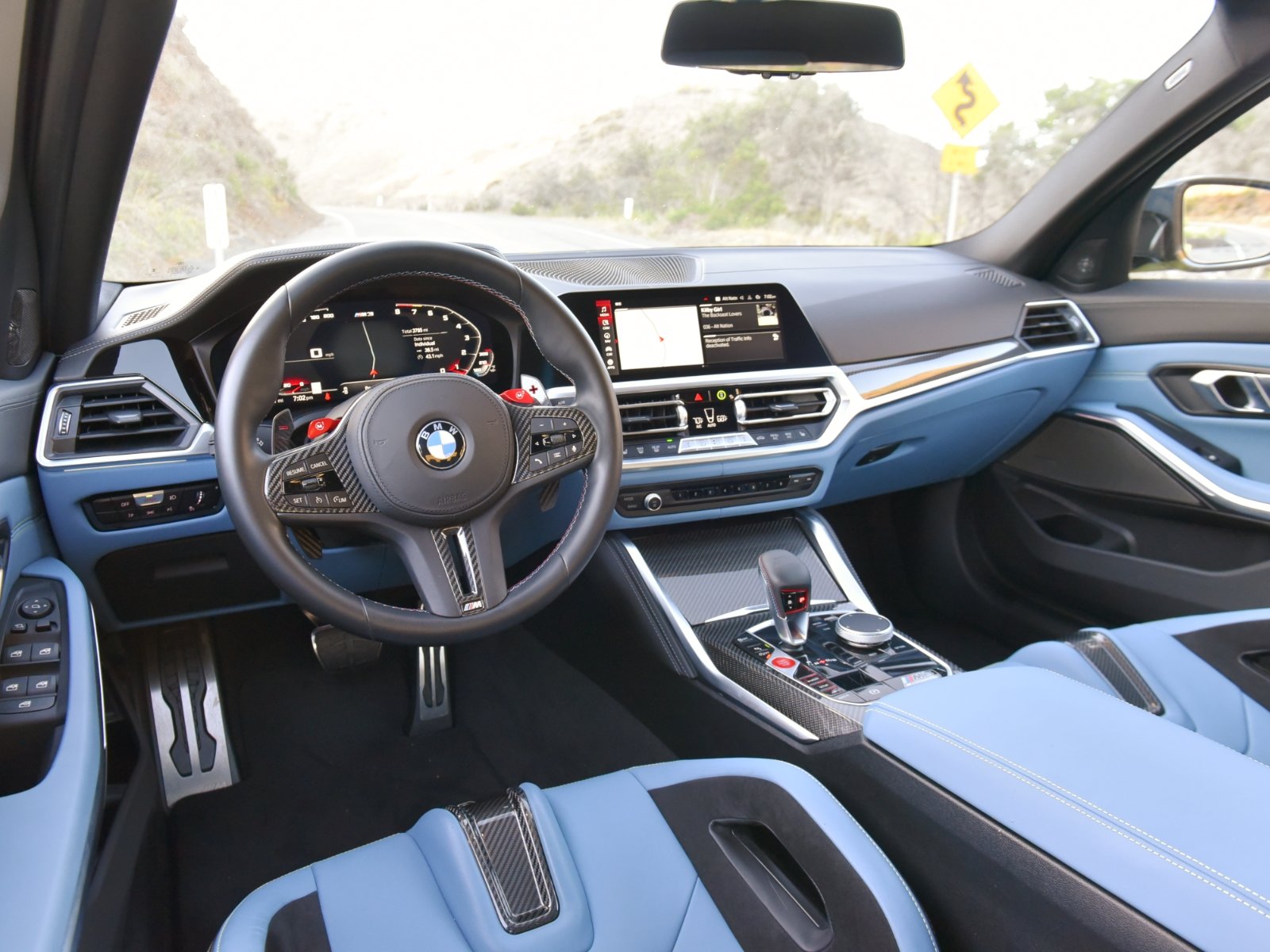
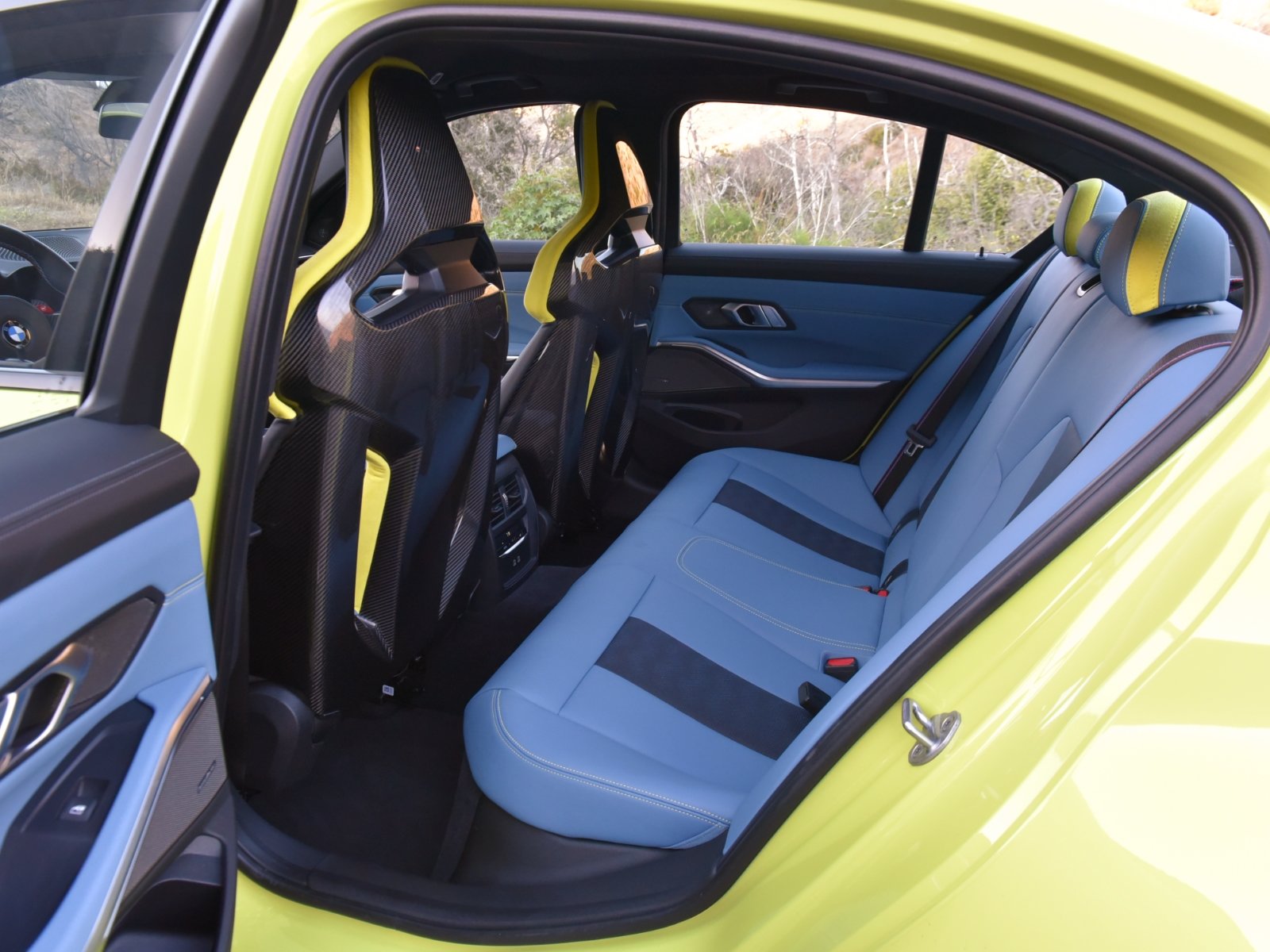
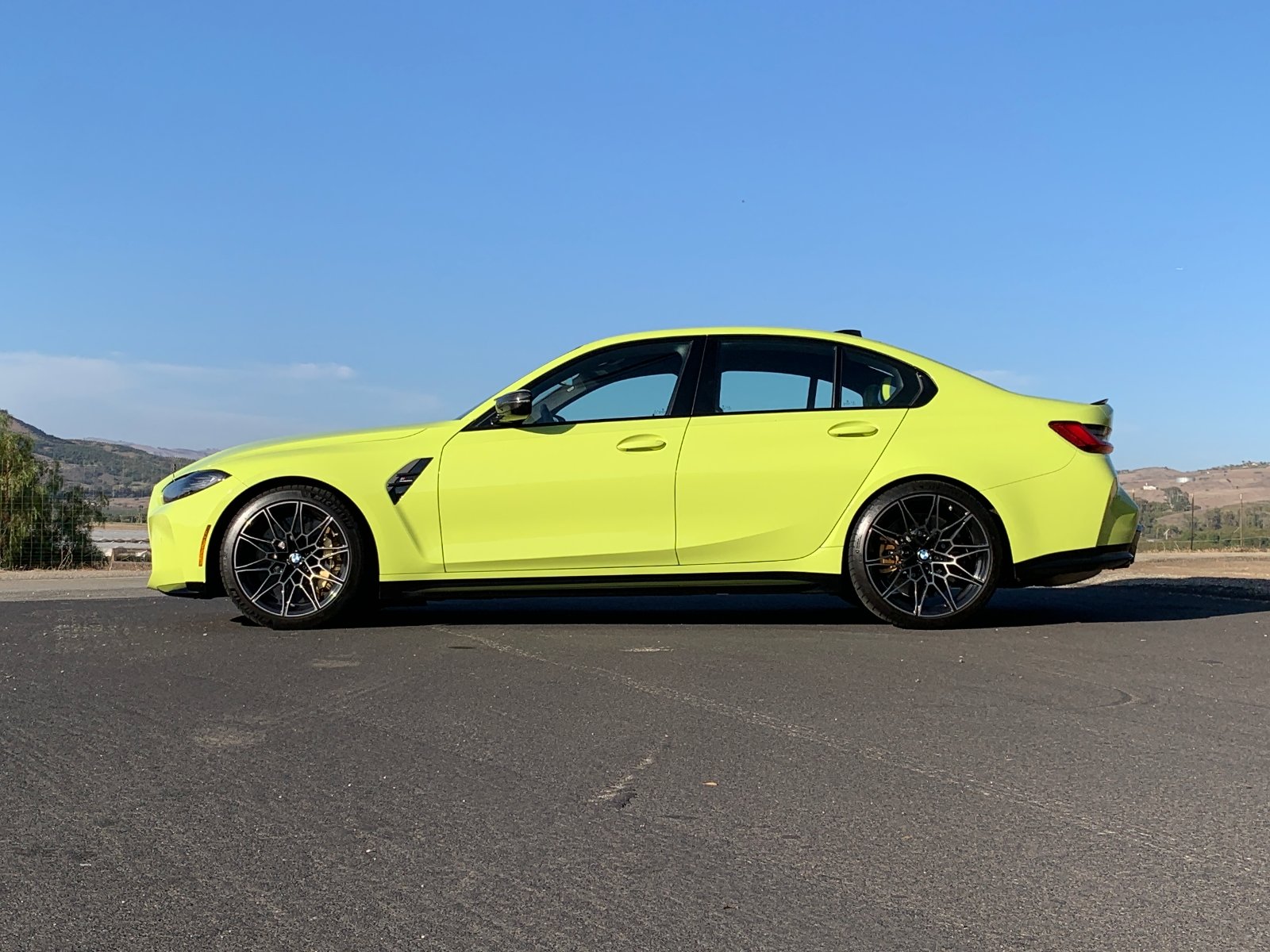
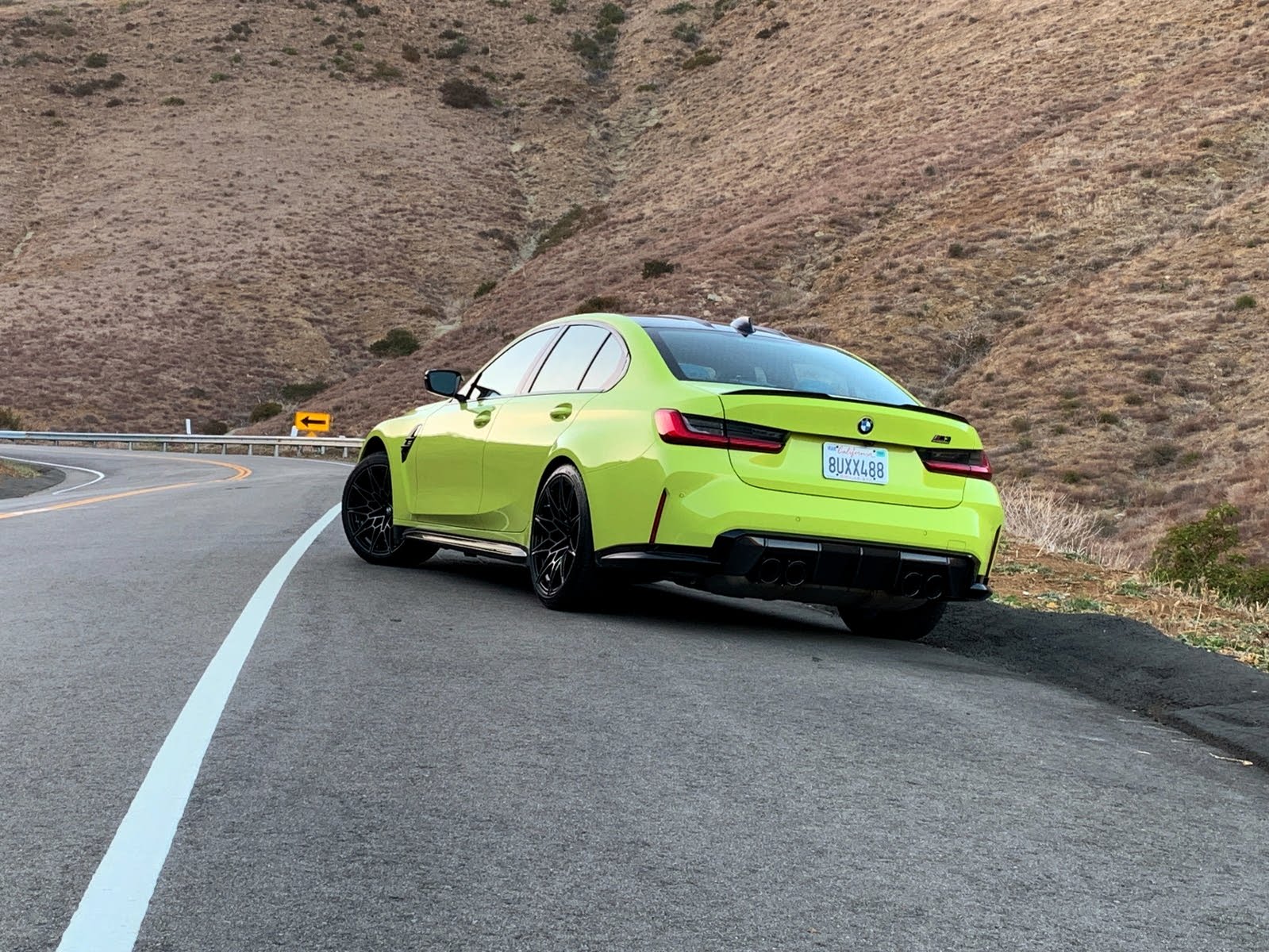
Oh, you thought we were going to comment about the Sao Paulo Yellow paint job? Yeah, that’s not good either. It’s like highlighter yellow with some lime green mixed in. And the test car also had Yas Marina Blue over Black premium leather upholstery with matching yellow accents, wrapped around the optional M carbon bucket seats. Driving this car around our sleepy Los Angeles suburb made us feel mighty conspicuous, and, when attempting to hoist a middle-aged dad-bod out of it with any semblance of dignity, slightly ridiculous.
Our 20-something pool guy liked it, though. When we asked his opinion, he said: “That car tells everyone you’ve got a lot of money.” So there you go. Introverts and the humble need not apply.
Of course, you need not spec your M3 like our test car. Instead, get one in Dravit Grey, stick with Black leather (or Silverstone for some contrast), and you’ll have yourself a fine-looking high-performance sedan. The dark paint even helps to hide the grille’s largess.
BMW charges a premium of $15,200 for the M3 compared to the M340i version of the 3 Series sedan. For the M3’s base price of $69,900, you get 91 more horsepower, 38 more pound-feet of torque, and acceleration to 60 mph in 4.1 seconds, instead of 4.4 seconds. However, fuel economy drops by 7 mpg to 19 mpg in combined driving.
There is also an M3 Competition model ($72,800) that bumps power another 30 horses and shaves the acceleration time down to 3.8 seconds, according to BMW. It also includes a standard eight-speed automatic transmission instead of the base M3’s six-speed manual transmission. If you can’t, or wish not to, operate a clutch pedal, the M3 Competition’s $2,900 premium makes choosing this version a no-brainer.
Our M3 Competition test car had plenty of extra equipment. In addition to the fancy leather and M carbon seats, BMW fitted it with the M Driver’s Package, M Drive Professional, M Carbon Ceramic Brakes, the M Carbon Exterior Package, carbon-fiber interior trim, and Shadowline headlights. With the $995 destination charge, the price tallied up to $97,645.
Performance
Driving the 2021 BMW M3 Competition is an unmitigated blast. It might have four doors, a functional back seat, and a reasonably-sized trunk, but it’s a legit sports car. The only way it could possibly be better is if it came in a wagon body style.
However, when the car wears Sao Paulo Yellow paint, you must be especially mindful of your speed. Everybody notices the M3 when it wears this paint color. Stealth driving is impossible. You might as well have signs on the doors that say: “Why yes, officer, I am going to drive too fast.” You’ll want to set the car’s speed warning system to remind you to keep velocity in check.
Not only that, everyone assumes you want to race. Especially, it seems, Tesla owners wishing to demonstrate how fast their electric cars are. It’s tiring.
Take the M3 Competition out for a rousing run when most people are at home, such as a weeknight in the hours before sunset, and you can explore the car’s potential in relative peace. We purposely choose the words “explore” and “potential” because it is impossible to safely reach the car’s limits on public roads. For that, you need a track.
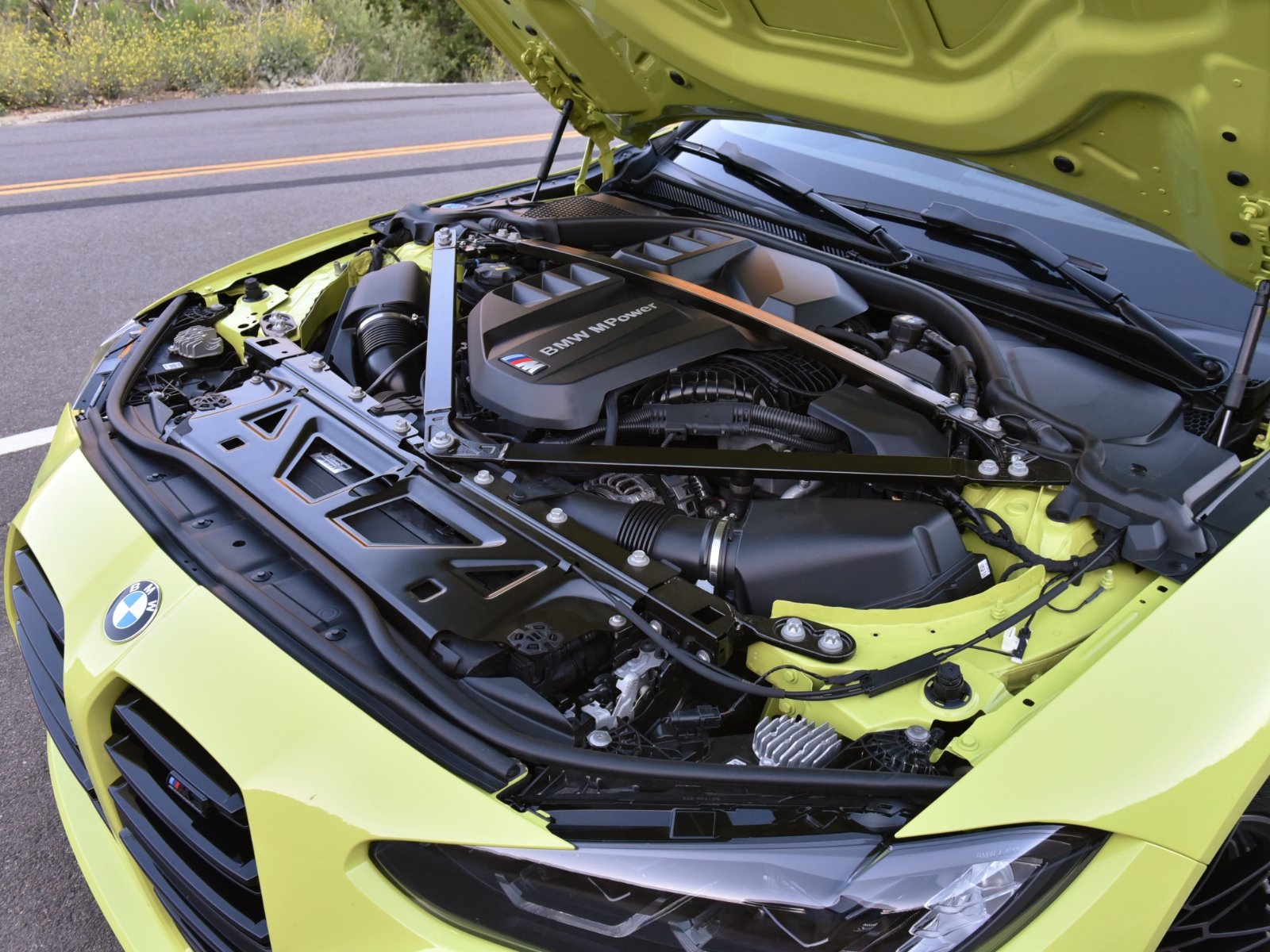
A standard M3 derives 473 horsepower and 406 pound-feet of torque from a twin-turbocharged 3.0-liter inline six-cylinder engine. Peak horsepower arrives at 6,250 rpm, and peak torque is available from 2,650 rpm to 6,130 rpm. A six-speed manual gearbox is standard and is the only transmission available for the M3 (the M3 Competition gets an automatic). The gearbox delivers the power to the rear wheels and features downshift rev-matching.
The M3 Competition uses the same twin-turbo inline six, but in this model, it generates 503 hp at 6,250 rpm and 479 lb-ft of torque between 2,750 rpm and 5,500 rpm. BMW says the increased torque requires the use of its eight-speed M Steptronic automatic transmission with Drivelogic, which offers multiple automatic and manual driving programs. The transmission powers the rear wheels, and in the M3 Competition, the top speed rises from 155 mph to 180 mph.
For the 2022 model year, an M-developed version of BMW’s xDrive all-wheel-drive system will be available for the M3 Competition. Frankly, we wished for this during our drive, as the added traction would’ve lent the car an extra sense of confidence when accelerating hard on winding mountain roads.
There is more to the BMW M3’s story than just the drivetrain. Engineers strove to maximize engine, oil, turbocharger, and brake cooling, and the performance exhaust system can be loud or quiet, depending on your preferences. We used the M Sound button to quell the car’s exhaust note as much as possible, and it works in any of the M3’s driving modes. After all, there’s not much sense in broadcasting your velocity, now is there?
Additionally, an adaptive performance suspension is standard, and you can choose settings for the ride, handling, brake sensitivity, and steering responsiveness. Depending on the component, you can select between Comfort, Sport, and Sport+ drive modes or program an Individual collection of calibrations the meet your specific requirements. An Efficient setting is also available to govern the powertrain, while an M mode button on the steering wheel provides immediate access to Road, Sport, and Track (Track is exclusive to the M Drive Professional option package).
Lastly, BMW offers a nod to wannabe drift kings painting black circles on roads from coast to coast. You can select from ten different stages of traction and stability control and then use the M Drift Analyzer to record the duration, distance, line, and angle associated with pitching the M3 sideways. Of course, BMW says you should only use this technology on a closed course, such as a track, and not in the middle of an intersection lined with spectators lacking any sense of self-preservation.
We did not perform track testing in the M3 Competition and cannot comment on the car’s at-the-limit driving characteristics. However, after nearly an hour traveling at a rapid clip on twisting two-lane mountain roads, our note-to-self was: “This is the most stupidly capable car we’ve driven in a long time.”
Part of this impression derives from the cognitive dissonance triggered by its 4-door sedan body style. Run the new Chevrolet Corvette or something like a Ford Mustang Shelby GT500 on the same roads, and you expect a certain amount of speed and a specific level of handling. But a BMW M3, regardless of its pedigree, still represents a dynamic surprise and delight because, at its heart, it’s a four-door family car.
So quick to respond and accurate and precise in its movements, the BMW M3 drives as though it can read your mind. Got an upcoming curve to get around? Before you’re aware that you’ve stepped on the brake pedal, the car is slowing down. Need to tighten your arc to cleanly clip the apex of the turn? The M3 reacts before you realize you’ve fine-tuned the steering input. Spot an opening in traffic that leads to a path around motorists who don’t know what the left lane is for? The speed-warning system is chiming before you’ve registered the additional velocity.
Our favorite setup for the car combined Comfort steering and braking settings with Sport mode for the powertrain and chassis. The suspension is firm and will cause the softer parts of you to jiggle, but it remains livable for daily driving.
We’d also note that we did not find the paddle shifters to be helpful. First, the automatic does a fine job on its own. Second, the M3 is capable of such incredible speed that we simply didn’t need one more thing to think about. Third, the paddles are not fixed to the steering column. If you prefer to shuffle steer, they can be hard to find.
The new BMW M3 rewards smooth, measured driving. Make sudden inputs, and it certainly feels as though the M3 might bite the hand that feeds it. However, drive it with respect and demonstrate a modicum of talent, and this brilliant machine proves immensely rewarding to drive.
Form & function
In the new M3, the controls are laid out in traditional BMW fashion, which is a nice way of saying there is a steep learning curve. From signaling lane changes and using the trip computer to shifting gears and setting the cruise control, BMW takes unusual approaches that require time and acclimation before they’re second nature. At least using iDrive isn’t nearly as onerous as it once was.
Choose the M3’s M carbon seats only if you’re planning to take your BMW to a track. Otherwise, save yourself $3,800 and stick with the standard front chairs. Though they are comfortable and incredibly supportive, the M carbon seats are also unyielding and have stiff side bolsters that are tough to gracefully clear when exiting the car.
Adults fit into the M3’s back seat, though when you’ve opted for the M carbon seats and their hard, unforgiving shells, people with longer legs will want to take care of their kneecaps when stepping into or getting out of the car. Passengers have their own climate control panel and air conditioning vents, and both foot and legroom are generous depending on how far back the people sitting in front recline their seats. The rear seat itself supplies a perfect backrest angle and thigh support for optimum comfort.
BMW says the M3’s trunk measures 13 cubic feet, on par with other compact sedans. The automaker encloses the trunk lid hinges to prevent accidental crushing of your belongings, and there are storage areas on each side of the load floor. In addition, a wide shelf spanning the width of the inner lid makes it easy to swing it shut without touching the exterior paint.
Technology
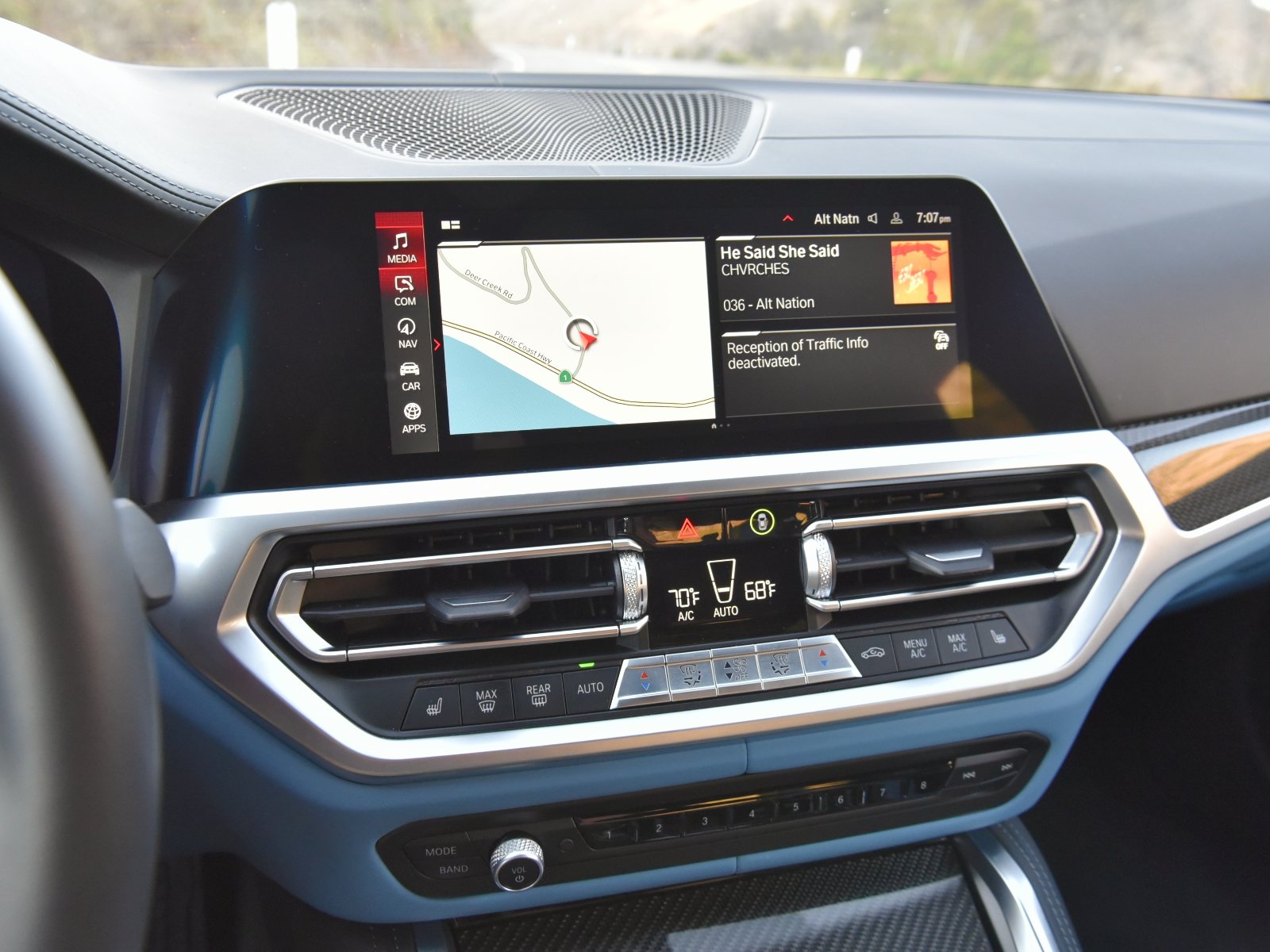
BMW equips the M3 with iDrive 7.0, an excellent example of a touchscreen and voice recognition infotainment system. The display is easy to see and use and is quick to respond to inputs. The natural voice recognition system works exceptionally well, offering effortless operation of multiple functions, including the climate controls. Even the iDrive controller and main shortcut buttons on the center console become second-nature in short order.
Using the stereo is simple, too. There is a volume knob on the dashboard, and controls on the steering wheel adjust speaker volume and cycle through radio station pre-sets. Programming your favorite radio stations is easy, too. You can also use gesture controls to adjust the volume and change stations, but this technology is hit-or-miss in terms of accuracy and effectiveness.
Naturally, the system includes Apple CarPlay and Android Auto. The test car also had a Harman Kardon surround sound system, but we weren’t impressed. It lacked the depth and resonance typical of Harman Kardon components and simply didn’t do the car’s price tag justice.
BMW also offers a head-up display for the M3, and it is 70 percent larger while providing a comprehensive range of information. However, if you wear polarized sunglasses, it is nearly invisible.
Safety
BMW equips the M3 with a primary collection of driver aids that include forward-collision warning, automatic emergency braking, lane-departure warning, lane-keeping assistance, a blind-spot warning system, and rear cross-traffic warning. Additionally, the M3 has a drowsy driver monitoring system, a post-crash braking system, and BMW Assist eCall with an SOS button and automatic collision notification.
As an option, you can install the Driving Assistance Professional Package. But it’s only available for the M3 Competition, which is counterintuitive until you realize this collection of features requires the automatic transmission. This upgrade installs adaptive cruise control with stop-and-go capability, extended traffic jam assistance for use on limited-access highways, lane-centering assistance, evasive steering assistance, and emergency stop assistance.
Though our M3 Competition test car qualified for this upgrade, it did not have this option. And since we never purposely test forward-collision warning and automatic emergency braking systems, our observations pertain to the lane-departure warning and lane-keeping assistance technologies. The subtle steering wheel vibration for a departure gets a big thumbs up, and the lane-keeping assistance system is exceptionally effective.
As far as crash-test ratings are concerned, neither the National Highway Traffic Safety Administration (NHTSA) nor the Insurance Institute for Highway Safety (IIHS) has performed testing on the new M3 sedan.
Cost-effectiveness
As much as we adore driving the BMW M3, its capabilities have progressed beyond what is accessible on public roads in the real world. For less than the M3’s base price, you can get yourself a loaded BMW M340i with nearly the same acceleration, but without all of the track-ready hardware you’re unlikely ever to require.
So, from that perspective, the BMW M3 is not a cost-effective choice in a compact luxury sports sedan. But as an alternative to a traditional sports car, its comparable performance combined with greater utility and rear passenger room for adults makes a compelling value proposition.
Within its universe of direct competitors, the M3 is priced below the Audi RS 5 Sportback and about the same as the Mercedes-AMG C63. Lexus will soon offer the IS 500 F Performance sedan in this space, but for now, the price is unknown. Cadillac is fielding the CT4 Blackwing at a substantial discount, but previous experience with the car on which it is based suggests the cabin’s materials and quality are the reasons it’s so much cheaper. Finally, Volvo offers the overlooked S60 Recharge Polestar Engineered competitor, a plug-in hybrid with plenty of performance.
Ultimately, a BMW M3 is not about value or cost. It is about owning the most capable version of the 3 Series sedan, the one that looks wildest, goes fastest, and costs the most. If that’s what is important to you, the M3 delivers on all counts.
Especially when it’s painted Sao Paulo Yellow.
What owners say
Overpriced for what you get. Car needs to be $10k-$12k cheaper. It’s being over hyped.
August 3, 2025Recently purchased one, and am loving it. Great to have the six-speed manual for the base trim. :)
May 19, 2021Manual transmission; great stye; may change color. Interior looks good
August 25, 2022Trims & specs
Base MSRP $79,300 | Seating 5 |
Engine 3.0L 473 hp I6 | Cargo Capacity 13.0 cu ft |
Combined MPG 19 | Drivetrain RWD |
Base MSRP $83,500 | Seating 5 |
Engine 3.0L 503 hp I6 | Cargo Capacity 13.0 cu ft |
Combined MPG 19 | Drivetrain RWD |


Pricing trends
MSRP range
$69,900 - $72,800
Current avg. market price
$69,348
Trending down by 0.7% this month
May 2026 - November 2026


