2014 Toyota Camry Reviews, Pricing & Specs
Write a review
If you decide to buy a new Toyota Camry, make sure you get a 2014.5 model, built after December of 2013, because this is the one that's rated a Top Safety Pick by the Insurance Institute for Highway Safety.
Depending on whom you ask, either the Honda Accord or the Toyota Camry is the best-selling car in America. Based on total sales, Toyota moved a mind-boggling 408,484 Camrys last year, while Honda cranked out 366,678 Accords. But, when you strip what are known as fleet sales out of the equation—those transactions made with rental-car companies, business entities, governments and similar types of sales—the story changes. According to Honda, people like you and me bought more Accords than we did Camrys last year.
Certainly, the battle for midsize sedan supremacy continues for 2014, and Toyota has made one very important mid-year change to its popular Camry, one that gives consumers an excellent reason to keep it on the short list of contenders when shopping for a new family 4-door. We’ll get to that later, as well as how to make sure you can take advantage of the improvement. First, let’s talk about the three distinctly different kinds of Camrys that Toyota offers.
When shopping for a new Camry, you can pick the one everyone else does, you can pick the one that is actually fun to drive, or you can pick the one that gets awesome gas mileage. We test-drove the most entertaining version of the car, the Camry SE with the optional V6 engine and a set of floor and trunk mats, for a total of $28,885 including the $810 destination charge.
If you’re more interested in a cushy ride, you want a Camry L, LE or XLE. The Camry L ($23,235) comes in any color you like, as long as you like silver. Dealers install the only upgrades for this model. These are the reasons why most people select the Camry LE ($23,680). It comes in a wider range of colors and also includes a fancier grille, automatic headlights and power door locks with remote keyless entry. Plus, the Camry LE can be optioned with features like an 8-way power driver’s seat, an upgraded Entune Audio Plus infotainment system and a power sunroof.
Luxury seekers will prefer the Camry XLE ($26,620). Fog lights, extra chrome trim and 17-inch aluminum wheels are standard for this model, along with fake wood for the interior, a leather-wrapped steering wheel, heated outside mirrors, an 8-way power driver’s seat, a trip computer, a power sunroof, dual-zone automatic climate control and an Entune Audio Plus infotainment system.
A lengthy list of options is offered for the Camry XLE, starting with a V6 engine. Additionally, option packages add leather seats, heated front seats, a power sunroof, an auto-dimming rear-view mirror, a universal garage door opener, Smart Key passive entry with push-button start, an Entune premium audio system, Entune App Suite technology and a navigation system. Toyota also offers a Blind-Spot Monitor, Rear Cross-Traffic Alert and Safety Connect telematics with an SOS emergency button and Automatic Collision Notification service for this model.
If you’re interested in maximizing your fuel economy, get the Camry Hybrid. It's EPA-rated to return about 40 mpg in combined driving and is offered in LE ($27,140) and XLE ($29,435) trim levels. Standard equipment is not the same as for the regular LE and XLE models, though, with the Hybrid LE adding an acoustic noise-reducing windshield, unique interior trim, a dual-zone automatic climate control system with a humidity sensor, a Smart Key passive entry system with push-button start and upgraded Optitron gauges with unique hybrid displays when compared to a standard Camry LE.
Toyota offers no options for the Camry Hybrid LE. Instead, buyers need to upgrade to the Hybrid XLE model, which is equipped similarly to the standard XLE while adding the Hybrid LE’s unique features plus rear air vents and an auto-dimming rear-view mirror with a compass. Options for this model are nearly identical to those for the standard XLE.
For 2014, Toyota is offering a limited-edition version of the Camry Hybrid decked out in SE trim ($28,755). It pairs the look of the standard Camry SE with a fuel-efficient hybrid powertrain, but the SE trim’s sport-tuned suspension doesn’t carry over for SE Hybrid duty.
You didn’t read that wrong. The Camry SE ($24,550) is equipped with a sport suspension, as well as a strut tower brace and a trunk brace to stiffen the car structurally. Paddle shifters are added to the transmission, and the SE sits on unique 17-inch aluminum wheels with lower profile tires. Automatic headlights with a darkened appearance, fog lights, a body-color mesh grille, a body kit and a rear spoiler are also standard for the Camry SE, and this trim is also equipped with heated side mirrors, sport fabric seats with leatherette bolsters, a sport steering wheel and lots of silver interior trim. Options for the sportiest Camry include a V6 engine, 18-inch aluminum wheels, and all the upgrades available for the Camry XLE with one exception. Toyota does not offer its Safety Connect telematics system for the SE model.
Whew. As you can see, Toyota offers a Camry for just about anyone, and even with all the popular options added, the sticker price for a loaded XLE Hybrid remains below $36,000. It’s not hard to see why the practical Camry is so appealing to many people.
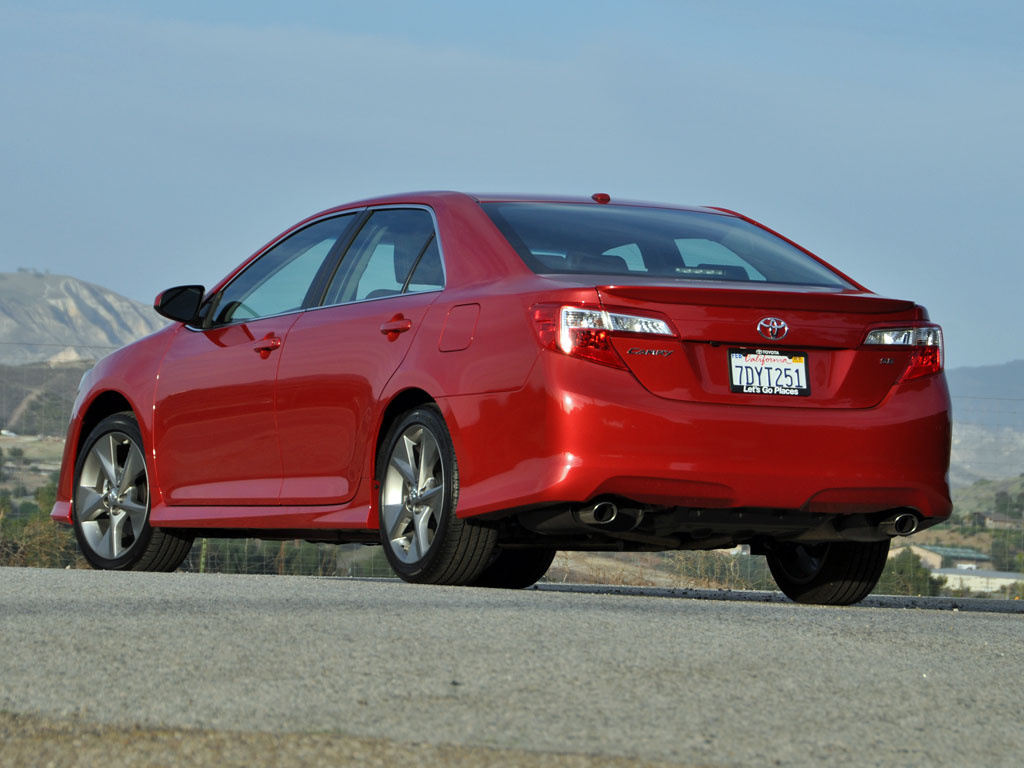
Of the different versions offered, though, my favorite is the car pictured here, the Camry SE with available 18-inch aluminum wheels. The SE model is offered in white, black, shades of gray and this color, called Barcelona Red Metallic, and the tasteful appearance modifications are just what the regular Camry’s detestable, generic, slab-sided, chrome-mustachioed styling needs to make this car look more appealing.
The Camry SE’s interior isn’t as cleanly executed, relying too heavily on silver plastic trim, 2-tone seats and increasingly trite exposed stitching to emphasize its role as the sporty trim. Ergonomically, though, just get into this car and drive it. There’s nothing to figure out, really, underscoring the car’s general simplicity.

Latigo Canyon Road is not the Toyota Camry’s natural habitat. Measuring more than 10 miles long, it is one kinky and writhing stretch of pavement, draped atop the Santa Monica Mountains between Malibu and Agoura Hills. At the last minute, I decided to ditch my usual driving loop in order to see just how capable the Camry SE might prove on one of the most difficult stretches of twisty road in the region.
As it turned out, the car did pretty well.
There’s too much weight over the Camry’s nose, of course, and while the P225/45R18 Michelin Primacy MXM4 tires are more aggressive tires than what Toyota mounts to other versions of the car, they tend to scrub and squeal fairly early. The Camry SE’s steering isn’t quicker than what’s installed in other varieties of the car, either, which doesn’t help the driver to thread S-curves. But so what. Nobody who loves to drive is likely to buy a Camry, and the person that does choose this version will likely be thrilled with the handling and impressed by the fade-free brakes.
The ride quality, though, is another matter. This is a stiffly tuned car, with modified springs and shocks, a strut tower brace and structural bracing in the trunk. The result is that the Camry SE feels more solid, but the ride is much firmer than what’s provided in other Camry trims. If you’re not interested in feeling every bump, crack and hole in the road, take a pass on the Camry SE and just add a rear spoiler to one of the other trims instead.
Toyota offers the Camry SE with a 178-horsepower, 2.5-liter 4-cylinder engine the EPA says should get 28 mpg in combined driving. My preference is the optional 3.5-liter V6, which feels stronger than its 268-hp rating would suggest, which revs freely and eagerly, and which can accelerate the Camry to 60 mph in less than 6 seconds. You’ll never want for power with this engine, and in the SE model the 6-speed automatic transmission includes a manual shift gate with an intuitive pattern and paddle shifters mounted to the steering wheel. I used them, but not often, as the automatic is well calibrated and always seems to be in the right gear at the right time.
Wondering what the penalty might be for choosing the V6? The EPA estimates that fuel economy is 25 mpg in combined driving, a 3-mpg drop compared to the 4-cylinder engine. I say that’s a small price to pay in exchange for the impressive amount of power. I averaged 23.9 mpg during my week with the car.

You’re not going to confuse this Toyota with a Lexus. Cheaply detailed, yet solidly constructed, you’re getting what you paid for with a Camry and nothing more. On a positive note, though, you’re also not going to have any trouble figuring out how to use this car. The controls are located exactly where you would expect to find them, they’re clearly labeled, and they operate intuitively.
My Camry SE test car’s seats featured cloth inserts, SofTex leatherette bolsters and vinyl seatbacks. The fabric inserts are stiff, almost abrasive, one more example of a car built to strict cost controls. The front seats are comfortable, though, especially on the driver’s side, where there is a power height adjuster and where a sliding center console armrest adjusts to drivers of different sizes.
The Camry’s back seat is roomy enough, but the bottom cushion sits too low and the backrest is angled too much for my comfort. At the same time I was test-driving the Camry, I also had a Nissan Altima, and while the Altima is a little short on headroom, it is a far more comfortable vehicle for rear-seat passengers.
With 15.4 cubic feet of space, the Camry’s trunk matches the Altima's and is well sized for the needs of a family. Also, like the Altima, the Camry lacks a grab handle for pulling the trunk closed, which means that if you live where it rains and snows all the time, you’d better be ready to dirty your hands when you shut the lid.

Simplicity is the name of the game when it comes to the Toyota Camry, so technological advancements are largely limited to the Entune family of touchscreen infotainment systems. Even the Camry Hybrid’s gas-electric drivetrain is fairly low-tech in comparison to more modern designs.
Personally, I don’t mind the Camry’s lack of complexity. It’s super easy to pair a smartphone to Entune and to use the system’s various menus and settings. Sometimes sun glare causes a problem, and I occasionally find that choosing the right radio station pre-set button requires extra accuracy and deliberate pressure, but for the most part Entune is agreeable enough.
Additionally, Toyota offers the right kinds of safety technologies for the Camry and limits extraneous features that often add unnecessary cost to a vehicle.

Lately, every time I review a Toyota, I need to criticize the company’s decision to offer its Safety Connect telematics technology only in the most expensive versions of its cars. Safety Connect is important and should be available in all versions of every Toyota, just as General Motors installs OnStar telematics for nearly every car, truck and SUV that it builds.
What makes Safety Connect important? How about the Roadside Assistance, SOS Emergency Assistance and Automatic Collision Notification services? Plus, Safety Connect offers a Stolen-Vehicle Locator service. Yes, this is a subscription-based service, and theoretically it's the people spending the most money for a new car who are likely to subscribe, but speaking as a parent seeking a car for a 16-year-old, I’d like to be able to get these kinds of features in the cheapest Camry, not just the most expensive Camry.
In addition to Safety Connect, available only for the XLE and Hybrid XLE, Toyota offers a Blind-Spot Monitor and Rear Cross-Traffic Alert system for the SE, XLE and XLE Hybrid. Both are quite useful, and both ought to be available on a wider range of Camry trims.
Okay, now it's time to pay attention. If you decide to buy a new Camry, make sure you're getting the 2014.5 model instead of the 2014 model. Why does this matter? It is the 2014.5 model, built after December of 2013, that is rated a Top Safety Pick by the Insurance Institute for Highway Safety (IIHS). Examples of the Camry assembled prior to January of 2014 are rated Poor for the small overlap frontal-impact test.
Combine that Top Safety Pick rating from the IIHS with an overall crash-test rating of 5 stars from the National Highway Traffic Safety Administration (NHTSA), and you’ve got one safe family sedan in the 2014.5 Toyota Camry.

Ever sit at a traffic light, look over at the next lane at a white or silver Camry LE and wonder to yourself: “Who would want to buy that?” I do. All the time. But then I remember that a basic Camry is an exceptionally cost-effective form of personal transportation.
This car blends a roomy interior with fuel-efficient engines and offers good value at a decent price. The Camry rates exceptionally well in quality, dependability and reliability studies, it holds its value well over time, and it's inexpensive to own and operate thanks in part to good gas mileage and free scheduled maintenance for the first two years or 25,000 miles of driving.
Plus, Toyota is keenly interested in keeping the Camry the best-selling car in America, so the company and its dealers are always ready to make a deal. If you have a solid credit history, long-term, low-rate financing is almost always available, and you can lease a Camry for very little money down and for a very reasonable monthly payment. Plus, rebates and discounts are usually available, sometimes amounting to 10% or more of the sticker price.

User reviews for 2014 Toyota Camry
Write a review2014 Toyota Camry Pricing
Trims & specs
Air Conditioning
Single front air conditioning zones
Airbags
Dual front airbags · Dual front knee airbags · Passenger airbag deactivation: occupant sensing deactivation · Front side airbags · Rear side curtain airbags
Audio System
Antenna Type: element · Auxiliary audio input: jack · Single disc in-Dash CD · MP3 player: CD MP3 Playback · Touch screen display radio · Total Number of Speakers: 6
Brakes
ABS: 4-wheel · Front brake diameter: 11.7 · Front brakes: ventilated disc · Rear brake diameter: 11.1 · Rear brakes: disc
Comfort Features
Armrests: rear center with cupholders
Convenience Features
Assist handle: front · Center console: front console with armrest and storage · Cupholders: rear · Multi-function remote: trunk release · One-touch windows: 1 · Power outlet(s): 12V · Power steering: electric · Power windows: lockout button · Reading lights: front · Steering wheel: tilt and telescopic · Steering wheel mounted controls: phone · Storage: front seatback · Vanity mirrors: dual illuminating
Driver Seat
Manual adjustments: 6
Drivetrain
Axle ratio: 3.63
Exterior Features
Door handle color: body-color · Front bumper color: body-color · Mirror color: body-color · Rear bumper color: body-color
Headrests
Front headrests: adjustable · Number of front headrests: 2 · Number of rear headrests: 2
In Car Entertainment
Infotainment screen size: 6.1 in.
Instrumentation
Fuel economy display: MPG · Warnings and reminders: maintenance reminder
Lights
Headlights: Halogen
Mirrors
Exterior mirrors: manual folding · Inside rearview mirror: manual day/night
Passenger Seat
Manual Adjustments: 4
Rear Seats
Type: 60-40 split bench
Safety
Active head restraints: driver · Child seat anchors: LATCH system · Crumple zones: front
Seatbelts
Emergency locking retractors: front · Front seatbelts: 3-point · Seatbelt force limiters: front · Seatbelt pretensioners: front · Seatbelt warning sensor: driver and passenger · Second row seatbelts: 3-point
Seats
Driver seat manual adjustments: height · Front seat type: bucket · Passenger seat manual adjustments: height · Rear headrests: adjustable · Rear seat folding: split · Upholstery: cloth
Spare Tire
Mount Location: inside · Size: temporary
Spare Wheel
Rim Type: steel
Suspension
Front Arm Type: lower control arms · Front Shock Type: gas shock absorbers · Front Spring Type: coil springs · Front Suspension Classification: independent · Front Suspension Type: MacPherson struts · Rear Shock Type: gas shock absorbers · Rear Spring Type: coil springs · Rear Suspension Classification: independent · Rear Suspension Type: multi-link · Stabilizer bar(s): front
Telematics
Phone wireless data link: Bluetooth
Tires
Type: all season
Tires and Rims
Wheels: steel
Wheels
Wheel covers: full
Windows
Front wipers: intermittent · Power windows: with safety reverse
Air Conditioning
Single front air conditioning zones
Airbags
Dual front airbags · Dual front knee airbags · Passenger airbag deactivation: occupant sensing deactivation · Rear side airbags · Rear side curtain airbags
Audio System
Antenna Type: element · USB auxiliary audio input · Single disc in-Dash CD · MP3 player: CD MP3 Playback · Touch screen display radio · Total Number of Speakers: 6
Brakes
ABS: 4-wheel · Front brake diameter: 11.7 · Front brakes: ventilated disc · Rear brake diameter: 11.1 · Rear brakes: disc
Comfort Features
Armrests: rear center with cupholders · Floor Material: carpet
Convenience Features
Assist handle: rear · Center console: front console with armrest and storage · Cupholders: rear · Multi-function remote: keyless entry · One-touch windows: 1 · Power outlet(s): two 12V · Power steering: electric · Power windows: lockout button · Reading lights: rear · Steering wheel: tilt and telescopic · Steering wheel mounted controls: audio · Storage: sunglasses holder · Vanity mirrors: dual illuminating
Driver Seat
Manual adjustments: 6
Drivetrain
Axle ratio: 3.63
Exterior Features
Door handle color: body-color · Front bumper color: body-color · Mirror color: body-color · Rear bumper color: body-color
Headrests
Front headrests: adjustable · Number of front headrests: 2 · Number of rear headrests: 3
In Car Entertainment
Infotainment screen size: 6.1 in.
Instrumentation
Fuel economy display: range · Warnings and reminders: low fuel level
Lights
Exterior entry lights: security approach lamps · Headlights: Auto on/off
Mirrors
Exterior mirrors: manual folding · Inside rearview mirror: manual day/night
Passenger Seat
Manual Adjustments: 4
Rear Seats
Type: 60-40 split bench
Safety
Child seat anchors: LATCH system · Crumple zones: rear · Impact absorbing seats: dual front
Seatbelts
Emergency locking retractors: front and rear · Front seatbelts: 3-point · Seatbelt force limiters: front · Seatbelt pretensioners: front · Seatbelt warning sensor: driver and passenger · Second row seatbelts: 3-point
Seats
Driver seat manual adjustments: height · Front seat type: bucket · Passenger seat manual adjustments: height · Rear headrests: adjustable · Rear seat folding: split · Upholstery: cloth
Spare Tire
Mount Location: inside · Size: temporary
Spare Wheel
Rim Type: steel
Suspension
Front Arm Type: lower control arms · Front Shock Type: gas shock absorbers · Front Spring Type: coil springs · Front Suspension Classification: independent · Front Suspension Type: MacPherson struts · Rear Shock Type: gas shock absorbers · Rear Spring Type: coil springs · Rear Suspension Classification: independent · Rear Suspension Type: multi-link · Stabilizer bar(s): front
Telematics
Phone wireless data link: Bluetooth
Tires
Type: all season
Tires and Rims
Wheels: steel
Wheels
Wheel covers: full
Windows
Front wipers: variable intermittent · Power windows: with safety reverse
Air Conditioning
Single front air conditioning zones
Airbags
Dual front airbags · Dual front knee airbags · Passenger airbag deactivation: occupant sensing deactivation · Rear side airbags · Front side curtain airbags
Audio System
Antenna Type: element · USB auxiliary audio input · Single disc in-Dash CD · MP3 player: CD MP3 Playback · AM/FM radio · Total Number of Speakers: 6
Brakes
ABS: 4-wheel · Front brake diameter: 11.7 · Front brakes: ventilated disc · Rear brake diameter: 11.1 · Rear brakes: disc
Comfort Features
Armrests: rear center with cupholders · Floor Material: carpet · Steering wheel trim: leather
Convenience Features
Assist handle: rear · Center console: front console with armrest and storage · Cupholders: front · Multi-function remote: trunk release · One-touch windows: 1 · Power outlet(s): two 12V · Power steering: electric · Power windows: lockout button · Reading lights: front · Steering wheel: tilt and telescopic · Steering wheel mounted controls: cruise controls · Storage: front seatback · Vanity mirrors: dual illuminating
Driver Seat
Manual adjustments: 6
Drivetrain
Axle ratio: 3.63
Exterior Features
Door handle color: body-color · Exhaust tip color: chrome · Front bumper color: body-color · Headlamp bezel color: black · Mirror color: body-color · Rear bumper color: body-color · Rear spoiler: wing · Rear spoiler color: body-color · Rocker panel color: body-color
Headrests
Front headrests: adjustable · Number of front headrests: 2 · Number of rear headrests: 3
In Car Entertainment
Infotainment screen size: 6.1 in.
Instrumentation
Fuel economy display: MPG · Warnings and reminders: low fuel level
Lights
Exterior entry lights: security approach lamps · Headlights: Halogen
Mirrors
Exterior mirrors: power · Inside rearview mirror: manual day/night
Passenger Seat
Manual Adjustments: 4
Rear Seats
Type: 60-40 split bench
Safety
Child seat anchors: LATCH system · Crumple zones: front · Impact absorbing seats: dual front
Seatbelts
Emergency locking retractors: front · Front seatbelts: 3-point · Seatbelt force limiters: front · Seatbelt pretensioners: front · Seatbelt warning sensor: driver and passenger · Second row seatbelts: 3-point
Seats
Driver seat manual adjustments: height · Front seat type: bucket · Passenger seat manual adjustments: height · Rear headrests: adjustable · Rear seat folding: split · Upholstery: premium cloth
Spare Tire
Mount Location: inside · Size: temporary
Spare Wheel
Rim Type: steel
Suspension
Front Arm Type: lower control arms · Front Shock Type: gas shock absorbers · Front Spring Type: coil springs · Front Suspension Classification: independent · Front Suspension Type: MacPherson struts · Rear Shock Type: coil over shock · Rear Spring Type: coil springs · Rear Suspension Classification: independent · Rear Suspension Type: multi-link · Stabilizer bar(s): rear
Telematics
Phone wireless data link: Bluetooth
Tires
Type: all season
Tires and Rims
Wheel type: aluminum alloy
Windows
Front wipers: variable intermittent · Power windows: with safety reverse
Air Conditioning
Single front air conditioning zones
Airbags
Dual front airbags · Dual front knee airbags · Passenger airbag deactivation: occupant sensing deactivation · Rear side airbags · Rear side curtain airbags
Audio System
Antenna Type: element · Auxiliary audio input: jack · Single disc in-Dash CD · MP3 player: CD MP3 Playback · AM/FM radio · Total Number of Speakers: 6
Brakes
ABS: 4-wheel · Front brake diameter: 11.7 · Front brakes: ventilated disc · Rear brake diameter: 11.1 · Rear brakes: disc
Comfort Features
Armrests: rear center with cupholders · Floor Material: carpet · Steering wheel trim: leather
Convenience Features
Assist handle: front · Center console: front console with armrest and storage · Cupholders: rear · Multi-function remote: keyless entry · One-touch windows: 1 · Power outlet(s): two 12V · Power steering: electric · Power windows: lockout button · Reading lights: rear · Steering wheel: tilt and telescopic · Steering wheel mounted controls: audio · Storage: sunglasses holder · Vanity mirrors: dual illuminating
Driver Seat
Manual adjustments: 6
Drivetrain
Axle ratio: 3.63
Exterior Features
Door handle color: body-color · Exhaust tip color: chrome · Front bumper color: body-color · Headlamp bezel color: black · Mirror color: body-color · Rear bumper color: body-color · Rear spoiler: wing · Rear spoiler color: body-color · Rocker panel color: body-color
Headrests
Front headrests: adjustable · Number of front headrests: 2 · Number of rear headrests: 3
In Car Entertainment
Infotainment screen size: 6.1 in.
Instrumentation
Fuel economy display: range · Warnings and reminders: low fuel level
Lights
Exterior entry lights: security approach lamps · Headlights: Halogen
Mirrors
Exterior mirrors: manual folding · Inside rearview mirror: manual day/night
Passenger Seat
Manual Adjustments: 4
Rear Seats
Type: 60-40 split bench
Roof
Moonroof: tilt/slide
Safety
Child seat anchors: LATCH system · Crumple zones: rear · Impact absorbing seats: dual front
Seatbelts
Emergency locking retractors: front and rear · Front seatbelts: 3-point · Seatbelt force limiters: front · Seatbelt pretensioners: front · Seatbelt warning sensor: driver and passenger · Second row seatbelts: 3-point
Seats
Driver seat manual adjustments: height · Front seat type: bucket · Passenger seat manual adjustments: height · Rear headrests: adjustable · Rear seat folding: split · Upholstery: premium cloth
Spare Tire
Mount Location: inside · Size: temporary
Spare Wheel
Rim Type: steel
Suspension
Front Arm Type: lower control arms · Front Shock Type: gas shock absorbers · Front Spring Type: coil springs · Front Suspension Classification: independent · Front Suspension Type: MacPherson struts · Rear Shock Type: gas shock absorbers · Rear Spring Type: coil springs · Rear Suspension Classification: independent · Rear Suspension Type: multi-link · Stabilizer bar(s): front
Telematics
Phone wireless data link: Bluetooth
Tires
Type: all season
Tires and Rims
Wheel type: aluminum alloy
Windows
Front wipers: variable intermittent · Power windows: with safety reverse
Air Conditioning
Automatic climate control front air conditioning · Dual front air conditioning zones
Airbags
Dual front airbags · Dual front knee airbags · Passenger airbag deactivation: occupant sensing deactivation · Rear side airbags · Rear side curtain airbags
Audio System
Antenna Type: element · Auxiliary audio input: jack · Single disc in-Dash CD · MP3 player: CD MP3 Playback · AM/FM radio · Total Number of Speakers: 6
Brakes
ABS: 4-wheel · Front brake diameter: 11.7 · Front brakes: ventilated disc · Rear brake diameter: 11.1 · Rear brakes: disc
Comfort Features
Armrests: rear center with cupholders · Floor Material: carpet · Steering wheel trim: leather
Convenience Features
Assist handle: front · Center console: front console with armrest and storage · Cupholders: rear · Multi-function remote: keyless entry · One-touch windows: 1 · Power outlet(s): two 12V · Power steering: electric · Power windows: lockout button · Reading lights: front · Steering wheel: tilt and telescopic · Steering wheel mounted controls: audio · Storage: front seatback · Vanity mirrors: dual illuminating
Driver Seat
Adjustable lumbar support: power · Power adjustments: 8
Drivetrain
Axle ratio: 3.63
Exterior Features
Door handle color: body-color · Exhaust tip color: chrome · Front bumper color: body-color · Mirror color: body-color · Rear bumper color: body-color
Headrests
Front headrests: adjustable · Number of front headrests: 2 · Number of rear headrests: 3
In Car Entertainment
Infotainment screen size: 6.1 in.
Instrumentation
Fuel economy display: MPG · Warnings and reminders: low fuel level
Lights
Exterior entry lights: security approach lamps · Headlights: Auto on/off
Mirrors
Exterior mirrors: power · Inside rearview mirror: manual day/night
Passenger Seat
Manual Adjustments: 4
Rear Seats
Type: 60-40 split bench
Roof
Moonroof: power glass
Safety
Child seat anchors: LATCH system · Crumple zones: front · Impact absorbing seats: dual front
Seatbelts
Emergency locking retractors: front · Front seatbelts: 3-point · Seatbelt force limiters: front · Seatbelt pretensioners: front · Seatbelt warning sensor: driver and passenger · Second row seatbelts: 3-point
Seats
Driver seat power adjustments: height · Front seat type: bucket · Passenger seat manual adjustments: height · Rear headrests: adjustable · Rear seat folding: split · Upholstery: cloth
Spare Tire
Mount Location: inside · Size: temporary
Spare Wheel
Rim Type: steel
Suspension
Front Arm Type: lower control arms · Front Shock Type: gas shock absorbers · Front Spring Type: coil springs · Front Suspension Classification: independent · Front Suspension Type: MacPherson struts · Rear Shock Type: gas shock absorbers · Rear Spring Type: coil springs · Rear Suspension Classification: independent · Rear Suspension Type: multi-link · Stabilizer bar(s): front
Telematics
Phone wireless data link: Bluetooth
Tires
Type: all season
Tires and Rims
Wheel type: aluminum alloy
Windows
Front wipers: variable intermittent · Power windows: with safety reverse
Air Conditioning
Single front air conditioning zones
Airbags
Dual front airbags · Dual front knee airbags · Passenger airbag deactivation: occupant sensing deactivation · Rear side airbags · Front side curtain airbags
Audio System
Antenna Type: element · Voice recognition audio system · Auxiliary audio input: jack · Single disc in-Dash CD · MP3 player: CD MP3 Playback · AM/FM radio · Satellite Radio: SiriusXM · Total Number of Speakers: 6
Brakes
ABS: 4-wheel · Front brake diameter: 11.7 · Front brakes: ventilated disc · Rear brake diameter: 11.1 · Rear brakes: disc
Comfort Features
Armrests: rear center with cupholders · Floor Material: carpet · Steering wheel trim: leather
Convenience Features
Assist handle: rear · Center console: front console with armrest and storage · Cupholders: front · Multi-function remote: trunk release · One-touch windows: 1 · Power outlet(s): two 12V · Power steering: electric · Power windows: lockout button · Reading lights: front · Steering wheel: tilt and telescopic · Steering wheel mounted controls: cruise controls · Storage: door pockets · Vanity mirrors: dual illuminating
Driver Seat
Adjustable lumbar support: power · Power adjustments: 8
Drivetrain
Axle ratio: 3.45
Exterior Features
Door handle color: body-color · Exhaust: dual exhaust tips · Exhaust tip color: chrome · Front bumper color: body-color · Headlamp bezel color: black · Mirror color: body-color · Rear bumper color: body-color · Rear spoiler: wing · Rear spoiler color: body-color · Rocker panel color: body-color
Headrests
Front headrests: adjustable · Number of front headrests: 2 · Number of rear headrests: 3
In Car Entertainment
Infotainment screen size: 6.1 in.
Instrumentation
Fuel economy display: range · Warnings and reminders: maintenance reminder
Lights
Exterior entry lights: security approach lamps · Headlights: Halogen
Mirrors
Exterior mirrors: heated · Inside rearview mirror: manual day/night
Passenger Seat
Manual Adjustments: 4
Rear Seats
Type: 60-40 split bench
Safety
Child seat anchors: LATCH system · Crumple zones: rear · Impact absorbing seats: dual front
Seatbelts
Emergency locking retractors: front and rear · Front seatbelts: 3-point · Seatbelt force limiters: front · Seatbelt pretensioners: front · Seatbelt warning sensor: driver and passenger · Second row seatbelts: 3-point
Seats
Driver seat power adjustments: height · Front seat type: bucket · Passenger seat manual adjustments: height · Rear headrests: adjustable · Rear seat folding: split · Upholstery: premium cloth
Security
Power door locks: anti-lockout
Spare Tire
Mount Location: inside · Size: temporary
Spare Wheel
Rim Type: steel
Suspension
Front Arm Type: lower control arms · Front Shock Type: gas shock absorbers · Front Spring Type: coil springs · Front Suspension Classification: independent · Front Suspension Type: MacPherson struts · Rear Shock Type: coil over shock · Rear Spring Type: coil springs · Rear Suspension Classification: independent · Rear Suspension Type: multi-link · Stabilizer bar(s): rear
Telematics
Navigation system: with voice recognition · Phone wireless data link: Bluetooth
Tires
Type: all season
Tires and Rims
Wheel type: aluminum alloy
Windows
Front wipers: variable intermittent · Laminated glass: acoustic · Power windows: with safety reverse
Air Conditioning
Automatic climate control front air conditioning · Dual front air conditioning zones
Airbags
Dual front airbags · Dual front knee airbags · Passenger airbag deactivation: occupant sensing deactivation · Rear side airbags · Rear side curtain airbags
Audio System
Antenna Type: diversity · Voice recognition audio system · Bluetooth auxiliary audio input · Single disc in-Dash CD · MP3 player: CD MP3 Playback · Touch screen display radio · Satellite Radio: SiriusXM · Total Number of Speakers: 6
Brakes
ABS: 4-wheel · Front brake diameter: 11.7 · Front brakes: ventilated disc · Rear brake diameter: 11.1 · Rear brakes: disc
Comfort Features
Armrests: rear center with cupholders · Floor Material: carpet · Steering wheel trim: leather
Convenience Features
Assist handle: front · Center console: front console with armrest and storage · Cupholders: front · Dimming rearview mirror: auto-dimming · Multi-function remote: keyless entry with panic alarm · One-touch windows: 1 · Power outlet(s): two 12V · Power steering: electric · Power windows: lockout button · Reading lights: rear · Steering wheel: tilt and telescopic · Steering wheel mounted controls: cruise controls · Storage: sunglasses holder · Universal garage door opener: Homelink · Vanity mirrors: dual illuminating
Driver Seat
Adjustable lumbar support: power · Power adjustments: 8
Drivetrain
Axle ratio: 3.45
Exterior Features
Door handle color: body-color · Exhaust: dual exhaust tips · Exhaust tip color: chrome · Front bumper color: body-color · Mirror color: body-color · Rear bumper color: body-color
Headrests
Front headrests: adjustable · Number of front headrests: 2 · Number of rear headrests: 3
In Car Entertainment
Infotainment screen size: 6.1 in.
Instrumentation
Fuel economy display: range · Warnings and reminders: low fuel level
Lights
Exterior entry lights: security approach lamps · Headlights: Halogen
Mirrors
Exterior mirrors: power
Passenger Seat
Power adjustments: 4
Rear Seats
Type: 60-40 split bench
Roof
Moonroof: one-touch open/close
Safety
Camera system: rearview · Child seat anchors: LATCH system · Crumple zones: rear · Impact absorbing seats: dual front · Rearview monitor: in dash
Seatbelts
Emergency locking retractors: front and rear · Front seatbelts: 3-point · Seatbelt force limiters: front · Seatbelt pretensioners: front · Seatbelt warning sensor: driver and passenger · Second row seatbelts: 3-point
Seats
Driver seat power adjustments: height · Front seat type: bucket · Rear headrests: adjustable · Rear seat folding: split · Upholstery: leather-trimmed
Security
Power door locks: anti-lockout
Spare Tire
Mount Location: inside · Size: temporary
Spare Wheel
Rim Type: steel
Suspension
Front Arm Type: lower control arms · Front Shock Type: gas shock absorbers · Front Spring Type: coil springs · Front Suspension Classification: independent · Front Suspension Type: MacPherson struts · Rear Shock Type: coil over shock · Rear Spring Type: coil springs · Rear Suspension Classification: independent · Rear Suspension Type: multi-link · Stabilizer bar(s): front
Telematics
Navigation system: with voice recognition · Phone wireless data link: Bluetooth
Tires
Type: all season
Tires and Rims
Wheel type: aluminum alloy
Windows
Front wipers: variable intermittent · Laminated glass: acoustic · Power windows: with safety reverse

