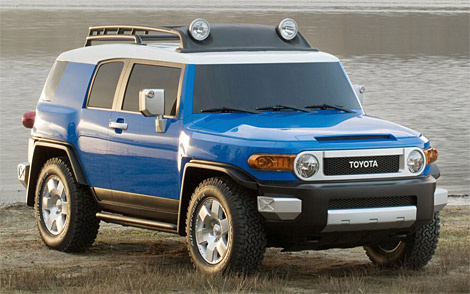
The Toyota FJ Cruiser debuted for the 2007 model year in North America, and drew clear inspiration from the iconic Toyota FJ series of off-road SUVs that birthed the modern Land Cruiser. Like the classic FJ40 that first hit the scene in the 1960s, the FJ Cruiser wore a blocky body and was based on durable components designed for tough off-road abuse.
Much of the powertrain, the four-wheel drive system, and the chassis components hiding under the Toyota FJ Cruiser’s retro-styled skin were shared with other Toyota trucks and SUVs. Bits and pieces from the Toyota Tacoma, the 4Runner, and the Land Cruiser made up the FJ Cruiser’s rugged suspension. Its 4.0-liter V6 engine could also be found under the hoods of trucks and SUVs sold in the U.S. and abroad, including the Toyota Land Cruiser and the Land Cruiser Prado. Even full-size trucks, such as the Toyota Tundra, share components with the FJ Cruiser.
What the FJ Cruiser had over and above other Toyota SUVs was a set of rear-hinged doors that, when opened with the normal front doors, created an entry point unencumbered by pillars. While that was a cool feature, those small rear doors didn’t make it particularly easy to access the rear seats. But when that split-folding rear seat was all the way down, it freed up a sizeable 66.8 cubic feet of cargo space. The FJ Cruiser could tow up to 5,000 pounds, and the factory roof rack provided additional utility. There were many more roof rack options along with all manner of off-road bits available from the aftermarket.
While rear-wheel drive was standard, most FJ Cruiser models featured one of two different four-wheel drive systems. Four-wheel drive FJ Cruisers equipped with a six-speed manual transmission used a full-time system, while those with a five-speed automatic transmission had a part-time system. Either way, a two-speed transfer case with low-range gearing—coupled with good ground clearance, a comparatively short wheelbase and several off-road packages—meant the Toyota FJ Cruiser was a seriously good machine for outdoor enthusiasts for whom a RAV4 crossover just wouldn’t cut it.
Toyota FJ Cruiser Buying Guide: Cost, Reliability, and the Best Years to Buy
Frequently Asked Questions
Which Toyota FJ Cruiser years are the best?
Every Toyota FJ Cruiser is powered by highly reliable engines hooked up to durable transmissions and four-wheel-drive systems. The 2008-2014 Toyota FJ Cruiser have received very few complaints from owners.
The original 2007 Toyota FJ Cruiser had a 4.0-liter V6 engine rated at 239 horsepower and 278 pound-feet of torque. In 2010, the engine was upgraded and power improved to 259 hp and 270 lb-ft. Interestingly, power was nudged just a bit to 260 hp and 271 lb-ft from 2011 through the end of the 2014 Toyota FJ Cruiser’s production run.
What are the worst Toyota FJ Cruiser years?
Owners have reported way more problems with the very first 2007 Toyota FJ Cruiser than any other year on CarComplaints.com, which isn’t surprising—first-year vehicles often go through a bit of teething trouble as issues are worked out.
The first 2007 Toyota FJ Cruiser model had some issues with the programming of its locking rear differential that affected all but the TRD Special Edition model. Early Toyota FJ Cruiser owners, primarily those with models from 2007-2009, have experienced an odd inner-fender bulge or a tear in the metal of the vehicle’s under-hood structure. Many early FJ Cruisers with fender bulges have been repaired, but it’s best to pop the hood to check for bulges or waves.
Another issue to watch out for is rust. While all vehicles are subject to corrosion, there have been quite a few complaints from FJ Cruiser owners citing rust on the bodywork and the chassis.
Is a used Toyota FJ Cruiser a good deal?
Whether or not you consider it to be a good deal largely depends on your point of view. The new Toyota FJ Cruiser wasn’t cheap (the starting MSRP of the 2014 Toyota FJ Cruiser was around $28,000 in dealerships at the time), and it has held its value pretty well, which means a decent used FJ Cruiser isn’t going to be particularly cheap. That said, considering the SUV’s overall reliability, an owner could purchase a well-cared-for used FJ Cruiser, enjoy it for several years, then reap the reward of a high resale value later on.
Buyers looking for a low-cost used SUV that can take four or five occupants through dirt, mud, and snow will find competitors such as the Nissan Xterra and the Jeep Grand Cherokee from the same era for significantly lower sums. Even the Jeep Wrangler, another off-road SUV known for its strong resale values, is a comparatively good deal on the used market.
Toyota FJ Cruiser Pros and Cons
Pros:
- Impressive off-road performance
- Manual transmission available
- Well-earned reputation for reliability
Cons:
- Poor fuel economy
- Cramped back seat
- Poor visibility
Toyota FJ Cruiser Generations
First Generation (2007-2014)
The first (and only) generation of the Toyota FJ Cruiser hit the market in North America in 2006, badged as a 2007 model. Power came from a 4.0-liter V6 engine rated at 239 horsepower and 278 pound-feet of torque. While its off-road capabilities were excellent, its gas mileage was not. The EPA estimated that the FJ Cruiser in rear-wheel drive form with a five-speed automatic transmission would return 17 mpg in the city, 21 mpg on the highway, and 18 mpg combined. Adding four-wheel drive dropped those figures to 15 mpg city, 19 mpg highway, and 17 mpg combined—and the six-speed manual transmission was even worse, at 16 mpg combined.
While many vehicles come in multiple styles or trim levels, there was only one version of the FJ Cruiser—but there were special edition packages. For the 2007 model year, Toyota offered A TRD Special Edition package with spec such as Bilstein shocks, unique wheels, rock rails, and a TRD exhaust system. It came in black and didn’t have a contrasting white roof.
The 2008 Toyota FJ Cruiser was much the same as the previous year, but the TRD Special Edition was replaced by a new All-Terrain Package, equipped with similar upgrades and came painted in an all-white shade called Iceberg. While there was still only one trim level, an Upgrade Package included alloy wheels in place of the standard steel wheels and included a locking rear differential, an upgraded audio system, and Toyota’s A-TRAC active traction control. There were no notable changes to the 2009 Toyota FJ Cruiser.
For 2010, the 4.0-liter V6 engine was upgraded and now made 259 hp and 270 lb-ft. A new Trail Teams Special Edition package debuted in 2010, painted in Sandstorm and featuring unique interior upholstery. Fuel economy improved a little with the upgraded engine, with EPA estimates of 17 mpg city, 22 mpg highway, and 19 mpg combined in its most fuel efficient form with a five-speed automatic transmission.
The 2011 Toyota FJ Cruiser again picked up a little more power, oddly increasing to 260 hp and 271 lb-ft (that’s one more pony and one more pound-foot over the 2010 edition), and those power ratings would continue through the final 2014 Toyota FJ Cruiser model year. The 2011 Toyota FJ Cruiser got a Trail Teams Special Edition, this time wearing Army Green paint and sporting a water-resistant interior. There weren’t any major changes to the 2012 Toyota FJ Cruiser, and the Off-Road and TRD Packages continued with Bilstein shocks and other off-road upgrades. The 2012 FJ Cruiser Trail Teams Special Edition came in Radiant Red paint, and the 2013 FJ Cruiser again offered a Trail Teams Special Edition Package, this time wearing Cement Gray paint.
The 2014 model year would be the Toyota FJ Cruiser’s last production year in North America. To send off the midsize SUV in style, Toyota created a Trail Teams Ultimate Edition for 2014. It got upgraded suspension components, bead-lock wheels, chunky off-road tires, a beefier skid plate package and Heritage Blue paint.
Related Topics