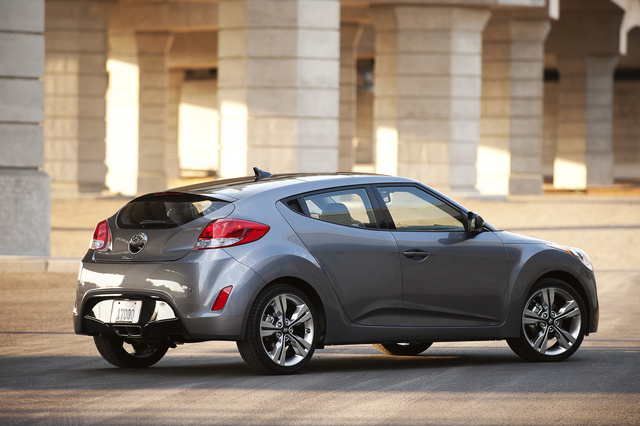
The front-wheel-drive Hyundai Veloster was a refreshing take on the five-door hatchback. Instead of four passenger doors, it had three, with two on the “safe” side, so all passengers could exit next to the curb. It had sporty looks, even if it initially lacked the powertrain to match. But the base engine was quickly joined by a turbo version with a sportier suspension.
The second generation solidified its hot-hatch status with the addition of the high-performance Veloster N and aggressive good looks. It also added some of the modern tech we’re used to in today’s vehicles, such as Apple CarPlay and Android Auto, rearview cameras, and automatic emergency braking.
While the first generation Veloster models had so-so crash test ratings, it came out of the gate in 2019 with the Insurance Institute for Highway Safety Top Safety Pick rating, and maintained that status through the 2021 model year.
With the option of a manual transmission or a seven-speed dual-clutch transmission (DCT) with paddle shifters, this was a vehicle that appealed to enthusiasts as well as those who simply wanted a compact vehicle with a practical hatchback. They weren’t enough to keep it going forever, though, and due to sluggish sales and Hyundai’s shifting focus to SUVs, the Veloster quietly slipped away, replaced by the Elantra N and the Kona N in the current new car lineup.
Gone but not forgotten, the Hyundai Veloster is a great pick for buyers who want something that’s fun to drive but also has a practical side.
Hyundai Veloster: Cost, Reliability, and the Best Years to Buy
Frequently Asked Questions
Which Hyundai Veloster years are the best?
The NHTSA.gov and CarComplaints.com websites suggest the second-generation Hyundai Velosters have far fewer complaints and recalls than the first. We’d say 2022 is the best vehicle to buy, because it has more modern tech, no recalls and single-digit consumer complaints. If you’re looking at a first-gen model, we’d opt for 2017, which has zero recalls and far fewer complaints than the other models years of this generation.
What are the worst Hyundai Veloster years?
The original Hyundai Velosters in the 2012 to 2013 model years have the largest numbers of recalls and complaints, so we’d steer clear of those two. CarComplaints.com calls the 2013 Hyundai Veloster the worst model year, due to the high level of complaints and engine problems. The most frequently reported problem in this year, however, was for poor speakers.
Is a used Hyundai Veloster a good deal?
If you want a fun used car for less than $10,000, the Hyundai Veloster could be the car for you, but you’re looking at a first-generation model in that price range. For the 2017 model year, the average price will be in the $6,000 to $7,000 range, when the original MSRP was in the $20,000 to $24,000 range. Go for a second-generation 2019 model, and you should be able to find a vehicle in the $12,000 to $14,000 range.
Hyundai Veloster Pros and Cons
Pros:
- Fun to drive
- Excellent value for the money
- Plenty of cargo space
Cons:
- Cramped back seat
- Polarizing three-door design
- Only seats four
Hyundai Veloster Generations
Hyundai Veloster Second Generation (2019–2022)
After skipping a model year, the second-generation returned with the 2019 Hyundai Veloster. It still had the same quirky three-door body style, but got more power, slightly bigger proportions, and a lot more technology. Styling was more aggressive, and you can see Hyundai was taking a clear aim at hot hatch competitors, such as the Honda Civic Si and the Volkswagen GTI—especially because it simultaneously introduced the new Veloster N.
The base engine was now a 147-horsepower 2.0-liter inline four-cylinder, the 1.6-liter turbocharged engine carried over from the previous generation, and the new powertrain was the 250-hp 2.0-liter turbo unit that appeared in the Hyundai Veloster N. A multi-link suspension system was standard on all models and a six-speed manual remained the standard transmission—and the only transmission available on Turbo R-Spec and Veloster N models. A six-speed automatic was available with non turbo models, and the seven-speed dual-clutch automatic with the Turbo.
Trim levels at launch included the base Veloster 2.0 model, the Premium Turbo R-Spec, the Turbo, the N, and the Turbo Ultimate.
Standard features included forward-collision avoidance, automatic emergency braking, lane keep assist, automatic headlights, Apple CarPlay and Android Auto, cruise control, Bluetooth phone connectivity, and a seven-inch infotainment system. Available features include blind spot monitoring, rear cross-traffic alert, wireless phone charging, an eight-speaker Infinity premium audio system, automatic climate control, LED headlights, and a head-up display.
While this generation received some minor changes each year, it was essentially a carry-over model until its demise. In 2020, the Veloster Turbo Ultimate lost its manual transmission, and wireless charging was made standard on the Turbo model. The 2021 model year was the last year that all variants of the Veloster were produced and, in 2022, the Veloster N was the only model available model, with the addition of a 25-hp power boost.
The lowest price we saw for used Velosters of this generation was about $10,000, but they tended to have higher mileage and were from the 2019 model year. There are some $24,000 beauties with low mileage and turbo engines, but low-mileage deals in the $15,000-$17,000 range are around if you’re willing to travel.
Hyundai Veloster First Generation (2012–2017)
The first-generation Hyundai Veloster arrived on the scene in 2012, largely to fill the void of the Tiburon coupe, which was discontinued after the 2008 model year. It had an interesting, asymmetrical design, with one door on the driver’s side, and two doors on the passenger side. Plus, rather than a coupe body style with a trunk, the Veloster was a hatchback with generous cargo space.
At launch, the front-wheel drive (FWD) Veloster was equipped with a 1.6-liter inline four-cylinder engine that delivered 138 hp and 123 lb-ft of torque. It had a standard six-speed automatic manual transmission, and a six-speed dual-clutch automatic with steering-wheel-mounted paddle shifters were available. EPA-rated fuel economy was 37 mpg on the highway.
One of the great things about the Veloster was the number of standard features on a vehicle that originally cost less than $20,000. It had 17-inch alloy wheels, steering wheel audio controls, a seven-inch infotainment touchscreen, cruise control, power windows, and a six-speaker audio system as well as USB and auxiliary audio ports. It also got Hyundai’s new Blue Link telematics system, with the likes of remote vehicle unlocking and stolen vehicle recover, complete with a six-month free trial.
Rather than trims, the first model year of the Hyundai Veloster offered package options—Style and Tech—and to get the Tech Package, you also had to get the Style Package. The Style Package included the likes of 18-inch alloy wheels, a panoramic sunroof, fog lights, leather seats, and an eight-speaker audio system. The Tech Package added rear parking sensors, navigation, a rearview camera, automatic headlights, keyless entry, push-button start, and painted wheel inserts.
In 2013, Hyundai added a Turbo model with a more powerful engine, unique front and rear styling, bigger wheels and more standard features. The Hyundai Veloster Turbo had a 201-hp turbocharged 1.6-liter engine and offered both manual and automatic transmissions. It also had standard features such as leather seats, a panoramic sunroof, and navigation.
In 2014, Hyundai added the Turbo R-Spec trim with a short-throw shifter, red interior, and enhanced suspension. The base version of the Veloster also added some key safety tech in this model year, including a rearview camera, driver’s blind-spot mirror, and daytime running lights. In 2016, there was a refresh, comprising a revised hood and grille, while a new seven-speed dual-clutch transmission was available with turbo models, along with upgraded interiors.
The first-gen Veloster was offered in a number of special editions, including the RE:MIX in 2013, the RE:FLEX in 2014 and the Rally Edition in 2016.
Used vehicles in this generation range from $1,500 for high-mileage beaters to about $14,000 for low-mileage turbo models in good condition. But if you’re willing to travel, you’ll be able to find a model with less than 100,000 miles for around $7,000.
Related Topics