2026 Toyota Corolla Cross Hybrid Reviews, Pricing & Specs



Pros & cons
What we like
Fuel-efficient
Standard all-wheel drive
Easy-to-use technology
What to consider
Sluggish performance
Not much cargo space
Noisy engine under acceleration
Expert review
The 2026 Toyota Corolla Cross Hybrid focuses on efficiency and little else.
If your priority is fuel economy, the lightly refreshed 2026 Toyota Corolla Cross Hybrid is one of the better choices in the small and subcompact SUV class. It's comfortable, easy to drive, and benefits from Toyota's reputation for safety and reliability, but it may leave some drivers wanting more power and excitement.
Verdict: It’s not very exciting to drive, but the Corolla Cross delivers on comfort, safety, and ease of use.
out of 10 expert review
Look & feel
The 2026 Toyota Corolla Cross is classified as a compact SUV but measures about five inches shorter in length than the popular Toyota RAV4, which is also in the compact class. The Corolla Cross straddles the line between the smaller subcompact SUV segment, and not surprisingly, it seems closer in size to the RAV4 than smaller subcompacts like the Honda HR-V and Hyundai Kona. The Corolla Cross's boxier shape and truck-inspired styling give it even more presence on the road.
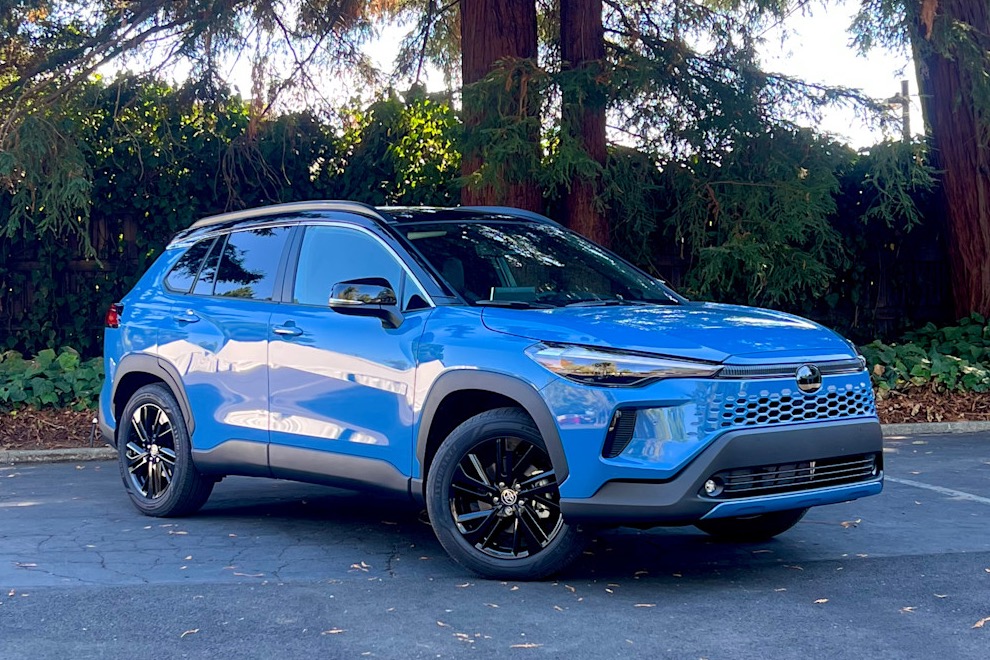
For 2026, both the standard gas-powered Corolla Cross and its Hybrid stablemate receive a slight styling refresh. The standard model gets larger and chunkier grille openings that suggest the vehicle needs to inhale more air to feed a more powerful engine, though in reality, the engine remains the same as before. The Corolla Cross Hybrid receives a more significant makeover with a restyled front that is more cohesive and substantial than its predecessor. The grille appears more upright and eliminates the awkward bump that previously enclosed the Toyota badge. The new Hybrid features a lattice-like mesh that has a cleaner look we typically associate with EVs.
The interior changes are more subtle, with a reshaped center console that is rectangular and flat compared to the more organically shaped console from previous years. In the process, it opens up a bit more space, allowing for a rubberized phone tray next to the wireless charging pad where the dashboard and console intersect. A larger infotainment touchscreen also better fills the space within its enclosure.
In the base and midrange trim levels, both Corolla Cross models come standard with fabric seat upholstery, while the top trims upgrade to Toyota's SofTex synthetic leather. The SofTex likely won't be mistaken for genuine leather, since its heft and texture look and feel more like a nicer vinyl. There is also no shortage of hard plastic materials, but most surfaces you're likely to come into contact with have some soft-touch cushioning.
We spent our time in the Corolla Cross Hybrid in the top XSE trim, and it compared well against other SUVs in its class. It's not quite as refined or luxurious as the Mazda CX-50, but it's also noticeably nicer than the more budget-conscious Hyundai Venue.
Performance
The 2026 Toyota Corolla Cross Hybrid is powered by a 2.0-liter four-cylinder engine that is paired with two electric motors that are fed by a lithium-ion battery pack. This setup sends power to the front wheels, but between the rear wheels is a third electric motor that activates when additional traction is needed, acting as an on-demand all-wheel-drive (AWD) system. Combined output is 196 horsepower, which should propel the Hybrid to 60 mph in 8 seconds, according to Toyota.
That makes the Hybrid the preferred Corolla Cross, as the gas-only model only produces 169 hp from its 2.0-liter four-cylinder engine. It has a continuously variable transmission (CVT), and is available with either front-wheel-drive (FWD) or AWD. The AWD model employs a more common mechanical driveshaft to power the rear wheels and requires a noticeably longer 9.6 seconds to accelerate to 60 mph.
The Hybrid is on the quick side among subcompact SUVs, while the standard gas Corolla Cross is about average, but whether it’s the standard Corolla Cross’ CVT or the Hybrid’s two-motor system, the lack of conventional gears tends to make them feel slower than they are. When accelerating, neither shifts in the way conventional transmissions do. Instead, the engine hangs at an elevated speed, emitting a loud and constant cow-like groan that permeates the entire cabin. To the uninitiated, it could sound as though something is mechanically wrong, and this isn't isolated to hard acceleration. Even moderate launches have similar results, which means you should give yourself a bit more space to merge onto a flowing highway and approach passing maneuvers with plenty of forethought.
Odds are, this tepid performance should still be adequate for many drivers, but far from impressive. That also applies to the way the Corolla Cross handles curves in the road. It doesn't purport to be sporty, and favors a comfortable and compliant ride quality over sharp cornering ability. Thankfully, the suspension isn't tuned so soft as to feel wallowy, and remains composed and fairly confident. Moderately sized flaws in the road are ably smoothed over to the point where you only feel and hear a muffled thud, though the tires do emit some noticeable white noise on some coarser asphalt surfaces.
If you're interested in subcompact hybrids, there's a good chance that performance is lower on your priority list. If that's the case, the Corolla Cross Hybrid should meet your expectations, as it makes up for the dearth in power with impressive fuel economy estimates.
Form & function
The front seats offer plenty of space for taller drivers and passengers, and have enough adjustments to find your optimal position. The SofTex upholstery can feel a little stifling on hot days until the air conditioning has a chance to cool down the cabin, and ventilated or cooled seats are not available. Outward visibility through the front and side windows is good, while the view out the rear is limited by the narrow glass. These are common issues among many SUVs in the class.
Storage for your personal items is rather limited, with a small center armrest bin and door pockets, and a pair of medium-sized cupholders. It's good to have a grippy wireless charging pad that keeps your smartphone in place, and the added tray beside it ensures your passenger also has a spot for their device (though that tray does not charge).
The rear seats have enough headroom for an average-sized adult, thanks to a carved-out section of the headliner, though legroom isn't as generous. Those passengers won't have much room to stretch their legs, but it should be adequate for anything but longer road trips. More likely than not, smaller passengers will be relegated to the rear seats, and they should have a better time back there. The rear passenger compartment also substitutes many of the soft-touch materials with hard plastic elements in order to improve durability in the face of children or pets.
Behind those seats, the AWD Corolla Cross models can accommodate up to 17.1 cubic feet of cargo, while the gas-powered FWD version can hold up to 19.6 cubic feet. Neither figure is very large for the subcompact SUV class, but should still be adequate for most shoppers' needs. The angled rear window will also complicate the loading of bulkier items, but folding the rear seatbacks should solve that problem. Helping matters is a power liftgate, but it's only available on the top trim as an option.
Technology
In the entry-level Corolla Cross trim, a seven-inch partial-digital instrument panel is standard, along with an eight-inch central infotainment touchscreen mounted atop the dash, wireless Apple CarPlay and Android Auto, and a six-speaker audio system with satellite radio. Stepping up to the midrange trim adds a wireless charging pad and two USB-C charge ports for the rear passengers. The top trim (XSE for Hybrids, XLE for non-hybrids) upgrades to a fully-digital 12.3-inch instrument panel, a 10.5-inch infotainment touchscreen, and a nine-speaker JBL premium audio system is available as an option.
Corolla Cross XLE and Corolla Cross Hybrid XSE models also come with a one-year free trial for Google-based cloud navigation, but it's more likely that owners will opt for the navigation built into their smartphones. All trim levels include a 30-day free trial for Wi-Fi Connect, which includes a Wi-Fi hotspot and streaming music compatibility, as well as a one-year subscription for Remote Connect (vehicle monitoring and control via a smartphone app).
If you're like many drivers, your reliance on your smartphone should prompt you to graduate to at least the midrange SE trim (LE for the non-Hybrid) to take advantage of the added tech amenities. Otherwise, the Corolla Cross could feel outdated or like a rental car.
Even at the top trim levels, the infotainment system lacks some of the panache and features found in other vehicles, functioning like a more basic last-generation system. The graphics are attractive and the responses are acceptably quick, which we consider more important. We're also pleased that the climate controls feature physical knobs and buttons, rather than integrating them into the touchscreen. This helps to reduce distraction when making adjustments. Overall, the Corolla Cross won't wow you with technology, but the systems are easy to use.
Safety
All 2026 Corolla Cross models come with the Toyota Safety Sense 3.0 suite of advanced safety features and driver assistants. These include: forward-collision warning with automatic emergency braking, adaptive cruise control, lane-keep assist with lane centering, automatic high beams, and a traffic sign reader. Also standard on all models is a rear-seat passenger reminder. The midgrade trim adds a blind-spot monitor with rear cross-traffic alert and a safe passenger exit alert system. The top trim adds parking proximity sensors with automatic braking. One notable absence is a surround-view camera system.
Other tech-related safety features include a five-year subscription to an emergency assistance button that can be activated manually or automatically after a collision, summoning roadside assistance or emergency responders. In our time with the Hybrid, we never experienced any false alarms or technical glitches with any of the safety systems.
The National Highway Traffic Safety Administration (NHTSA) has only published crash test results for frontal and side protection, with four and five out of five star ratings, respectively. The Insurance Institute for Highway Safety (IIHS) has more complete results. The Corolla Cross earned the top score of "Good" in all categories except for the updated moderate frontal overlap test, where it scored a second-best "Acceptable" rating.
Cost-effectiveness
The 2026 Toyota Corolla Cross Hybrid has a starting price of $30,445 (including $1,450 in destination charges) and pricing climbs to $34,480 for the top XSE trim. These represent between $3,350 and $4,360 more than the equivalent non-Hybrid Corolla Cross models and are comparable to other hybrid SUVs in the class. Toyota estimates the Hybrid will return an impressive 46 mpg city, 39 mpg highway, and 42 mpg combined. An AWD gas-only Corolla Cross is estimated to be a full 10 mpg lower in the combined testing cycle than the Hybrid.
If we estimate gasoline at $4.00 per gallon and budget for 15,000 miles driven annually, that figures out to between 7.5 and 9.8 years to recoup the Hybrid's price premium over the non-Hybrid. It would make financial sense to take the hybrid route if you plan on owning the vehicle that long, but an increase in gas prices or mileage will reduce that breakeven time. For those seeking to reduce their carbon footprint, the benefits are immediately realized, as the Corolla Cross Hybrid is one of the more efficient choices without stepping up to a plug-in hybrid or fully-electric vehicle.
While neither Corolla Cross is very exciting to drive, they make up for it where it matters most to the majority of shoppers in this class: comfort, safety, and ease of use. Both are assembled in Huntsville, Alabama, which we hope might help to insulate them from the current tariffs and trade issues.
If you're looking for a more engaging and sporty alternative, the Mazda CX-50 is an excellent choice that also gains an advantage with its more luxurious interior—and it added a Hybrid model just last year. The Hyundai Tucson and Kia Sportage Hybrids are also more powerful and pack a lot of features for the money. In more practical terms, the Corolla Cross holds an advantage with Toyota's reputation for reliability and durability, though the Hyundai and Kia are backed by a very generous warranty.

What owners say
Trims & specs
Base MSRP $29,795 | Seating 5 |
Engine 2.0L 196 hp I4 Hybrid | Cargo Capacity 21.5 cu ft |
Combined MPG 43 | Drivetrain AWD |
Base MSRP $31,115 | Seating 5 |
Engine 2.0L 196 hp I4 Hybrid | Cargo Capacity 21.5 cu ft |
Combined MPG 43 | Drivetrain AWD |
Base MSRP $33,830 | Seating 5 |
Engine 2.0L 196 hp I4 Hybrid | Cargo Capacity 21.5 cu ft |
Combined MPG 43 | Drivetrain AWD |


Pricing trends
MSRP range
$29,795 - $33,830
Current avg. market price
$34,381
Trending down by 0.9% this month
June 2026 - October 2026


