2026 Acura Integra Reviews, Pricing & Specs


Pros & cons
What we like
Stylish design
Fun to drive
Practical hatchback configuration
What to consider
All-wheel drive not available
Hybrid powertrain not available
Outdated technology
The CarGurus verdict
Beloved by driving enthusiasts, the 2026 Acura Integra is a special car in an SUV world.
Arguably positioned between the Civic and Accord in the Honda/Acura universe, but serving as an alternative to the Audi A3, BMW 2 Series Gran Coupe, and Mercedes-Benz CLA, the 2026 Integra blends comfort, utility, and driving satisfaction in an appealing five-door liftback configuration. For the 2026 model year, subtle styling updates and an improved standard infotainment system keep the Integra fresh, and with the cancellation of the TLX, it serves as Acura’s only car model.
Verdict: Thanks to its liftback design and appealing price point, the Acura Integra has no direct rivals. However, it faces significant in-house competition from the Acura ADX crossover SUV and the Honda Civic Hatchback. They render the Integra obsolete, which is a shame because it is a genuinely stylish, practical, and fun car.
out of 10 expert review
Look & feel
Acura offers the 2026 Integra in base, A-Spec, A-Spec with Technology, and Type S trim levels. They’re all based on the Honda Civic, but distinguish themselves through exclusive design, powertrain, and packaging details. Base pricing ranges from $34,595 to $54,595, including the $1,195 destination charge.
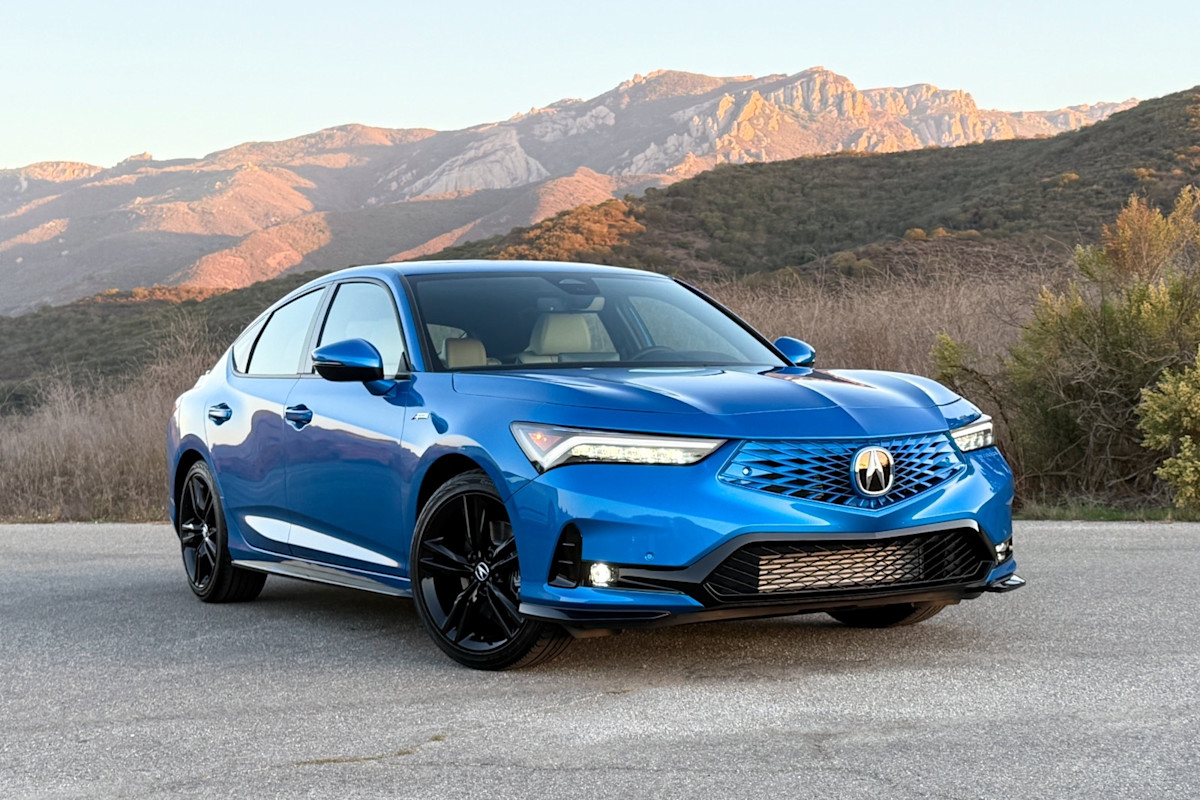
Our A-Spec with Technology test car arrived with the available six-speed manual transmission, a real rarity in the market. Equipped with extra-cost Double Apex Blue Pearl paint, it had a manufacturer’s suggested retail price (MSRP) of $40,995, including destination. That’s more than a loaded Honda Accord Touring Hybrid.
The 2026 Integra is an appealing car, wearing Acura’s now familiar “diamond pentagon” grille, “jewel eye” LED headlights, and sculpted bodywork. It shares its 107.7-inch wheelbase with the Honda Civic Hatchback, but the Acura is 6.8 inches longer, 1.1 inches wider, and slightly shorter than the Honda. Those dimensions translate into a more balanced look than the stubby Civic.
For the 2026 model year, Integra A-Spec models wear a new exterior body kit with gloss-black detailing, and the 18-inch wheels are painted black rather than dark gray. Solar Silver, Urban Gray Pearl, and Double Apex Blue are the new paint colors, and a body-color grille is newly available. Interior trim is revised as well, while the A-Spec and A-Spec with Technology add ambient lighting. Choose one of those A-Spec trims with an Orchid interior color, and new blue microfiber trim adds even more contrast to the cabin. Get the Ebony interior color, and enjoy new yellow contrast stitching throughout.
Quality and subtle luxury characterize the Integra’s interior, which is slightly smaller inside than that of the Civic Hatchback. It doesn’t seem that way from the driver’s seat, though, thanks to an expansive hood that makes the Integra feel much wider than it is.
The controls and displays are simple and straightforward, with clear white markings on matte-finish black backgrounds. Elegant detailing adds subtle luxury, such as the diamond-mesh air vent trim and metallic knurled stereo volume and climate system knobs. An aluminum-topped knob caps the test car’s shifter, and the A-Spec models feature sporty stainless steel pedal covers and red gauge needles.
Plenty of what you find in the Integra is also evident in the Honda Accord and Civic. That’s a compliment for the Hondas, and not a ding against the Acura. But it also underscores the thin line separating the comparatively expensive Integra from its more sensibly priced Honda cousins.

Performance
If your top objective is thrilling performance, you can drive a stick, and you’re not into the boy-racer styling of the Honda Civic Type R, find an Acura Integra Type S, and don’t look back. It’s a terrific car, and is a blast to drive thanks to a turbocharged 2.0-liter four-cylinder engine producing 320 horsepower and 310 pound-feet of torque, full hardware upgrade, and exclusive dynamic tuning.
The rest of the Integra lineup employs a turbocharged 1.5-liter four-cylinder engine supplying 200 hp and 192 lb-ft of torque. It’s the same engine Honda uses in the Civic Si, but unlike the Civic, the Integra pairs it with a continuously variable transmission (CVT) by default. Choose the A-Spec with Technology, and the Si’s six-speed manual gearbox with automatic downshift rev-matching is available, along with Honda’s masterful helical limited-slip front differential to tame the front wheels when exiting corners and curves.
Notably, the Acura ADX crossover also uses the 1.5-liter turbo-four and CVT, but it doesn’t make as much power and has to motivate more mass. So, while the heavier ADX offers merely adequate performance, the lighter Integra feels zippy and fun. Still, you can’t get all-wheel drive (AWD) in the Integra, and that’s where the ADX might make more sense for some people. You also can’t get a hybrid powertrain in the Integra, like you can in a Honda Civic Hatchback. It’s an outstanding setup offering plenty of power and impressive fuel economy at a much better value than the Acura.
When you upgrade to an Acura Integra A-Spec, you get a thicker rear stabilizer bar, quicker steering, and larger 18-inch wheels with wider and lower profile all-season tires. The A-Spec with Technology further improves the ride and handling with an adaptive damping suspension, while an Active Sound Control system enhances the powertrain’s sound for a more engaging driving experience. An Individual mode joins the standard Comfort, Normal, and Sport modes.
We tested the Integra in Southern California, right after spending a week driving a Honda Civic Sport equipped with its standard naturally-aspirated 150-hp four-cylinder engine and CVT. Aside from its sedate acceleration, that Civic was delightful to drive, and we expected more from the sportier and more expensive Integra.
As expected, the Integra’s turbocharged engine proved far livelier, though launching the car without wheel spin and manually shifting through the gears made it no quicker in daily driving than a Civic Sport. We observed this in traffic and when accelerating hard to 60 mph; the latter scenario caused the traction control to engage after launch and required two upshifts before passing that velocity.
Still, it is nothing but a pleasure to row the Integra’s precise, short-throw manual transmission, in part thanks to the super-smooth automatic downshift rev-matching feature. Purists might miss heel-and-toeing, but when you’re threading a canyon and you’re on the lookout for rockfall, cyclists, damp spots, and errant oncoming drivers who don’t know what a double yellow line means, the rev-matching means you have one less thing to concentrate on.
The adaptive damping suspension works well in the city, providing a composed yet communicative ride. The Integra tackled speed humps at 35 mph and speed bumps at 20 mph, proving far more isolated over the latter than the Civic. The Acura is quieter than the Honda, too, especially on the highway.
Driving across the Santa Monica Mountains revealed the Integra A-Spec to be a little soft and squishy, even in Sport mode. While it is nose-heavy, with 60 percent of its curb weight sitting over the front wheels, we blame the adaptive suspension and the 235/40R18 Continental ContiProContact all-season tires. The Integra is fun to drive, just not as much fun as expected following a week spent living with the Civic.
Acura could resolve that by further stiffening the suspension in Sport mode and by including performance tires when customers choose the manual transmission. That way, the silky-smooth engine, delightful gearbox, effective helical limited-slip differential, and excellent variable-ratio steering could shine even brighter.
Overall, the Integra A-Spec with Technology is enjoyable, but not exciting, to drive. It also fell short on fuel economy, missing the official EPA estimate of 30 mpg in combined city and highway driving by 3.5 mpg, notching 26.5 mpg on our evaluation loop. So, unless you’re willing to substantially increase your budget and get the Integra Type S, or you cannot live without a manual transmission, we think you’re better served by the Honda Civic Hatchback equipped with the hybrid powertrain.

Form & function
Though it’s a smidgeon smaller than a Civic Hatchback inside, the Integra is nevertheless comfortable while supplying plenty of practicality and utility.
Our Technology package-equipped test car had a 12-way power-adjustable driver’s seat offering excellent thigh support and impressive long-distance comfort. It also had a four-way power-adjustable front passenger’s seat, but without seat-height adjustment, we fail to see why Acura bothers. Both front seats are heated, but you can’t get ventilated seats in the Integra.
Likewise, you can’t get rear air conditioning vents—something Acura makes available on the ADX. Rear legroom and foot space are decent, and the seat cushion and backrest are comfortable and supportive. A fifth passenger would be a tight squeeze unless all three are children.
Interior storage is commendable. Based on our experience, you won’t have any trouble securing smartphones, house keys, reasonably-sized water bottles, and more. However, the cupholders embedded into the rear-seat center armrest are shallow, so tall and tippy drinks could succumb to the laws of physics if someone is driving the Integra with enthusiasm.
Open the Integra’s gaping liftback, and you’ll find a 24.3 cubic-foot cargo area. The liftover height is high, but the cargo space is roomy and can hold full-size suitcases on their sides. A cargo cover blocks the contents of the trunk from view. For added room, you can fold the 60/40-split rear seat down, but Acura doesn’t divulge a maximum cargo volume for the Integra with the second row folded.

Technology
Acura is not trying to wow customers with flashy technology here but, depending on your point of view, that can be a good thing.
Instead of a panoramic display housing graphically-rich digital instrumentation and infotainment displays with customizable themes, the Integra offers a comparatively plain and simple 10.2-inch digital instrumentation display nestled into the usual binnacle forward of the driver, paired with a 9-inch touchscreen standing proud of the dashboard.
Believe it or not, the newly standard 9-inch touchscreen is an improvement over the 7-inch touchscreen Acura used to offer on the base and A-Spec models. With that 9-inch upgrade, all Integras now feature wireless Apple CarPlay, wireless Android Auto, and wireless phone charging. A faster processor enhances system response for 2026.
Upgrade to the A-Spec with Technology model, and the infotainment system adds SiriusXM satellite radio, HD radio, Alexa Built-in, and AcuraLink connected services with access to a Wi-Fi hotspot. Additionally, an ELS Studio 3D surround-sound system with 16 speakers replaces the car’s standard eight-speaker audio system, and a 5.3-inch head-up display is included as well.
Though you can get a more sophisticated Google Built-in infotainment system in a Honda Accord or Civic, that’s unavailable in the Integra. Nevertheless, we had no trouble pairing an iPhone to the system, streaming music via Pandora and Apple Music, and using voice commands to request directions to destinations. Furthermore, the volume knob and tuning buttons are easy to find and use without taking your eyes off the road.
However, we encountered some issues with display legibility. When the sun shone on the Orchid white upholstery, the reflection on the infotainment system made it almost unreadable. Similarly, after several days of dust gathering on the instrumentation screen, it washed out in direct sunlight.

Safety
Every 2026 Integra comes standard with the AcuraWatch collection of driver assistance systems. They include: forward collision warning with pedestrian detection, automatic emergency braking, lane departure warning, lane keep assist, lane centering assist, and adaptive cruise control. The Integra also has blind-spot monitoring and rear cross-traffic alert, while the A-Spec Technology adds front and rear parking sensors with low-speed automatic braking.
Since the test car had a manual transmission, the adaptive cruise control couldn’t bring the Integra to a full stop and then continue when traffic ahead moved forward. Instead, you get a warning to retake control, and the tech disengages. On the highway, the adaptive cruise control reacts with a refined, sophisticated response when other vehicles cut into the gap ahead. It slows gradually instead of suddenly to return to the prescribed following distance.
The lane-centering assist system doesn’t employ steering wheel sensors, so you must regularly add small steering inputs to tell it that you’re still holding the steering wheel or suffer through the regular reminders to do so. We did not like using the lane-centering assist without adaptive cruise control, and when driving toward late-afternoon sun, the lane-keeping assist system allowed the Integra to wander out of a lane without any attempt at correction. We’re not fans of Acura’s steering wheel wobble to issue a lane departure warning, either. A vibration would be better.
If a collision occurs, know that the Acura Integra earns a five-star overall rating from the National Highway Traffic Safety Administration (NHTSA). Not only that, but it gets five-star ratings in every individual assessment, including for rollover resistance. The Insurance Institute for Highway Safety (IIHS) gives the Integra a mix of “Good” and “Acceptable” ratings.

Cost-effectiveness
The 2026 Acura Integra has a lot going for it. This car looks good, is enjoyable to drive, exudes quality, and offers a rare five-door liftback design with utility that can approach that of a crossover SUV. Plus, it provides the technology you’re most likely to want, without any extraneous features you’re unlikely to need.
Compared to other small luxury cars, the Integra offers value and segment-exclusive features, such as its rear hatch and manual gearbox. However, the Audi A3, BMW 2 Series Gran Coupe, and Mercedes-Benz CLA offer AWD as standard or optional equipment.
Within the Acura lineup, if you want AWD, you need the ADX or one of the brand’s other crossovers. Outside of the Acura lineup, you could get the equally stylish and upscale Mazda 3 Hatchback with turbocharging and AWD. The Mazda offers a manual gearbox, too, but only with front-wheel drive (FWD) and the naturally-aspirated base engine.
Furthermore, unless you really want to row your own gears, we recommend sticking with the Integra’s standard CVT. And if you’re going to do that, then you might as well get a Honda Civic Hatchback Hybrid in Sport Touring trim and save yourself a few grand while getting better fuel economy and zippier acceleration.
That leaves the 2026 Integra to attract buyers on the strength of its legendary name, its available manual transmission, and its fantastic but relatively rare Type S performance variant. Is that enough to sustain the current Integra, or is the car’s return to the market after a two-decade absence a one-and-done scenario? As always, time is going to tell, but as it stands, the Integra is compelling only to a very narrow slice of the car-buying public.

What owners say
The Acura Integra is a blast to drive and offers great gas mileage alongside a ton of features. It is one of the few semi-luxury vehicles left with a manual transmission, and the excellent sound system more than makes up for the slight increase in road noise—it is a sports car, after all.
March 21, 2026Trims & specs
Base MSRP $33,400 | Seating 5 |
Engine 1.5L 200 hp I4 | Cargo Capacity 24.3 cu ft |
Combined MPG 33 | Drivetrain FWD |
Base MSRP $35,950 | Seating 5 |
Engine 1.5L 200 hp I4 | Cargo Capacity 24.3 cu ft |
Combined MPG 33 | Drivetrain FWD |
Base MSRP $39,200 | Seating 5 |
Engine 1.5L 200 hp I4 | Cargo Capacity 24.3 cu ft |
Combined MPG 31 | Drivetrain FWD |
Base MSRP N/A | Seating N/A |
Engine N/A | Cargo Capacity N/A |
Combined MPG N/A | Drivetrain N/A |
Base MSRP $53,400 | Seating 4 |
Engine 2.0L 320 hp I4 | Cargo Capacity 24.3 cu ft |
Combined MPG 24 | Drivetrain FWD |


Pricing trends
MSRP range
$33,400 - $53,400
Current avg. market price
$33,366
Trending down by 1.7% this month
May 2026 - November 2026


