2024 Dodge Hornet Reviews, Pricing & Specs



Pros & cons
What we like
Powerful engine options
Standard all-wheel drive
Impressive technology
What to consider
Claustrophobic back seat
Not much cargo space
R/T trim offers poor value
The CarGurus verdict
America’s muscle-car experts take on a new project with the 2024 Dodge Hornet R/T.
There’s no V8 under the hood of a Dodge Hornet. Instead, this compact crossover (or compact utility vehicle, as Dodge calls it) comes equipped with a four-cylinder engine or, in the case of the 2024 R/T trim, a plug-in hybrid powertrain.
As fuel-efficiency and low-emissions vehicles become more appealing to shoppers, the Hornet represents a major milestone for Dodge. If the company is going to remain relevant in an increasingly eco-conscious marketplace, this little crossover needs to be a hit.
out of 10 expert review
Look & feel
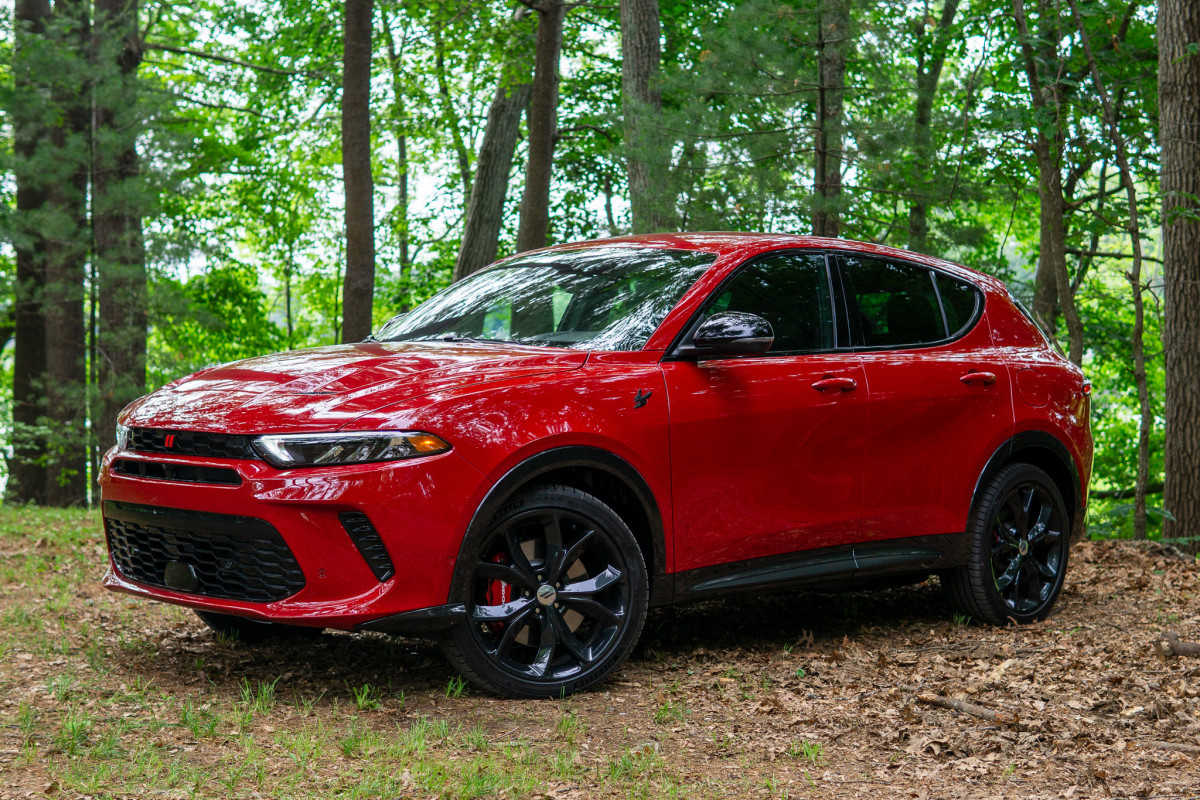
Sure, it might not be a big, V8 muscle car like the Dodge Charger or Dodge Challenger, but the 2024 Dodge Hornet still has the brand’s distinctive styling. From the big, muscley front end to the integrated heat extractors on the hood, the Hornet looks tough. The grille (or grilles, more accurately) features a large opening at the bottom, a smaller "mail slot" opening in the middle, and a new logo lives front-and-center on the upper-most portion. The new emblem, called the Rhombi, has been seen plenty of times before, but never on its own, stamped front and center as the primary identifier for a Dodge model.
The 2024 Dodge Hornet’s tail lamp extends across the width of the crossover, and it features an illuminated Rhomb at its center. At the bottom rear corners, oversized tailpipes reveal that the Hornet isn’t your regular crossover. It’s still a Dodge, and performance is a standard feature.
Dodge sells the Hornet in four trim levels: GT and GT Plus, which feature a regular gas engine and cost less, and the R/T and R/T Plus, which are more expensive but employ a more advanced plug-in hybrid (PHEV) powertrain. Our test vehicle for this review was an R/T Plus trim level equipped with Dodge’s Blacktop Package. At a cost of roughly $1,600, the Blacktop Package includes black wheels, black mirror caps, and darker badging and window trim.
Built alongside the Alfa Romeo Tonale, the Hornet shares a lot of visual similarities with its Italian sibling. Although much of the family resemblance is obvious, the Hornet’s blunt nose showcases classic Dodge design while the Tonale’s more streamlined front end helps it look a little less stubby.
Thanks in part to the Italian side of its family tree, the Hornet’s interior benefits from a much more modern feel than you can expect in other Dodge models. With our test vehicle’s $2,595 Track Pack, the seats feature Alcantara upholstery and a Dodge Rhombi logo. To maintain its sporty intentions, The Hornet’s center stack is ever-so-slightly tilted toward the driver. We also appreciated the row of physical switches for climate control settings and the impressive widescreen infotainment display.
In terms of items you’ll spend the most time touching, the steering wheel in the 2024 Hornet is a good size, although some of its buttons feel a bit outdated–as if they were pulled from Dodge’s existing parts bin rather than made special for this new model. The seats, similarly, look cool but feel like they're likely too heavily bolstered for typical shoppers.

Performance
Dodge sells the 2024 Hornet with different powertrains, designated by the GT and R/T trim levels. Each of those trim levels will have a “plus” iteration, too. So, essentially you can choose from the GT, GT Plus, R/T, and R/T Plus.
The GT is a full-gas model, employing a 2.0-liter turbocharged four-cylinder engine to deliver 268 horsepower and 295 pound-feet of torque. Those are impressive figures in a compact crossover, and the fact that they’re available courtesy of the standard powertrain is all the more impressive. For auto enthusiasts shopping for a small family vehicle, the Hornet has an immediate leg up on its competition. The GT also uses a nine-speed automatic transmission, and all-wheel drive (AWD) is standard fare. However, it’s worth noting that the GT’s 2.0-liter turbo engine requires premium fuel, making daily running costs higher.
Our R/T test vehicle is a different animal than the Hornet GT. For one, it’s a PHEV. That means there’s an engine, a 1.3-liter turbocharged four-cylinder, but there’s also a 15.5-kWh battery and two electric motors. All told, the power output in the Hornet R/T measures 288 horsepower (20 more than the GT) and 383 pound-feet of torque (88 more than the GT).
Like the GT, the R/T comes standard with AWD. However, while the GT uses a mechanical linkage for AWD, the R/T supplies an electric AWD system, thanks to its two electric motors. Also, while the GT has a nine-speed, the R/T uses a six-speed automatic transmission, instead. Largely because of its battery, the R/T weighs about 425 pounds more, overall, too.
Despite its extra weight (and because of its extra power), the Hornet R/T is quick, no doubt about it. It has a pretty heavy pedal, and it feels like you have to get into it a bit to access all that power. But once you get into the meat of the powerband, it can seriously move. The R/T might be a plug-in hybrid, but it’s still a Dodge, so you get Sport mode courtesy of a big button on the center console. And if you pull on both of the oversized paddle shifters, you activate “Powershot,” which gives you an extra 30 horsepower for 15 seconds.
The suspension feels soft enough to soak up all but the worst road imperfections, but it’s stiff enough that it doesn’t create too much body roll when cornering, which is impressive considering the Hornet R/T’s 4,100-pound curb weight. A heavy steering feel can distract from its precision, but it certainly is accurate and demonstrates almost no play or vagueness off-center. We’d like a tighter turning radius, but at the end of the day, this is a crossover, not a sports car.
Shoppers with relatively short commutes are going to be enticed by the Hornet R/T’s all-electric driving range. On a full charge, our test car could travel roughly 30 miles without needing to drink a sip of gasoline. With a 15.5-kWh battery, that means the Hornet R/T can manage roughly 2 miles per kilowatt hour–not a terrifically efficient statistic, but if you can charge for free at work, it can still save you plenty of money on fuel.
In the R/T, you can specify whether you want it to drive in all-electric mode, save the battery for later use, or operate as a typical hybrid. The EPA hasn’t released fuel economy figures for the R/T trim levels yet, but in the hybrid mode, the Hornet will prioritize the battery, so expect to see your MPGs shoot up while it’s doing that, and then drop pretty rapidly once the battery has been largely depleted. The 2024 Dodge Hornet GT should return 21 mpg in the city, 29 highway, 24 combined. That’s not as impressive as what you can expect from, say, a 2024 Subaru Crosstrek with its upgraded 2.5-liter engine (26/33/29), but the Subaru doesn’t deliver nearly 300 lb-ft of torque, either.

Form & function
From a space and comfort perspective, the 2024 Dodge Hornet was designed with front passengers in mind first, and rear passengers second. In the front seats, headroom is good and visibility is surprisingly good, given how beefy the hood looks from the outside. In the back seat, unfortunately, it’s a bit of a different story.
Due to the Hornet’s high beltline and our test vehicle’s all-black interior, the back seat feels a bit cramped. On paper, the figures aren’t too bad: roughly 38 inches of legroom and headroom should provide plenty of space. Unfortunately, the back seat doesn’t feel spacious–it feels claustrophobic. We suspect a lighter interior color would help deter this feeling immensely.
The R/T’s PHEV battery results in less cargo capacity, as it eliminates the underfloor storage available in GT trims. Ultimately, it’s not a huge sacrifice. Behind the rear seat, the R/T offers 22.9 cubic feet of cargo space instead of the 27 cubic feet available in the GT trims. Fold down the rear seat and maximum cargo figures reach 50.5 cubic feet in the R/T and 54.7 cubic feet in the GT. Ultimately, both iterations fall short of the Hyundai Tucson PHEV, which supplies almost 32 cubic feet behind the second row and nearly 72 cubic feet with it folded.

Technology
A best-in-class 12.3-inch digital driver information display can be customized across three separate “zones,” and it looks crisp and clear. However, we’re even more impressed with the Hornet’s standard widescreen infotainment display.
At 10.25 inches, the Hornet’s touchscreen looks like it should be in a luxury car, not a mass-market crossover. It operates on Dodge’s Android-based system, UConnect 5. Overall, UConnect5 is incredibly user-friendly and delightfully customizable. Our test car’s system did seem a bit slow to respond at times, but it appeared to be a RAM issue; subsequent visits to the slow-reacting features resulted in much faster load times. This may be due to our Hornet being a pre-production model meant for testing.
Wireless Android Auto and Apple CarPlay come standard with UConnect 5, and our test vehicle also had a premium Harman Kardon audio system and a wireless phone charger. If you do plug in, there’s not a good place to put your phone, so we hope you’ve got wireless charging. Ultimately, our favorite thing about this Hornet’s tech system is how easy it is to personalize. You can set up a dedicated user profile and then add the widgets you want to see on various screens.

Safety
Neither the 2023 nor the 2024 Dodge Hornet have yet been evaluated or crash-tested by the National Highway Traffic Safety Administration (NHTSA) or the Insurance Institute for Highway Safety (IIHS). As such, we can’t comment on how the Hornet would fare in a crash. However, Dodge does include an impressive selection of advanced driver assistance systems (ADAS) as standard equipment, all designed to lower the chances of a crash happening in the first place.
Standard safety features include automatic emergency braking, lane-departure warning, lane-keeping assist, blind-spot monitoring, and rear cross-traffic alert. You also get adaptive cruise control as standard, but a more advanced version with traffic-sign recognition is available for an extra cost.
You can also equip the Hornet with some level 2 autonomous driving functions, which we had thanks to our test car’s $2,245 Tech Pack. Built upon the adaptive cruise control system with intelligent speed assist and a lane-tracing assist function, the Tech Pack’s level 2 capabilities did a fine job keeping our test car between the lines and traveling at a safe rate of speed.

Cost-effectiveness
Overall, The 2024 Dodge Hornet is a pretty compelling little crossover, but it feels a bit pricey. When Dodge debuted the Hornet, it announced a starting price below the $30,000 threshold. However, that doesn’t seem to be the case, as it now carries a starting MSRP of $30,735. Making matters worse, the destination fee for this CUV (coming from Italy) is $1,595. While the total starting cost is less than that of a Mazda CX-30 Turbo, it doesn’t represent significant savings, and the Hornet can’t quite match the Mazda in terms of look and feel or performance.
As of this writing, Dodge hasn’t officially added pricing for the R/T trims on its consumer website, but our car included an as-test price that looks pretty wild: $52,305
That’s a lot of cash for a small crossover from a mass-market automaker, even if it does include the destination fee and $6,930 in extras. That as-tested price also reflects a $615 credit for our pre-production vehicle’s deleted sunroof and $600 in savings, thanks to the Track Pack and Blacktop packages being bundled together.
It’s hard to envision shoppers lining up to spend north of $50,000 for a Dodge Hornet R/T, but the GT’s $30-35K price range looks quite a bit more reasonable. Although PHEV (and eventually EV) technology may represent Dodge’s future, we recommend sticking with the good old-fashioned gas Hornet for now.

What owners say
I recently had the privilege of test driving the 2024 Dodge Hornet R/T, and I must say, it was an exhilarating experience that left me craving more. This compact sports car from Dodge delivers a potent combination of performance, style, and innovation, making it a thrilling option for drivers who crave speed and excitement.
July 7, 2023Trims & specs
Base MSRP $41,400 | Seating 5 |
Engine 1.3L 288 hp I4 Hybrid | Cargo Capacity 22.9 cu ft |
Combined MPG 77 | Drivetrain AWD |
Base MSRP $36,695 | Seating 5 |
Engine 2.0L 268 hp I4 | Cargo Capacity 27.0 cu ft |
Combined MPG 25 | Drivetrain AWD |
Base MSRP $31,400 | Seating 5 |
Engine 2.0L 268 hp I4 | Cargo Capacity 27.0 cu ft |
Combined MPG 25 | Drivetrain AWD |
Base MSRP $46,745 | Seating 5 |
Engine 1.3L 288 hp I4 Hybrid | Cargo Capacity 22.9 cu ft |
Combined MPG 77 | Drivetrain AWD |


Pricing trends
MSRP range
$31,400 - $46,745
Current avg. market price
$22,087
Trending down by 1.4% this month
May 2026 - November 2026