2023 Dodge Hornet Reviews, Pricing & Specs



Pros & cons
What we like
Stylish design
Standard all-wheel drive
Easy-to-use technology
What to consider
Small standard wheels
Slow pickup at higher speeds
The CarGurus verdict
The Dodge Hornet is Big News. For one thing, it’s Dodge’s first all-new model in over a decade.
The Hornet is introduced as a compact utility vehicle, or CUV. This would seem to suggest that “compact” and “sport” are mutually exclusive (no shade on Dodge; they didn’t coin the term). But the Hornet defies that with its emphasis on power, attitude, and in-crowd fun.
Yes, the Hornet is also notable in that the 2024-model-year hybrid R/T is Dodge’s first electrified performance vehicle. But every automaker has—or will soon have to have—its own first electrified model. That in itself is these days remarkable only internally. However, we would argue that the Hornet represents a gateway with influence far outside the company as well: It creates a previously nonexistent pathway for the type of consumers the Dodge brand targets, who will now be able to take the step toward electrification without sacrificing their street cred.
out of 10 expert review
Look & feel
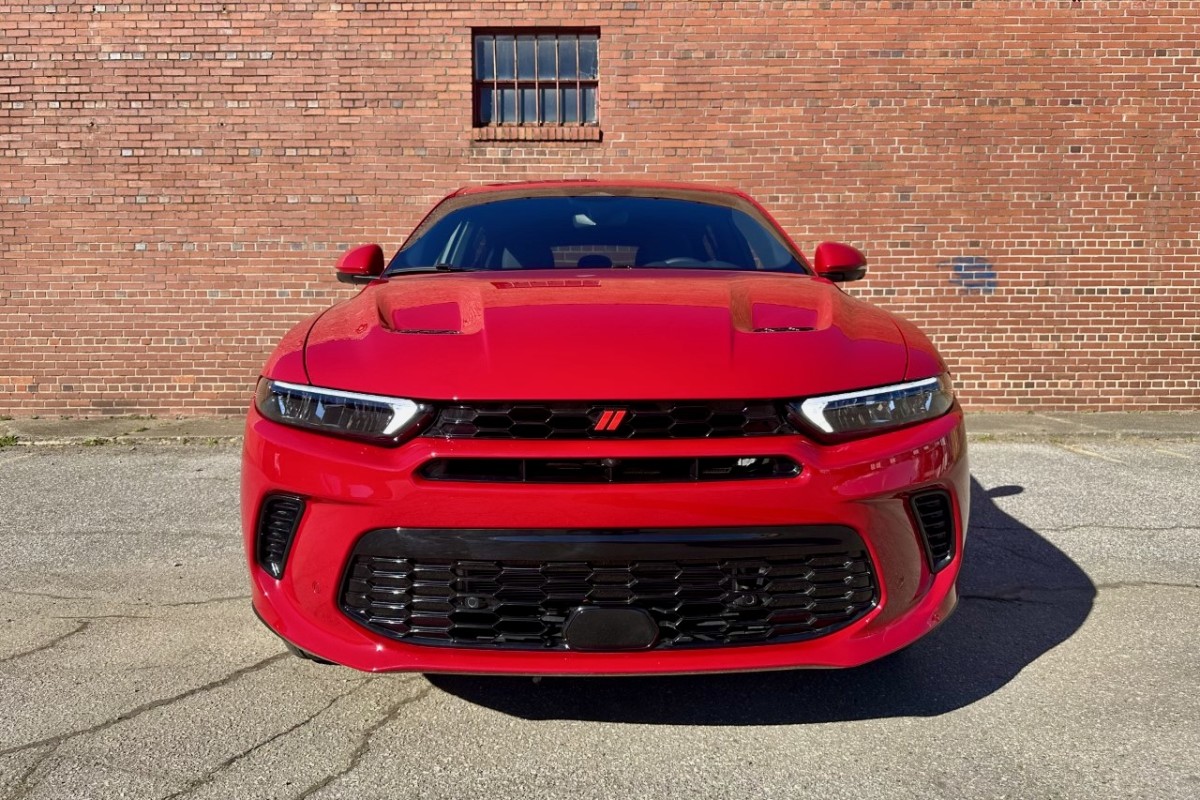
The new Hornet’s front end absolutely displays the Dodge DNA. It’s got all the muscle-car styling cues: the wide, mean “raccoon mask” face, the bulging hood, the dual extractors, and the now-classic Dodge “mail slot” just beneath the Dodge Rhombi. Likewise, no one sitting behind the Hornet in traffic (or eating its dust) will mistake it for anything but itself. The standard illuminated Rhombi logo, a Dodge first, punctuates taillights that span the vehicle’s width.
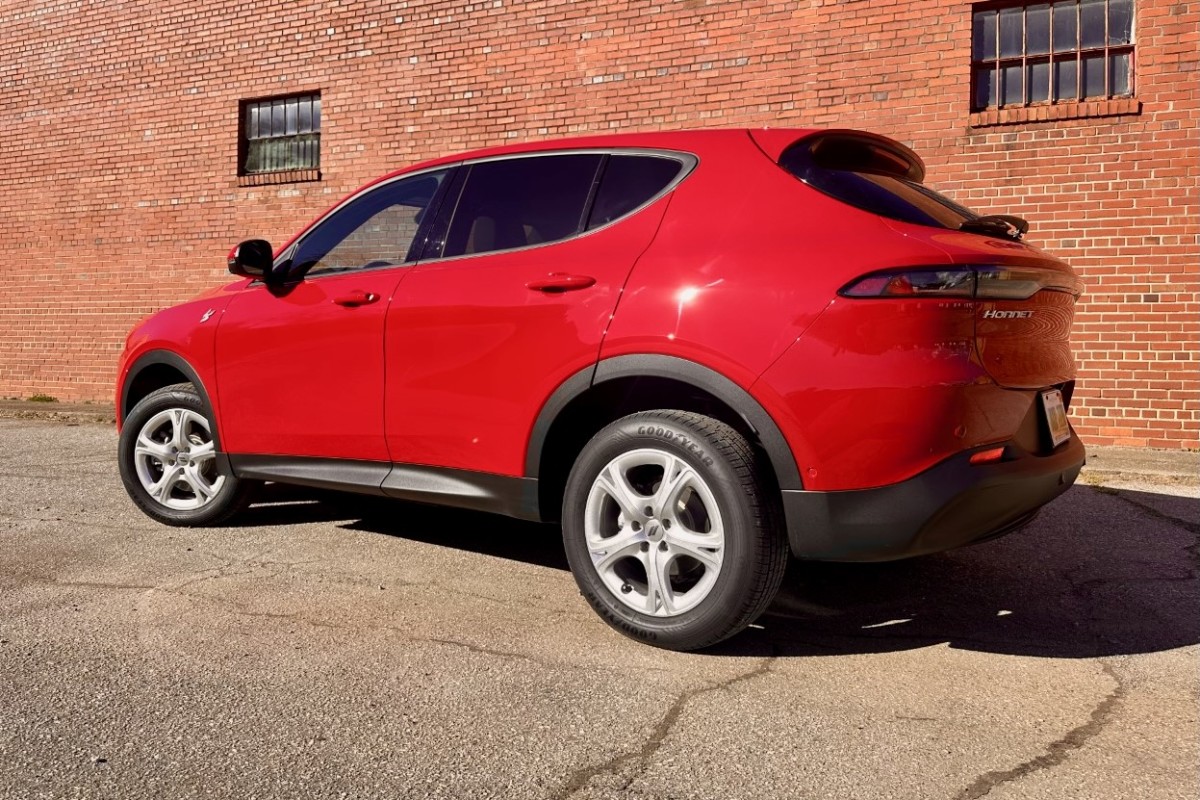
From the side and particularly from the rear quarter, however, the back half of the Hornet CUV looks a lot like a Porsche Macan or Cayenne, except that its windows point upward, cat-eye-fashion. It’s not bad; it just doesn’t feel especially Dodge. If anything, this choice feels more premium in the shared language of 2020s automotive design, and that’s because the Hornet is based on the Tonale from Stellantis sibling Alfa Romeo (it’s built in Italy, too). It will be interesting to see whether Dodge brand loyalists are ready to move in that direction. For our part, we think that what would certainly be out of place on a Challenger is right at home here, appropriately mitigating the bolder muscle-car strokes for the family vehicle milieu.
Perhaps more divisive than the aspirational rear end is the choice of standard silver 17-inch wheels. The color and smaller size make them look cheap from afar, though the design itself has its merits and, as you approach the vehicle, you do notice the machined surface. Car buyers who march to the beat of their own drum—and those who prioritize gas mileage—will be happy with these. Everyone else will likely want to upgrade. The available Blacktop package swaps the silver dishes for 18-inch black (“Abyss”) alloy wheels and also gets you Gloss Black badging, mirror caps, and moldings. If you’d prefer 20-inch wheels, go for the Track Pack package. That will also add red Brembo brake calipers (and the accompanying brakes, plus other actual performance enhancements).
Dodge continues the “High Impact Paint” tradition with seven fun exterior color options for the Hornet: Acapulco Gold, Blu Bayou, Blue Steele, Gray Cray, Hot Tamale (pictured), Q Ball, and 8 Ball.
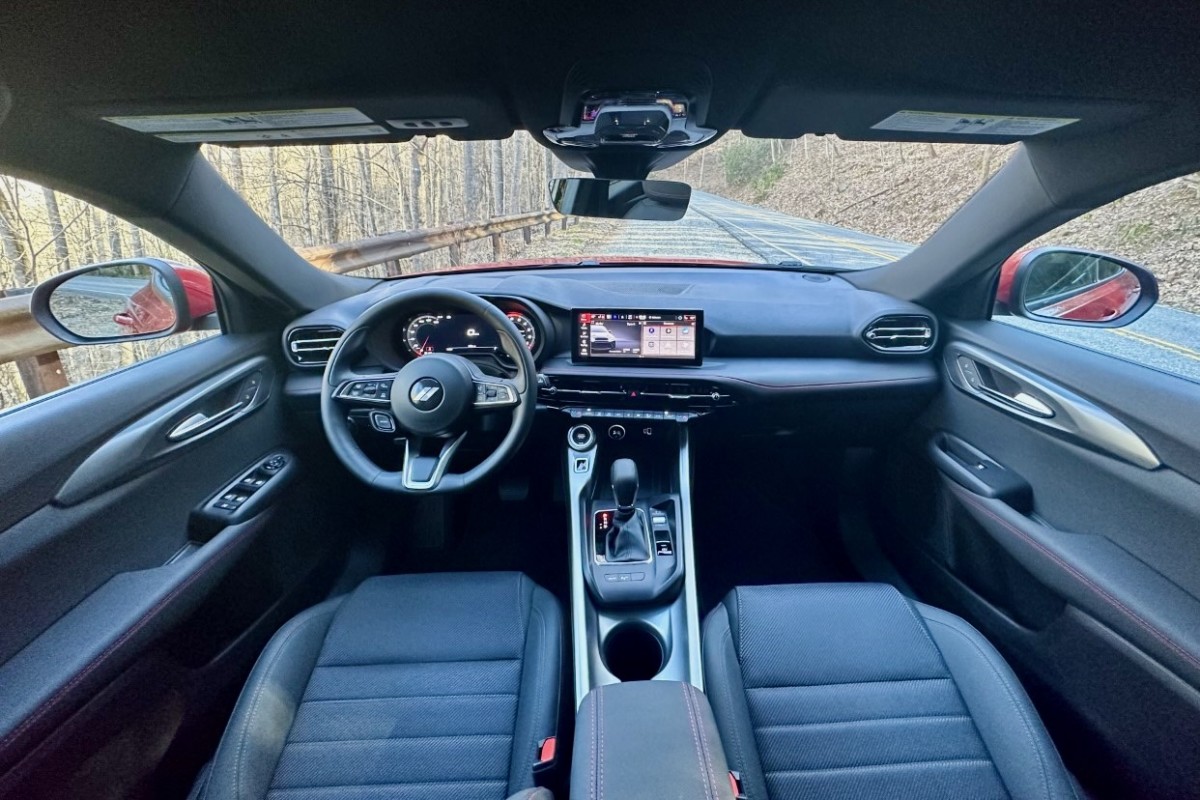
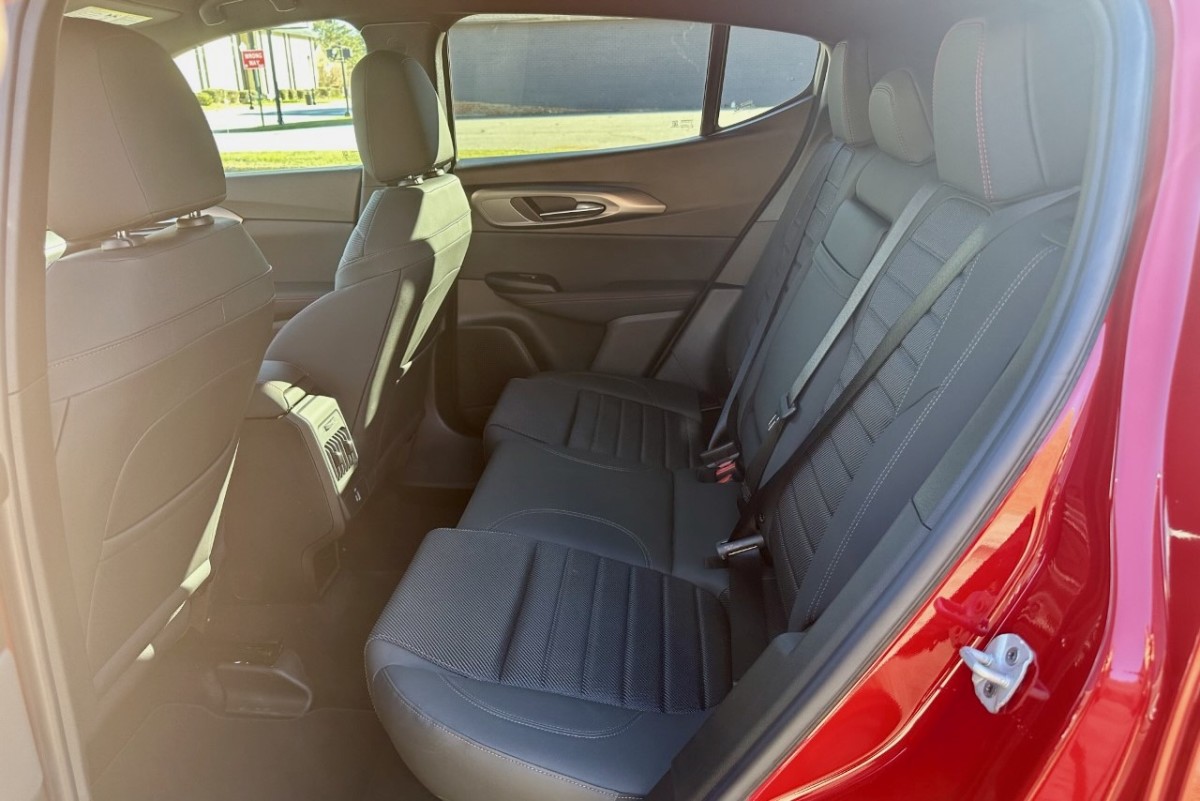
Inside, standard red stitching accents and flat-bottomed steering wheel emphasize the Hornet’s performance-inspired roots. The sunroof is not available on the base trim, but it does come with GT Plus. Black cloth seats are standard on the GT trim; these are six-way manual-adjust, while GT Plus gets eight-way power-adjustable black or red perforated leather seats. We liked the red seats best out of all the options we experienced, though the effect of the red accent color peeking through the perforated black of the Track Pack’s Alcantara seats was certainly the raciest option.
Performance
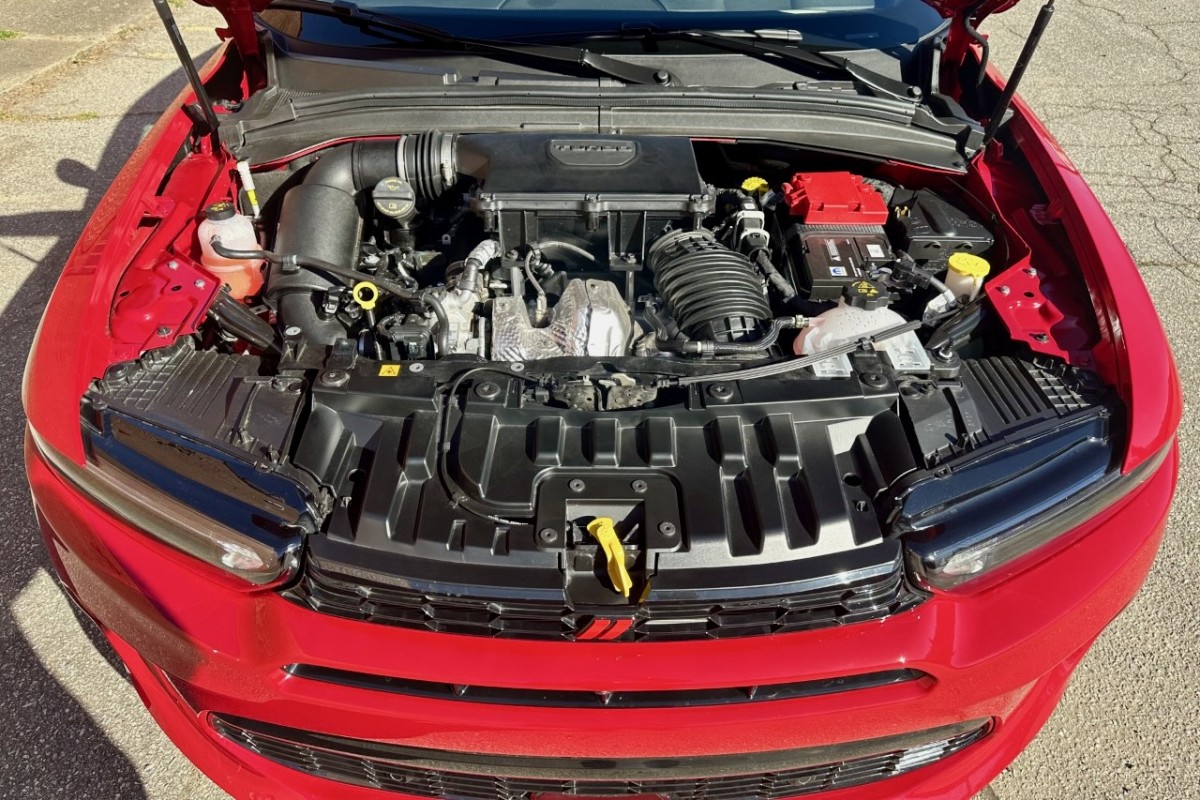
Dodge touts the Hornet’s “best-in-class performance,” and it’s true that the power stats blow most fellow CUVs’ out of the water. The Hurricane 2.0-liter turbocharged inline-four makes 268 horsepower and 295 lb-ft of torque. Compare that with up to 155 hp from the Chevy Trailblazer, up to 158 from the Honda HR-V, and up to 195 from the Hyundai Kona. Only the Mazda CX-30 comes close, with 250 hp when turbocharged, and beats the Hornet on torque with 320 lb-ft. But not a one sounds as good as the Hornet does: Our base-model tester emitted a low, menacing rumble that was audible from the driver’s seat and drew looks from passersby.
Sport mode sharpens the Hornet’s throttle responses, tightens its steering, and optimizes its upshifts, bringing the zero-to-60 time down to 6.5 seconds. No, that’s not staggering, but it smokes the competition, and shoppers looking for more performance can boost it with the available Track Pack package or with Direct Connection parts straight from one of Dodge’s “Power Broker” dealers.
From a standstill, the base Hornet GT is peppy, bordering on touchy, which we felt was a nice match for our tester’s Hot Tamale candy red color. It’s quite responsive, and acceleration works just the way you’d want it to. But, when you’re cruising at, say, 50 mph and need to put on a burst of speed, there’s a significant lag between stomping on the pedal and actually moving faster. We suspect that labored pickup would be less disappointing if not for its stark contrast with the rowdy performance the Hornet exhibits at slower speeds. It’s worth mentioning that we found the Hornet R/T’s hybrid powertrain ameliorated the pickup pace.
Form & function
We were not surprised to find the leather seats in the GT Plus-trim Hornet noticeably more comfortable than the cloth-covered models from the base Hornet GT. The four-way powered lumbar adjustment that comes with the leather went a long way, and we’re sure the two memory settings would be handy for a two-driver family. These seats cannot be added to the GT-trim Hornet, but as part of the Track Pack, the Alcantara versions are available, bringing the same additional features. The front passenger’s seat matches the driver’s for adjustability at every level, though it does not have a memory function. Both are heated and ventilated by default for GT Plus, or heated as part of the Cold Weather package for GT.
Behind the wheel, we did appreciate the driver-oriented nature of the cockpit’s layout. The screen positioning favors driver over passenger, a bias we are used to seeing in more performance-focused vehicles, and both the shift lever and start button placements felt natural. Visibility over our shoulders was just what we expected, but we did notice a quirk in the front—the angle of the A-pillar and the way it swoops around to meet the dash blocked our view of traffic coming from the right. This is not a blanket condemnation: We only noticed it when we were waiting to make a left turn on an especially busy road, and, more importantly, whether or not you experience this will more than likely depend on your own driving position. It’s simply something to be aware of on a test drive or when operating your own Hornet on a daily basis.
Technology
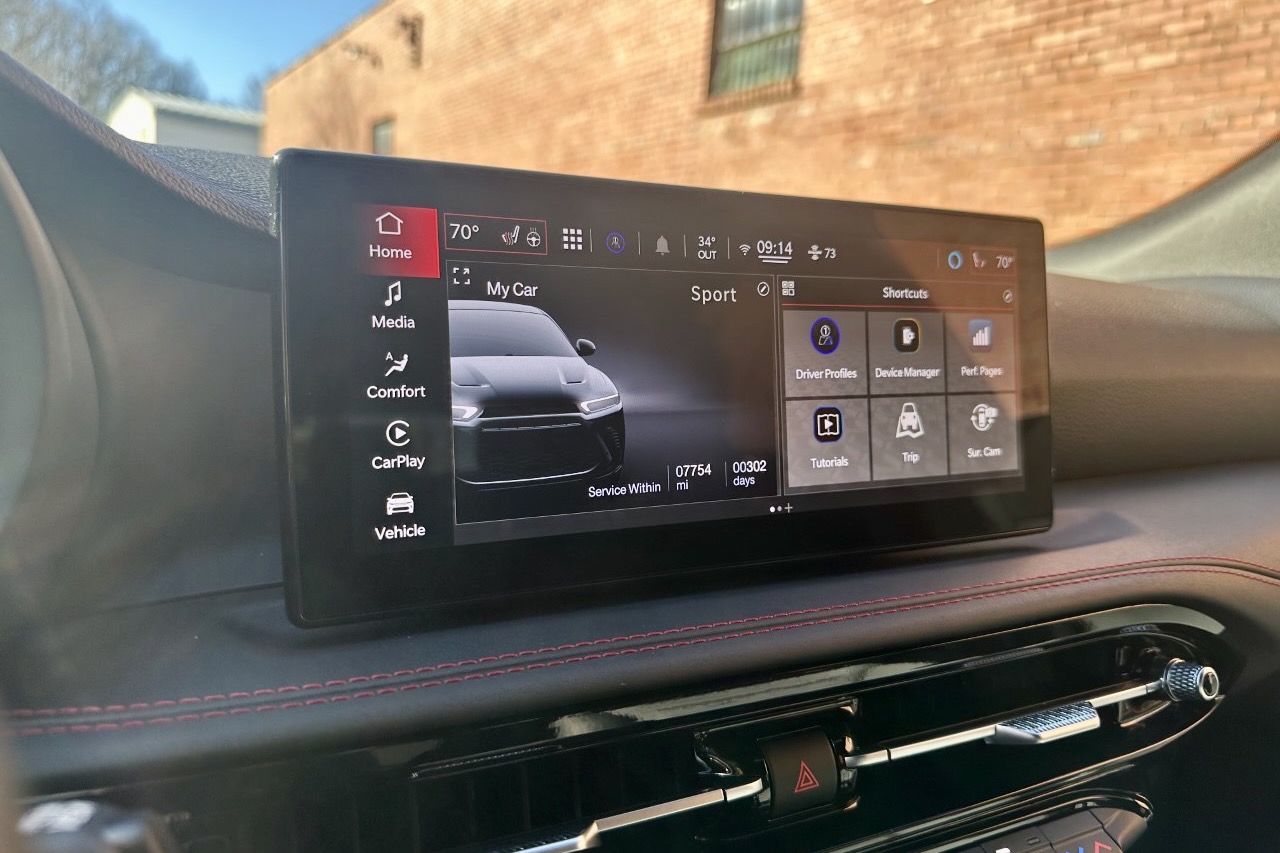
The cockpit’s focus on the driver is underlined by the digital gauge cluster: At 12.3 inches, it’s more than 2 inches larger than the center display. The entire center stack is angled toward the driver, as are the physical controls for basic climate and media functions. More advanced features, like seat warmers, must be accessed through the touch screen, but at least they’re anchored to the top of the display and always just a tap away.
We at CarGurus have long been fans of Stellantis’s Uconnect 5 system, and we were pleased to find it just as intuitive and easy to use as ever in the Hornet. The 10.25-inch touchscreen works well, and while its very long, wide stretch made the Apple CarPlay execution look a little different than we’re used to, it also somehow made the screen easier to operate, as though we didn’t have to work as hard to mentally map it. We had no trouble reaching the far side of the panel from our seat.
A six-speaker sound system is standard, but the GT Plus comes with a 14-speaker Harman Kardon premium system. Every Hornet comes with wireless Apple CarPlay and Android Auto, SiriusXM, dual-phone Bluetooth connectivity, and Amazon Alexa connectivity. GT Plus trim adds a wireless charging pad and navigation. We had the opportunity to test the nav system and felt that it worked well, though in one instance it continued to give verbal instructions well after we had pressed the button to end the route.
Safety
The 2023 Dodge Hornet comes standard with the advanced driver-assistance features consumers expect from a family vehicle—or, these days, just about any vehicle. Blind-spot monitoring with rear cross-path detection is included on the base GT trim, as are adaptive cruise control, lane-departure warning and lane-keep assist, forward-collision warning, a rear backup camera, and a rear park-assist system.
The Tech Pack, available on both trims, adds a front, side, and rear park-assist system, driver-attention monitoring, and a 360 “ParkView” surround-view camera. The Tech Pack will also make your Hornet capable of Level 2 autonomous driving, meaning the vehicle can manage steering, acceleration, and braking under some circumstances but must be continuously supervised by a driver. (If Level 2 sounds low, it’s not: Levels 3 and above are not available in the United States at this time.) That includes lane-centering, intelligent speed assist, and intelligent adaptive cruise control with traffic-sign recognition and stop & go functionality.
The Dodge Hornet has not yet been evaluated by the Insurance Institute for Highway Safety (IIHS) or the National Highway Traffic Safety Administration (NHTSA). We might venture to speculate if the Alfa Romeo Tonale on which the Hornet is based had been rated, but it is also still too new.
Cost-effectiveness
Dodge says the Hornet is “the quickest, fastest, most powerful compact utility vehicle under $30,000.” That’s pretty compelling, and, since the 2023 Dodge Hornet in its base GT trim starts at $29,995 before destination fees, it’s technically true. Of course, if you want the leather seats and sunroof that its Alfa Romeo design elements scream for, you’re looking at $35,490 to start.
Is that a lot for a Dodge that the company itself is labeling “compact?” Well, remember that “compact” does not necessarily mean “economy,” and the Hornet comes well-equipped with great tech and standard all-wheel drive (AWD). Could you get a vehicle of similar size for less? Sure; you could look at the Honda HR-V, which starts at $23,650, or the Hyundai Kona, which starts at $22,140, or the Chevrolet Trailblazer, which starts at $23,395. It takes a lot of add-ons to get those models north of $30k (supply-and-demand pricing varies too much with time and geography to factor into this particular discussion). Meanwhile, the Mazda CX-30’s seven trims put its starting price anywhere from $22,950 to $35,400.
But, while we would never discourage anyone from considering every option available—that’s why we’re here, providing this advice—realistically, we know that there’s a lot more overlap between Hyundai and Honda shoppers than there is between Hyundai or Honda shoppers and Dodge shoppers. The fact is that there’s not a lot out there that can really compete with the Hornet on its own turf. (As an EV, the Mustang Mach-E is both separately categorized and at least 50% pricier.) This combination of American and sporty is rare in the segment, and as long as that remains true, Dodge can command a premium for daring to offer it.
What owners say
Trims & specs
Base MSRP $46,990 | Seating 5 |
Engine 1.3L 288 hp I4 Hybrid | Cargo Capacity 22.9 cu ft |
Combined MPG 77 | Drivetrain AWD |
Base MSRP $41,645 | Seating 5 |
Engine 1.3L 288 hp I4 Hybrid | Cargo Capacity 22.9 cu ft |
Combined MPG 77 | Drivetrain AWD |
Base MSRP $35,490 | Seating 5 |
Engine 2.0L 268 hp I4 | Cargo Capacity 27.0 cu ft |
Combined MPG 25 | Drivetrain AWD |
Base MSRP $29,995 | Seating 5 |
Engine 2.0L 268 hp I4 | Cargo Capacity 27.0 cu ft |
Combined MPG 25 | Drivetrain AWD |


Pricing trends
MSRP range
$30,735 - $44,995
Current avg. market price
$21,507
Trending down by 2.7% this month
May 2026 - November 2026