2022 Ford Explorer Reviews, Pricing & Specs


Pros & cons
What we like
Multiple powertrain options
Plenty of cargo space
Great safety ratings
What to consider
Cramped third row
Outdated infotainment technology
Unimpressive value equation
Expert review
In the 1990s, Americans fell in love with the original Explorer as much as they did SUVs in general, and the 2022 Ford Explorer remains worthy of their adoration.
Two years ago, Ford redesigned its popular Explorer midsize three-row SUV. It moved to a rear-drive platform, added an optional hybrid powertrain, and offered everything from a value-rich base model to a luxurious Platinum trim level. Since then, Ford has added ST-Line, Timberline, and King Ranch trim levels while simultaneously honing the Explorer’s packaging to appeal to the broadest cross-section of Americans possible.
out of 10 expert review
Look & feel
There are no fewer than eight 2022 Explorer models available, priced from $33,745 to $54,495, not including the $1,495 destination charge. Last year, the Explorer lineup expanded with rugged Timberline and luxurious King Ranch trim levels, and for the 2022 model year the Explorer ST-Line is new, adding a sporty look to the popular Explorer XLT version of the SUV.
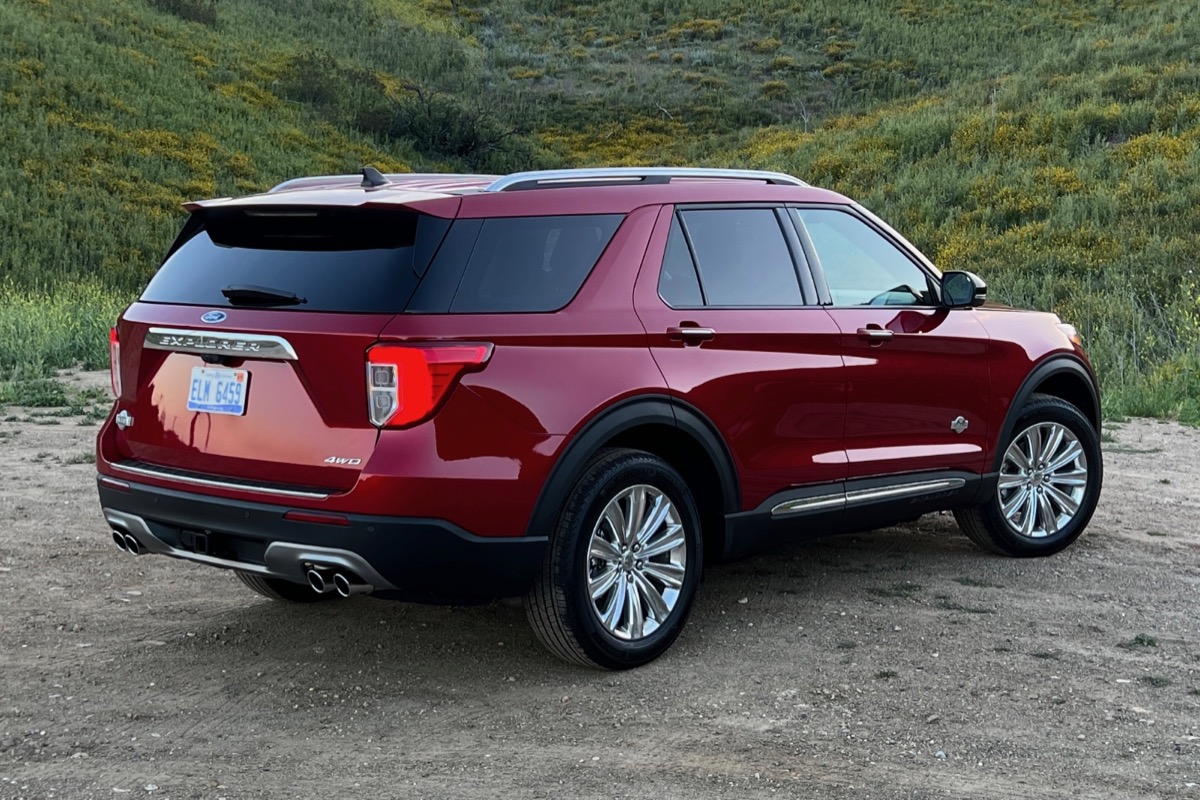
Our test vehicle was the Explorer King Ranch. It had four-wheel drive (4WD), extra-cost Rapid Red paint, a Premium Technology package, and a twin-panel sunroof, bringing the Manufacturer’s Suggested Retail Price (MSRP) to $59,880, including the destination charge.
Aside from its King Ranch emblems on the doors and liftgate, shiny 20-inch 10-spoke wheels, and quad exhaust outlets, there isn’t much to visually differentiate the top-trim Explorer from other models. As long as this doesn’t bother you, know that this is an appealing SUV.
The Ford Explorer’s basis on a rear-drive platform allowed designers to craft a long and tall hood, short front overhang, rakish roofline, and tapering greenhouse for a taut, athletic appearance. At the same time, blacked-out roof pillars (save for those directly behind the back doors) give the Explorer the familiar “floating roof” visual effect that proved popular on the previous-generation version of the SUV.
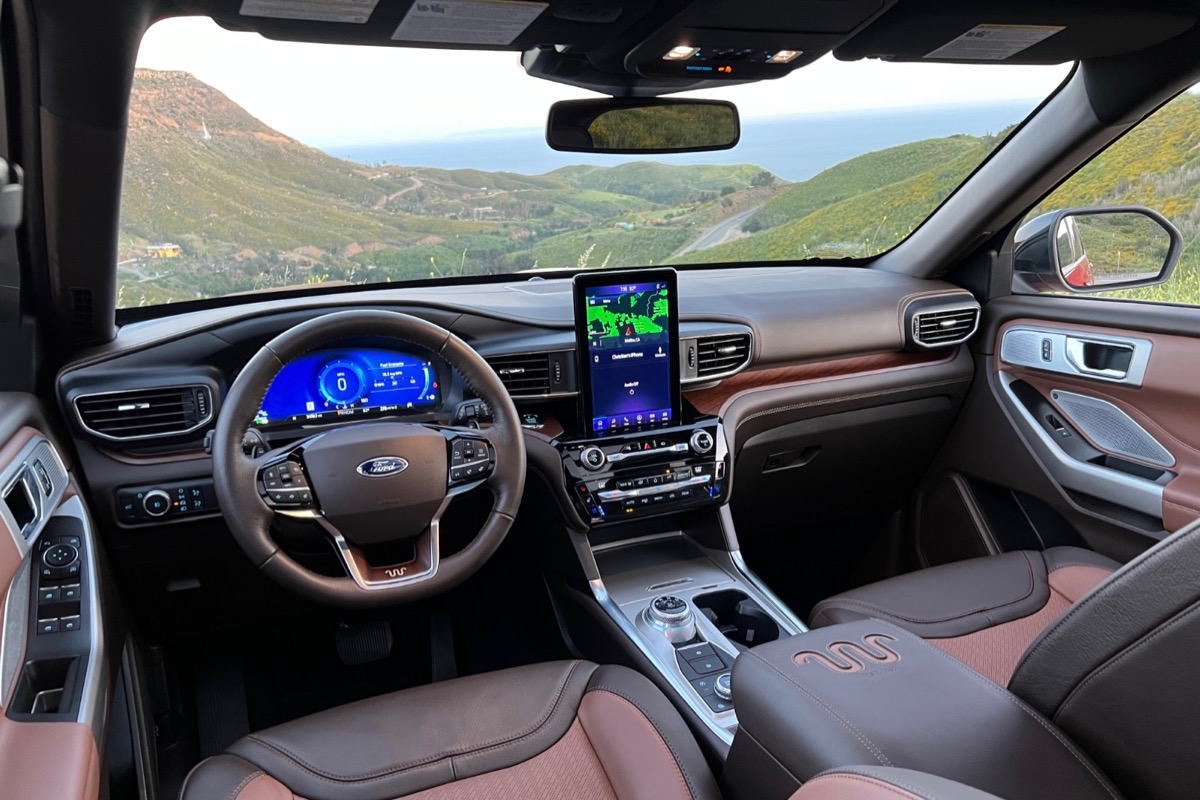
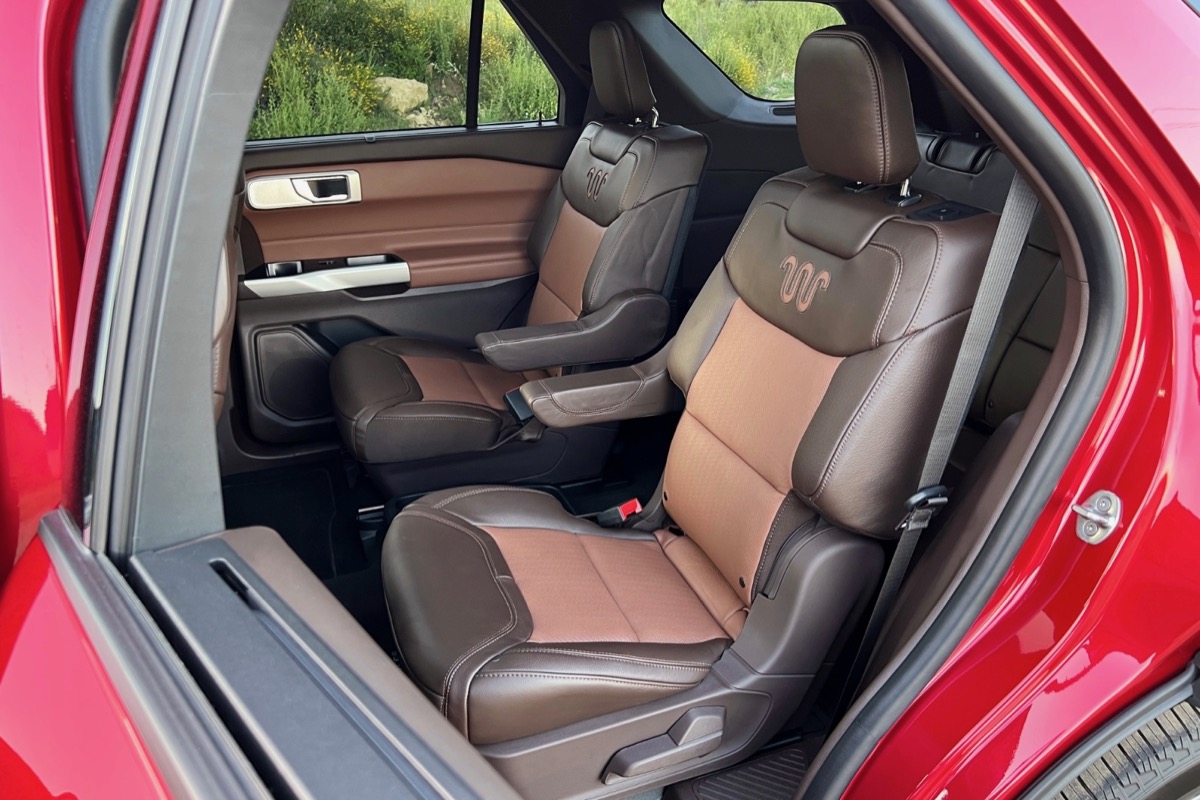
Inside, the Explorer King Ranch features exclusive Del Rio leather seating with what Ford says are lasso-perforated inserts. The King Ranch branding mark decorates the seats and center armrest pad, and the leather comes in only one color combination. So, choose the Platinum trim if you’d rather not have the King Ranch’s chocolate brown over caramel interior.
As is commonly the case with vehicles that have broadly diverse model lineups, the King Ranch’s cabin exhibits a mix of quality and questionable materials for the price point. Mostly, it looks and feels worthy of its near $60,000 window sticker, but you will get whiffs of the Explorer’s base trim from time to time.
Performance
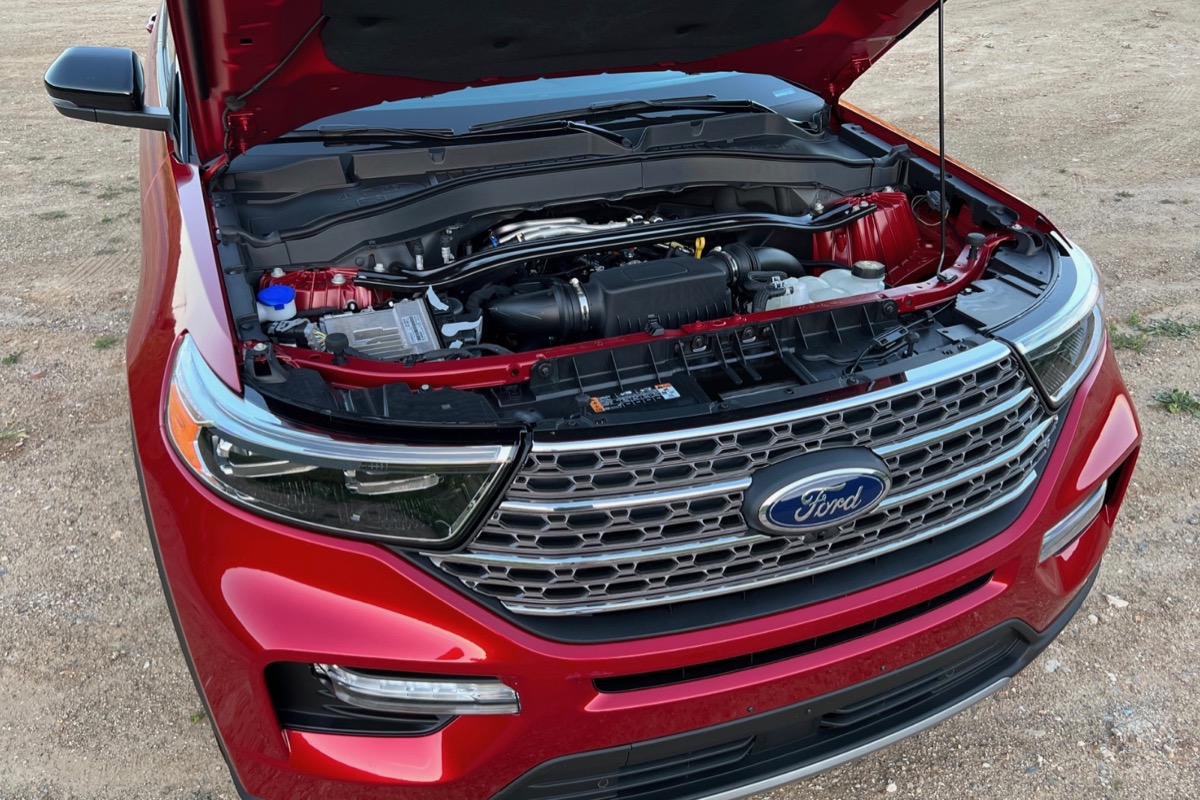
Ford offers three powertrains for the 2022 Explorer. Base, XLT, ST-Line, Limited, and Timberline trim levels come with a turbocharged 2.3-liter four-cylinder engine generating 300 horsepower and 310 pound-feet of torque. It pairs with a 10-speed automatic and rear-wheel drive (RWD), and four-wheel drive (4WD) is available. Maximum towing capacity amounts to 5,300 pounds, and this engine provides up to 24 mpg in combined driving.
An efficient hybrid drivetrain is an option for the Explorer Limited and can reduce the price of the Platinum by $1,400. It is based on a 3.3-liter V6 engine and makes a combined 318 hp and 322 lb-ft of torque, tows up to 5,000 lbs, and returns as much as 27 mpg in combined driving. It comes with RWD or 4WD and a 10-speed automatic transmission.
If you’re willing to trade fuel economy for acceleration and maximum towing capacity, a twin-turbocharged 3.0-liter V6 engine is available. It is standard with ST, Platinum, and King Ranch trim, and for 2022 all three applications of the engine generate 400 hp and 415 lb-ft of torque. Previously, Ford restricted these output figures to the racy Explorer ST. This engine pairs with a 10-speed automatic, RWD or 4WD, and can tow as much as 5,600 lbs. Maximum gas mileage is 21 mpg in combined driving, according to EPA fuel economy ratings.
Our King Ranch 4WD test vehicle carried an official rating of 20 mpg, and we averaged 20.6 mpg on the testing loop. In return for lower efficiency, the twin-turbo V6 supplies plenty of power, satisfying acceleration, and a more pleasing exhaust note compared to the standard turbo-four. However, unless you require the added 600 lbs of towing capacity or the sheer grunt of the V6, we think the hybrid powertrain offers the best blend of power, efficiency, and capability. Sadly, it’s not available with King Ranch trim, so there’s another reason to instead choose the Explorer Platinum.
As far as the ride is concerned, the Explorer feels more like a traditional SUV than a typical crossover, but without the usual skittishness over bumps and holes in the pavement. The result is a remarkably robust sensation from behind the wheel, and that extends to off-roading situations. We tackled moderately challenging terrain using the Trail setting, and the Explorer King Ranch got us up and then back down a mountainside even though it supplies just 7.9 inches of ground clearance. Explorer Timberline models are even better equipped for this type of travel, supplying almost 8.7 inches of ground clearance along with improved angles of approach, breakover, and departure.
For daily driving, the Explorer King Ranch feels good in your hands, proving athletic if you decide to take a corner or a curve with enthusiasm. Of course, if you truly love to drive, you’ll want the sport-tuned Explorer ST for its available High-Performance option package that installs black 21-inch wheels, performance brakes, and red brake calipers. Still, any 2022 Explorer should prove more engaging to drive than your typical midsize, three-row crossover SUV.
Form & function
For families of four, the 2022 Ford Explorer offers plenty of comfort. Get one with the second-row bench seat, and you can occasionally carry five people. Unfortunately, the Explorer’s rear-drive platform, low rear roofline, and tapered tail make its third-row seat useful only for children.
As a fully-equipped model, our King Ranch had all of the extras including triple-zone automatic climate control, a power-adjustable heated steering wheel, heated and ventilated front seats, and heated second-row captain’s chairs. Massaging front seats are also standard on the King Ranch, and drivers benefit from 14-way power adjustment while front passengers enjoy eight-way power adjustment.
Even without the massage function active, the front seats are exceptionally comfortable and are suitable for long-distance driving. The second-row seats are nearly as accommodating, and our King Ranch had manual side window sunshades. But the third-row seat is difficult for adults to access and its low, flat cushion and lack of legroom make any grown-ups assigned to this location mighty unhappy.
Practical storage space within the cabin could be better. Ford has missed several opportunities to make up for the Explorer’s stingy center console storage bin. For example, the front door armrests lack a tray and simulated wood trim resides where a dashboard shelf would come in handy. The wireless charging pad and a smartphone holder near the cupholders are helpfully shaped and located, though it’s easy to forget your phone in the SUV since it is hidden from view while charging.
Thoughtfully, Ford added built-in cupholders in the rear seat door panels and there is a shallow tray with more cupholders located between the captain’s chairs. But the interior’s lack of practical pockets, shelves, cubbies, and hooks is palpable. Maybe Ford decided early on to emphasize the “sport” portion of the sport/utility equation.
Around the back, our King Ranch test vehicle had a hands-free power liftgate that rose to reveal 18.2 cubic feet of cargo space behind the third-row seat. Flatten the 50/50-split, power-folding third-row seats down, and you’ll create 47.9 cubic feet of cargo space. Fold both rear rows of seats down to make a maximum of 87.8 cubic feet of cargo volume.
Technology
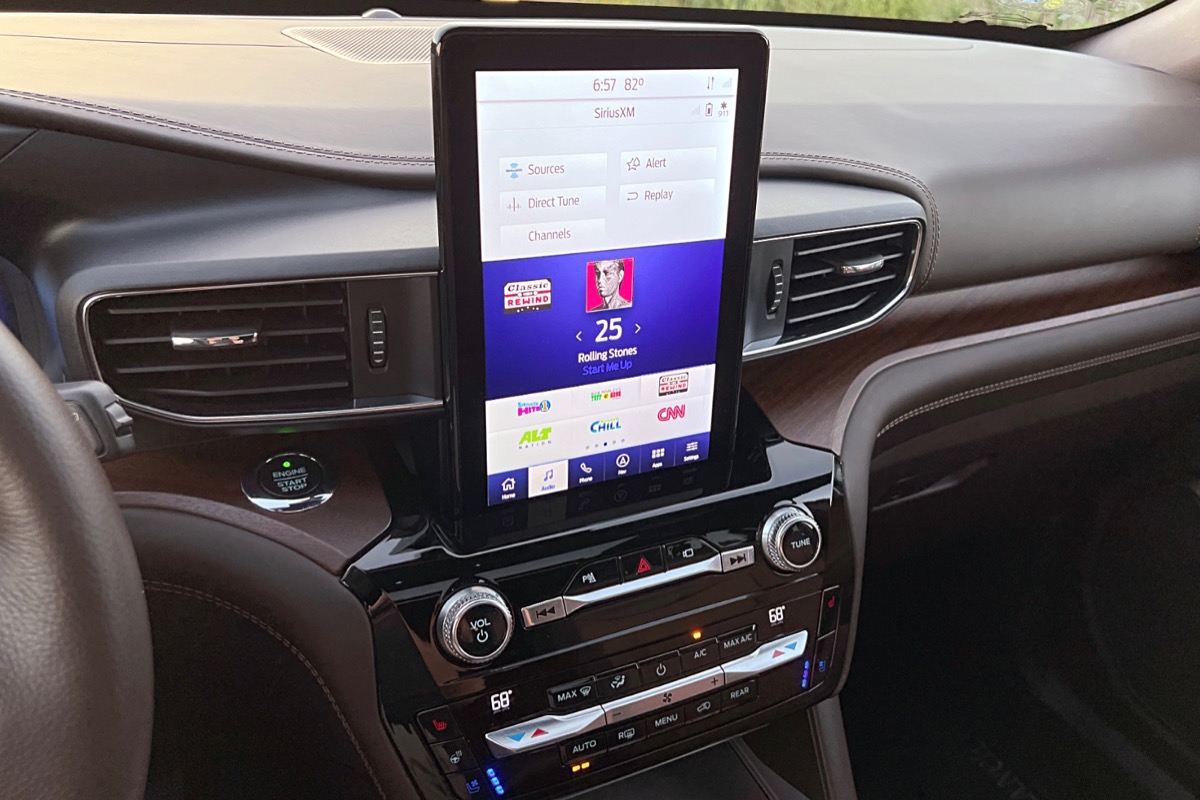
Ford offers two versions of its Sync 3 infotainment system in the 2022 Explorer. The first has an 8-inch touchscreen display mounted horizontally between the center dashboard air vents. The second is a 10.1-inch touchscreen affixed portrait style.
The smaller screen is well integrated with the Explorer’s interior design, while the larger screen looks like someone glued an iPad to the dashboard. It appears to be an afterthought, like someone decided late in the current-generation Explorer’s gestation period that a bigger screen would be necessary to make the SUV competitive.
Our test vehicle had the full menu of Sync 3 technology, including FordPass Connect services with remote engine starting, a 4G LTE WiFi hotspot (service costs extra), Ford+Alexa functionality, Apple CarPlay, Android Auto, satellite radio, and a navigation system. Additionally, Ford equips the King Ranch with wireless smartphone charging, a surround-view camera system, and an outstanding 14-speaker Bang and Olufsen premium sound system.
Ford offers next-generation Sync 4 technology in many of its models, and the differences between it and the Explorer’s old Sync 3 system are significant. This is especially evident when it comes to the voice recognition system and operating various features using spoken commands.
For example, one of our standard test prompts is to get directions to 1600 Pennsylvania Avenue in Washington D.C. On our first attempt, the Explorer tried to direct us to local Sixt rental car agency offices. On our second attempt, it gave us what it thought were the closest matches in the state of Washington. As it turns out, even when you follow the on-screen directions to a T, the system doesn’t recognize Washington D.C. as a valid destination. Whoops.
Furthermore, trying to find a favorite local restaurant using nothing but the establishment’s name and street took several tries. You cannot request a genre of music, such as alternative rock or reggae, but if you have a specific station in mind, you can switch using voice commands. Want to change the cabin temperature or turn on the seat heaters? Use your fingers, not the spoken word.
Clearly, Ford needs to upgrade the Explorer to Sync 4 ASAP. While it’s at it, a new dashboard accommodating larger touchscreen displays would be nice.
Additional tech for the King Ranch includes a nicely executed 12.3-inch digital instrumentation display and Active Park Assist 2.0, which can autonomously park the Explorer as long as you’re sitting in the driver’s seat ready to take control if necessary. An available rear-seat entertainment system comes with dual rear touchscreen displays.
Safety
According to the Insurance Institute for Highway Safety (IIHS), every version of the 2022 Explorer earns a Top Safety Pick+ safety rating. It doesn’t matter if you buy the base trim or a loaded-up Platinum or King Ranch.
Unfortunately, as this review is written, the National Highway Traffic Safety Administration (NHTSA) has not published complete crash-test ratings for the 2022 Explorer. Last year, the SUV earned five-star ratings across the board except for rollover resistance, where the Explorer got a four-star rating. It is unclear why the frontal-impact ratings are not carried forward for 2022.
Ford equips every 2022 Explorer with Ford Co-Pilot360, a collection of driver-assist and collision-avoidance safety features. All of the most useful ones are standard equipment: forward-collision warning, automatic emergency braking, lane-departure warning, lane-keeping assist, blind-spot monitoring, and rear cross-traffic alert. The Ford Explorer also has standard automatic high-beam headlights.
Choose an Explorer equipped with Co-Pilot360 Assist+ and you’ll get adaptive cruise control with stop-and-go capability, lane-centering assist, and evasive steering assist that can add stability when the driver takes sudden action to steer around a pedestrian, cyclist, or other obstacles.
Beyond these Co-Pilot360 features, the Explorer has a standard post-collision braking system and MyKey programmable vehicle functions. MyKey is helpful to parents of teenage drivers, while post-collision braking automatically attempts to bring the Explorer to a stop as soon as possible following a collision. This is important to prevent secondary impacts after the SUV’s airbags have already deployed and deflated.
Overall, as applied to the 2022 Explorer, Co-Pilot360 and Co-Pilot360 Assist+ work well, operating smoothly and accurately in a refined manner. The most aggravating thing about it is a lack of steering wheel sensitivity to the presence of the driver’s hands. We got numerous warnings to hold the steering wheel even though we’d never let go of it.
When vehicles tuck into the space ahead in moderate traffic, the SUV can brake a little too much, but when traffic clears, it doesn’t hesitate to kick down a gear or two and quickly accelerate back up to the pre-selected speed. When driving on a road with sharper bends and curves, such as the Pacific Coast Highway (PCH) north of Malibu, the lane-centering assist system regularly shuts off and re-engages when the pavement straightens out.
However, on this same stretch of the PCH, parts of the highway where two lanes narrow to one or one lane widens into two did not cause confusion in Ford Co-Pilot360 Assist+. Similarly, the freeway off- and on-ramps on Route 1 near Point Mugu Naval Air Station didn’t produce any indecisiveness in the Explorer’s semi-autonomous driving tech.
Cost-effectiveness
When you research a new 2022 Explorer, you might find that when this SUV is equipped with the features you most want, nearly every model is priced between $45,000 and $55,000. Lower trims offer lots of desirable options, while higher trims come with plenty of those features as standard equipment, which considerably reduces the Explorer lineup’s price spread.
The good news is that the price range represents the heart of the midsize, three-row SUV market. But when equivalently equipped, the Explorer does command a premium compared to some rivals, especially the surprisingly affordable Hyundai Palisade and Kia Telluride.
Furthermore, several alternatives to the Explorer offer attractive ownership perks that Ford doesn’t provide, such as long warranty coverage, complimentary scheduled maintenance, and generous trial periods to connected services. That can make the Hyundai and Kia, as well as the Jeep Grand Cherokee L, Toyota Highlander, and Volkswagen Atlas, especially appealing.
Over 30 years ago, the first Ford Explorer kick-started the SUV buying trend in America. Now, there are more alternatives to a new Explorer than ever before, and many of them are worthy of your consideration. Still, the SUV that first showed us how sport/utility vehicles can offer style, practicality, and adventure in a comfortable daily driver remains among the better choices in the segment.

What owners say
"Overall, owners generally have a positive impression of the 2022 Ford Explorer, praising its comfort, performance, and practicality. Many appreciate the spacious interior and cargo capacity, especially for families, while the safety features and driving experience are also highlighted. However, some drivers wish for improvements in power and the handling of warning systems, indicating a few minor frustrations."
The heated & cooling seats are fantastic. I havent tried out all of the features yet, but I am looking forward to figuring them all out. The drive is smooth and quite. Seats are comfortable, the third row fold down easily and add so much more room for a giant Sams Club or Costco run. I feel that I got a fantastic deal for the cost and the mileage on the vehicle. I was looking at the Toyota Highlander, GMC Acadia and Jeep Cherokee, but choose the Ford Explorer for all the reasons listed above.
November 21, 2024Great features. Fully loaded. Enjoying the adaptive cruise control. Very spacious front seats!
August 9, 2025Love all the features that the car has very quite car also great on fuel economy
May 26, 2025What owners say
The heated & cooling seats are fantastic. I havent tried out all of the features yet, but I am looking forward to figuring them all out. The drive is smooth and quite. Seats are comfortable, the third row fold down easily and add so much more room for a giant Sams Club or Costco run. I feel that I got a fantastic deal for the cost and the mileage on the vehicle. I was looking at the Toyota Highlander, GMC Acadia and Jeep Cherokee, but choose the Ford Explorer for all the reasons listed above.
November 21, 2024Great features. Fully loaded. Enjoying the adaptive cruise control. Very spacious front seats!
August 9, 2025Love all the features that the car has very quite car also great on fuel economy
May 26, 2025Got this car almost a week ago and absolutely in love with it! Has all the amazing features this mom of 4 needs and plenty of room for all the kiddos!
November 9, 2022Fantastic ride, fantastic features, very comfortable and fast.
September 26, 2023It will be my 4th Ford Explorer in 17 years , Great Ride , Safe and designed for space efficiency.. great looking as well .
January 16, 2022Fantastic vehicle. Still new but very happy at this point.
November 21, 2023The ST model is really fun to drive. Very noticeable change in power when you change driving modes. I like that they changed the display screen from portrait to landscape orientation since the 2020 and 2021 models. I also like the dashboard controls for volume, temperature because they are easy to adjust by feel without taking your eyes off the road. Only thing that I dont like so far is the warning about keeping your hands on the steering wheel (when cruise control is activated). The warning keeps going off even when my hands are securely wrapped around the wheel. I wish that particular warning could be turned off, but I think the only way to turn it off is to disable all warnings. Overall, really fun car to drive.
September 22, 2023Good value for a great car. Had enough bells and whistles to compliment the car. Nothing missing from my lists of options. Compared to Chevy Tahoe. Explorer is a better all around car and value.
June 5, 2024The XLT is a sturdy SUV built on what seems to be a pickup frame. Its a nice vehicle that rides well and is easy to drive. Mine is a 2022 with the turbo 4cylinder. More than enough power for the normal driver.
December 25, 2023Trims & specs
Base MSRP $49,070 | Seating 7 |
Engine 2.3L 300 hp I4 | Cargo Capacity 18.2 cu ft |
Combined MPG 23 | Drivetrain AWD |
Base MSRP $47,070 | Seating 7 |
Engine 2.3L 300 hp I4 | Cargo Capacity 18.2 cu ft |
Combined MPG 24 | Drivetrain RWD |
Base MSRP $55,775 | Seating 7 |
Engine N/A | Cargo Capacity 18.2 cu ft |
Combined MPG N/A | Drivetrain N/A |
Base MSRP $37,740 | Seating 5 |
Engine 3.3L 285 hp V6 Flex Fuel Vehicle | Cargo Capacity 52.0 cu ft |
Combined MPG 13 | Drivetrain AWD |
Base MSRP $53,775 | Seating 7 |
Engine N/A | Cargo Capacity 18.2 cu ft |
Combined MPG N/A | Drivetrain N/A |
Base MSRP $47,760 | Seating 7 |
Engine 2.3L 300 hp I4 | Cargo Capacity 18.2 cu ft |
Combined MPG 23 | Drivetrain AWD |
Base MSRP $48,320 | Seating 7 |
Engine 2.3L 300 hp I4 | Cargo Capacity 18.2 cu ft |
Combined MPG 20 | Drivetrain AWD |
Base MSRP $45,760 | Seating 7 |
Engine 2.3L 300 hp I4 | Cargo Capacity 18.2 cu ft |
Combined MPG 24 | Drivetrain RWD |
Base MSRP $40,570 | Seating 7 |
Engine 2.3L 300 hp I4 | Cargo Capacity 18.2 cu ft |
Combined MPG 23 | Drivetrain AWD |
Base MSRP $38,570 | Seating 7 |
Engine 2.3L 300 hp I4 | Cargo Capacity 18.2 cu ft |
Combined MPG 24 | Drivetrain RWD |
Base MSRP $55,630 | Seating 7 |
Engine N/A | Cargo Capacity 18.2 cu ft |
Combined MPG N/A | Drivetrain N/A |
Base MSRP $53,630 | Seating 7 |
Engine N/A | Cargo Capacity 18.2 cu ft |
Combined MPG N/A | Drivetrain N/A |
Base MSRP $37,510 | Seating 7 |
Engine 2.3L 300 hp I4 | Cargo Capacity 18.2 cu ft |
Combined MPG 23 | Drivetrain AWD |
Base MSRP $35,510 | Seating 7 |
Engine 2.3L 300 hp I4 | Cargo Capacity 18.2 cu ft |
Combined MPG 24 | Drivetrain RWD |
Base MSRP $51,260 | Seating 7 |
Engine 3.0L 400 hp V6 | Cargo Capacity 18.2 cu ft |
Combined MPG 21 | Drivetrain AWD |
Base MSRP $49,260 | Seating 7 |
Engine 3.0L 400 hp V6 | Cargo Capacity 18.2 cu ft |
Combined MPG 21 | Drivetrain RWD |


Pricing trends
MSRP range
$35,510 - $55,775
Current avg. market price
$27,011
Trending down by 1.9% this month
May 2026 - October 2026


