2020 Volkswagen Tiguan Reviews, Pricing & Specs



Pros & cons
What we like
Spacious
Easy-to-use technology
What to consider
Poor handling
The CarGurus verdict
If you want a compact crossover—and you need three rows of seating—this is your best choice.
The Volkswagen Tiguan is one of only two compact crossover SUV’s that currently offer third-row seating. (And the other is the hopelessly outdated Mitsubishi Outlander.) To fit the extra pair of surprisingly spacious seats, VW made the Tiguan much larger than average for its competitive set—which suits a vehicle that fills big shoes in VW dealerships. With five trim levels and prices that stretch from just under $26,000 to a bit over $40,000, the Tiguan is the German brand’s best-selling vehicle in the U.S.
out of 10 expert review
Look & feel
Volkswagen completely overhauled the Tiguan for the 2018 model year, introducing an all-new second generation of its compact crossover SUV. In addition to addressing the original Tiguan’s biggest shortcoming—its diminutive size—VW sought to do something about the price, which was often more expensive than the Honda CR-V’s and Toyota RAV4’s, both of which were gobbling up more and more sales year after year. The result is a vehicle that is every bit as stylish and conservatively German on the surface, but that shows some evidence of cost-cutting if you look closely.
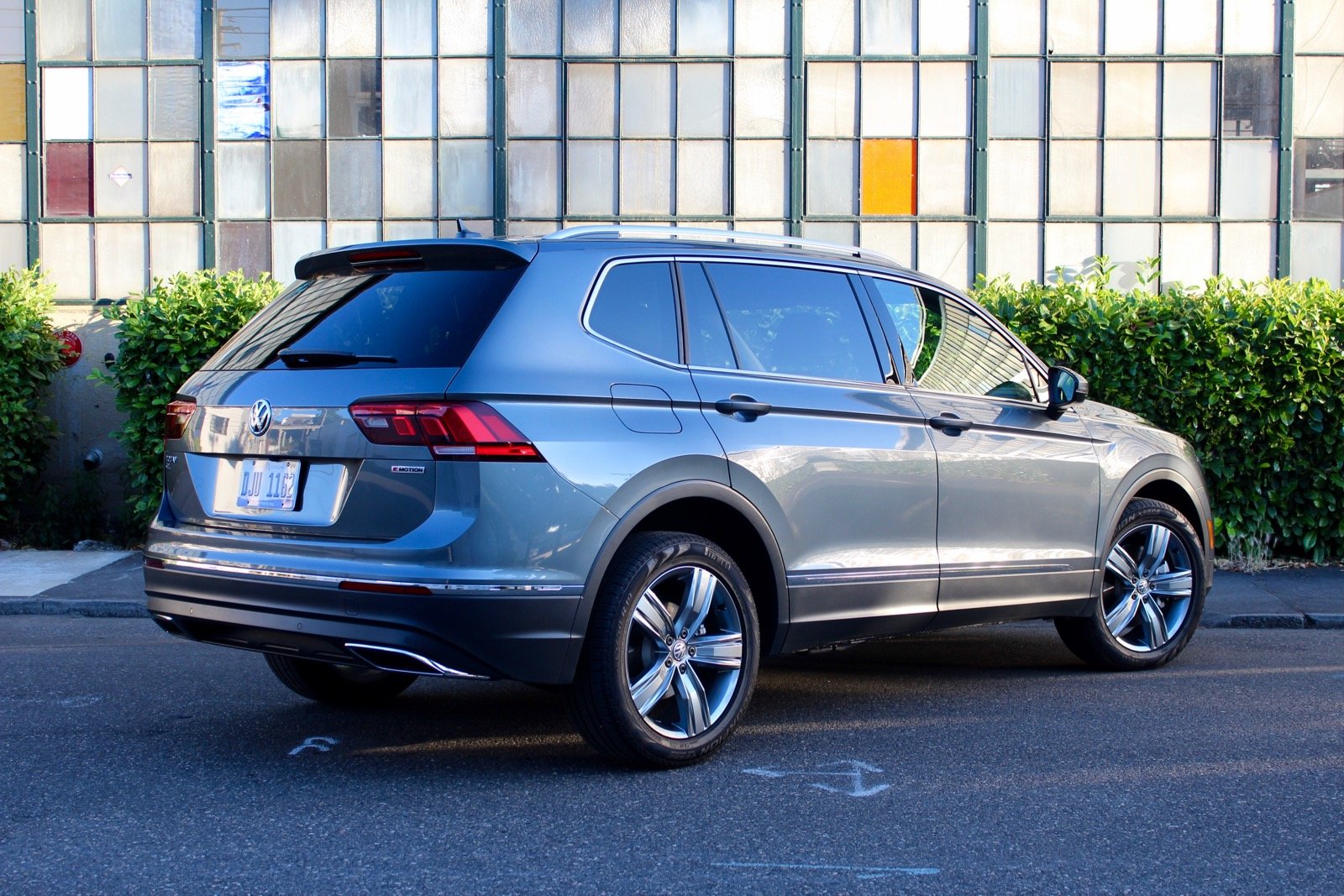
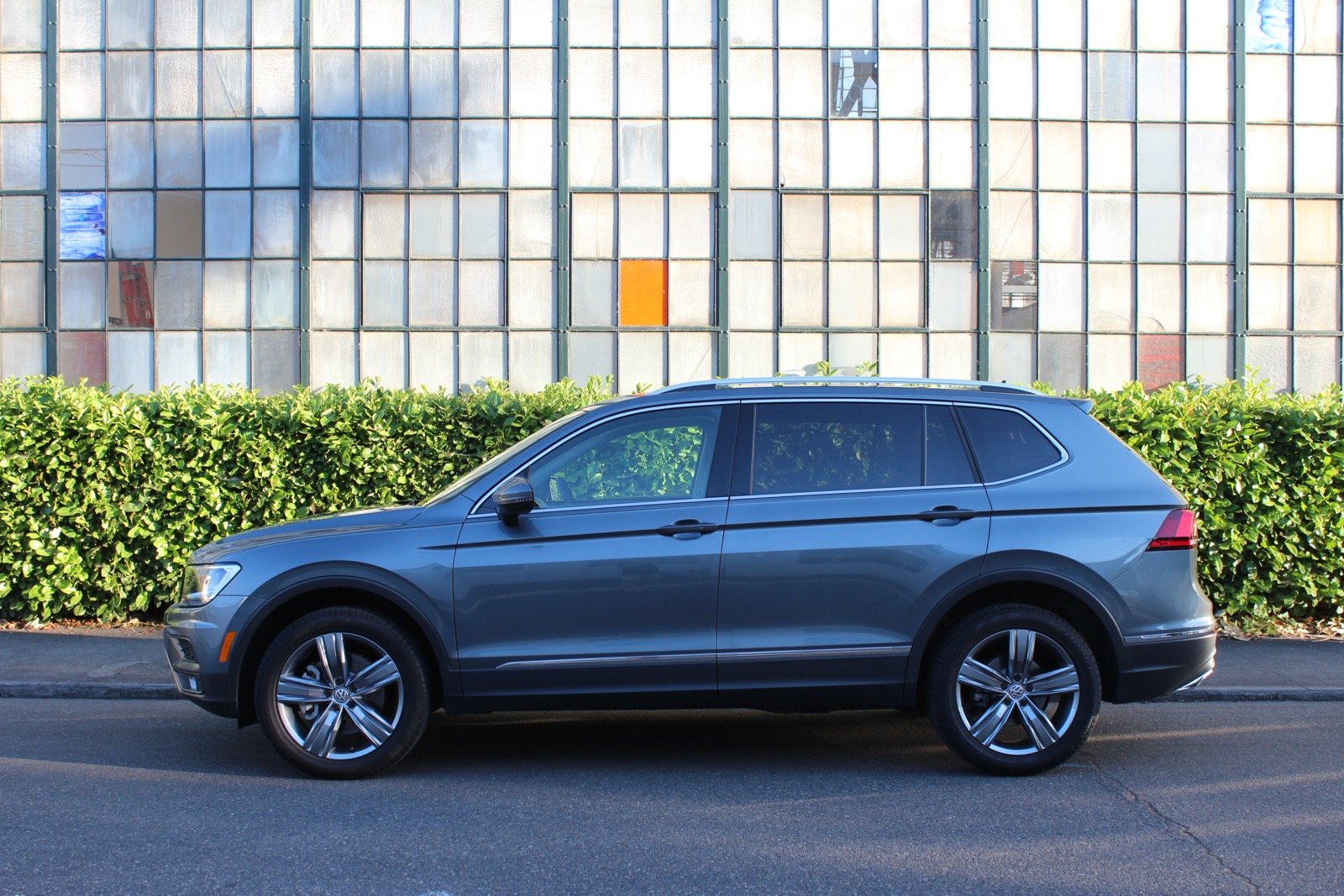
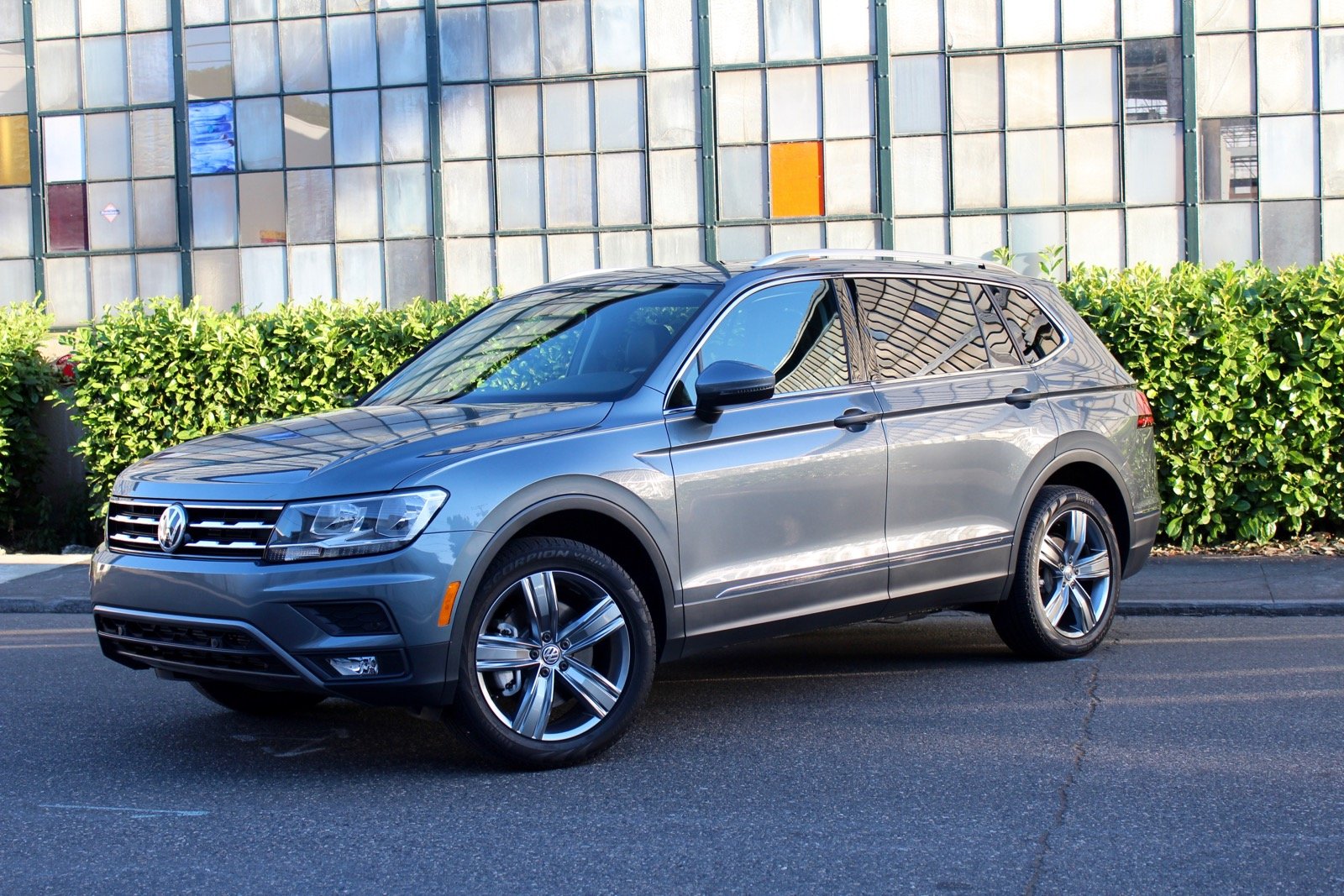
Indeed, the styling of the Tiguan screams contemporary Volkswagen with clean and simple lines. The automaker's new flat logo adorns a horizontal grille that runs the full width of the front fascia, connecting the Tiguan’s headlights. There is nothing adventurous about the look, no angry face or cartoonish visage. Volkswagen’s design staff seems entirely content with designing cars that look like cars, an approach that has its own intrinsic appeal.
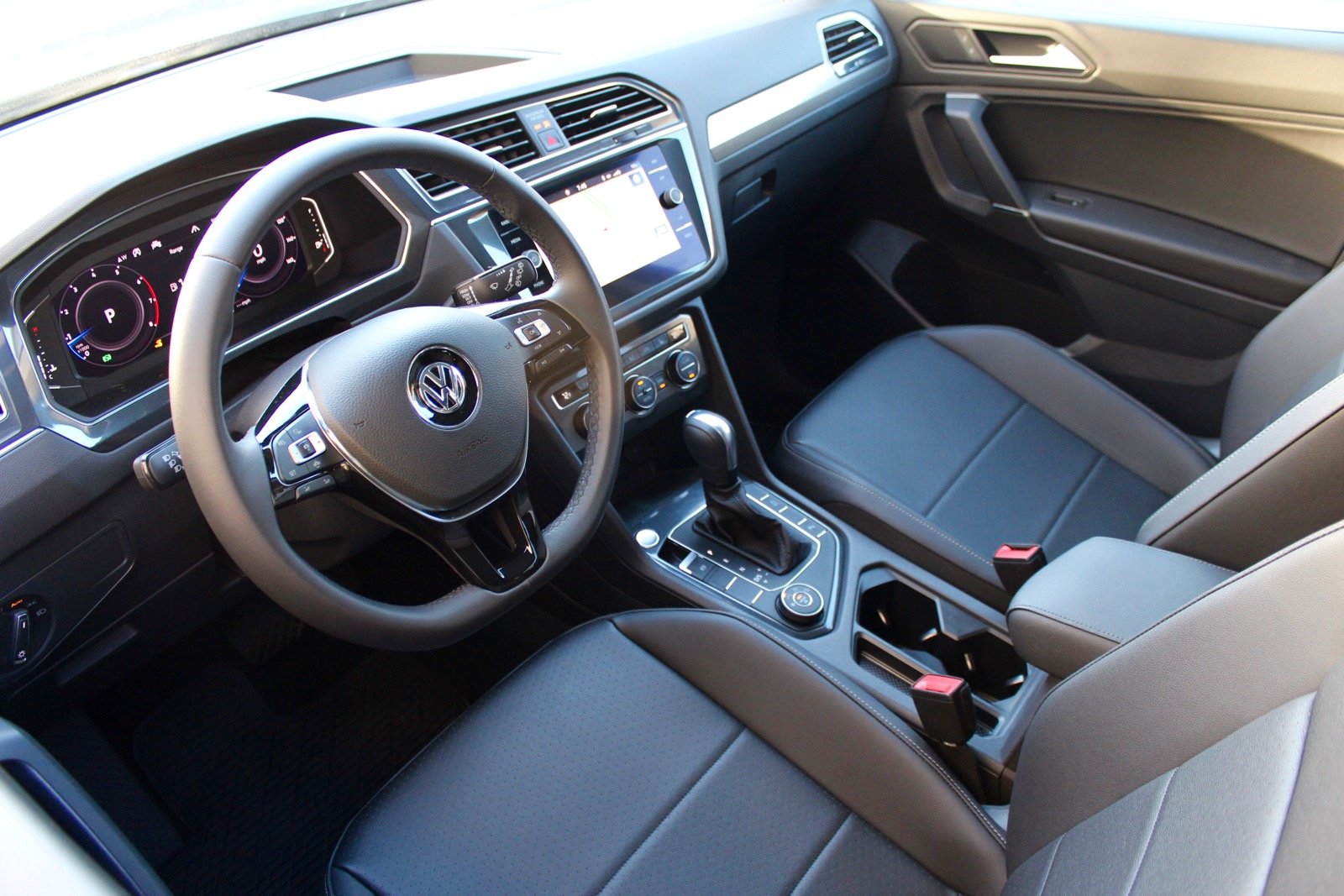
Inside, however, this fails to come off as anything more than plain. Volkswagen once did interiors better than anyone, but the Tiguan has enough dull surfaces and hard black plastic that such a design likely wouldn’t have passed muster in Wolfsburg a decade or two ago. Calling the cockpit “simple” would be charitable; “boring,” more accurate. Clearly VW is now dumbing it down to match the competition, as if all the money the company has to spend on the insides of the Tiguan now goes into electronics. Displays are not just the focus but also the highlight—an optional digital dashboard and a glass-covered touchscreen infotainment system are gorgeous in a smartphone kind of way.
Performance
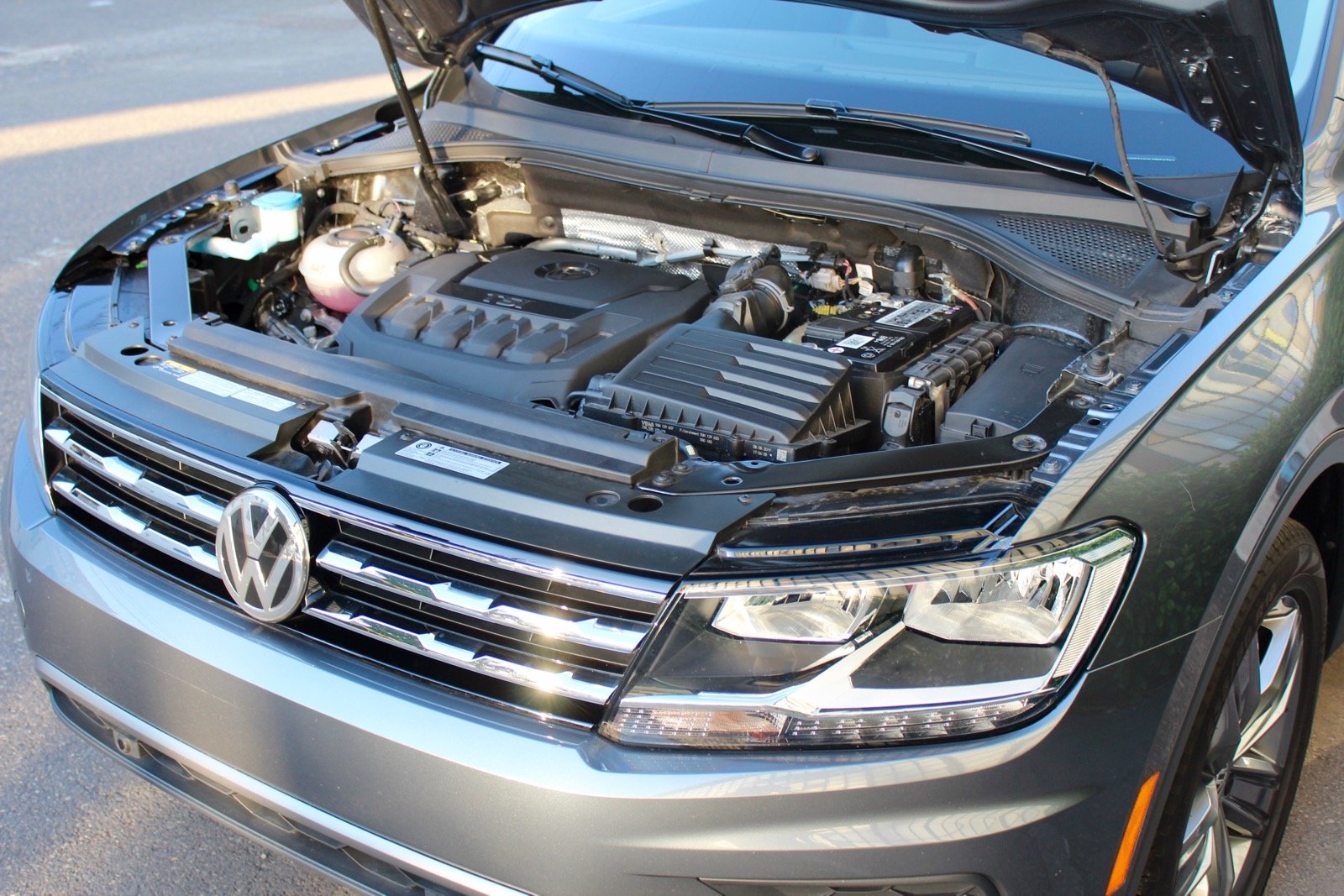
All Tiguans are powered by Volkswagen’s signature engine, a turbocharged 2.0-liter four-cylinder. It drives either the front or all four wheels through an eight-speed automatic transmission. For the Tiguan, VW tuned its tried-and-true “2.0T” for torque, rather than horsepower. So, it makes 184 horsepower and 221 pound-feet of torque here, regardless of whether front-wheel drive (FWD) or all-wheel drive (AWD)—a $1,300 option—is fitted.
All that torque is needed because the Tiguan is big. With a listed curb weight of 3,757 pounds for a front-driver and 3,847 pounds for an AWD model, it tips the scales between 275-300 pounds more than a Honda CR-V. While the Tiguan's powertrain offers a snappy throttle response and only minimal turbo lag before the engine’s grunt is brought to bear on its wheels, it is only moderately fleet of foot. Although the automatic transmission downshifts quickly and smoothly, passing on the highway in a fully loaded Tiguan may still require patience.
You won’t need earplugs during such maneuvers, as the Tiguan has a relatively muted engine sound and when the turbo-four does start to sing at high revs, its notes are deep and refined. The cabin is well insulated from wind noise, and on the right pavement, it is a quiet highway cruiser. Still, some road noise can filter through the tires and suspension when the road surface gets rough.
The Tiguan’s handling is also impacted by its larger size. It has a much longer wheelbase than its competitors, meaning it doesn’t feel quite so nimble. The Tiguan’s suspension is soft and has enough travel to ensure a comfortable driving experience, even on the sort of two-track lane that would give the driver a reason to turn the drive-mode selector to the off-road setting. Set the drive mode to sport, and the steering firms up some but not enough that this shouldn’t just supplant the normal setting, which is too light.
If you want to buy a compact crossover solely because it’s fun to drive, there are better choices—principally the Mazda CX-5—but the Tiguan doesn’t give up that much considering its advantage in size.
Form & function
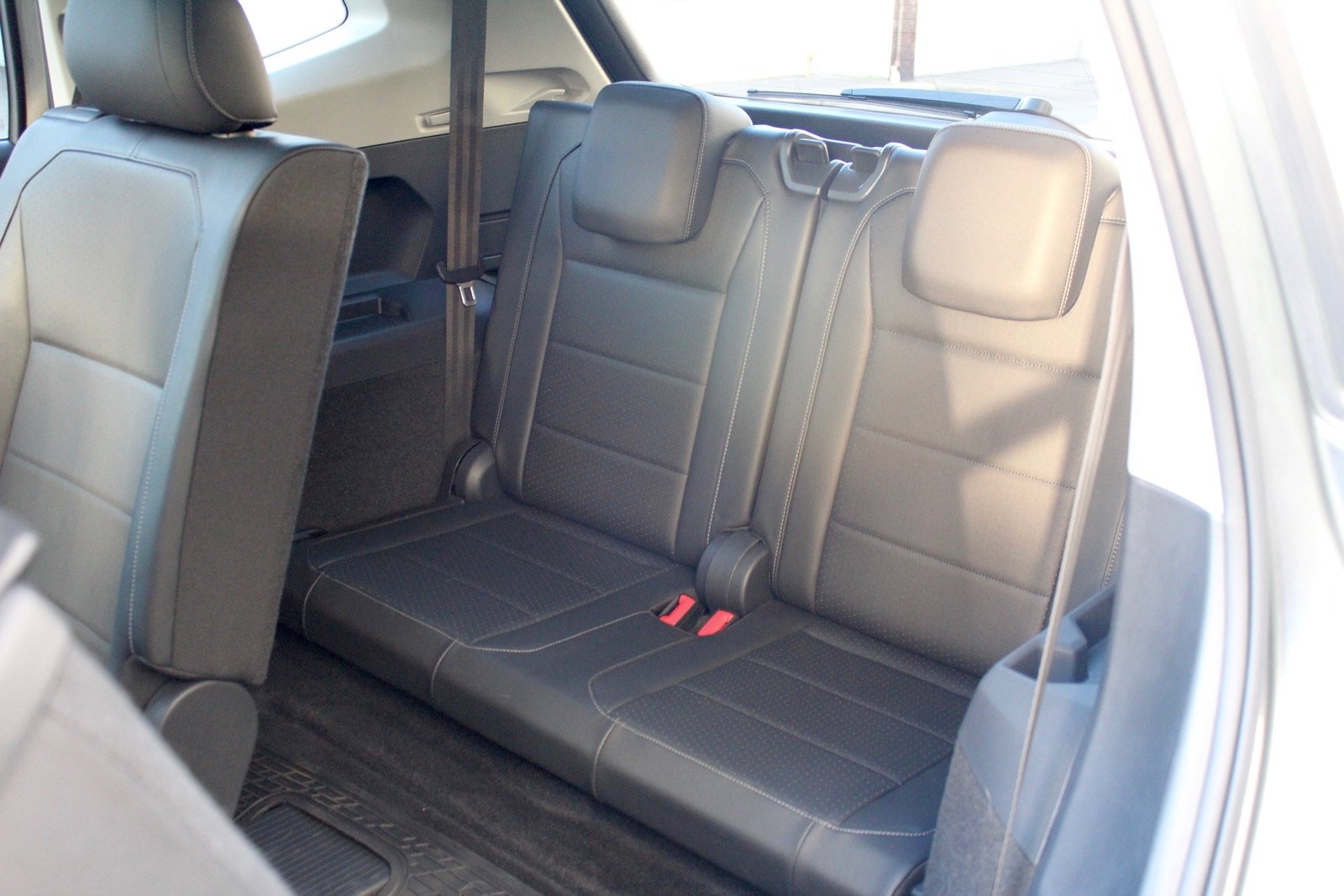
If the performance of VW’s compact crossover is a step off the pace, this is more than made up for by the practicality of the Tiguan’s package. This all starts with the second row of seats, which can slide up to seven inches fore and aft, thus making the third row actually useful. Although the third row is far from spacious, it has enough legroom for shorter adults back there and kids might even find the confines cozy and comfortable.
Front-drive Tiguans all have the third row, while AWD models are standard five-seaters, with the third row available as a $595 option.
The main problem with the VW Tiguan’s available third row is actually less the lack of headroom and more the low cushion position relative to the floor. That said, the two seats in the Tiguan’s way back are still roomier than many third rows in far larger vehicles. Access is convenient thanks to a simple latch at the top of either outboard second-row seat, which allows the seatback to tip forward and the entire seat to slide forward.
The split second row rear seats in the Tiguan also folds flat, giving the cargo hold a 65.7 cubic-foot capacity when the third row is collapsed. Open the liftgate in two-row Tiguans, and that cargo space number is bumped up to 73.5 cubic feet, which is far more cargo capacity than what’s available in the back of a compact SUV like the Ford Escape or the Toyota RAV4, but just shy of the 75.8 cubic feet of the Honda CR-V.
Up in the driver's seat, the Tiguan feels as roomy as many midsize SUV’s, like the Toyota Highland or Honda Pilot. Its wide beam offers the front seats plenty of hip and shoulder room. Although the Tiguan’s numbers don’t bear it out (for the most part just matching the competition) the VW seems roomier because of the abundant glass in its greenhouse and a seating position that is more tucked back behind and below the cowl. This makes the Tiguan feel every bit as big as it is—and then some—which is either a desirable feature or a demerit, depending on your comfort with a larger vehicle. Certainly, those buyers who might be downsizing from a larger SUV like the Volkswagen Atlas will appreciate the Tiguan as much as someone trading up from a VW Golf could find the Tiguan gross in proportion.
Technology
Volkswagen calls the infotainment software in the 2020 Tiguan “MIB II,” which is only of interest because it is about to be supplanted with “MIB3” next year. While this might seem like a reason to wait a year before buying a new Tiguan, the current infotainment system is already one of the best on the market. Next year’s update will bring a new, expanded satellite radio and streaming service from SiriusXM, called “360L,” and an upgrade to VW’s onboard navigation system.
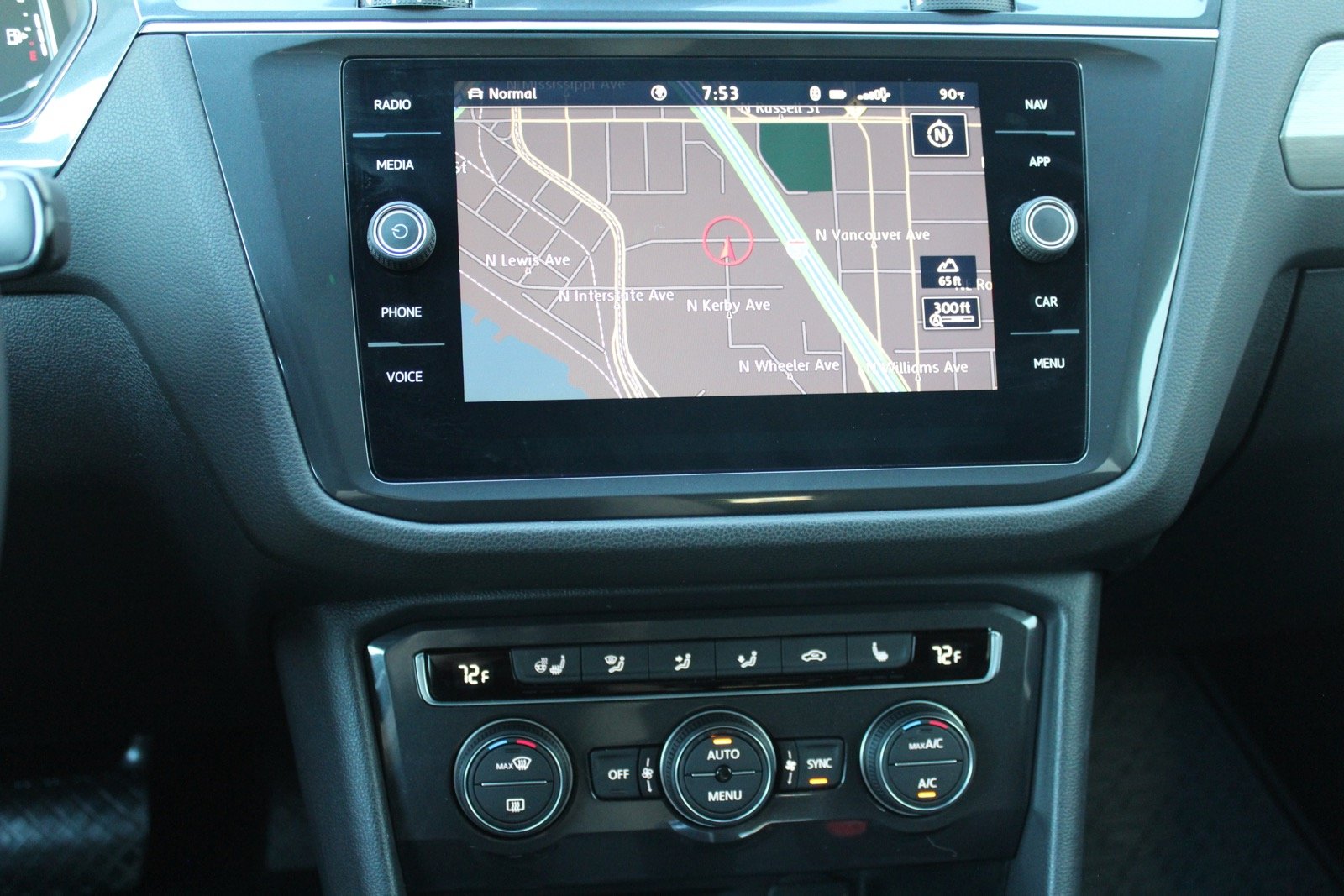
For now, buyers of 2020 model year Tiguans will have to make do with the old system, which in the base S trim uses a 6.5-inch touchscreen display. This is on par with most of the competition, however, the 8-inch capacitive touchscreen upgrade found in SE and higher trim levels is among the best in the industry, particularly in non-luxury segments. With a glass surface, bright colors and graphics, and a speedy processor that responds to touches with an immediacy often lacking in units from higher-priced brands, VW’s infotainment system is pleasure to use.
The Tiguan S has a single USB-C port in the front, while higher trims have none. Instead two standard USB-A ports sit in front of the gearshift lever, with a third in the second row. On trims above S, a wireless charging pad in the center console offers an additional charging option.
VW’s Digital Cockpit, a fully digital instrument panel that can be customized and reconfigured – including a setting to display a panoramic map – is available on top SEL trims. It’s not just a show-off piece of tech, but a smart use of cockpit real estate that helps VW stay a step ahead of the ubiquitous Apple CarPlay and Android Auto interfaces. Of course, they are both standard equipment here, as is Bluetooth connectivity and a WiFi hotspot.
Safety
For the 2020 model year, Volkswagen improved the Tiguan’s standard safety package, adding forward-collision warning with automatic emergency braking, blind spot monitoring, and rear cross-traffic alert to all models. However, other safety features, such as adaptive cruise control with lane-keeping assistance and LED headlights with automatic high beams are reserved for the top SEL trim. By comparison, even the base models of the Honda CR-V ($26,270) and Toyota RAV4 ($27,070) come with safety packages that include the adaptive cruise equipment VW charges extra for. (At least until next year, that is, because VW is adding adaptive cruise to the SE trim for 2021.)
VW does equip all 2020 Tiguan models with Car-Net, a telematics package that connects the vehicle to an owner’s smartphone or watch through an app. Complimentary features are available for five years, and include remote locking and unlocking, status checks of the doors and windows, and vehicle location.
Additional functionality comes with an upgraded infotainment system, as navigation-equipped Tiguans can also receive real-time parking information, and points of interest from an owner’s phone. Car-Net also makes possible roadside assistance and geofencing services for teen driver monitoring. Activating even more robust vehicle surveillance can score Tiguan drivers an insurance discount, though be prepared to give up a minute-by-minute record of driving behavior, including generating a record of braking and speed.
VW offers a Car-Net subscription plan for $99 per year called Safe & Secure which bundles operator-enabled emergency assistance, automatic accident reporting, and antitheft features.
The National Highway Traffic Safety Administration (NHTSA) has not crash-tested the Tiguan, however the Insurance Institute for Highway Safety (IIHS) has rated it a Top Safety Pick, but for only top-of-the-line SEL Premium models with LED headlights. Most Tiguans, however, are equipped with halogen headlights, which the IIHS rates poor.
Cost-effectiveness
The Tiguan's MSRP starts at just $25,290 for the S model with front-wheel drive, but like many affordable vehicles, the entry-level trim offers less value compared to what you get by spending just a little more. In this case, an extra $2,150 for the SE adds VW’s high-quality leatherette upholstery, heated front seats, automatic climate control, and the much more desirable 8-inch infotainment touchscreen.
The SE trim level is the Tiguan’s value leader, as heading up the scale to the SE R-Line Black (starting at $31,315) nets mostly cosmetic upgrades like alloy wheels and R-Line badging, save for a panoramic sunroof (an option on the SE). A much larger jump to the $33,265 SEL trim includes plenty of luxury and safety equipment such as adaptive cruise control with lane-keeping assist. And at the pointy end of the Tiguan pricing spectrum sits the SEL Premium R-Line with all-wheel drive (which VW calls 4Motion). With a list price of $39,815, it’s almost $4,000 more than a loaded Honda CR-V.
In terms of cost and standard features, the Tiguan matches up best at lower price points compared to its most popular competitors from Honda and Toyota, but no matter the trim, the Volkswagen still falls short when it comes to fuel economy. This is yet another byproduct of the Tiguan’s larger size, as its extra weight requires a bigger and more powerful engine and thus a lower EPA fuel economy estimate.
A front-drive Tiguan earns just 25 miles per gallon combined, while the AWD version is saddled with a 23-mpg rating. Highway numbers do not crack 30 mpg for either version. By comparison, the CR-V—with its smaller, 190-hp 1.5-liter turbo four-cylinder engine—manages 30 mpg combined in front-drive configuration and 29 with AWD. The RAV4 returns similar numbers, and even in its burly TRD Offroad trim with AWD and knobby, oversized tires, Toyota’s erstwhile cute ute is rated at 27 mpg combined. What this means is that according to the EPA, an AWD Tiguan will cost its owner an additional $300 per year in fuel compared to the most popular versions of the CR-V and RAV4.
Still, there’s such a thing as being penny wise and pound foolish. Neither the CR-V nor the RAV4 can seat seven passengers. For those buyers who will use the Tiguan’s third-row seat with any regularity, the smaller competitors are no competition at all.
Like other modern VW’s, the Tiguan occupies a different place in the competitive landscape than Volkswagens past. It’s still a desirable way to put a Germanic vehicle (although the Tiguan is actually built in Mexico) in your driveway without paying luxury brand money for an Audi, BMW, or Mercedes. Buying a German new car no longer guarantees an appreciably better designed or engineered car, but with the Tiguan, you’ll be getting a lot of vehicle no matter how much you spend.
What owners say
"Overall, owners of the 2020 Volkswagen Tiguan are really pleased with its value, space, and quality. Many appreciate its roomy interior and smooth handling, often comparing it favorably to more expensive models like the Audi Q5 and RAV4. However, some wish it had a power liftgate, which is seen as a missing feature for convenience."
A near perfect mix of capability , economy and comfort. The only thing missing is a bit more power.
April 15, 2025This car is great. I think it was a good value because I also looked at a RAV4 and the RAV4 was more expensive, even though it had the exact same features and the Tiguan even was a bit roomier. The only thing the car is missing is a power lift gate.
November 19, 2020I do think this car is a great value. I would compare it to the Audi Q5. I traded an Audi Q3 for it. There is way more space and features. I absolutely love it!
October 13, 2020What owners say
A near perfect mix of capability , economy and comfort. The only thing missing is a bit more power.
April 15, 2025This car is great. I think it was a good value because I also looked at a RAV4 and the RAV4 was more expensive, even though it had the exact same features and the Tiguan even was a bit roomier. The only thing the car is missing is a power lift gate.
November 19, 2020I do think this car is a great value. I would compare it to the Audi Q5. I traded an Audi Q3 for it. There is way more space and features. I absolutely love it!
October 13, 2020I’ve never owned a VW before, and I gotta say that the Tiguan SEL really surprised me- the interior is simple and elegant, not to mention the technology is easy to use. Exterior is sung and sporty. Could use more HP but I can’t complaint since the MPG is great
September 24, 2023For our current/future needs and vehicle desires the Tiguan checks all the boxes. Build quality is excellent, ease of operation is great and overall its just excellent.
August 15, 2021Roomie, smooth, handles great, fit and finish nice and tight, quiet. Great all around vehicle.
March 13, 2021Interior is pretty and all the controls are were they should be. Drove nicely and I purposely ran over potholes and the car handled it beautifully. I bought it and so far I am extremely pleased with the car.
August 28, 2023I love the car, great family vehicle. Highly recommended.
October 7, 2024Excellent vehicle, smooth riding n a little sporty
April 18, 2022Trims & specs
Base MSRP $38,795 | Seating 7 |
Engine 2.0L 184 hp I4 | Cargo Capacity 37.6 cu ft |
Combined MPG 23 | Drivetrain AWD |
Base MSRP $32,245 | Seating 7 |
Engine 2.0L 184 hp I4 | Cargo Capacity 12.0 cu ft |
Combined MPG 25 | Drivetrain FWD |
Base MSRP $30,295 | Seating 7 |
Engine 2.0L 184 hp I4 | Cargo Capacity 12.0 cu ft |
Combined MPG 25 | Drivetrain FWD |
Base MSRP $31,595 | Seating 7 |
Engine 2.0L 184 hp I4 | Cargo Capacity 37.6 cu ft |
Combined MPG 23 | Drivetrain AWD |
Base MSRP N/A | Seating N/A |
Engine N/A | Cargo Capacity N/A |
Combined MPG N/A | Drivetrain N/A |
Base MSRP $26,245 | Seating 7 |
Engine 2.0L 184 hp I4 | Cargo Capacity 37.6 cu ft |
Combined MPG 23 | Drivetrain AWD |
Base MSRP N/A | Seating N/A |
Engine N/A | Cargo Capacity N/A |
Combined MPG N/A | Drivetrain N/A |
Base MSRP N/A | Seating N/A |
Engine N/A | Cargo Capacity N/A |
Combined MPG N/A | Drivetrain N/A |
Base MSRP N/A | Seating N/A |
Engine N/A | Cargo Capacity N/A |
Combined MPG N/A | Drivetrain N/A |
Base MSRP $28,395 | Seating 7 |
Engine 2.0L 184 hp I4 | Cargo Capacity 37.6 cu ft |
Combined MPG 23 | Drivetrain AWD |
Base MSRP $24,945 | Seating 7 |
Engine 2.0L 184 hp I4 | Cargo Capacity 12.0 cu ft |
Combined MPG 25 | Drivetrain FWD |
Base MSRP $33,545 | Seating 7 |
Engine 2.0L 184 hp I4 | Cargo Capacity 37.6 cu ft |
Combined MPG 23 | Drivetrain AWD |
Base MSRP $27,095 | Seating 7 |
Engine 2.0L 184 hp I4 | Cargo Capacity 12.0 cu ft |
Combined MPG 25 | Drivetrain FWD |


Pricing trends
MSRP range
$24,945 - $38,795
Current avg. market price
$15,202
Trending down by 2.6% this month
May 2026 - November 2026


