2015 BMW i3 Reviews, Pricing & Specs
Write a review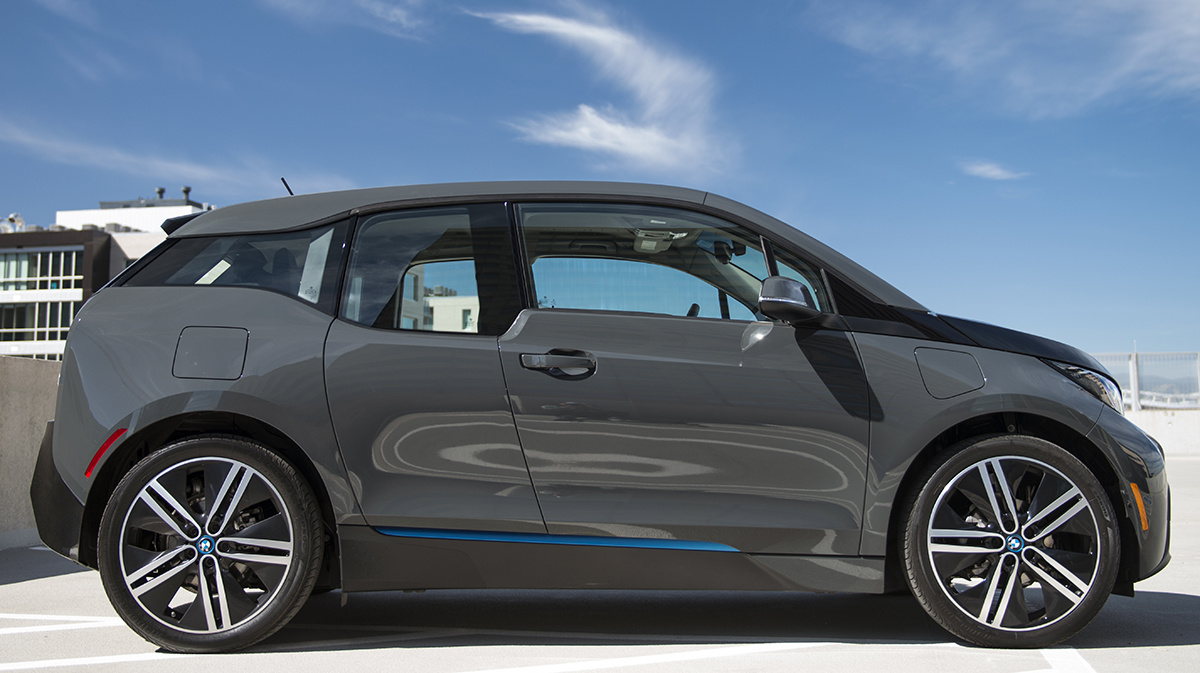
The BMW i3 is an interesting proof-of-concept for the automaker that battery-first tech has a future in the rest of its lineup.

The 2015 BMW i3 is the Bavarian automaker’s second half of its “i” lineup, an experimental mix of practicality and power, which may expand in coming years.
New last year, the i3 is BMW’s most aggressive attempt at a battery-powered car—even though it can be paired with an optional traditional internal combustion engine, which adds $3,850 to the bottom line. On batteries alone the i3 can run up to 81 miles, and the range extender roughly doubles that.
The i3 comes in three trims or “Worlds”—Mega, Giga, and Tera—and with or without the 34-horsepower 2-cylinder engine in the rear that gets used only as a generator. The gas-powered engine never mechanically drives the wheels, which separates it from the Chevrolet Volt that has a similar powertrain system, but it's debatable if the i3 is a fully electric car, or if it just comes close like the Volt.
The three trims are awash with BMW comforts: the Mega sports 19-inch tires and Sensa-tec fabric, the Giga adds leather seats and an open-pore eucalyptus-wood dash (responsibly farmed, of course), and the Tera adds a leather dash and hand-stitched accents. Optional 20-inch tires can be fitted to the top two trims.
The i3 is a 5-door hatchback that looks unlike any other car in BMW’s portfolio. The rear doors swing outward from the front doors like the Honda Element's. The whole car may be a little bit of a frump underneath the blue-accented kidney grilles and “look-at-me” interior, but that’s the reality of a lightweight carbon fiber and aluminum body that’s meant to be efficient first and look good second.

The i3 is motivated by a 170-hp, all-electric powertrain that sends power to the rear wheels via a single-speed transmission. A 22kWh charge is good enough for roughly 80 miles of city driving and will take 5 hours on a Level 2 (240-volt) charger. A regular wall plug would take more than 12 hours to replenish the i3’s battery.
The optional engine, which BMW calls the i3’s “range extender,” is a 600cc engine borrowed from its motorcycle lineup that acts only as a generator for the car. Its 34 hp doesn’t add to the i3’s total horsepower figure like in a traditional hybrid, rather, the engine kicks in only to add juice to the battery. Predictably, the car's performance slows when it’s using the gas engine to recharge the battery, and it’s not a usable long-term replacement for regularly recharging the i3.
The i3 is notable not only for how it goes, but also for how it slows.
The BMW i3 uses the most aggressive brake regeneration system on the roads today, and the little Bavarian runner drives like nothing else on the road.
The brakes bite noticeably hard when you let off the gas, and the braking system does its best to recoup electrons from slowing the car. It is a completely different way of driving a passenger vehicle and is comparable to the way a golf cart slows when you let off the gas.
After a couple days of driving the i3, it becomes clear that the brake pedal is purely optional—or for use only in case of emergency—and it’s easy to drive just about anywhere using the gas.
Power is shifted from the motor to Bridgestone Ecopia tires that were specifically made for the i3. At just 155 millimeters wide, the tires are skinnier than the shoes on a 1970s BMW 2002.
The EPA has given the i3 a rating of 117 mpge on electricity alone, and 39 mpg when using the range extender, which runs on premium fuel.

The BMW i3 is built specifically to be a city car, and its internal layout reflects that purpose. The open, airy cabin uses lightweight sound-deadening material and “gee-whiz” aesthetics that aren’t necessarily conducive to long hours spent in the car.
The open-pore eucalyptus-wood dash looks like a cheeseboard and sets the table for the car’s unique features elsewhere. A stalk-mounted shifter and exposed carbon fiber everywhere confirm what most people think when they first step foot in the i3: The car is completely different than anything else on the road.
Despite focusing heavily on lightweight materials, the seats feel neither cheap nor uncomfortable. Finding a suitable driving position isn’t hard, and the tilting steering wheel can be configured to give a decent perspective to the small instrument cluster ahead of the driver.
Clambering into and out of the back seat could be challenging for adults, but children should fit just fine.
The aforementioned driving dynamics (aggressive regenerative braking) take center stage ahead of any of the other on-road characteristics of the i3. In reality, it’s a rear-engined lightweight car with skinny tires—or on paper, an old Porsche 911.
As any electric car owner would attest to, the low-end torque of electric motors is phenomenal, and the i3 can run up to 60 mph in 6.5 seconds. Once there, it’ll deplete its batteries quickly, so it’s better from 0-30-0 mph every day of the week.
The car won’t break beads on its skinny tires, however, it’s unusually heavy in the front end and won’t be confused with a speed machine. There’s a considerable amount of road noise in the wide-open cabin, likely because sound deadening and acoustic glass would add much to the car’s 3,000-pound heft.
The driving experience isn’t completely numb, and it’s more fun than many econo-hatchbacks. The drawback is, of course, that it’s twice as expensive.

It’s entirely possible that the i3 wouldn’t be much of a BMW without its tech, so the German luxury carmaker stuffed it full of fun features.
The aforementioned dash and stalk and BMW’s iDrive system headline the car’s visible tech. Its optional 10.2-inch high-definition screen is expressive and clear, and the system is easy to navigate, even though it’s older than Mercedes' and Audi's systems.
“Indirect tech,” or the stuff you can’t see, is where the i3 shines. The carbon fiber construction is visible in places such as the doorsills, and the lightweight materials in the i3 almost certainly have a future in BMW’s mainstream cars in the future as the automaker stretches to meet fuel-economy requirements.
The car drives in either Normal, Eco Pro, or Eco Pro+ mode, and each Eco mode improves battery efficiency by 12 percent. Cranking the geek button all the way up to Eco Pro+ limits the i3’s top speed to 56 mph and cuts off the air conditioning to conserve electrons. Unsurprisingly, there’s no Sport button in the i3.
The i3 can also be fitted with an optional Parking Assistance Package ($1,000) that uses sensors to help “see” around the small car. Despite being a small hatchback, it’s surprisingly difficult to see the front hood of the i3. An optional Technology + Driving Assistance Package ($2,500) adds the high-def screen and real-time traffic info.
Of course, the i3’s unique powertrain qualifies as tech, and the range extender could be how future automakers offer battery-powered cars with ranges comparable to those of normal cars.

Due to its extremely low volume, neither the National Highway Traffic Safety Administration nor the Insurance Institute for Highway Safety has rated the i3 for crash safety.
According to the manufacturer, the i3 uses a LifeDrive construction to compartmentalize and protect the passenger cabin in a crash. Carbon fiber composites were used to reinforce collision areas, and the i3 has front- and side-impact airbags.
Antilock brakes and child seat safety latches are standard across all versions.

Starting at $42,400, or $46,250 with the range extender, before federal and applicable state incentives, the BMW i3 is considerably more expensive than other electric cars in its class. It’s also twice as expensive as some gas-powered compact hatches, if you reach that far.
Our tester, a fully decked i3 Tera with range extender, topped out at $54,450, which is an eye-watering figure considering its 140-mile range.
But it’s clear that BMW is positioning the i3 for early-adopter buyers looking for a bleeding-edge car who are willing to trade battery range and affordability for “look at me” tech.

User reviews for 2015 BMW i3
Write a review2015 BMW i3 Pricing
Trims & specs
Air Conditioning
Automatic climate control front air conditioning · Single front air conditioning zones
Airbags
Dual front airbags · Passenger airbag deactivation: occupant sensing deactivation · Front side airbags · Front side curtain airbags
Audio System
Antenna Type: diversity · Bluetooth auxiliary audio input · Single disc in-Dash CD · HD radio · Satellite Radio: SiriusXM · Total Number of Speakers: 4
Brakes
ABS: 4-wheel · Front brake diameter: 11.0 · Front brakes: ventilated disc · Rear brake diameter: 11.0 · Rear brakes: disc
Comfort Features
Armrests: front center · Floor Mat Material: carpet · Floor Material: carpet · Floor Mats: front
Convenience Features
Assist handle: front · Cupholders: front · Dimming rearview mirror: auto-dimming · Memorized settings: driver side mirror · Multi-function remote: keyless entry with panic alarm · One-touch windows: 4 · Power outlet(s): 12V front · Power steering: electric · Power windows: lockout button · Reading lights: front · Steering wheel: tilt and telescopic · Steering wheel mounted controls: cruise controls · Storage: seatback · Vanity mirrors: dual illuminating
Engine
EV battery capacity: 27 kWh · Electric Charge Cord: 240 volt · Electric Motor Battery Type: lithium ion · Electric Motor HP: 168 · Electric Motor Power Output (Kilowatts): 125 · Electric Motor Torque: 184 · Electric motor charger: DC fast charging · Electric motor charger connector: SAE Combo CCS · Electric motor charging time: 4 hours · Electric motor miles per charge: 81
Exterior Features
Door handle color: body-color · Front bumper color: body-color · Grille color: black · Mirror color: black · Rear bumper color: body-color · Rear trunk/liftgate: power operated · Window trim: black
Headrests
Front headrests: adjustable · Number of front headrests: 2
In Car Entertainment
Infotainment screen size: 6.5 in.
Instrumentation
Fuel economy display: MPG · Warnings and reminders: low battery
Lights
Headlights: auto delay off · Tail and brake lights: LED
Mirrors
Exterior mirrors: power
Rear Seats
Type: 50-50 split bench
Safety
Child seat anchors: LATCH system · Crumple zones: front · Impact sensor: door unlock
Seatbelts
Front seatbelts: 3-point · Seatbelt force limiters: front · Seatbelt pretensioners: front · Seatbelt warning sensor: driver and passenger · Second row seatbelts: 3-point
Seats
Driver seat manual adjustments: height · Front seat type: bucket · Passenger seat manual adjustments: height · Rear headrests: adjustable · Upholstery: leatherette
Steering
Steering ratio: 14.2
Suspension
Front Arm Type: lower control arms · Front Shock Type: gas shock absorbers · Front Spring Type: coil springs · Front Suspension Classification: independent · Front Suspension Type: MacPherson struts · Rear Shock Type: gas shock absorbers · Rear Spring Type: coil springs · Rear Suspension Classification: independent · Rear Suspension Type: multi-link · Stabilizer bar(s): front
Telematics
Driver assistance app: roadside assistance · Navigation system: with voice recognition · Phone: hands free · Phone wireless data link: Bluetooth · Satellite communications: BMW Assist · Smart device app function: engine start
Tires
Type: all season
Tires and Rims
Wheel type: aluminum alloy
Windows
Front wipers: variable intermittent · Liftgate window: fixed · Rear wiper: variable intermittent
Air Conditioning
Automatic climate control front air conditioning · Single front air conditioning zones
Airbags
Dual front airbags · Passenger airbag deactivation: occupant sensing deactivation · Front side airbags · Rear side curtain airbags
Audio System
Antenna Type: diversity · USB auxiliary audio input · Single disc in-Dash CD · HD radio · Satellite Radio: SiriusXM · Total Number of Speakers: 4
Brakes
ABS: 4-wheel · Front brake diameter: 11.0 · Front brakes: ventilated disc · Rear brake diameter: 11.0 · Rear brakes: disc
Comfort Features
Armrests: front center · Floor Mat Material: carpet · Floor Material: carpet · Floor Mats: front
Convenience Features
Assist handle: front · Cupholders: front · Dimming rearview mirror: auto-dimming · Memorized settings: driver seat · Multi-function remote: keyless entry · One-touch windows: 4 · Power outlet(s): 12V front · Power steering: electric · Power windows: lockout button · Reading lights: rear · Steering wheel: tilt and telescopic · Steering wheel mounted controls: cruise controls · Storage: seatback · Vanity mirrors: dual illuminating
Engine
EV battery capacity: 27 kWh · Electric Charge Cord: 240 volt · Electric Motor Battery Type: lithium ion · Electric Motor HP: 168 · Electric Motor Power Output (Kilowatts): 125 · Electric Motor Torque: 184 · Electric Vehicle Extended Range Generator Displacement: 0.7 · Electric Vehicle Extended Range Generator HP: 38 · Electric Vehicle Extended Range Generator Number of Cylinders: 2 · Electric motor charger: DC fast charging · Electric motor charger connector: SAE Combo CCS · Electric motor charging time: 4 hours · Electric motor miles per charge: 72
Exterior Features
Door handle color: body-color · Front bumper color: body-color · Grille color: black · Mirror color: black · Rear bumper color: body-color · Rear trunk/liftgate: liftgate · Window trim: black
Headrests
Front headrests: adjustable · Number of front headrests: 2
In Car Entertainment
Infotainment screen size: 6.5 in.
Instrumentation
Fuel economy display: MPG · Warnings and reminders: maintenance reminder
Lights
Headlights: auto delay off · Tail and brake lights: LED
Mirrors
Exterior mirrors: auto-dimming
Rear Seats
Type: 50-50 split bench
Safety
Child seat anchors: LATCH system · Crumple zones: front · Impact sensor: alert system
Seatbelts
Front seatbelts: 3-point · Seatbelt force limiters: front · Seatbelt pretensioners: front · Seatbelt warning sensor: driver and passenger · Second row seatbelts: 3-point
Seats
Driver seat manual adjustments: height · Front seat type: bucket · Passenger seat manual adjustments: height · Rear headrests: adjustable · Upholstery: leatherette
Steering
Steering ratio: 14.2
Suspension
Front Arm Type: lower control arms · Front Shock Type: gas shock absorbers · Front Spring Type: coil springs · Front Suspension Classification: independent · Front Suspension Type: MacPherson struts · Rear Shock Type: gas shock absorbers · Rear Spring Type: coil springs · Rear Suspension Classification: independent · Rear Suspension Type: multi-link · Stabilizer bar(s): front
Telematics
Driver assistance app: roadside assistance · Navigation system: hard drive navigation system · Phone: hands free · Phone wireless data link: Bluetooth · Satellite communications: BMW Assist · Smart device app function: maintenance status
Tires
Type: all season
Tires and Rims
Wheel type: aluminum alloy
Windows
Front wipers: rain sensing · Liftgate window: fixed · Rear wiper: variable intermittent

