Ford Mustang Mach-E vs Hyundai IONIQ 9
Overview | |
MSRP$37,795 | MSRP$58,995 |
Listings6900 | Listings261 |
Ratings & Reviews | |
User Reviews | User Reviews |
Expert reviews7.8 out of 10 | Expert reviews7.3 out of 10 |
Pros
Cons
| Pros
Cons
|
Reviews SummaryEvery automaker needs a successful electric SUV, and the best way to go about that is to make it look good. Ford’s bread-and-butter electric SUV does that by borrowing design elements from the legendary Mustang coupe and convertible, teaming them with a roomy interior and useful electric driving range. Offered in a variety of trims, the Mach-E works as a practical daily driver and can be had with big-time power and even as a rally-inspired trail beast. Verdict: The Ford Mustang Mach-E’s appealing looks are backed up by a practical interior, a viable range, and a variety of trim levels. It doesn’t charge as quickly or go as far as some rivals and the ride could be better, but the Mach-E offers style in a market sadly lacking it. | |
Reviews SummaryAlthough the 2026 Hyundai Ioniq 9 isn’t the first three-row electric SUV through the door, it may be the best choice for most shoppers. With a starting price of $60,555 and qualifying for a $7,500 federal EV tax credit, it’s more affordable than a Tesla Model X or a Rivian R1S, and its standard 110.3-kWh battery pack provides a long range compared to a base-model Kia EV9. Verdict: The Hyundai Ioniq 9 isn’t a perfect vehicle but it offers terrific passenger space, good tech, and family-friendly features. Shoppers may find its design polarizing (you could easily say the same about the Hyundai Ioniq 5 or the Ioniq 6), but families interested in electric vehicles will do well to test drive this new option. | |
No video found | |
Popular Features & Specs | |
Engine | Engine215 hp Electric |
Drivetrain | DrivetrainRWD |
Seating Capacity5 | Seating Capacity7 |
EV Battery Capacity73 kWh | EV Battery Capacity110 kWh |
Fuel Economy (City) | Fuel Economy (City)103 MPG/MPGe |
Fuel Economy (Highway) | Fuel Economy (Highway)81 MPG/MPGe |
Battery Charge Time (120V) | Battery Charge Time (120V)93 hours |
Battery Charge Time (240V)14.1 hours | Battery Charge Time (240V)9.7 hours |
Engine | |
Engine Name264 hp Electric | Engine Name215 hp Electric |
Battery Charge Time (120V) | Battery Charge Time (120V)93 hours |
Battery Charge Time (240V)14.1 hours | Battery Charge Time (240V)9.7 hours |
DrivetrainRWD | DrivetrainRWD |
Fuel Economy | |
EV Battery Capacity73 kWh | EV Battery Capacity110 kWh |
Fuel Economy (City) | Fuel Economy (City)103 MPG/MPGe |
Fuel Economy (Highway) | Fuel Economy (Highway)81 MPG/MPGe |
Interior | |
Seating Capacity5 | Seating Capacity7 |
Key Features | |
Navigation SystemStandard | Navigation SystemStandard |
Safety | |
Front Crash Overall4 | Front Crash Overall5 |
Side Crash Overall5 | Side Crash Overall5 |
Dimensions & Capacity | |
Cargo Space29.7 cu ft | Cargo Space21.9 cu ft |
Curb Weight4595 lbs | Curb Weight5507 lbs |
Height64.0 in | Height70.5 in |
Length185.6 in | Length199.2 in |
Width82.6 in | Width78.0 in |
Wheelbase117.5 in | Wheelbase123.2 in |
Maximum Payload | Maximum Payload1393 lbs |
Number of doors4 | Number of doors4 |
Maximum Towing Capacity | Maximum Towing Capacity3500 lbs |
Overview | ||
MSRP | $37,795 | $58,995 |
Listings | ||
Ratings & Reviews | ||
User reviews | ||
Expert reviews | 7.8 out of 10Read full review | 7.3 out of 10Read full review |
Pros & cons | Pros
Cons
| Pros
Cons
|
Summary | Every automaker needs a successful electric SUV, and the best way to go about that is to make it look good. Ford’s bread-and-butter electric SUV does that by borrowing design elements from the legendary Mustang coupe and convertible, teaming them with a roomy interior and useful electric driving range. Offered in a variety of trims, the Mach-E works as a practical daily driver and can be had with big-time power and even as a rally-inspired trail beast. Verdict: The Ford Mustang Mach-E’s appealing looks are backed up by a practical interior, a viable range, and a variety of trim levels. It doesn’t charge as quickly or go as far as some rivals and the ride could be better, but the Mach-E offers style in a market sadly lacking it. | Although the 2026 Hyundai Ioniq 9 isn’t the first three-row electric SUV through the door, it may be the best choice for most shoppers. With a starting price of $60,555 and qualifying for a $7,500 federal EV tax credit, it’s more affordable than a Tesla Model X or a Rivian R1S, and its standard 110.3-kWh battery pack provides a long range compared to a base-model Kia EV9. Verdict: The Hyundai Ioniq 9 isn’t a perfect vehicle but it offers terrific passenger space, good tech, and family-friendly features. Shoppers may find its design polarizing (you could easily say the same about the Hyundai Ioniq 5 or the Ioniq 6), but families interested in electric vehicles will do well to test drive this new option. |
Video | No video found | |
Popular Features & Specs | ||
Engine | 215 hp Electric | |
Drivetrain | RWD | |
Seating Capacity | 5 | 7 |
EV Battery Capacity | 73 kWh | 110 kWh |
Fuel Economy (City) | 103 MPG/MPGe | |
Fuel Economy (Highway) | 81 MPG/MPGe | |
Battery Charge Time (120V) | 93 hours | |
Battery Charge Time (240V) | 14.1 hours | 9.7 hours |
Engine | ||
Engine Name | 264 hp Electric | 215 hp Electric |
Battery Charge Time (120V) | 93 hours | |
Battery Charge Time (240V) | 14.1 hours | 9.7 hours |
Drivetrain | RWD | RWD |
Fuel Economy | ||
EV Battery Capacity | 73 kWh | 110 kWh |
Fuel Economy (City) | 103 MPG/MPGe | |
Fuel Economy (Highway) | 81 MPG/MPGe | |
Interior | ||
Seating Capacity | 5 | 7 |
Key Features | ||
Navigation System | Standard | Standard |
Safety | ||
Front Crash Overall | 4 | 5 |
Side Crash Overall | 5 | 5 |
Dimensions & Capacity | ||
Cargo Space | 29.7 cu ft | 21.9 cu ft |
Curb Weight | 4595 lbs | 5507 lbs |
Height | 64.0 in | 70.5 in |
Length | 185.6 in | 199.2 in |
Width | 82.6 in | 78.0 in |
Wheelbase | 117.5 in | 123.2 in |
Maximum Payload | 1393 lbs | |
Number of doors | 4 | 4 |
Maximum Towing Capacity | 3500 lbs | |
The 2026 Hyundai Ioniq 9 presented a polarizing design that some found appealing while others did not. Its aerodynamic shape, inspired by smooth pebbles and midcentury modern sofas, was crafted to house seven passengers comfortably. Measuring 199.2 inches in length with a 123.2-inch wheelbase, the Ioniq 9 offered impressive interior volume, comparable to larger SUVs. Despite its size, it achieved a 0.27 drag coefficient, enhancing its aerodynamic efficiency. However, its design elements, such as the swooping roofline and stubby rear end, created a dissonant styling that was not universally admired. The rear view, with LED taillights wrapping around the tail's circumference, was particularly distinctive.
The Ioniq 9 was available in nine paint colors, with trim-specific options. The Calligraphy Design trim, tested in Sage Silver Matte, featured unique 21-inch wheels inspired by jet turbines. Inside, the Ioniq 9 offered a spacious and airy cabin, with flat floors and minimal clutter. The dashboard had multiple cubbies, and the panoramic sunroof on higher trims added to the open feel. Upholstery options varied by trim, with premium H-Tex and two-tone dark teal available on the Calligraphy trim. While the interior featured high-quality plastic, some elements, like the dashboard insert, felt underwhelming. The seats, though soft, lacked thigh support, impacting overall comfort.
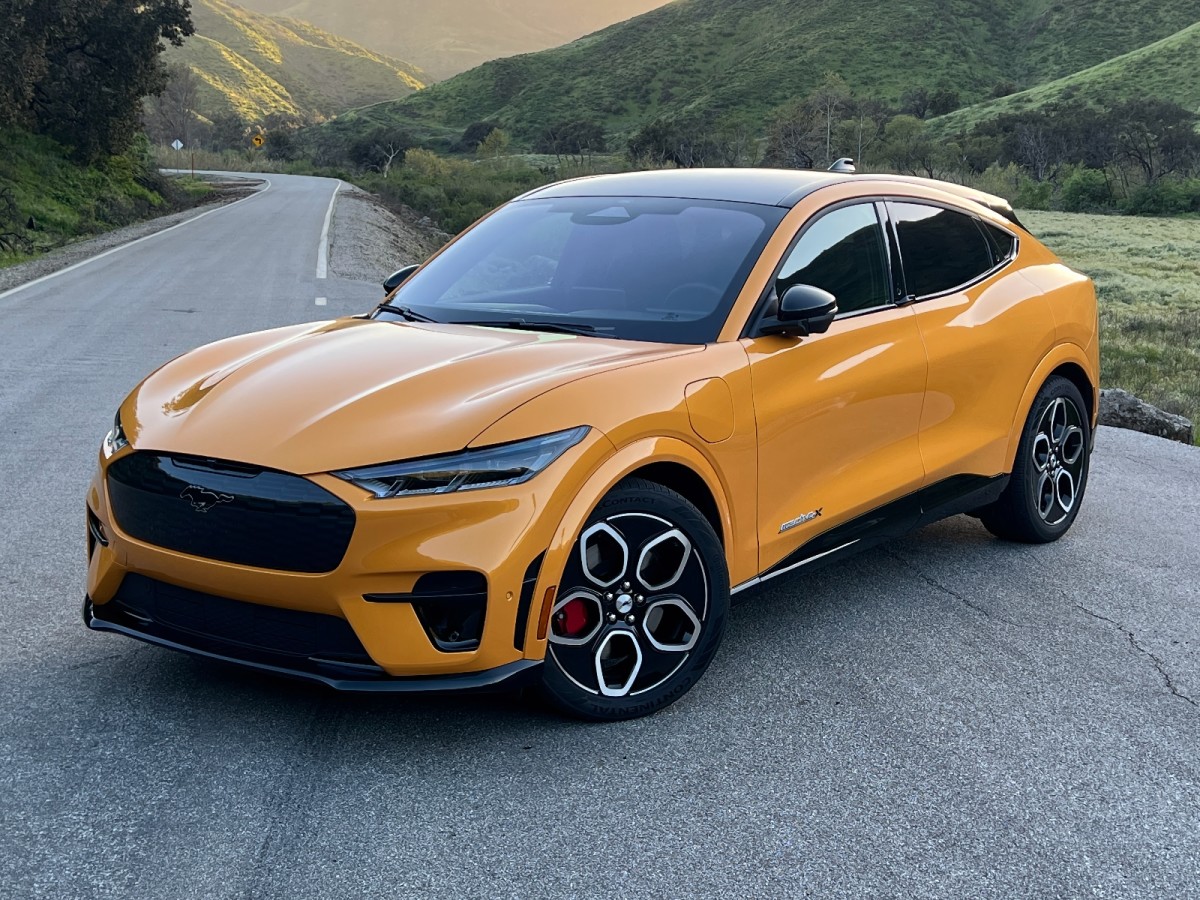
The 2026 Ford Mustang Mach-E stood out with its Mustang-inspired design, featuring a familiar grille insert and squinting headlights. Its sculpted sides and SUV-coupe-like profile, reminiscent of the BMW X6, maintained a sporty theme. The rear showcased a roof spoiler and Mustang's sequential three-bar taillights. Most Mach-E models came with 19-inch alloy wheels, while the GT trim sported 20-inch wheels. The Rally trim added a black roof, wheel arches, and side cladding, with dish-style wheels inspired by Ford rally cars. Optional dual hood stripes and a taller rear spoiler enhanced its sporty appearance.
Inside, the Mach-E offered synthetic leather that mimicked the real thing, with contrast stitching on the doors, dash face, and center console. The GT trim featured sport seats with bigger bolsters and contrast stitching. The Mach-E Rally added aluminum pedals, "Mach-E Rally" logos, and white trim. Ambient lighting brightened the interior, except in the base Select trim. The Mach-E's interior was spacious, with good headroom and legroom in both rows. Cargo space was practical, with 29.7 cubic feet behind the second row, expanding to 59.7 cubic feet with the seats folded. An optional front trunk provided additional storage.

The 2026 Hyundai Ioniq 9 featured a 110.3-kWh battery pack on Hyundai's e-GMP platform, offering a larger capacity than similar models. The base S trim had a single rear-mounted 160-kW motor, producing 215 horsepower with rear-wheel drive. Other trims had dual-motor all-wheel-drive systems, with power outputs ranging from 303 hp in the SE and SEL trims to 422 hp in the Limited and Calligraphy trims. The Ioniq 9 demonstrated impressive energy efficiency, achieving 3 to 3.2 miles per kilowatt hour, aligning with Hyundai's range estimates of 335 miles for the S trim and 311 miles for the Calligraphy Design. The Ioniq 9's chassis provided a smooth ride, though its weight and soft suspension limited cornering agility. It offered a quiet cabin, thanks to active noise cancellation and sound-absorbing features. Towing capacity was 3,500 pounds for the RWD S trim and 5,000 pounds for AWD models. Charging options included Tesla-style NACS superchargers and CCS-port Level 2 chargers, with fast charging capabilities.
The 2026 Ford Mustang Mach-E offered a range of powertrain options, starting with a single-motor RWD setup producing 264 horsepower and a 73-kWh battery, providing 260 miles of range. Dual-motor configurations increased output to 325 hp but reduced range to 240 miles. An Extended Range battery offered 320 miles with a single motor or 300 miles with dual motors, with power outputs ranging from 325 to 370 hp. The Mach-E GT delivered 480 hp and 280 miles of range, while the Rally trim had the same power but a 255-mile range. The Premium model tested had dual motors, 370 hp, 500 lb-ft of torque, and a 300-mile range. The Mach-E's electric motors provided immediate torque, achieving 0-60 mph in under five seconds. The GT trim, with 480 hp and 600 lb-ft of torque, reached 60 mph in 3.8 seconds, with a Performance Upgrade increasing torque to 700 lb-ft. The Mach-E offered selectable sound modes and one-pedal driving. It handled well, with agile moves and a rear-drive bias, though the ride could be improved, especially in the rear. The GT and Rally trims featured stronger brakes and performance enhancements.
The 2026 Hyundai Ioniq 9 focused on family-SUV practicality, seating seven in S, SE, and SEL trims with a middle-row bench seat. Limited and Calligraphy trims offered ventilated captain's chairs, reducing seating to six. The Universal Island 2.0, available on higher trims, improved access for middle-row passengers. The Ioniq 9 provided 42.8 inches of legroom in the middle row, though the 32 inches in the third row felt tight for adults. Access and headroom were impressive, with wide rear doors facilitating easy loading and unloading. Dual-zone climate control, air vents in all rows, and a standard heat pump enhanced comfort. The driver's seat had limited adjustability, and the glove compartment's low placement was inconvenient. Cargo space was 21.9 cubic feet behind the third row, expanding to 46.7 and 86.9 cubic feet with seats folded. The small front trunk was best for storing charging accessories.
The 2026 Ford Mustang Mach-E offered a spacious interior, with a longer wheelbase than gas-powered equivalents. It accommodated couples or families like a compact or midsize two-row crossover. The first row had good headroom and legroom, while the second row was comfortable but tight for three passengers. Power-adjustable front seats, driver’s seat memory, heated and ventilated front seats, and a heated steering wheel were available. The GT and Rally trims featured sportier seats with additional bolstering. Cargo space was 29.7 cubic feet behind the second row, expanding to 59.7 cubic feet with seats folded. The sloping rear roof limited space compared to some competitors. An optional 4.8-cubic-foot front trunk provided secure storage and could be used as a cooler.
The 2026 Hyundai Ioniq 9 featured a dual, curved 12.3-inch display infotainment system, similar to those in other Hyundai models. The screens offered good visuals but were prone to fingerprints and glare. Standard features included SiriusXM Satellite Radio, over-the-air updates, a Wi-Fi hotspot, wireless Android Auto and Apple CarPlay, and a wireless charging pad. However, the charging pad struggled to keep up with high-demand devices and lacked ventilation. Six USB-C ports provided ample charging options. The Limited and Calligraphy trims came with a 14-speaker Bose audio system, delivering impressive sound quality.
The 2026 Ford Mustang Mach-E borrowed from Tesla with a large, 15.5-inch portrait-style touchscreen, housing many controls. A 10.2-inch digital instrument cluster displayed essential information. The Sync 4A software was user-friendly but slow to load. The Ford Connectivity package included a 5G Wi-Fi hotspot, real-time navigation, and streaming services, with a subscription fee after the first year. Standard features included wireless Apple CarPlay and Android Auto, a satellite radio trial, and a digital key. Optional features included a wireless charging pad and a 10-speaker B&O audio system.
The 2026 Hyundai Ioniq 9 had not yet been rated by NHTSA or IIHS. It came with a comprehensive suite of advanced driver assistance systems, including collision avoidance, lane-guidance, driver attention warning, safe-exit assist, and Highway Driving Assist 2. The latter provided supervised hands-free driving without a subscription. Higher trims featured a surround-view monitor, parking aids, and a blind-spot view monitor.
The 2026 Ford Mustang Mach-E included Ford’s Co-Pilot 360 Assist+ suite, offering features like automatic emergency braking, adaptive cruise control, lane-keep assist, blind-spot monitors, and more. BlueCruise hands-free driver-assist was standard for 90 days, with subscription options available. BlueCruise handled steering, throttle, and brakes on mapped highways but required driver attention. The Mach-E earned a Top Safety Pick award from IIHS and a five-star rating from NHTSA.
CarGurus highlights
According to CarGurus experts, the overall rating for the 2026 Hyundai IONIQ 9 is 7.3 out of 10, while the 2026 Ford Mustang Mach-E scores 7.8 out of 10. Based on these ratings, the Ford Mustang Mach-E is the recommended choice, offering a blend of sporty design, performance, and advanced technology that appeals to a wide range of consumers.
Choose the 2026 Hyundai IONIQ 9 if:
- You prioritize a spacious and family-friendly interior with flexible seating options.
- You value a smooth and quiet ride with impressive energy efficiency.
- You prefer a comprehensive suite of standard safety features without subscription fees.


Choose the 2026 Ford Mustang Mach-E if:
- You desire a sporty design with Mustang-inspired styling and performance.
- You appreciate a variety of powertrain options with strong acceleration capabilities.
- You want advanced driver-assist features like BlueCruise for hands-free driving.


CarGurus highlights
According to CarGurus experts, the overall rating for the 2026 Hyundai IONIQ 9 is 7.3 out of 10, while the 2026 Ford Mustang Mach-E scores 7.8 out of 10. Based on these ratings, the Ford Mustang Mach-E is the recommended choice, offering a blend of sporty design, performance, and advanced technology that appeals to a wide range of consumers.
Choose the 2026 Hyundai IONIQ 9 if:
Shop Now- You prioritize a spacious and family-friendly interior with flexible seating options.
- You value a smooth and quiet ride with impressive energy efficiency.
- You prefer a comprehensive suite of standard safety features without subscription fees.
Choose the 2026 Ford Mustang Mach-E if:
Shop Now- You desire a sporty design with Mustang-inspired styling and performance.
- You appreciate a variety of powertrain options with strong acceleration capabilities.
- You want advanced driver-assist features like BlueCruise for hands-free driving.

By: CarGurus + AI
At CarGurus, our team of experienced automotive writers remain at the heart of our content operation, conducting hands-on car tests and writing insightful guides that are backed by years of industry experience. To complement this, we are harnessing AI to make our content offering more diverse and more helpful to shoppers than ever. To achieve this, our AI systems are based exclusively on CarGurus content, ratings and data, so that what we produce is both unique to CarGurus, and uniquely helpful to car shoppers.

