Tesla's goal with the Cybertruck wasn't to build a traditional body-on-frame pickup truck powered by electricity, but to create an entirely new category. No other vehicle on sale looks or drives quite like it, and it remains one of the most polarizing vehicles on the market. Technically, the Cybertruck is a rival for other full-size pickups but it makes sense to compare it with electric alternatives such as the Rivian R1T, the Chevrolet Silverado EV, and the Ford F-150 Lightning. Powertrain agnostics could also consider it alongside the Ford F-150, the Ram 1500, and the Chevrolet Silverado 1500.
Tesla first teased the Cybertruck in November 2019 with a scope that seemed almost impossible for a mass-production pickup: a stainless-steel exoskeleton, bulletproof-adjacent glass, and on-road performance that would rival a Porsche 911. Reservations opened for a fully refundable $100 deposit, and the truck spent the next four years in development before deliveries finally began in November 2023.
The development story is almost more interesting than the finished product. The design brief called for a genuinely next-generation vehicle rather than an EV version of an existing truck, which meant building around a 48-volt electrical architecture years before the rest of the industry. A steer-by-wire system with no mechanical connection between the steering wheel and the front wheels was part of that same disruptive approach, and a first for a mass-production consumer vehicle.
The Cybertruck is easiest to recommend to buyers who like their tech, have home charging, and want a truck for daily driving and occasional towing rather than heavy-duty use. If reliability and resale values matter most, look for a build date of April 2025 or later. Whatever the year, shoppers should get an insurance quote before they commit, because it's the ownership cost most likely to surprise a first-time buyer.
Tesla Cybertruck Buying Guide: Cost, Reliability, and the Best Years to Buy
Frequently Asked Questions
Which Tesla Cybertruck years are the best?
Cybertrucks built after April 2025 are the best because they received many revisions. From a structural safety update to reliability improvements and safety upgrades, the later model years benefitted from the lessons learned in the first production run.
Which Tesla Cybertruck years are the worst?
The 2024 models are hands-down the worst, with double-digit recalls and many owner complaints on file, including crash- and fire-related issues. Common problem areas include the fit and finish, electrical faults, and windshield wiper failures. Consumer Reports specifically cites uneven panel gaps, door fitment issues, and other cosmetic inconsistencies as the main reliability drags.
Is a used Tesla Cybertruck a good deal?
A used Cybertruck can be a good deal, but it depends on the truck. In favor of the Cybertruck: reliability has been improving, EV running costs are generally low, and CarGurus data shows buyers can find meaningful discounts on the used market. However, operating costs can be a challenge. A Cybertruck is considerably more expensive to insure than a typical full-size truck, due to the unique stainless-steel body and the limited repair network. Some insurers have even stopped covering the Cybertruck.
Pros and Cons
Pros:
- Impressive Performance
- Useful truck features
- Interesting engineering
Cons:
- Polarizing Design
- Poor rear visibility
- Below-average reliability
Tesla Cybertruck Generations
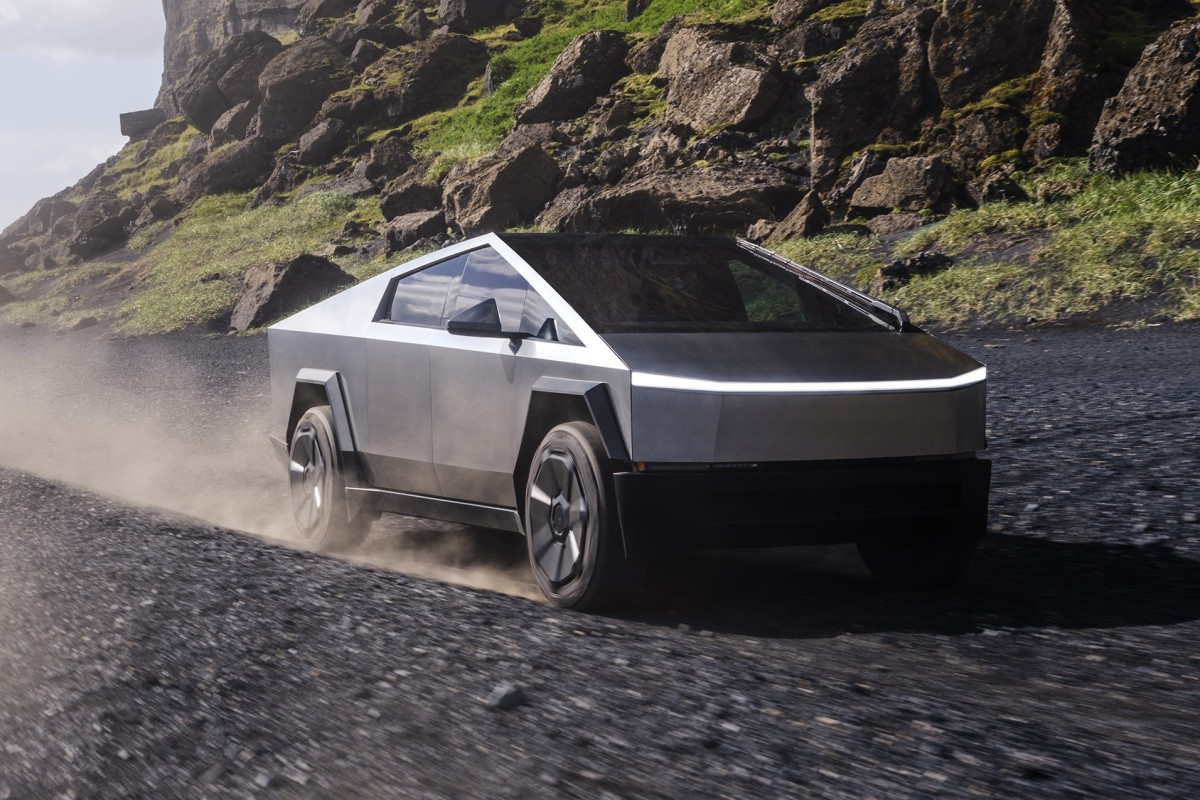
Tesla Cybertruck First Generation (2024-Present)
Every Cybertruck on the road is technically the same first generation, but there is a difference between the 2024 model year and 2025-and-later production. The 2024 launch year prioritized getting the truck into customers' hands after years of delays, and it showed; panel gaps and trim rattles were common and there were some recalls. Tesla used regular over-the-air (OTA) updates and production changes to iron most of this out, and by 2025 the truck was noticeably tighter in fit-and-finish, helped along by a genuine structural update.
All Cybertrucks are battery-electric vehicles (EVs), with no engine or transmission in the traditional sense. Depending on the trim and model year, the Cybertruck was equipped with one, two, or three electric motors. Dual Motor AWD models do 0-60 mph in about 4.1 seconds, while the top-of-the-line, tri-motor Cyberbeast is still AWD and significantly quicker, sprinting to 60 mph in just 2.6 seconds.
The dual-motor and tri-motor trims share the same 123 kWh battery pack, while the single-motor RWD trim used a smaller pack. Towing tops out around 11,000 pounds on the Premium AWD and Cyberbeast trims, while the entry-level AWD trim is 7,500 lbs. Regular towers should beware, though, because buyers report a real-world range reduction of 40%-60% versus the EPA-rated range of up to 325 miles (320 miles for Cyberbeast models).
Five trim levels have been offered since the Cybertruck launched in late 2023 as a 2024 model. Foundation Series trim was only available during the first year on sale. It added a $20,000 premium over the equivalent standard configuration, was available with either the Dual Motor AWD or Cyberbeast powertrain, and included early delivery, unique badging, and a bundle of features that are now standard or optional elsewhere.
The lineup settled into two AWD trims and a flagship. The entry-level Dual Motor AWD is the value trim, with the lowest towing capacity of the lineup but the longest range. The Dual Motor uses conventional coil-spring suspension with adaptive damping, rather than the air suspension found on higher trims. The Premium AWD model adds comfort and convenience features, adaptive air suspension, and has an 11,000 lb towing capacity.
The Cyberbeast, with its three motors, is the high-performance flagship, offering the quickest acceleration and the highest towing figures. Finally, the single-motor RWD trim, badged Long Range, was briefly sold in 2025 and discontinued after a few months due to a low take rate.
Inside, the cabin is classic Tesla minimalism. It’s built around a large, 18.5-inch center touchscreen, with premium materials but few physical controls. Rear-seat passengers get their own 9.4-inch touchscreen, mounted between the front seats, with control over rear climate, seat heaters, media playback, video streaming, and even a built-in gaming mode. Like other Teslas, Apple CarPlay and Android Auto are not available; buyers relying on them either for navigation or media should plan on using Tesla's native software instead.
The distinctive squared-off steering wheel takes some getting used to, but it needs less than a full turn lock-to-lock thanks to the steer-by-wire system, and rear-wheel steering further tightens the truck's turning radius at low speeds. New Tesla drivers also need to get used to “one-pedal driving”, where the vehicle slows down due to regenerative braking and therefore makes the brake pedal largely redundant. The Cybertruck only drives in one-pedal mode, with no driver-adjustable regenerative braking levels.
A notable Cybertruck-specific feature is the powered 6x4-foot truck bed with integrated outlets and lighting (useful as a worksite or campsite power source), complete with a powered tonneau cover for secure storage. Software features have expanded steadily via OTA updates since 2024, including newer active safety features such as a blind spot warning while parked.
Safety credentials have improved meaningfully over the production run. The Cybertruck carries a five-star NHTSA overall rating, with four out of five stars in the rollover category—a fairly normal result for a tall, heavy pickup. On the IIHS side, the 2026 Cybertruck earned Top Safety Pick+, the only pickup truck in the industry (gas or electric) to do so, with perfect Good ratings across small overlap front, updated side, and updated moderate overlap front tests.
The important caveat for used buyers is this top rating specifically applies to trucks built after April 2025, when Tesla reinforced the front underbody and footwell structure to improve occupant protection in small-overlap front crashes. Tesla's lead Cybertruck engineer has stated that internal testing shows no meaningful difference in crash outcomes between pre- and post-April 2025 trucks, but the IIHS ratings themselves do not formally cover the earlier build.
The 2024 model year is the most problematic. Common complaints include inconsistent panel gaps and body fitment, tonneau cover leaks and mechanism failures, and low-voltage electrical faults. Several recalls were issued covering the accelerator pedal, windshield wipers, exterior lighting, and an issue with the rear-view camera display. Most of these were addressed through service campaigns or OTA fixes, but they're worth asking about specifically for those looking at early models.
Early- to mid-2025 production saw build quality improve steadily, but trucks built before April 2025 lack the reinforced front underbody/footwell structure of later cars. From mid-2025, fit-and-finish and reliability continue to improve, and JD Power has rated the truck highly for quality and dependability from this point. The main ongoing consideration on later trucks isn't a defect so much as an ownership cost; the Cybertruck's unique stainless-steel body and specialized parts mean collision repairs are expensive and not every shop can do them, which is reflected in insurance pricing and has led some insurers to limit or decline coverage.
CarGurus price data puts average used Cybertruck pricing in the $80,000-$82,000 range, with deals available in the high $60,000s for high-mileage examples. Depreciation has hit early, high-spec units hardest, and a well-optioned 2024 Cyberbeast generally has a bigger discount on its original MSRP than a 2025+ AWD.
Related Topics