Safety is one of the most practical factors to consider when shopping for any vehicle, and particularly when you're looking for a compact car. Whether you're navigating a busy city commute, driving on the highway, or hauling family members, a car with strong crash-test results and comprehensive driver-assistance technology can make a meaningful difference in everyday confidence. The good news is that the compact segment has become one of the most safety-competitive in the market, with many models now offering automatic emergency braking, lane-keeping assist, and adaptive cruise control as standard equipment rather than costly add-ons.
This guide covers the safest compact cars of 2026, drawing on real-world expert testing, National Highway Traffic Safety Administration (NHTSA) and Insurance Institute for Highway Safety (IIHS) crash-test results, and CarGurus market data to help you find the right fit. You'll find a range of options here, from the value-focused Kia K4 and Nissan Sentra to the IIHS Top Safety Pick+ Mazda3 and Toyota Prius, as well as a few compact-adjacent vehicles like the Subaru Crosstrek Hybrid and Hyundai Santa Cruz for shoppers whose needs go beyond a traditional sedan. Each entry is ranked by its Overall CarGurus rating, which combines expert scores, real owner reviews, and current market conditions.
What Makes CarGurus Best Cars Guides Different
The Safest Compact Cars of 2026
FAQs
Shopping Tools
Related Topics

1. Kia K4
CarGurus expert rating: 7.8 out of 10
CarGurus user rating: 5 out of 5
Percentage of Good and Great Deals available on CarGurus: 35.2%
Overall CarGurus rating: 4.6 out of 5
| Pros |
Cons |
| Excellent cargo space |
Underwhelming powertrains |
| Impressive tech features |
|
| Affordable price |
|
The Kia K4's biggest advantage is how much driver-assistance tech comes standard, even before you climb into the more expensive trims. Every K4 includes lane-keeping assist and lane-following assist, plus forward collision warning and automatic emergency braking with car/pedestrian/cyclist detection (including turning vehicles at junctions). Adaptive cruise control with stop-and-go is also standard, which is a meaningful everyday safety and stress-reduction feature for heavy traffic commutes.
It's worth noting the K4 is still new enough that it hasn't been crash-tested by NHTSA or IIHS yet, but Kia offers additional safety-focused upgrades for shoppers who want more visibility and more help on the highway. Available features include blind-spot warning, rear cross-traffic alert, and notably crisp surround-view and blind-spot view monitors; on the GT-Line Turbo, the Technology Package can add Highway Drive Assist 2 for hands-on semi-autonomous driving. Beyond safety, the K4's practical layout supports family duty with 14.6 cubic feet of trunk space and up to 38 inches of rear legroom, while the standard 2.0-liter engine makes 147 hp and 132 lb-ft of torque (a 1.6-liter turbo bumps output to 190 hp and 195 lb-ft of torque).
The CarGurus Verdict: "The Kia K4 is better than the outgoing Kia Forte. It offers more impressive tech, more standard safety features, more passenger space, and more cargo space. It's still not quite as satisfying to drive as the segment leader, but with a starting price hovering around $22,000, it's a far sight less expensive, too." - Matt Smith
Read our most recent Kia K4 review

2. Honda Civic
CarGurus expert rating: 6.8 out of 10
CarGurus user rating: 4.5 out of 5
Percentage of Good and Great Deals available on CarGurus: 31.9%
Overall CarGurus rating: 4.5 out of 5
| Pros |
Cons |
| Choice of body styles |
All-wheel drive not available |
| Enjoyable to drive |
Noisy at speed |
| Premium interior materials |
Outdated technology |
The 2026 Honda Civic brings a strong baseline: every Civic comes with Honda Sensing driver-assistance tech, including forward collision warning with automatic emergency braking, lane-departure warning, lane-keeping assist, lane-centering assist, and adaptive cruise control with Traffic Jam Assist at lower speeds. In NHTSA testing, the Civic sedan earns a five-star overall rating, with five stars in side impact and rollover resistance. One important trim detail: blind-spot monitoring and rear cross-traffic alert aren't available on the base LX, but they are included on the Sport and above.
The Civic's safety story also ties into everyday usability. It's a familiar sight, but it's well worth a second look, especially if you want a compact car that feels thoughtfully engineered and easy to live with. The Sport sedan pairs a 150 hp 2.0-liter four-cylinder with a continuously variable transmission (CVT) and front-wheel drive (FWD), and while it can feel underpowered during hard merges or mountain climbs, its predictable responses and well-tuned steering and suspension help drivers feel confident. Inside, the layout is refreshingly logical, and the sedan's 14.8 cubic feet of trunk space plus a 60/40-split folding rear seat make it easy to carry cargo; just note that the standard tech on lower trims is simple rather than flashy, and some drivers may find the lane-centering assist and adaptive cruise tuning a bit intrusive in traffic.
The CarGurus Verdict: "You'll pay a premium to buy a Honda Civic. In many ways, it's worth the extra money. In others, not so much. Still, while there are better deals in the compact car class, few are as satisfying to drive, and that's true even when the Civic is equipped with its base engine." - Christian Wardlaw
Read our most recent Honda Civic review
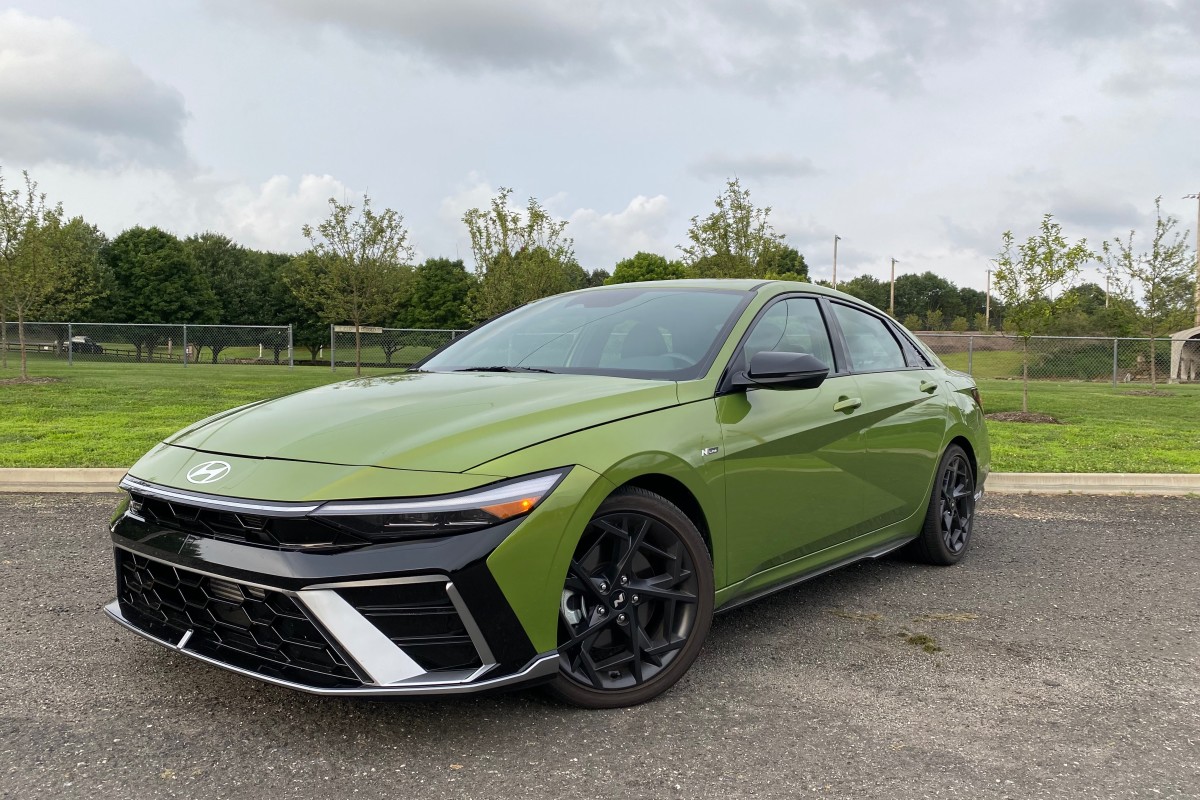
3. Hyundai Elantra
CarGurus expert rating: 7.3 out of 10
CarGurus user rating: 4.4 out of 5
Percentage of Good and Great Deals available on CarGurus: 32.9%
Overall CarGurus rating: 4.5 out of 5
| Pros |
Cons |
| Multiple powertrain options |
Potentially polarizing design |
| Stylish design |
Underwhelming base engine |
| Manual transmission available |
Interior materials feel cheap |
The Elantra brings a strong mix of crash-test results and widely available driver-assistance tech. It earned a five-star overall rating from NHTSA, and IIHS named it a Top Safety Pick, though IIHS didn't run the full slate of its standard crash tests and noted worse results in its newer moderate-overlap frontal test versus the 2021 Elantra, with added concern for rear-passenger injury risk even after Hyundai added two rear side airbags for 2024. On the features side, forward automatic emergency braking with pedestrian detection, lane-keep assist, a driver attention monitor, blind-spot monitoring with rear cross-traffic alert, and automatic high beams are standard on SE and N trims, while adaptive cruise control (plus cyclist detection and front cross-traffic alert) comes with SEL Convenience and Limited, and the Limited adds extras like a 360-degree camera and Highway Driving Assist.
Day to day, the Elantra is easy to live with, with good sight lines, generous headroom, and a roomy back seat with USB-C ports; its 14.2-cubic-foot trunk is also big for the class, and 60/40 split-folding rear seats are standard. Hyundai's wide range of powertrains lets buyers prioritize efficiency or passing power: most trims use a 147-hp 2.0-liter four-cylinder with 132 lb-ft of torque, the N Line upgrades to a 201-hp turbo four with 195 lb-ft, the Elantra Hybrid pairs gas-electric components for 139 hp and 125 lb-ft, and the Elantra N turns it up to 276 hp and 289 lb-ft for drivers who want maximum performance (with a six-speed manual available). A big touchscreen is standard on SEL and above, and while the system is quick, it skips wireless Apple CarPlay and Android Auto.
The CarGurus Verdict: "Get past the strange bodywork and plasticky interior, and you'll find a well-mannered sedan that is equally adept at being comfortable and economical as it is sporty and truly entertaining." - Clifford Atiyeh
Read our most recent Hyundai Elantra review
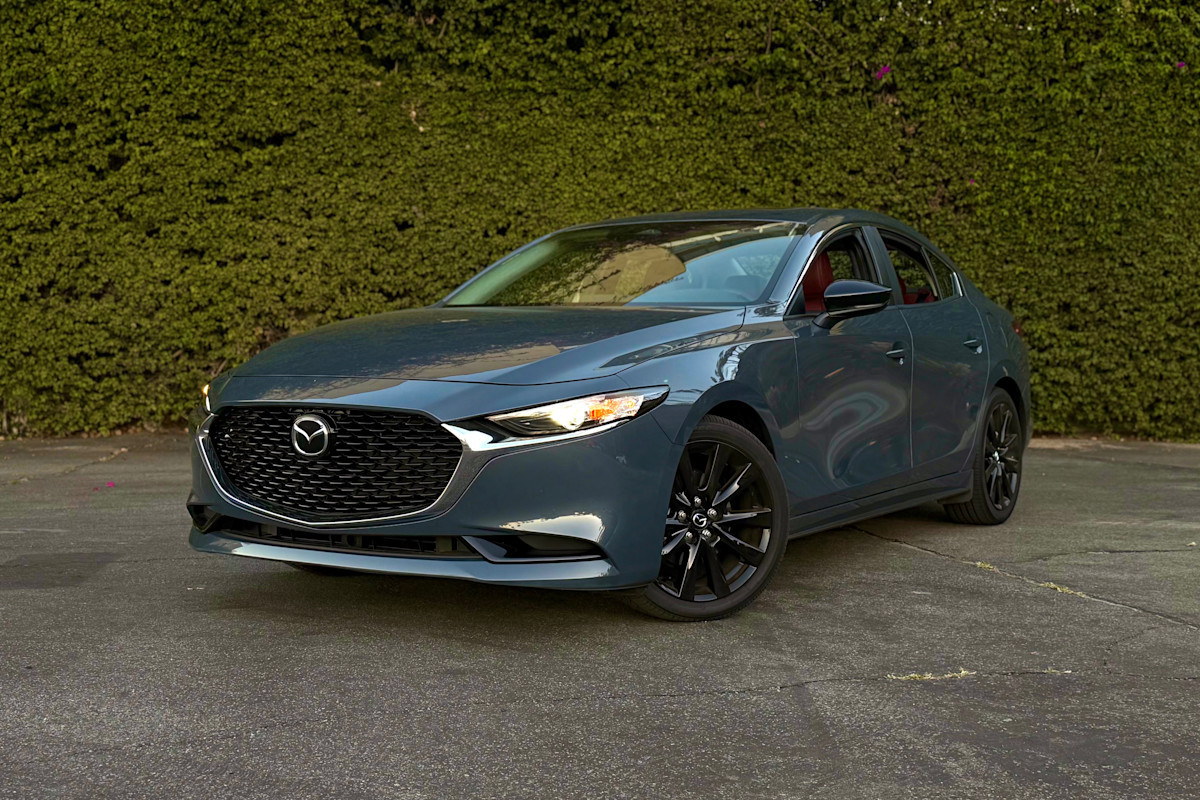
4. Mazda Mazda3
CarGurus expert rating: 6.5 out of 10
CarGurus user rating: 4.6 out of 5
Percentage of Good and Great Deals available on CarGurus: 32.5%
Overall CarGurus rating: 4.5 out of 5
| Pros |
Cons |
| Available all-wheel drive |
Underwhelming base engine |
| Stylish design |
Cramped back seat |
| Fun to drive |
Outdated technology |
The 2026 Mazda3 checks the big boxes: The sedan earns a five-star overall rating from NHTSA, and both the sedan and hatchback received the coveted IIHS Top Safety Pick+ award. Every Mazda3 comes with i-Activsense driver assists such as automatic emergency braking, adaptive cruise control, lane-departure warning, lane-keep assist, automatic high beams, and a driver condition monitor, while upper trims can add features like a surround-view camera system and reverse automatic braking. One caveat from our time behind the wheel: the adaptive cruise control could react late to slowing traffic, sometimes braking harder than expected and occasionally triggering a collision warning.
Beyond the test results, the Mazda3's day-to-day feel helps it fit a "safe compact car" brief in a more holistic way. Available i-Activ all-wheel drive (AWD) can improve traction in bad weather, and the car's stable, confident handling makes it easy to place in corners and during quick lane changes. The tradeoff is practicality: rear-seat space is tight for adult passengers, and the sedan's 13.2-cubic-foot trunk is merely average; the hatchback is the better pick if you need more room (up to 20.1 cubic feet behind the rear seats). Tech is more function-first than flashy, with a smaller standard 8.8-inch display and a dial controller instead of a touchscreen on most trims.
The CarGurus Verdict: "The Mazda 3 proves that small cars don't have to be boring." - Mark Takahashi
Read our most recent Mazda Mazda3 review
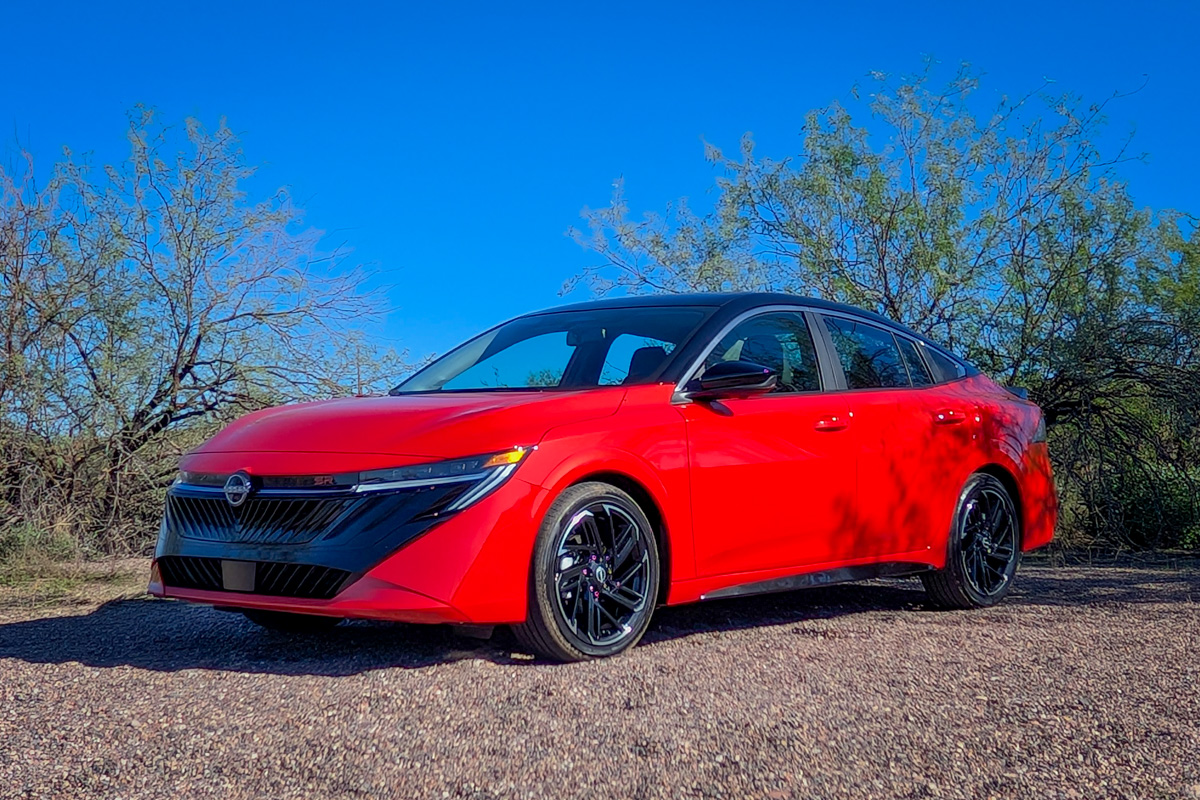
5. Nissan Sentra
CarGurus expert rating: 7.7 out of 10
CarGurus user rating: 4.3 out of 5
Percentage of Good and Great Deals available on CarGurus: 34.3%
Overall CarGurus rating: 4.5 out of 5
| Pros |
Cons |
| Impressive tech for the price |
Lackluster performance |
| Comfortable zero-gravity seats |
Tight rear-seat legroom |
| Great value for money |
|
The 2026 Nissan Sentra makes driver-assistance technology a cornerstone of its value proposition for safety-conscious buyers. Every Sentra comes standard with Nissan Safety Shield 360 features such as automatic emergency braking, forward collision warning, and lane-departure mitigation, plus new-for-2026 blind-spot intervention to help prevent unsafe merges. It also includes high-beam assist and traffic sign recognition—an unusually upscale feature in this price range—while higher trims can add a surround-view monitor and Nissan ProPilot Assist to reduce fatigue on highways and in stop-and-go traffic.
It's worth noting that, at the time of writing, neither NHTSA nor IIHS has crash-tested the 2026 Sentra, so shoppers who prioritize published crash results may want to keep an eye out for those scores as they arrive. As a daily driver, the Sentra focuses on calm, predictable behavior rather than quick acceleration, using a 2.0-liter four-cylinder making 149 hp and 146 lb-ft of torque, paired with a CVT and FWD. Inside, the comfortable zero-gravity seats and bright 12.3-inch center touchscreen help make long commutes feel less punishing, which matters when "safe" also means alert and comfortable behind the wheel.
The CarGurus Verdict: "The 2026 Nissan Sentra is a stylish and safe compact sedan that delivers impressive technology at an attractive, affordable price. It's not the most thrilling car in its segment (look to the Honda Civic or Mazda3 for that honor), but it nevertheless delivers premium, in-demand features. " - Matt Smith
Read our most recent Nissan Sentra review

6. Toyota Prius
CarGurus expert rating: 6.7 out of 10
CarGurus user rating: 4.7 out of 5
Percentage of Good and Great Deals available on CarGurus: 32.0%
Overall CarGurus rating: 4.5 out of 5
| Pros |
Cons |
| Stylish design |
Real-world fuel economy falls short of EPA ratings |
| Easy-to-use technology |
Cramped back seat |
| Great safety ratings |
Not much cargo space |
Safety is a major reason the Prius fits a "safest compact cars" short list. Every Prius comes standard with Toyota Safety Sense 3.0, bundling forward collision warning with automatic emergency braking, lane departure warning, lane-keeping and lane-centering assist, adaptive cruise control, and automatic high beams; blind-spot monitoring with rear cross-traffic alert is also standard. Crash-test results are strong, too: the Prius earns an IIHS Top Safety Pick+ award, and the NHTSA gives it five stars in crashworthiness testing (with a four-star rollover rating), which should reassure shoppers prioritizing proven protection.
In daily use, the Prius pairs those safety credentials with a low, aerodynamic hatchback shape that can make entry/exit and around-town visibility a bit more work than in taller compact cars. The hybrid system's 194-hp combined output is responsive in traffic, and available front/rear parking sensors and low-speed automatic braking help when you're trying to place the car precisely in a tight spot. Practicality is more mixed: the back seat is snug, and the Nightshade Edition's quoted 20.3 cubic feet of cargo space behind the rear seat can feel smaller than the number suggests, even though folding the 60/40 rear seat opens up more room.
The CarGurus Verdict: "The point of the Toyota Prius is fuel economy, but our Prius Nightshade test car averaged 39.2 mpg, falling significantly short of the EPA estimate of 52 mpg in combined driving. That certainly isn't superior to roomier hybrid cars from Honda, Hyundai, or from within Toyota's own lineup." - Christian Wardlaw
Read our most recent Toyota Prius review
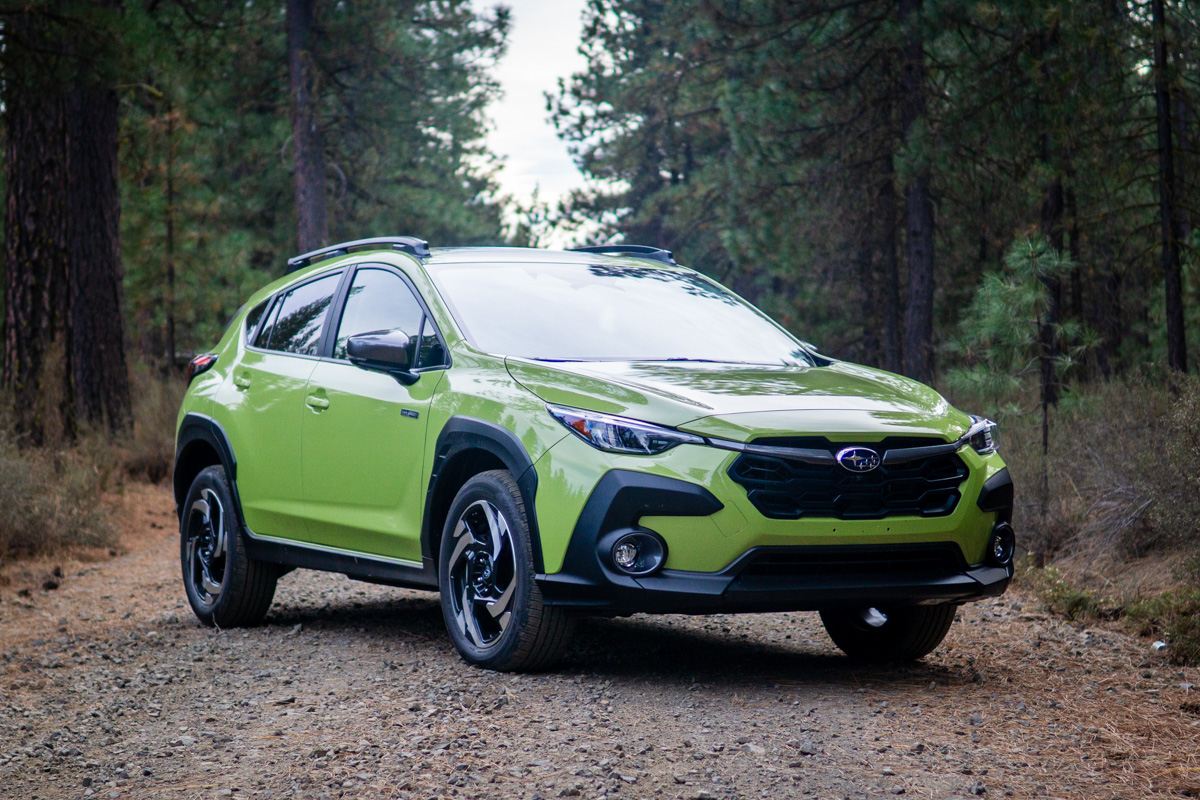
7. Subaru Crosstrek Hybrid
CarGurus expert rating: 7.2 out of 10
CarGurus user rating: 4.4 out of 5
Percentage of Good and Great Deals available on CarGurus: 40.0%
Overall CarGurus rating: 4.2 out of 5
| Pros |
Cons |
| Capable AWD |
Expensive |
| Smooth engine performance |
Trades fuel efficiency for AWD capability |
| Stylish design |
Unimpressive technology |
For safety-minded shoppers who also deal with rain, snow, or rough roads, the 2026 Subaru Crosstrek Hybrid leans into Subaru's traditional strengths: standard AWD and a compact footprint that's easy to place in traffic. Subaru notes it added side-curtain airbags for rear-seat occupants to address areas where the 2025 Crosstrek fell short in updated IIHS crash testing, though the IIHS and NHTSA haven't rated the 2026 model yet. Still, NHTSA awarded the 2025 Crosstrek a five-star overall safety rating, which is reassuring context for buyers considering the latest version.
Driver-assistance tech is another part of the Crosstrek Hybrid's safety story. Every Hybrid includes Subaru EyeSight ADAS features such as adaptive cruise control, lane-keeping assist, pre-collision braking with automatic emergency braking, and a rearview camera—useful everyday aids whether you're commuting or traveling. The Hybrid powertrain pairs a 2.5-liter Boxer four-cylinder with an electric drive motor for a 194-hp total system output, and Subaru's X-Mode traction management can help maintain control on low-grip surfaces; just be aware that some key vehicle functions run through the 11.6-inch touchscreen, which can feel laggy when you're trying to make quick adjustments.
The CarGurus Verdict: "With its attractive styling, comfortable interior, and tested AWD system, the 2026 Subaru Crosstrek delivers a terrific package, even if it's not as efficient as some larger (and more expensive) competitors." - Matt Smith
Read our most recent Crosstrek Hybrid review
Search for Subaru Crosstrek Hybrid
See all
The Safest Compact Cars of 2026 FAQs
Which compact cars have the best crash-test ratings for 2026?
Among the models covered in this guide, the 2026 Mazda3 stands out for earning both a five-star NHTSA overall rating and the IIHS Top Safety Pick+ award for both its sedan and hatchback body styles. The 2025 Toyota Prius also earns IIHS Top Safety Pick+ status along with five NHTSA stars in crashworthiness testing. The 2026 Honda Civic sedan earns a five-star NHTSA overall rating as well. Keep in mind that some newer models, including the Kia K4 and 2026 Nissan Sentra, have not yet been crash-tested by either agency at the time of publication.
What driver-assistance features should I expect as standard on a safe compact car?
Most compact cars in this segment now include automatic emergency braking with pedestrian detection, lane-keeping assist, and forward collision warning as standard equipment. Many also include adaptive cruise control and lane-centering assist at no extra cost. For example, every Kia K4 includes adaptive cruise control with stop-and-go as standard, and every Honda Civic comes with Honda Sensing, which bundles several key driver-assistance features. Blind-spot monitoring and rear cross-traffic alert are common on mid-level trims and above, though they may not be available on base models.
Does all-wheel drive make a compact car safer?
AWD can improve traction and stability in rain, snow, and slippery conditions, but it doesn't improve braking performance or crash-test results on its own. Among the cars in this guide, the 2026 Mazda3 offers available i-Activ AWD, and the 2026 Subaru Crosstrek Hybrid comes with standard AWD. If you live in an area with harsh winters or frequently drive on wet roads, AWD is worth considering as part of your overall safety calculus, but it should be weighed alongside crash-test ratings and driver-assistance features rather than treated as a substitute for them.
Are there any safety concerns I should know about with these compact cars?
A few models in this guide come with caveats worth noting. The Hyundai Elantra earned IIHS Top Safety Pick status but showed worse results in the newer moderate-overlap frontal test, with added concern for rear-passenger injury risk. The Hyundai Santa Cruz received a "Marginal" IIHS rating in the updated moderate overlap frontal-impact test and a "Marginal" rating for its front-crash prevention system. Always check the most current NHTSA and IIHS ratings before purchasing, as results can be updated as new tests are conducted.
What's the difference between NHTSA and IIHS safety ratings?
NHTSA (National Highway Traffic Safety Administration) and IIHS (Insurance Institute for Highway Safety) are two independent organizations that crash-test vehicles, but they use different methods and criteria. NHTSA uses a star rating system (one to five stars) across frontal, side, and rollover tests. IIHS uses ratings of Good, Acceptable, Marginal, or Poor across a broader range of tests, including newer small overlap and moderate overlap frontal tests, and awards Top Safety Pick or Top Safety Pick+ to vehicles that meet its highest standards. A car can score well with one agency and less well with the other, so it's worth checking both sets of results when evaluating a vehicle's safety credentials.
What Makes CarGurus Best Cars Guides Different?
Most car-shopping websites publish lists of the best cars across a variety of categories, with recommendations generally driven by editorial expertise. Here's what makes ours different: In addition to the insights and verdicts of our team of car-testing experts, our best cars guides take into account other factors that we know matter to buyers-real owner experiences and current market value.
Our expert reviewers are among this country's most trusted automotive journalists, also writing for publications including US News and World Report, Edmunds, Digital Trends, J.D. Power, and Car & Driver. They put each car through real-world testing and create detailed reviews of performance in a range of categories, from practicality and driving manners to cost-effectiveness and safety.
We also analyze hundreds of thousands of used car listings on CarGurus.com to track which models consistently offer the highest percentage of best deals relative to how many are listed for sale. Then we factor in reviews from owners-people who actually live with these cars every day. Our proprietary Best Cars algorithm then creates a final Overall CarGurus rating combining expert scores, user reviews, and the percentage of listings that have earned the Good or Great Deal rating. This multi-pronged approach reveals not just which cars excel on paper, but which ones deliver satisfaction and value when you're ready to buy.
The CarGurus market data used in this guide was last updated in September 2026. Values were accurate at time of publication and should be used as a guide only.
Shopping Tools
Related Topics