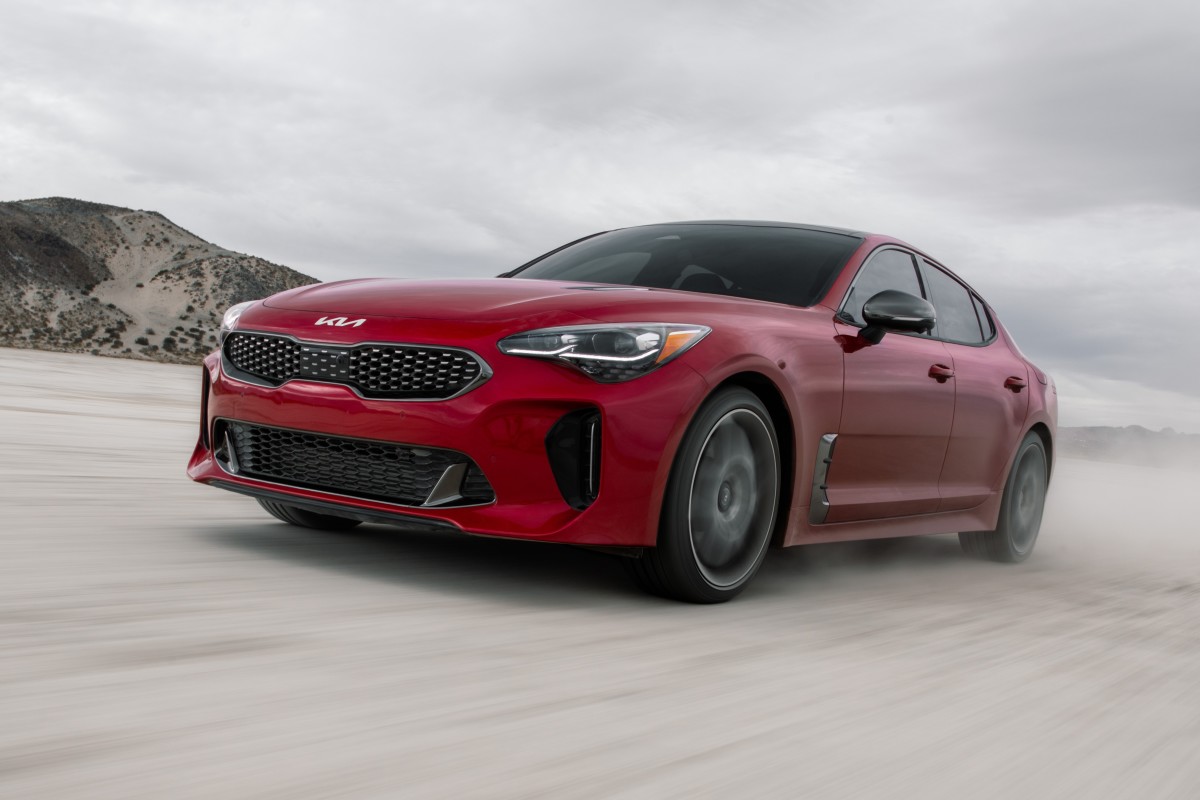
The Kia Stinger was a revolutionary vehicle for the South Korean brand when it was introduced in late 2017 for the 2018 model year. While not a big seller, it helped to change the perception of a manufacturer known more for low prices than as a maker of desirable cars. Although the Kia Stinger has a five-door liftback design, it sits in the premium midsize sport sedan segment. With turbocharged powertrains, sporty handling, and standard rear-wheel drive, it's a viable alternative to pricier German sport sedans such as the BMW 4 Series Gran Coupe and the Audi A5 Sportback as a used buy.
A single model generation was on sale until the 2023 model year, with a mid-lifecycle refresh for the 2022 model year. For those in the market for a handsome, sporty sedan and who don’t need a manual transmission, a used Kia Stinger is a great option. The Stinger has relatively good reliability ratings, especially in its later years, and can be a very good deal as long as any recall work has been carried out.
Our Kia Stinger buying guide looks at how the model evolved over the years and what buyers should look out for.
Kia Stinger Buying Guide: Cost, Reliability, and the Best Years to Buy
Frequently Asked Questions
Which Kia Stinger years are the best?
The Kia Stinger is fairly reliable, but later models are generally a better bet because Kia had worked through a lot of the initial glitches. We think the best year is probably the last, 2023, as JD Power gave it a Quality and Reliability score of 87 out of 100. NHTSA data also shows the 2023 model year only has one recall and five consumer complaints. The 2022 model year is also a great year to buy, with a JD Power score of 82 out of 100, one recall, and only 14 consumer complaints. It might even be the more shrewd purchase, since there are more trim options and prices are lower. It's worth noting that all Stingers have a critical recall affecting the V6 engine due to an oil leak, so check to ensure this has been addressed.
Which Kia Stinger years are the worst?
The Kia Stinger was a completely new car for the brand, so it’s no surprise that there were a few teething problems. There are more recalls and consumer complaints for the first four model years, according to the NHTSA website. The two years that get the worst JD Power Quality and Reliability scores are 2018 (78) and 2021 (73), both of which are pre-refresh models. The 2018 model suffered from a wiring harness recall, brake shudders, and paint issues. The 2018 to 2021 models also suffered from high-pressure fuel pump failures, hydraulic electronic control unit short circuits, and trunk hatch rattling.
Is a used Kia Stinger a good deal?
A used Kia Stinger can be a good deal, especially compared to some of its BMW, Audi, and Genesis competitors. It had steep depreciation in the first model years, so they are comparatively affordable, although they have their issues. The four-cylinder models cost less to run, because they have fewer high-performance components, smaller brakes, cheaper tires, and better fuel economy. Another unexpected expense is insurance, as the Stinger is classified as a performance vehicle rather than a family sedan, so premiums will be higher—especially for younger drivers.
Pros and Cons
Pros:
- Stylish design
- Excellent value for money
- Fun to drive
Cons:
- Advanced safety features are not standard
- Cramped back seat
- Sluggish touchscreen response
Kia Stinger Generations
Kia Stinger First Generation (2018-2023)
The Stinger took aim at German performance vehicles when it arrived in 2017, specifically the Audi A5 and the BMW 4 Series. It was a bold attempt to show that the brand could enter new territory but it was a critical—if not commercial—success. The Stinger was a convincing sports sedan with rear-wheel-drive performance and upscale features that helped Kia break away from its budget reputation. With design input from Peter Schreyer, previously of Audi, and engineering overseen by Albert Biermann, previously of BMW, the Stinger had the looks and drive to compete with its European rivals.
Throughout its lifespan, the Stinger came with turbocharged four-cylinder or V6 engines. At launch, it had a 255-horsepower 2.0-liter inline four-cylinder or a 365-hp 3.3-liter twin-turbo V6. The Stinger had a rear-wheel-drive (RWD) chassis as standard, but all-wheel drive (AWD) was optional with either powertrain. The only available transmission was an eight-speed automatic.
There were initially five trim levels—base, Premium, GT, GT1, and GT2. The base and Premium models were equipped with the 2.0-liter engine, and the GT trims got the V6. Standard features included Apple CarPlay and Android Auto integration, leather seats, front and rear parking sensors, a rear-view camera, and a 7-inch infotainment screen. Available features included LED headlights, adaptive cruise control, an 8-inch infotainment screen, a 15-speaker Harman Kardon audio system, a power-operated sunroof, a head-up display, a surround-view camera system, and high-beam assist. The GT models with the V6 engine came standard with Brembo brakes. The GT1 trim added an adaptive suspension, and the GT2 models included a limited-slip differential and launch control.
From the 2018 to 2021 model years, the Stinger received minor changes to its option packages and trim specifications. A more significant refresh took place for the 2022 model year, when Kia replaced the base 2.0-liter engine with a new 2.5-liter four-cylinder unit. Power increased by 45 hp to 300 hp, while AWD remained an option. The existing V6 got a 3 hp power boost to 368 hp. In addition to the new base engine, other changes included an infotainment upgrade with a standard 10.25-inch screen, additional convenience features, revised LED headlights, a new taillight design, updated wheels, and more standard safety equipment. At this time, trim levels comprised GT-Line, GT1, and GT2. For the final year of the Stinger, there were just two trims: GT-Line and GT2.
A huge point in favor of the Kia Stinger is its strong safety ratings. The National Highway Traffic Safety Administration gave it a top five-star rating from the 2020 model year. The Insurance Institute for Highway Safety similarly gave it Good scores across the board for all model years, and every year except the first one received some kind of Top Safety Pick designation. The 2019, 2022, and 2023 model years got a Top Safety Pick+ designation. However, advanced driver-assistance features often didn't come as standard. Buyers who want them will need to look for the driver-assist package, especially on earlier models, which bundles forward-collision avoidance, adaptive cruise control, lane-keep assist, blind-spot monitors, and rear cross-traffic alert.
The biggest known problem with the Kia Stinger touches every model year and is specific to the V6 engine. These models had a left turbocharger oil feed line failure due to a hose assembly deterioration that caused a leak. There is a recall to replace the left turbocharger oil feed pipe and hose assembly.
Another known issue involves 2018 to 2021 GT models equipped with Brembo brakes. Owners have reported steering wheel shake under braking, brake pedal pulsation, and generally bumpy braking. Another issue to be aware of with these specific model years equipped with the V6 engine is that the ABS unit could cause a fire. This is also covered by a recall. Other known issues include high-pressure fuel pump failures (2018 to 2021), fuel pump jet nozzle blockages (2020 to 2021), various squeaks and rattles (2018 to 2020), and paint quality issues (2018 to 2019).
At the time of writing, CarGurus used pricing data showed that the average price of a used Kia Stinger was about $26,000. The pricing of each model year is a clear reflection of the most desirable years to own, with the pre-refresh models ranging from $20,000 to $25,000. Starting at the 2022 model year, the average transaction price jumps to $29,000. Prices for the final model year averaged about $34,000.
Related Topics