The Edge was Ford’s answer to the crossover SUV boom. Launched for the 2007 model year, it joined the likes of the Hyundai Santa Fe, the Nissan Murano, and the Toyota Highlander by offering the space and ride height of an SUV without the lumbering handling and heavy-duty running costs. It was this generation of vehicles that really repackaged and popularized the format, paving the way for the body style’s current dominance.
The Edge was originally revealed at the 2006 North American International Auto Show and sat between the Escape compact crossover and the Explorer SUV in Ford’s lineup over two generations, the second of which arrived for the 2015 model year, until it bowed out in 2024.
Its mid-market status combined with Ford’s clout meant it sold in serious numbers, and sales only dipped below 100,000 units for four of the 17 full model years it was on sale in the U.S. That means used examples are available in droves and for very reasonable money, with average prices starting at less than $5,000 and topping out around $25,000.
Ford Edge Buying Guide: Cost, Reliability, and the Best Years to Buy
Frequently Asked Questions
Which Ford Edge years are the best?
The newer, the better, according to Carcomplaints.com, on which reported issues tail off after 2017. That makes a strong case for the second-generation Edge, particularly the facelifted 2019-on models. The 2009, 2010, and 2014 models have the fewest complaints of the first generation.
Which Ford Edge years are the worst?
According to Carcomplaints.com, the 2017 model year is the worst, followed by 2013 and 2011—none of which correspond to significant updates. While 2017 models don’t have the most complaints, a coolant leak into a cylinder is a known and expensive problem and can necessitate a replacement engine. The 2013 model year has the highest number of complaints, but they typically relate to lower-level electrical issues, such as a door-ajar warning light that won’t switch off, and 2011 models reportedly have similar issues. We’d also skirt the 2007, 2008, 2015, and 2016 models—the first two years of each generation—which are known for engine and/or transmission issues.
Is a used Ford Edge a good deal?
Steer clear of the problem years, find one in good condition with a good service history, and the Ford Edge is a fantastic deal. Prices were falling at the time of writing, so while it isn’t an appreciating asset, it’s cheap, and the sheer number of the things Ford sold means used examples are readily available. It’s a big manufacturer with a broad dealer network, too, so most buyers won’t be far from a showroom or workshop.
Pros and Cons
Pros:
- Wide range of powertrains
- Impressive passenger and cargo space
- Strong safety ratings
Cons:
- Aging technology
- Thirsty V6 engines
- Outdated design
Ford Edge Generations
Ford Edge Second Generation (2015-2024)
The second-generation Edge traded its predecessor’s soft, blocky looks for styling more befitting of its name—there were actual edges on the body—and the front more closely echoed the Taurus and Explorer of the time. It was built on Ford’s CD4 platform, which was used for the company’s mid-size and full-size cars, grew by 2.4 inches in length, and had a wheelbase an inch longer than its predecessor’s.
That led to a significantly more spacious interior. Head room was up 0.2 inches in the front and a full inch in the rear, shoulder room by 1.4 (front) and 1.7 (rear) inches, hip room by 1.1 (front) and 1.2 (rear) inches, and maximum leg room by 3 inches. Cargo capacity rose by 7.1 cubic feet to 39.2 with the rear seats up and by 3.8 cubic feet to 73.4 with them folded down. In short, it was a lot roomier than before and known for being among the roomier options in the crossover SUV class.
It was available with three engines at launch starting with a 2.0-liter turbocharged EcoBoost with 245 horsepower and 275 pound-feet of torque. There were also two V6 engines—a 3.5-liter Ti-VCT with 280 hp and 250 lb-ft and a 2.7-liter turbocharged EcoBoost version (widely regarded as the one to go for) with 315 hp and 350 lb-ft. Each engine was paired with a six-speed automatic transmission and available in front-wheel drive (FWD) and all-wheel drive (AWD) guises.
EPA fuel economy ratings were as follows: 20mpg city, 30mpg highway, and 24mpg combined for the FWD 2.0-liter EcoBoost and 20/28/23mpg for the AWD version. The 3.5-liter V6 with FWD returned 18/26/21mpg and 17/25/20mpg with AWD, while the FWD 2.7-liter EcoBoost V6 got 18/27/21mpg and 17/24/20mpg with AWD. There was also a FWD-only version of the 2.0-liter EcoBoost model fitted with an automatic stop-start system, which returned 21/30/24mpg.
Three trim levels were available at launch, starting with SE, which came with 18-inch alloy wheels, keyless entry, and Ford’s SYNC connectivity system with 4.2-inch screen and aux and USB ports. SEL added a 10-way power-adjustable driver’s seat, an auto-dimming rearview mirror, dual-zone automatic climate control, push-button start, a leather-wrapped steering wheel, SiriusXM satellite radio with a six-month subscription, heated mirrors, LED running lights, and reversing sensors. Titanium added 10-way power-adjustable driver and front passenger sport bucket seats with memory, leather trim, a 12-speaker audio system, ambient lighting, a garage door opener, 19-inch alloy wheels, and a foot-activated hands-free power liftgate (this was heavily promoted by Ford at the time).
A 2019 facelift sharpened the Edge’s styling, ditched the 3.5-liter V6 engine, and added an eight-speed automatic transmission, a series of new driver-assistance features, plus two new trims—Titanium Elite and ST. The former was the plush option and added a front split-view camera that helped drivers to see around corners when inching forward, enhanced park-assist, cooled front seats, and heated rear seats. The latter was the sporty choice, adding a tuned version of the 2.7-liter V6 with 335hp and 390 lb-ft of torque and standard AWD, standard 20-inch alloys and optional 21s, tuned suspension, and ST styling elements.
The 2021 model gained a tablet-style touchscreen with wireless Apple CarPlay and Android Auto and over-the-air updates, and an ST-Line trim based on SEL with ST styling elements.
Every second-generation Ford Edge for which results were available on the National Highway Traffic Safety Administration’s (NHTSA) website had five-star overall ratings (not every model year was published, but many were), and the 2015 model—the first of the second generation—received the Top Safety Pick gong from the Insurance Institute for Highway Safety (IIHS).
The 2015 and 2016 model years had the most reported issues on Carcomplaints.com, many relating to engine problems, while 2017 models are known for coolant leaks into an engine cylinder, which can be very expensive to fix and potentially necessitate a replacement engine.
The number of reported issues drops off after that, so those with the budget for a 2018 or later model (the average CarGurus price for that year was around $13,300 at the time of writing) should start there—even better if funds stretch to around $15,000 for a 2019 facelift model. The earliest 2015 second-generation cars averaged about $10,200 at the time of writing, while the youngest 2024 examples cost around $25,500.
Ford Edge First Generation (2007–2014)
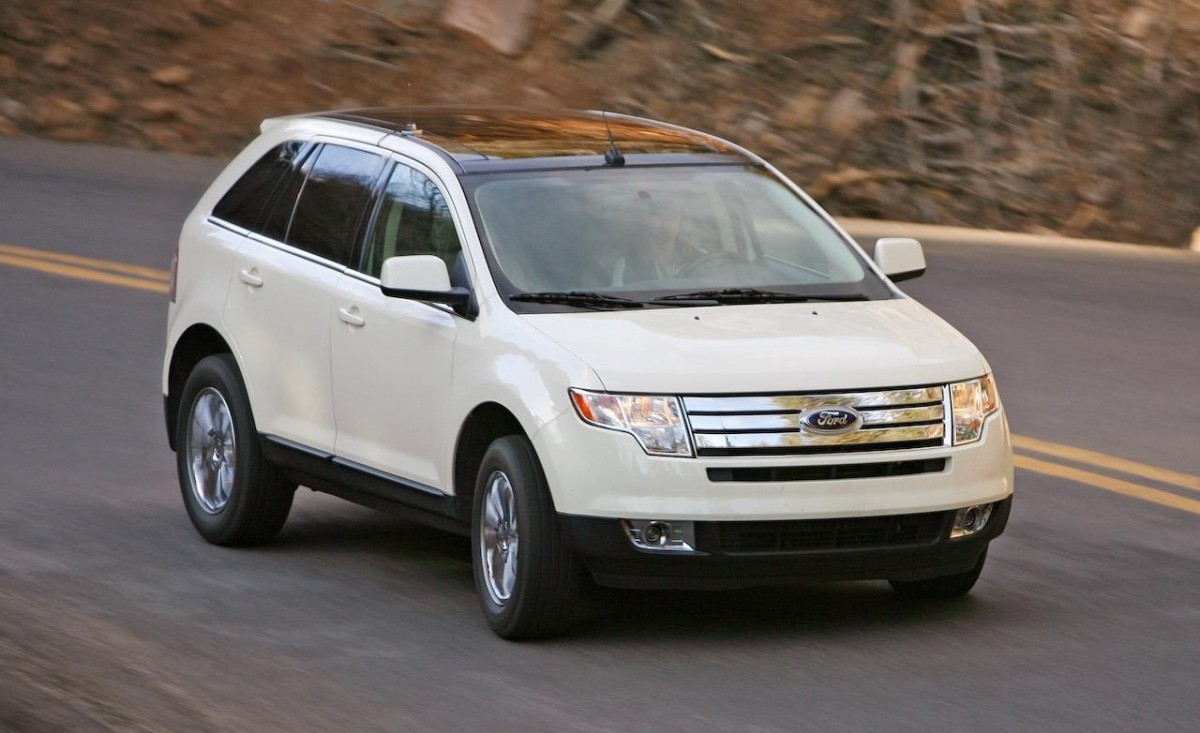
The original Edge was Ford’s offering in the then-nascent crossover SUV segment and primed to cash-in on intense growth. Its round, chunky looks and happy medium footprint between a car and a full-size SUV ticked a lot of boxes for a lot of buyers, who flocked to the vehicles of this size and shape in their droves.
It was available with just one engine at launch—a 3.5-liter V6 with 265 hp and 250 lb-ft for torque paired with a six-speed automatic transmission and FWD (AWD was optional). FWD models returned 18 mpg city and 25 mpg highway and AWD versions 17 mpg city and 24 mpg highway.
There were three trim levels at launch, starting with SE, which included 17-inch alloy wheels, power mirrors, keyless entry, and a CD stereo with MP3 capability. SEL added body-colored exterior trim, an in-dash six-CD stereo with steering-wheel-mounted controls, a leather-wrapped steering wheel and gear shift knob, a six-way power-adjustable driver’s seat, automatic headlights, an auto-dimming rearview mirror, and a driver’s side keyless entry keypad. SEL Plus (known as Limited from 2008) essentially combined two packages—Premium and Seating flexibility—adding leather trim, heated front memory seats, heated mirrors, dual-zone automatic climate control, a six-way power folding front passenger seat, and Ford’s EasyFold rear seatback release, which could collapse the rear seats at the touch of a button.
A facelifted version arrived for the 2011 model year, maintaining the chunky body but sharpening the front end. It also heralded a more powerful and economical version of the 3.5-liter V6 engine with 285 hp (up 20 hp) and 253 lb-ft (up 3 lb-ft) and up to 19 mpg city/27 highway/22 combined mpg for front-wheel drive models with the new SelectShift six-speed automatic transmission (the standard six-speed remained available). A flagship 3.7-liter V6 also joined the lineup, offering 305 hp, 280 lb-ft and 18/25/20 mpg with FWD and 17/23/19 mpg with AWD.
The 2011 model was the first of the manufacturer’s vehicles with the MyFord Touch or Ford Sync 2 infotainment system, with what was, at the time, a large 8-inch LCD touchscreen and a pair of 4.2-inch screens flanking the speedometer.
It veered towards economy for 2012, when Ford added a 2.0-liter inline-four turbocharged EcoBoost engine. Producing 240 hp and 270 lb-ft and exclusively available in FWD guise, it returned 21/30/24 mpg, according to the EPA.
The Edge carved out a solid reputation for safety from the off, as the 2007 model received a Top Safety Pick Plus award from the IIHS—an honor the first-generation maintained in each model year except 2010 and 2014.
The 2007 and 2008 models are known for transmission problems, according to Carcomplaints.com, with brake and engine issues also figuring highly. The number of reports tails off significantly for 2009 and 2010, then surges for 2011, 2012, and 2013 vehicles, but these are generally for lower-level electrical issues, chiefly a door-ajar warning light that won’t switch off.
Average prices on CarGurus at the time of writing ranged from around £4,500 for a 2007 Edge to about £8,500 for a 2014 model, so most buyers can afford to be choosy.
Related Topics