BMW X6 Third Generation (2020-Present)
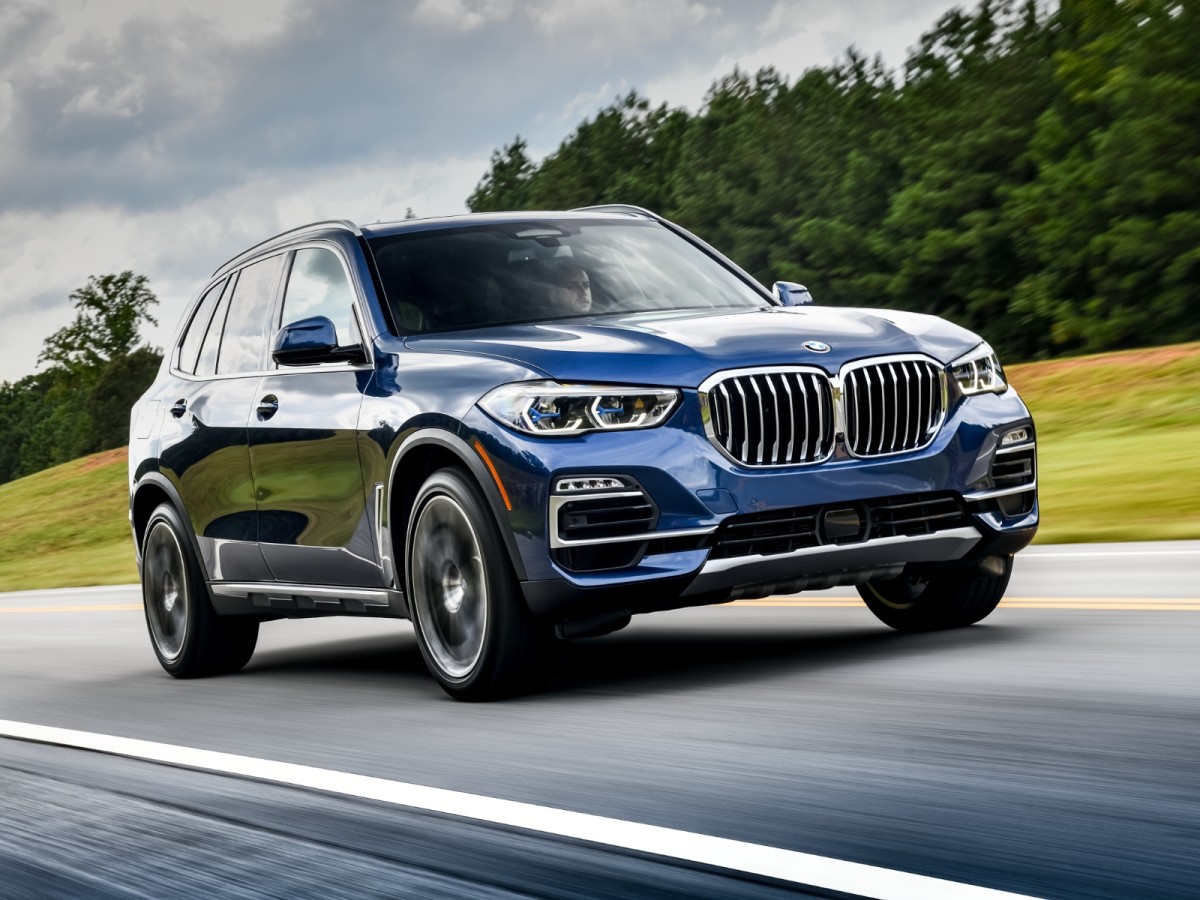
The latest X6 was most like the original in terms of a lowered stance, a hyper-aggressive body kit, huge wheels, and a sleeker roofline versus the comparatively tepid look of the second generation. It was an inch longer, about a half-inch wider, nearly an inch lower, and the wheelbase was stretched by nearly two inches. Thinner, wider taillights, a tall black lower section of the rear bumper, enlarged fender flares, and a wider front grille with optional backlighting were notable upgrades.
A new single-turbo 3.0-liter inline-six now made 335 horsepower and 330 pound-feet on the sDrive40i and xDrive40i (the "s" denoting rear-wheel drive and the "x" all-wheel drive). The M50i used a heavily revised version of the 4.4-liter twin-turbo V8, now with 523 hp and 553 lb-ft. A sport exhaust was made standard on this trim and optional on the M Sport Package on six-cylinder trims. An eight-speed automatic routed power on all trims. The torque-vectoring rear differential (renamed as M Sport Differential) was standard on the M50i and optional on the xDrive40i. Adaptive dampers were standard and the Dynamic Handling Package, which still came with active anti-roll bars, now included rear-wheel steering.
Four-corner air suspension, formerly just on the rear axle, was a new option on the all-wheel drive trims. On the xDrive40i, it was paired with a new Off-Road Package that could raise the car by 1.6 inches. While 20-inch wheels were standard on all trims, the M50i came with optional 21- or 22-inch wheels. Fuel economy was EPA-estimated at 20 mpg city, 26 mpg highway, and 22 mpg combined for the xDrive40i (the sDrive40i was rated at one mpg greater in the city and combined cycles). The M50i was rated at 16 mpg city, 22 mpg highway, and 18 mpg combined. Towing capacity was greatly increased to 7,200 pounds. Cargo capacity also rose to 27.4 cubic feet and 59.6 cubic feet.
Standard equipment included a panoramic moonroof, a proximity key, two 12.3-inch displays running iDrive 7, navigation, adaptive LED headlights, blind-spot monitors, forward emergency braking, lane-departure warning, a sports leather steering wheel, and heated front seats. The M50i added the M Sport differential, larger brakes, a sports exhaust, multi-contour seats, four-zone climate control, SiriusXM satellite radio, a Harman Kardon stereo, Wi-Fi, and wireless charging. New interior amenities included glass controls for the infotainment and other switches, night vision, a leather dash, Bowers & Wilkins surround sound, acoustic-laminated glass, rear heated seats, and remote engine start, among many others. Gesture Control, which could sense a pointed finger or hand waves, was another option for the iDrive infotainment system. Base prices ranged from $64,300 to $85,650 before destination.
Android Auto became standard for 2021, six-cylinder models added a mild hybrid setup, and certain options such as night vision were removed. The M50i added remote start and ventilated front seats as standard. The sDrive40i was discontinued for 2022 and there were no major changes for 2023. The 2024 X6 received a refresh with updated lighting with sequential turn signals, new fascias and bumpers, new wheels, more power for the xDrive40i (375 hp), and an optional Highway Assistant for hands-free driving. The M50i was renamed the M60i. A larger, single curved display was introduced with upgraded software and the removal of many physical controls. Updates to smartphone apps, navigation, digital keys, and the Highway Assistant were made for 2025. There were no significant changes for 2026 or 2027.
At the time of writing, the 2027 X6 xDrive40i started at $77,300 and the 2027 X6 M60i at $98,000. Average list prices for this generation ranged from $38,800 for a 2020 X6 to $77,700 for a 2026 model.
BMW X6 Second Generation (2015-2019)
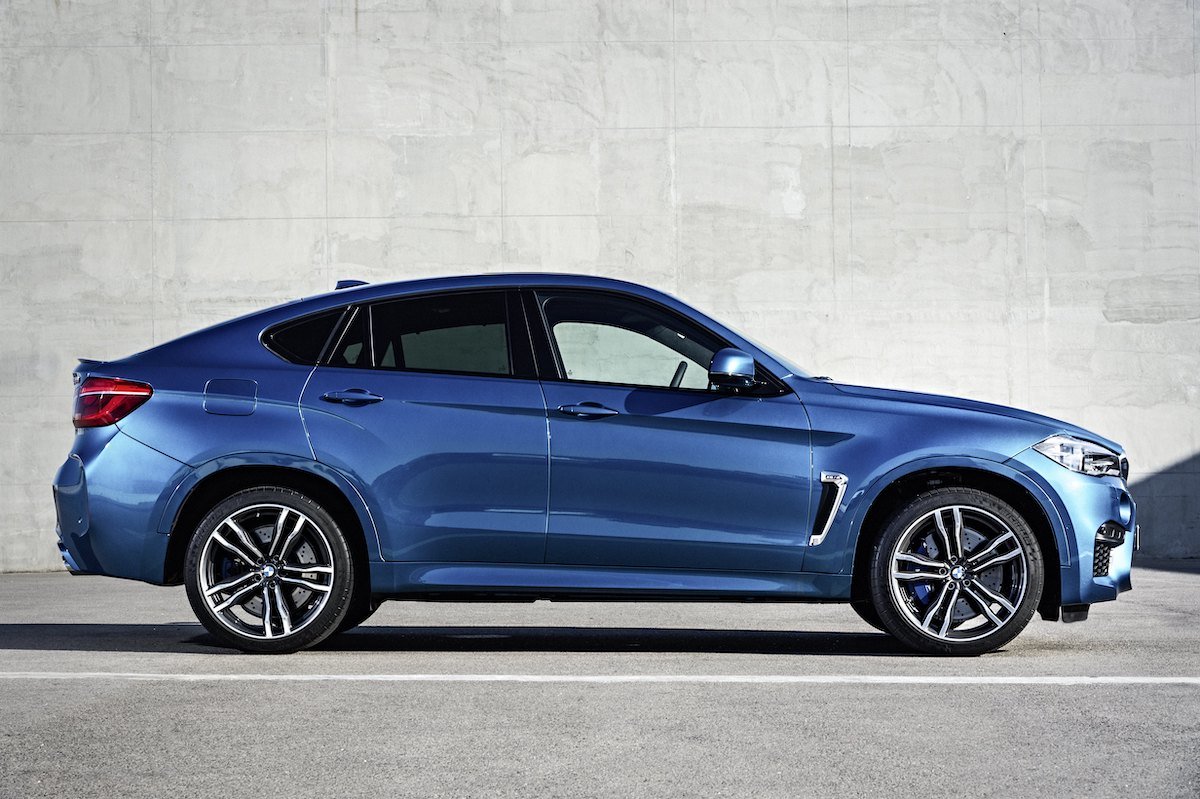
The X6 gained a fifth seat in its second generation, even though its identical wheelbase meant there was no more room in the back. At nearly two inches longer, this X6 helped spawn the X4—a coupe version of the compact X3—and the 6 Series Gran Turismo—an SUV version of the 5 Series, which was effectively a lowered X6. Also at this time, BMW sold a 3 Series Gran Turismo, which raised the roof like the 6 Series Gran Turismo, while building the 4 Series Gran Coupe—a sleeker version of the 3. The X6 was the source of all these intermingling body styles.
The interior received a larger 10.2-inch touchscreen, a new gear selector that was the start of ever more confusing gear selectors in the auto industry, and more color choices such as Ivory White and Cognac. The core design of the cabin and the exterior were largely unchanged, but there were two exterior design packages—xLine and M Sport—which changed the wheels, the front fascia, the side skirts, and the rear fascia. The engines were carryovers, including the 3.0-liter twin-turbo inline-six in the xDrive35i making 300 hp and 300 lb-ft of torque, and the xDrive50i's 4.4-liter twin-turbo V8, uprated to 445 hp and 480 lb-ft. Rear-wheel drive was now offered on the six-cylinder trim, called sDrive35i. The torque-vectoring rear differential, known as Dynamic Performance Control, was no longer standard; it became optional on the Dynamic Handling Package, which included active anti-roll bars and a rear air suspension. All trims used the same eight-speed automatic transmission as the previous generation.
A new driving mode, Eco Pro, would decouple the engine from the transmission so the car could coast, and would lower the intensity of the climate control and heated seats, while the X6's body was lighter and stronger than the first generation's. Fuel economy was EPA-estimated at 18 mpg city, 26 mpg highway, and 21 mpg combined for the xDrive35i (the sDrive35i added one mpg to each rating). The xDrive50i was rated at 15 mpg city, 22 mpg highway, and 17 mpg combined. Cargo space was reduced from the first generation X6 to 20.5 cubic feet and 53.9 when the rear seats were folded and towing capacity was 6,000 pounds.
Navigation and heated front seats were now standard in addition to leather, 19-inch wheels, a digital instrument panel, sunroof, power tailgate, and xenon headlights. New options included night vision, an improved head-up display with more graphic capabilities, an automated parking function, a surround-view camera system, and safety features such as forward emergency braking and lane-departure warning. Base prices ranged from $60,550 to $73,850.
For 2016, the xDrive50i added the Harman/Kardon stereo, satellite radio, and four-zone climate control as standard. The 2017 X6 gained a touchscreen—a rarity for a German car at this time—with iDrive 5.0. A Wi-Fi hotspot and wireless phone charger were new options. Reshaped exhaust tips on the six-cylinder trims and a rear-view camera were made standard for 2018, while Apple CarPlay was a new option. Apple CarPlay was standard for 2019 along with several safety features that had been optional, including automatic emergency braking and blind-spot monitors.
Average list prices on CarGurus at the time of writing ranged from $16,100 for a 2015 X6 to $25,700 for a 2019 model.
BMW X6 First Generation (2008-2014)
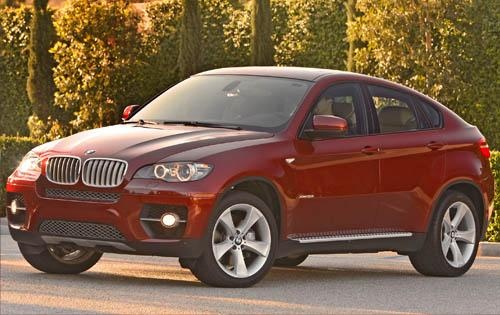
BMW described the first X6 as combining "the sporting elegance of a large BMW Coupe with the powerful presence of a BMW X model". In reality, the X6 was an X5 with a chopped roof and a heavily sloped tail, and looked nothing like a 6-Series coupe of the time. On wide, fat tires with large exhaust tips and air intakes, the X6 looked crazy in 2008, but since Mercedes shocked everyone years earlier with the CLS sedan, the X6 was easier to comprehend, even though it had no direct competitors. Like Mercedes, BMW had made an entirely new vehicle segment; it was a statement piece, and put fashion over function.
The 2008 X6 launched with two trims exclusively with four seats. A small console replaced the middle seat and split the rear two so that they appeared closer in style to the front seats, with thick bolstering and integrated headrests. Compared to the X5, rear headroom was reduced by nearly two inches and cargo space with all seats folded was 59.7 cubic feet—a loss of two cubic feet. Cargo space behind the seats was 25.6 cubic feet. Innovations included a standard torque-vectoring rear differential (Dynamic Performance Control) which, at the time, was only offered by Acura and Mitsubishi; a clutch pack in the axle could route more torque to the outside or inside wheel to tighten cornering or prevent skids. BMW's design, however, could shift torque without any engine power so the vehicle would be stabler whenever the driver lifted off the gas.
BMW was also the first automaker to use FlexRay, a higher-speed computer protocol that allowed for more complex functions in the X6, such as Electronic Damping Control, which introduced active anti-roll bars that used motors to vary their torsion. The V8 introduced a "hot vee" that incorporated the turbochargers and the catalytic converters between the two banks of cylinders for sharper responses and more power. The engines also featured direct injection, which at the time was rare due to its hefty cost (it increased power and efficiency). Other BMW wizardry that was either uncommon or nonexistent in 2008 included a series of smart braking functions, such as automatic pad drying in wet weather, a brake-hold function on uphills, and an anti-fade function that could increase brake pressure in hot conditions. Another feature, Active Steering, could provide countersteering during heavy braking on surfaces with varying levels of grip. With all of these mechanical and electronic feats, the X6 indeed drove with more verve and sportiness than an X5.
The X6 xDrive35i came with a twin-turbo 3.0-liter inline-six rated at 300 hp and 300 lb-ft of torque with all-wheel drive and a six-speed automatic transmission. It started at $53,275 and came standard with 19-inch wheels, run-flat tires, stability control, side and curtain airbags, bi-xenon headlights, dual-zone climate, Bluetooth, a sunroof, 10-way power-adjustable front seats with driver memory, leather, wood trim, adaptive cruise control, front and rear parking sensors, and a 12-speaker stereo with a CD player and aux input. Optional features included a proximity key, soft-close doors, a power tailgate, a head-up display, navigation, HD radio, a satellite radio, a rearview camera, heated/cooled front seats, heated rear seats, and packages that included an iPod/USB adapter, a garage-door opener, and navigation. The X6 xDrive50i came with a 4.4-liter twin-turbo V8 rated at 400 hp and 450 lb-ft. Some features, such as 20-way multicontour sport seats and navigation, were standard, but more or less everything that was optional on the xDrive35i was optional on this trim. Fuel economy was EPA-estimated at 15 mpg city, 20 mpg highway, and 17 mpg combined for the xDrive35i and 13 mpg city, 18 mpg highway, and 15 mpg combined for the xDrive50i.
There were no changes for 2009 other than heated rear seats and the power tailgate now bundled in packages instead of as standalone options. For 2010, HD radio and the power tailgate were standard. An updated iDrive infotainment system came with a new controller and a revised user interface. The 480-hp ActiveHybrid X6 debuted, which we review separately. It used two electric motors and a dual-mode CVT developed jointly with General Motors and Mercedes-Benz. High-beam assist and a top view for the rearview camera were new options. For 2011, BMW upgraded the X6 with an eight-speed automatic and fuel economy improved to 16/23/19 and 14/20/16, respectively.
The ActiveHybrid X6 was discontinued for 2012. Newly standard equipment came on board, including heated front seats, auto-dimming mirrors, and an iPod adapter. A 2013 refresh included restyled front and rear fascias with LED taillights and optional adaptive LED headlights. An M Performance Package boosted power and torque on both trims. There were no major changes for 2014, the last year for this generation.
Average list prices on CarGurus range from $7,000 to $19,000 at the time of writing.
Related Topics