The BMW i8 is a high-tech sports car with futuristic looks and a plug-in hybrid powertrain that was ambitious, had few direct rivals, and was ahead of its time. It’s one of the most distinctive and unusual cars BMW has made in recent years, but while it has plenty of fans, it wasn’t a big seller and wasn’t replaced after six years on sale.
The i8 became one of a handful of plug-in hybrid cars on the market when it went on sale in 2014. Its powertrain combined a 1.5-liter turbocharged three-cylinder engine with two electric motors—one at the front and one at the rear—for a total of 357 horsepower sent to all four wheels. The i8’s high-tech chassis sat below dramatic bodywork made from aluminum and carbon fiber; technically, it was a four-seater, although the rear perches were small. From 2014-2018, the BMW i8 was only offered in coupe form. BMW launched a refreshed i8 in 2019 with a bit more performance and introduced the Roadster with a folding soft top. The upgraded i8 would only be sold for two model years before BMW discontinued the futuristic machine after the 2020 model year.
Although the BMW i8 looked like a bona fide supercar, in reality, it didn't quite have that level of performance. Instead of accelerating like a Ferrari 458 or a Lamborghini Huracan, the i8 was more in line with Chevrolet Corvette and Porsche 911 levels of performance. Prices started at about $135,000 when it was new, but today, shoppers can pick up the earliest used examples for about $40,000, which makes the i8 more attainable than many rivals.
Our buying guide looks at the history and specs of the BMW i8 over the course of its single model generation, with details of what to look out for and the best and worst versions to buy.
BMW i8 Buying Guide: Cost, Reliability, and the Best Years to Buy
Frequently Asked Questions
Which BMW i8 years are the best?
Considering that the BMW i8 sold in low numbers, it’s not surprising that there isn’t much reliability data or that it’s hard to identify a best year. CarComplaints cites exactly zero complaints over the car’s production run. Consumer Reports doesn’t offer any reliability data, and neither does J.D. Power. Fortunately, internet searches turn up surprisingly few woeful tales of major faults or big-ticket repairs from owners. Buyers looking for a car that they won’t likely see anywhere else may want to consider a 2019 or 2020 BMW i8 Roadster, because BMW sold fewer than 4,000 of them during the car’s two-year run.
Which BMW i8 years are the worst?
There isn’t any data to suggest any particular i8 model year is better or worse than another. That said, 2014-2018 i8s were slightly less powerful (though acceleration figures are pretty much the same) and had a shorter electric range than 2019 and 2020 models.
Is a used BMW i8 a good deal?
The BMW has the looks and rarity to match most sports car rivals, if not the performance. Objectively it could be a great deal, since used values are comparatively low and it has the potential to become a collectible future classic. Running costs can be reasonable, too, thanks to the car's hybrid powertrain.
Pros and Cons
Pros:
- Futuristic styling
- Fun to drive
- Good fuel economy
Cons:
- Not as quick as true supercars
- Difficult to get in and out of
- Unimpressive electric range
BMW i8 Generations
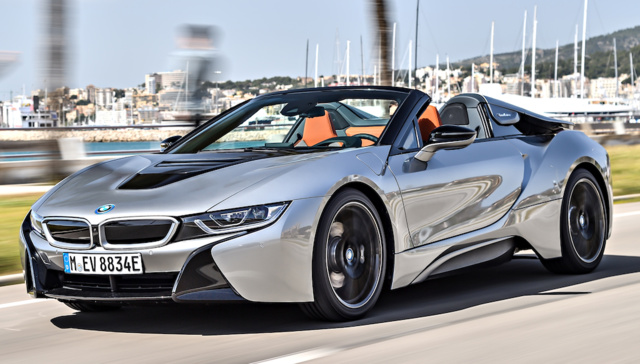
BMW i8 First Generation (2014-2020)
With its concept car looks, advanced construction, and plug-in hybrid powertrain, the BMW i8 was something of a pioneer when it went on sale in 2014 for the 2015 model year. BMW’s decision to build a car that didn’t play by the rules meant it didn’t really have any direct competitors, which gave it a unique presence in the market but limited its appeal.
Much of the i8’s uniqueness is down to its powertrain. Where most rivals at the time featured a V6 or V8 engine, the i8 combined electric power with a gasoline-fueled three-cylinder turbocharged engine related to the engines used in various other BMW and Mini models. Total combined output measured in at 357 hp and 420 pound-feet of torque, but there’s more to the i8’s powertrain story than its three sources of power. The front-mounted electric motor made around 130 hp, channeled solely to the front wheels through a two-speed automatic gearbox. The rear wheels received 228 hp from the gas engine, which was also paired with its own small electric motor, through a separate six-speed automatic transmission. The two electric motors were powered by a 7.1-kWh battery pack nestled in the center of the i8’s lightweight chassis.
At the time of its launch, BMW said the i8 had “the performance attributes of a pure-bred sports car and the fuel consumption of a small city model”. Considering the i8’s performance capabilities, its EPA-estimated fuel mileage rating of 28 mpg combined is quite good. For short trips, the BMW i8 could run on electricity alone, with an EV-only range of 15 miles.
Its environmental credentials extended to the way it was built, too. Its interior leather was tanned using olive leaf extract, and accent strips on the seats and door trim, roof liner, floor mats, body pillar trim, and floor covering were fashioned with recyclable PET combined with 40% virgin wool. Even the car’s key was made from a biopolymer based on castor beans.
BMW incorporated lots of sophisticated engineering into the i8. The coupe’s passenger cell was made from carbon fiber reinforced plastic (CFRP), its upward-swinging doors wore aluminum skin on CFRP frames, its instrument panel was supported by a lightweight magnesium structure, and its chassis was fashioned primarily from aluminum that was either recycled or produced using renewable energy. Even the i8’s glass was advanced, thinner than normal and then chemically hardened.
This advanced structure wasn’t unique just to be different. BMW pointed to its weight-minimizing construction, low center of gravity, and even weight distribution as significant benefits over traditional construction techniques. The BMW i3, which was offered in both fully electric and in range-extended form with a gasoline-fueled generator, used a similarly high-tech design.
All of that technology didn’t come cheap. When the i8 debuted in 2014, it cost a little over $135,000. Though there was only a single i8 trim level, BMW offered three option packages called Giga World, Terra World, and Pure Impulse World, each of which featured different wheels and interior themes.
Adaptive cruise control, a rain sensor with automatic headlight activation, and front and rear parking sensors were standard in the 2014 i8. BMW offered a ConnectedDrive driver assistance package that added high-beam assist, a rear-view camera, a surround-view camera system, speed limit info, and a collision warning system with pedestrian recognition and braking functions. The i8 was never tested for crashworthiness by the Insurance Institute for Highway Safety (IIHS) or National Highway Traffic Safety Administration (NHTSA).
There were no meaningful changes to the i8 for the 2015 model year, but optional laser light technology was added for 2016. The first production car fitted with such lighting technology, the 2016 i8’s laser lights were brighter and more energy-efficient than the standard LED units. A Protronic Red special-edition i8 was launched in 2017 with bright red paint with gray accents, Frozen Gray 20-inch wheels, and black leather interior trim with red contrast stitching. There were no major changes for the 2018 model year.
The biggest change came for the 2019 model year, when BMW introduced an updated i8 range that included the all-new BMW i8 Roadster. The Roadster kept the coupe’s upward-hinged doors but lost its rear seat in favor of an electrically powered foldable soft top that could be raised or lowered in around 15 seconds. A small rear windscreen could be raised or lowered to vary the amount of wind let into the cabin.
Power for all models was bumped from 357 to 369 hp and the pure-electric range went from 15 to 18 miles, thanks to improved battery cell technology (the pack went from 7.1 kWh to 11.6 kWh) and software updates.
In addition to the powertrain upgrades and addition of the Roadster, BMW upgraded the i8 with its iDrive 6.0 software in 2019. The 8.8-inch touchscreen didn’t change, and was still mounted atop the center of the dashboard. As before, Apple CarPlay was supported, but Android Auto was not.
There were no changes for the 2020 model year, which would be the i8’s last in the United States. By the time production came to an end, the car’s MSRP had risen to nearly $150,000 for the coupe and around $165,000 for the Roadster. Over the course of its production run, BMW sold 20,465 i8 models in the United States, with 3,884 of them Roadsters.
At the time of writing, prices for used BMW i8 models ranged from around $40,000 for an early coupe model with less than 100,000 miles on the odometer to nearly $100,000 for low-mileage Roadsters from 2019 or 2020. Solid i8 Coupes with low miles can be found across the United States in the $50,000 range, with well cared-for Roadsters a little above that sum. Considering the car’s uniqueness, performance, comparatively strong efficiency, and its potential to stand out as a future collectible, those asking prices seem reasonable.
Related Topics