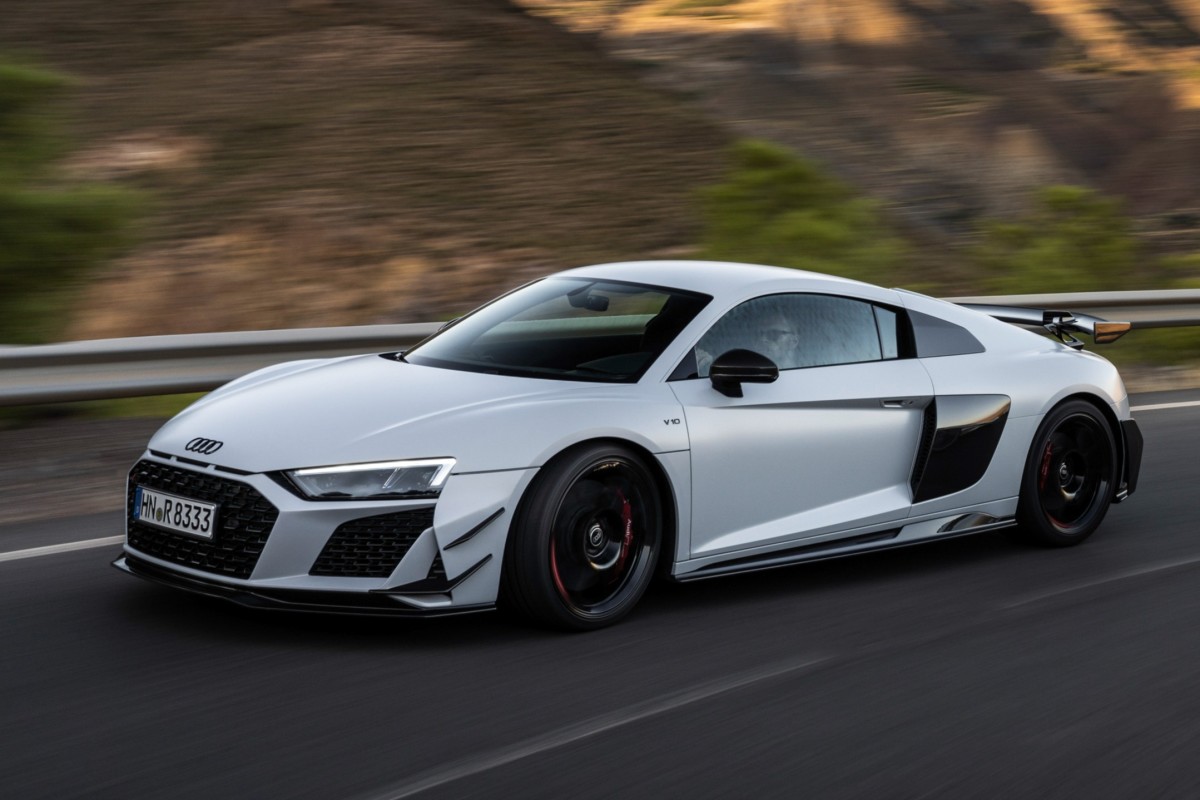
The Audi R8 is a mid-engined sports car unlike anything the brand had made before. While it seemed to come out of nowhere, its existence had much to do with Audi’s ownership of Lamborghini. The Italian supercar brand became part of the Volkswagen Group in 1998, and subsequently a subsidiary of Audi. Those close family ties allowed the German automaker to borrow design and engineering expertise from Lamborghini, and thus the Audi R8 was born.
While the original Audi R8 and Lamborghini Gallardo shared much of their aluminum-intensive structures, they are not the same. Audi gave the R8 a character that mixed the refinement and ease-of-use of its mainstream models with Lamborghini-style performance, to brilliant effect. Initially power came from a 4.2-liter V8 engine, though the R8 would later get a 5.2-liter V10 engine borrowed from its Italian subsidiary, along with racier, more expensive variants. The second-generation R8, which arrived for the 2017 model year and was related to the Lamborghini Huracan, added even stronger performance and more aggressive looks, with V10-only power.
The R8’s comfortable interior, well-engineered drivetrain, and availability through Audi’s dealership network made the German supercar an attainable, mid-engined, exotic machine. No wonder Audi sold 45,949 units over the R8’s 17-year production run from 2008 through 2024. As a used buy, it has serious appeal, offering supercar looks and performance in a car that’s unusually easy to live with.
Our Audi R8 buying guide covers the two model generations available, with everything shoppers need to know about specs, pricing and the best and worst versions to buy.
Audi R8 Buying Guide: Cost, Reliability, and the Best Years to Buy
Frequently Asked Questions
Which Audi R8 years are the best?
Although the Audi R8 was popular for an exotic mid-engined supercar, it’s still comparatively rare, and that means sites such as CarComplaints.com don’t have many reported issues from owners. RepairPal rates the R8 as above average when judged against midsize luxury cars, but again, there likely isn’t much data on which to base those ratings. Which R8 to buy therefore depends more on factors such as cost and options than the model year.
Which Audi R8 years are the worst?
Technically, CarComplaints data shows that the 2008, 2010, and 2014 R8 model years are the “worst,” but each one shows only a single complaint. Buyers looking for an automatic transmission will likely be happier with an R8 built between 2014 and 2024 with the seven-speed dual-clutch instead of the older, single-clutch automated gearbox.
Is a used Audi R8 a good deal?
Yes, a used Audi R8 can be a great deal, although it’s far from cheap. Like the Chevrolet Corvette, the R8 was widely available, came with an excellent warranty, and was sold at prices that were far more attainable than low-slung coupes and convertibles from the likes of Ferrari and Lamborghini. The first-generation Audi R8 with the 4.2-liter V8 and six-speed manual transmission stands out as a head-turner that isn’t so far out of reach that buyers with some disposable income can’t consider it a realistic option. Along with the Corvette and some versions of the Porsche 911, the Audi R8 is a beautiful car with world-class performance credentials that can be driven on a regular basis.
Pros and Cons
Pros:
- Comparatively attainable price point
- Easier to drive than most exotic cars
- Multiple powertrain options
Cons:
- Irritating automatic transmission until 2014
- Not much cargo space
- Advanced safety features not offered
Audi R8 Generations
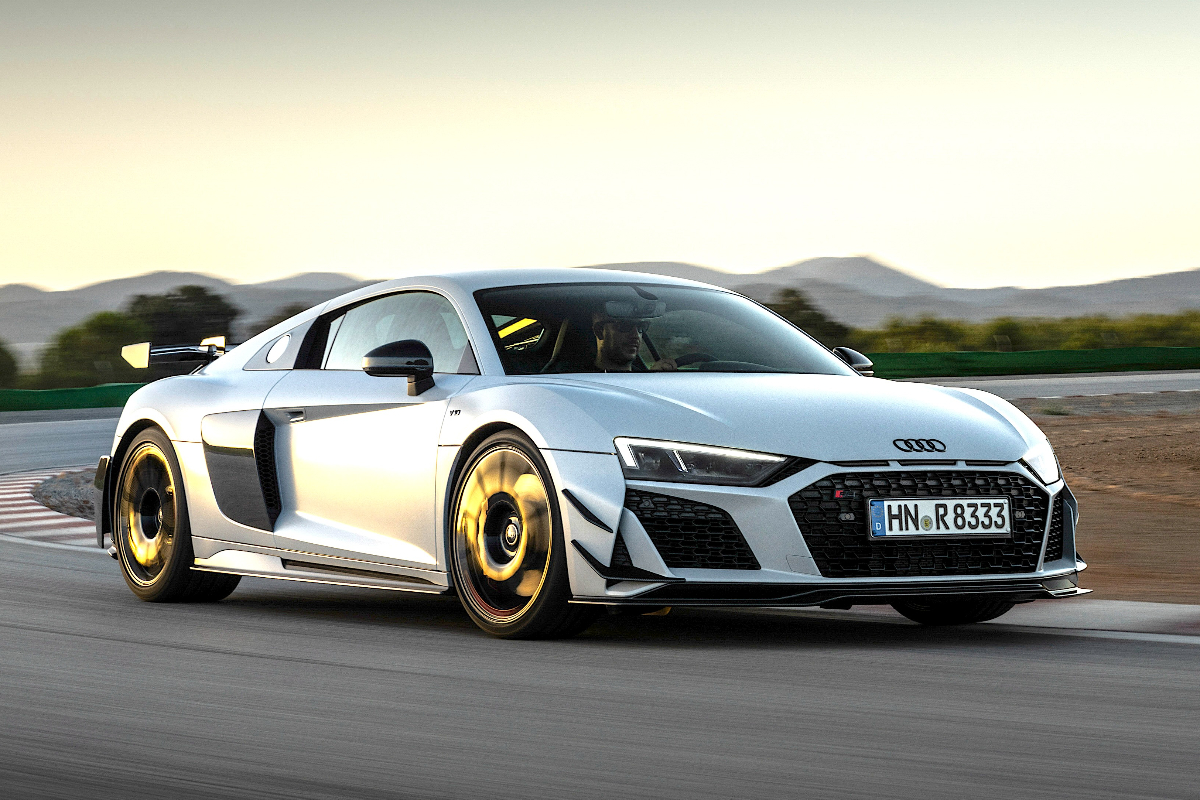
Audi R8 Second Generation (2017–2024)
The second-generation Audi R8 officially launched for the 2017 model year and shared much of its mechanical makeup with the Lamborghini Huracan that replaced the Gallardo. Unlike the first R8, the new model was powered solely by V10 engines and, in a move that riled an enthusiast or two, the only transmission offered was a seven-speed dual-clutch automatic that Audi labeled “S tronic” and that could be controlled by steering wheel-mounted paddles. Fortunately, the dual-clutch transmission was a much better shifting partner than the first-generation R8’s six-speed automated manual gearbox. Audi’s quattro all-wheel-drive (AWD) system was standard in 2017 and was tuned to emulate a rear-wheel-drive feel but had the ability to send up to 100% of the car’s power to the front or rear wheels as needed.
Two V10 engine options were offered in the 2017 Audi R8. In base form, for $165,450, the R8’s 5.2-liter V10 engine produced 540 horsepower and 398 pound-feet of torque, sufficient to push the sleek supercar from 0–60 mph in 3.5 seconds and to a top speed of 199 miles per hour. The 2017 Audi R8 V10 Plus carried an MSRP of $192,450 and had a version of the same engine tuned to deliver 610 hp and 413 lb-ft, resulting in a 0–60 run of 3.2 seconds and a top speed of 205 mph. At the time, the 2017 R8 V10 Plus was the most powerful production car in Audi’s history.
The second-generation R8 featured Comfort, Auto, Dynamic, and Individual drive modes, while the V10 Plus model gained an additional Performance mode with separate programming for wet, dry, and snow. The V10 Plus also benefited from Audi's Magnetic Ride suspension that constantly adjusted firmness according to the road surface.
In addition to the Coupe, Audi introduced a convertible R8 V10 Spyder with a soft top that could be raised or lowered in 20 seconds and at speeds up to 31 miles per hour. The Spyder’s performance figures were slightly lower than the Coupe's, while prices when new were about $12,000 higher.
Both the interior and exterior of the second-generation Audi R8 were refined and sharper than the first generation's. With its short front and rear overhangs, the R8’s mid-engine design was evident, and full LED lighting front and rear added a high-tech look. The first-generation R8’s large sideblades were gone, replaced by a split pair of side-mounted air intakes. Audi’s large front grille opening was still front and center, but was now carved using straight-edge lines. Inside, Audi modernized the 2017 R8’s cabin with a 12.3-inch Virtual Cockpit—a digital screen in front of the driver that replaced traditional gauges.
Audi lowered the horsepower of both V10 engines slightly in 2018—the base version was now rated at 532 hp and the Plus version was rated at 602 hp—but performance figures didn’t change at all. Also new for 2018 was the Audi R8 Rear Wheel Series (RWS), which dropped quattro AWD in favor of rear-wheel drive. It could accelerate from 0–60 in 3.7 seconds and hit a top speed of 199 mph. Audi made a number of changes to the R8 RWS’s steering and chassis settings in order to make it handle neutrally. Just 320 R8 RWS models were imported to the United States in 2018.
The Audi R8 took the 2019 model year off but came back better than ever for 2020 in both Coupe and Spyder forms. Styling was refreshed with sharper edges, aggressive aerodynamic bits that included a front splitter and rear diffuser, and a bump from 19- to 20-inch wheels. Power for the base 2020 R8 V10 was pumped to 562 hp and 406 lb-ft, resulting in a top speed of 201 mph (200 for the Spyder). The R8 V10 Plus was renamed Performance in 2020, and kept its 602-hp V10 engine. The R8 RWS was no longer offered for the 2020 model year, meaning all 2020 R8 models featured quattro AWD.
A special-edition Audi R8 Decennium was created for the 2020 model year to celebrate 10 years of V10 engines in Audi’s supercar. Limited to 50 units in the U.S., the Decennium was painted Mythos Black and featured matte bronze wheels, a bronze-painted intake manifold, and blacked-out exterior elements. Inside, copper-colored stitching and extra badging were added.
For the 2021 model year Audi reintroduced a rear-wheel-drive option, so R8 buyers could go for either the R8 RWD with a 532-hp 5.2-liter V10 engine or the R8 V10 Performance with a 602-hp engine. Both models were offered in both Coupe and Spyder body styles. A new R8 Panther edition, limited to 30 Coupes, was also launched in 2021 with Panther Black crystal-effect paint, carbon exterior mirror housings, matte black 20-inch wheels with red trim, and black interior with Crimson red stitching.
Audi increased the R8 RWD’s power from 532 to 562 hp for 2022 and renamed it the R8 RWD Performance. A Sport Exhaust package with a new Performance mode on the steering wheel and a Dynamic package with ceramic brakes, unique 20-inch wheels, and Racing Shell seats were offered in 2022.
The 2023 model year would be the final one for the R8 in the U.S. and Audi celebrated the supercar’s run with a new GT model that paired the RWD chassis with the high-power 602-hp V10 engine. Audi produced 150 examples split evenly between red, gray, and black exterior colors. With all that power going to the rear wheels, Audi included a Torque Rear mode that allowed extra rear slip for smoky fun at the track. In its final year of production, the 2023 Audi R8 carried an MSRP of $161,395 in base Coupe form or $173,795 for the Spyder. At the top of the range, the GT Coupe, which was only offered in 2023, sold for $253,290.
Although the second-generation R8 is a comparatively young model on the used market, Audi did not equip its supercar with many advanced driver assistance systems. Features such as adaptive cruise control and lane-keep assist were not offered. Contemporary European competitors, such as the Mercedes-AMG GT and the Porsche 911, offered more advanced safety tech, so buyers cross-shopping in the supercar aisle will have to decide if the latest safety gear is important to them.
Buyers interested in a used second-generation Audi R8 should expect to pay at least $120,000 according to CarGurus pricing data at the time of writing. That bags a base V10 Coupe, while Spyder models and V10 Plus trims command a premium. Audi R8s from 2020–2023 are generally the most expensive, with many wearing a price tag of more than $200,000.
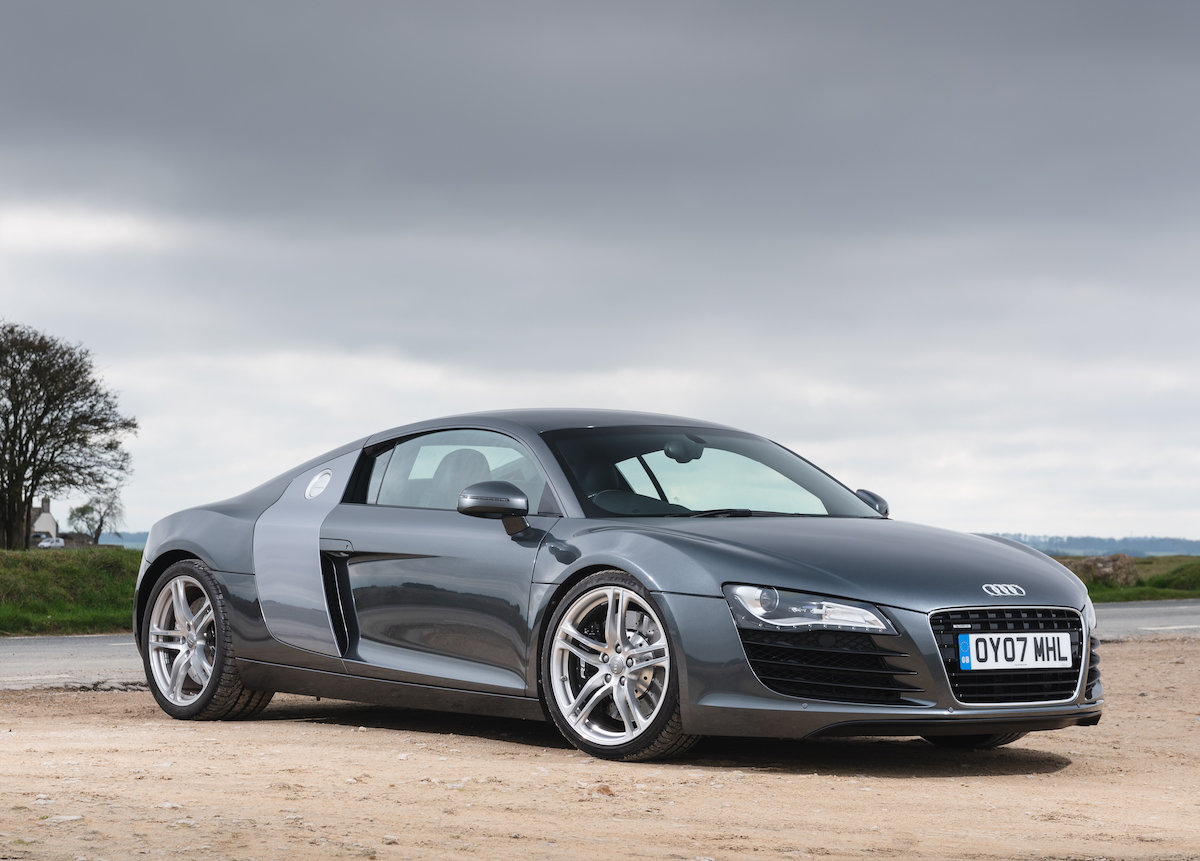
Audi R8 First Generation (2008–2015)
The first-generation Audi R8 was a bolt from the blue for a brand best known at the time for its sedans and wagons. The name was borrowed from Audi’s highly successful endurance racing machine, while the mid-engine layout and aluminum-intensive structure were largely shared with the Lamborghini Gallardo. Its powerplant, at least initially, was a modified version of the 4.2-liter V8 engine found under the hood of the Audi RS4 sedan.
The R8 stood out as an instantly desirable sporting machine, with its low stance, distinctive sideblades, and muscular shape. The 420 hp and 317 lb-ft of torque made by the V8 engine were channeled through either a traditional six-speed manual or an optional automated gearbox to all four wheels through a quattro AWD system, while a high-tech adaptive suspension system with magnetorheological dampers gave it great poise.
Audi positioned the R8 as a high-performance two-seater that was comfortable enough to drive every day. Even at its starting price of around $110,000, the very first Audi R8 was a relative bargain compared to other mid-engine exotics from European automakers. The only thing that let it down for daily driving was the “R tronic” automated manual gearbox that could be hesitant or jerky.
For 2010, Audi expanded the R8 lineup with the addition of the 5.2 quattro model and its V10 engine, which generated 525 hp and 391 lb-ft of torque. Like the V8 version, the V10 model offered six-speed manual or automated transmission options. In addition to the new V10 engine, Audi also debuted the R8 Spyder for the 2010 model year with a soft top that could be raised or lowered electronically from inside the cabin. For 2011, power from the standard 4.2-liter V8 engine was increased by 10 hp to 430 hp.
Audi introduced a new R8 GT in 2012 with a 560-hp version of the 5.2-liter V10 engine, lightweight components such as a thinner windshield, a carbon-fiber engine cover, single-piece seats, and an adjustable coilover suspension. Only 90 GT units were produced in 2012, each at a significantly higher sum than the standard V8 or V10 R8 models.
Audi skipped the 2013 model year and released a facelifted R8 for 2014. Though the styling was slightly revised, the biggest news for 2014 was a new dual-clutch S tronic transmission that replaced the R tronic automated manual of earlier cars. The standard six-speed manual was still available, and all R8s were equipped with quattro AWD. Three R8 trim levels were offered in 2014, starting with the base R8 V8 in Coupe and Spyder forms, followed by the R8 V10 Coupe and Spyder, and finally a V10 Plus Coupe that pumped power to 550 hp (from 525) and included various weight-saving measures and a stiffer suspension setup.
New V10 Carbon Spyder and V10 Competition Coupe editions debuted for the 2015 model year. The Carbon Spyder used the 550-hp engine from the V10 Plus, while the Competition Coupe pushed output to 570 hp, which was enough for a 0–60 mph run of 3.2 seconds, according to Audi. Carbon fiber sideblades and red brake calipers visually set the Competition Coupe apart from other R8 models.
The 2015 model year would mark the end of first-generation R8 production. At the time, the base R8 V8 sold for around $116,000 with the manual transmission or $125,000 with the seven-speed dual-clutch automatic. The R8 V8 Spyder carried an MSRP of around $130,000 (or around $140,000 with the automatic), while the R8 V10 Plus Coupe with 550 hp started at close to $175,000.
It isn’t hard to find nice Audi R8 Coupe or Spyder models for well under $100,000, with some base models selling for less than $70,000. First-generation Audi R8 models with particularly low mileage or desirable trim levels easily crest the $100,000 mark, but still generally cost less than second-generation R8s.
Related Topics