2027 Volvo EX60 Reviews, Pricing & Specs
Write a review$60,750 to $67,350
Original MSRP
8
of 10
expert review
avg user rating
(0 reviews)
Pros
Standard advanced safety features
Impressive electric range expected on the P12 version
Premium interior materials
Cons
Insufficient cabin storage
Artificial steering feel
Base trim and top powertrain both unavailable to the US at launch
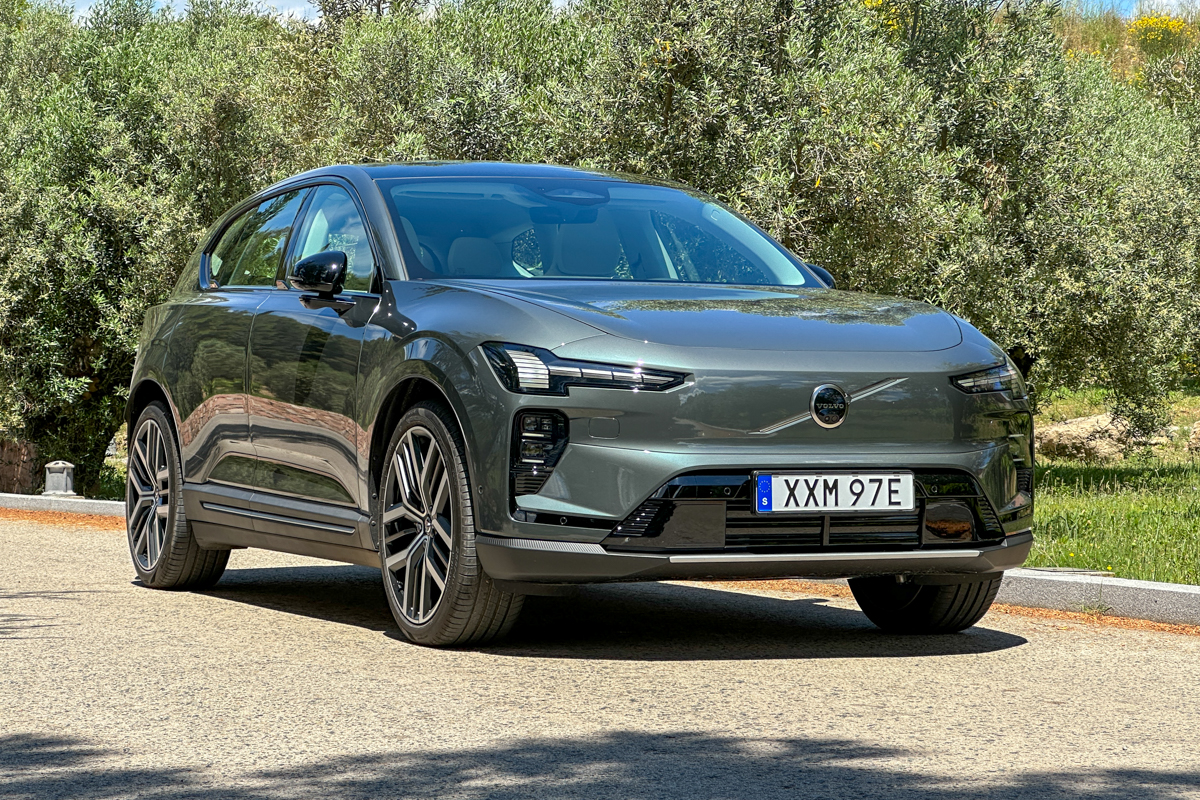
The Volvo EX60 debuts with two trims, two powertrains, and a lot to offer.
In the months leading up to the release of the 2027 Volvo EX60, the automaker’s all-new midsize battery-electric crossover, much has been made of its 400-mile range and coffee-break-equivalent charging time. That promise persists, but it won’t quite be met in the earliest versions to arrive in the United States. Nevertheless, with cutting-edge safety features worthy of Volvo’s legacy, high-end comforts and conveniences worthy of its standards, and a starting price that undercuts our expectations, the EX60 arrives as a genuinely compelling addition to a segment where the competition is really heating up.
Verdict: The EX60 may not be without fault, but its many strengths unquestionably outweigh its few minor misses–in a vacuum. In context, with the superior powertrain and two key rivals still pending, the recommendation is a tougher call. Those who can truly live the old adage that “comparison is the thief of joy” have no reason to wait; this is a comfortable, attractive, and highly livable EV.
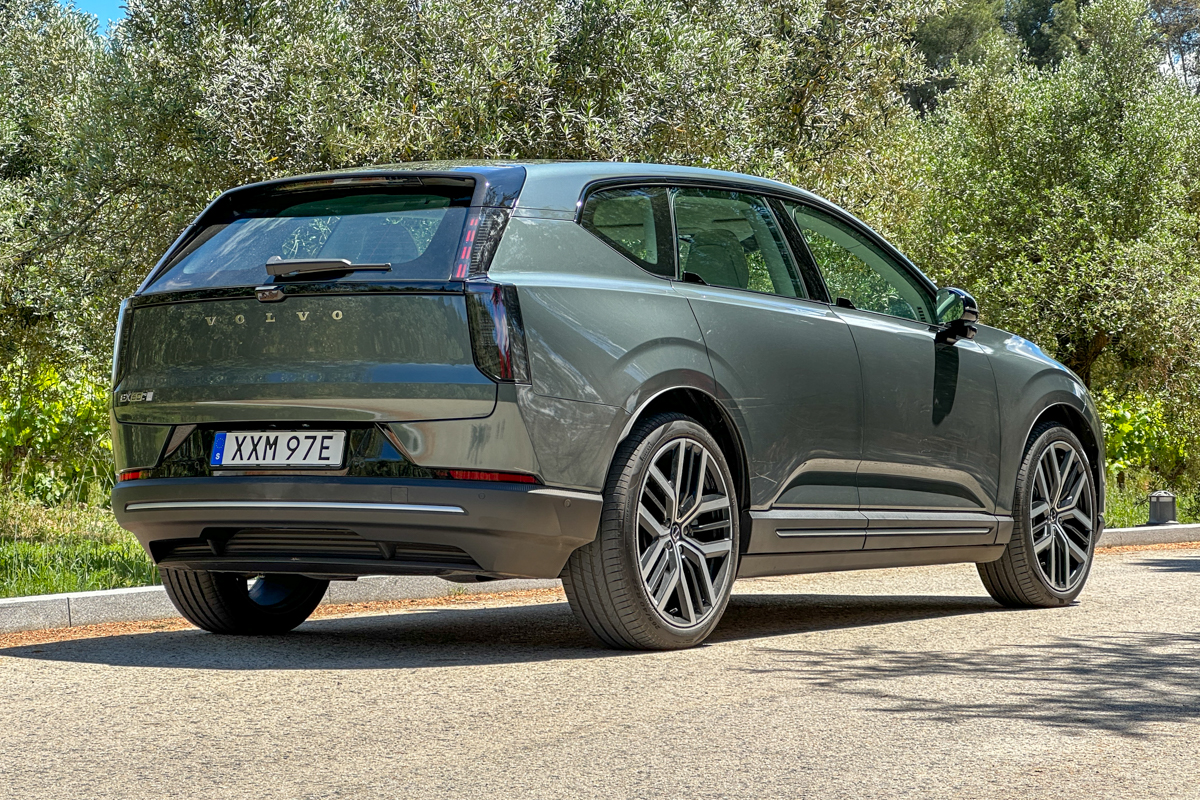
The EX60 slots in between the recently discontinued EX30 and the still-available EX90 in Volvo’s electric SUV lineup, but its exterior design leans in the direction of the larger model, and that’s for the best. The extra length of the EX60 compared to the subcompact EX30 allows the front wheel arch the room it needs to sit naturally rather than being cut off. Like both siblings, the EX60 wears Volvo’s Iron Mark logo set into a smooth, body-colored panel–no grille here. The Plus trim level comes standard with Matrix LED headlights, while the Ultra trim follows the trend toward pixelated, digital-age lighting, albeit still in the style of Volvo’s classic “Thor’s Hammer” headlight design. Wheel sizes start at 20 inches on both, with 21-inch alloys available on Plus and 22-inch on Ultra. The overall look of the EX60 is sleek and subtle, in keeping with Volvo’s quiet-luxury, stealth-wealth aesthetic.
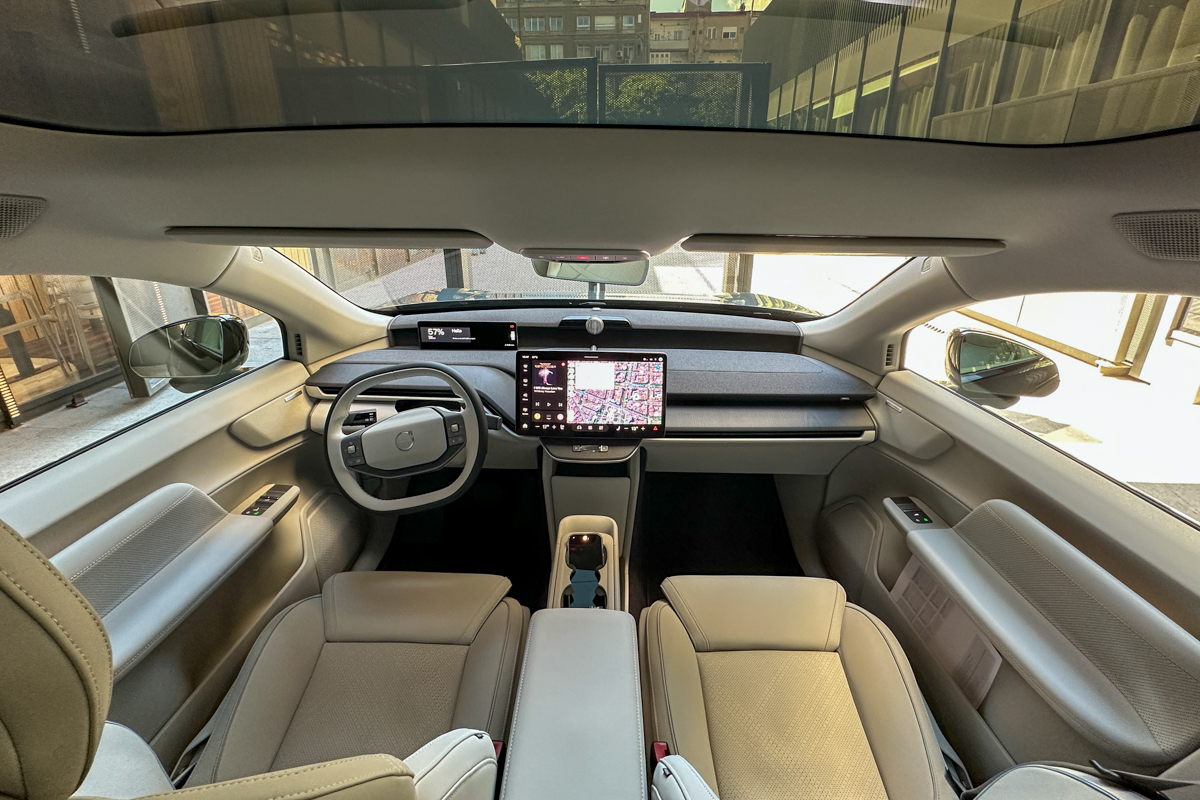
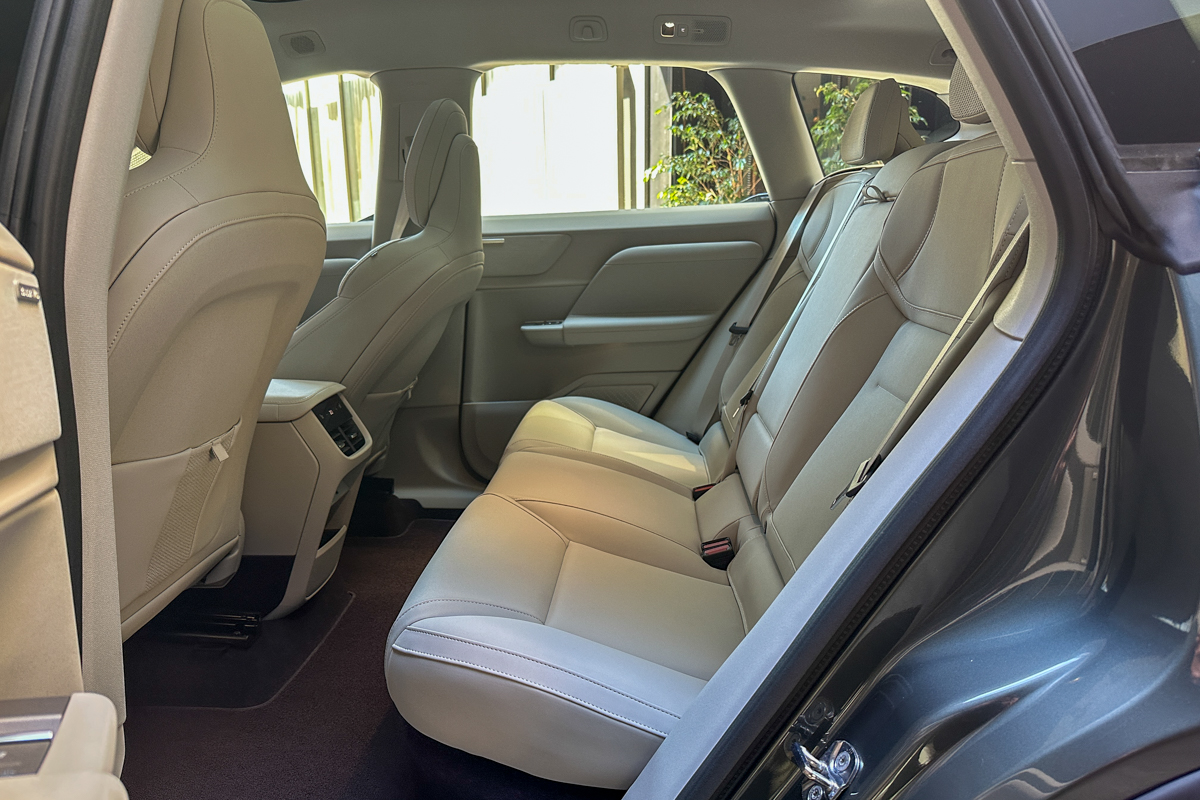
The interior is minimalist in a Scandinavian way, not an ascetic one. It feels deliberate rather than bare, with clean lines, soft materials, and neutral tones. We experienced the Ultra trim in two configurations: the “Rye” gray interior in Tailored Wool blend on the P6, and the “Dawn” colorway in Nordico synthetic leather on the P10. Most elements were sufficiently plush for Volvo’s luxury positioning, and we loved that the traditional Orrefors crystal remains even though the gear shift is now a plastic stalk on the steering wheel. The crystal is incorporated instead as an infotainment control–less of a stunning centerpiece and more of an easter egg, but still present. This treatment also means that it’s not just for the driver anymore. Same is true of the electrochromic glass roof (a $950 option on Plus), which we also loved: It’s not as visible for drivers who sit fairly close to the steering wheel, but it makes sitting in the back seat feel like a privilege. The functional seating features, covered later in this review, bear out initial impressions that the second row is no afterthought in this midsize crossover.
The most-publicized, longest-range version of the Volvo EX60 is yet to come: The all-wheel-drive (AWD) P12 is expected to arrive later in the 2027 calendar year. The two configurations of the Volvo EX60 available at launch are the P6, a rear-wheel-drive (RWD) single-motor variant, and the P10, an AWD dual-motor variant. We drove both in Spain as part of a Volvo press program.
The P6 produces 369 horsepower and 354 pound-feet of torque, and Volvo says it will reach 60 mph in 5.7 seconds—that’s quick for a midsize SUV, and the P10 steps up considerably from there. The two-motor variant makes 503 hp and 524 lb-ft of torque, with a zero-to-60 time of 4.4 seconds. Despite these impressive stats, neither vehicle felt aggressively fast in the way that some performance EVs do. Both have the instant torque that makes driving an EV feel effortless, as if the vehicle is weightless, but the power delivery is appropriate for a family vehicle. Both were plenty brisk without being theatrical about it, making for a controlled and composed driving experience, and the ride was surprisingly comfortable in spite of the large 22-inch wheels.
Our only complaint was steering, which is lighter than we’d like, more so than feels reasonable for a vehicle with this much power on tap. On the P6, you’re stuck with it, but the P10 offers selectable drive modes, several of which sharpen the steering to make it feel more connected and less virtual. This is one of several critical differences between the two powertrains that will significantly impact the ownership experience. In addition to drive modes, the P10 comes with the “Active” chassis in place of the P6’s passive “Touring” chassis. This electronically adjustable suspension is a high-end feature included for just a $2,350 price differential, along with AWD over RWD, a 95-kilowatt-hour battery compared to the P6’s 83 kWh, and 330 miles of range compared to 307. That’s a lot of extra car for a pretty modest step up in price.
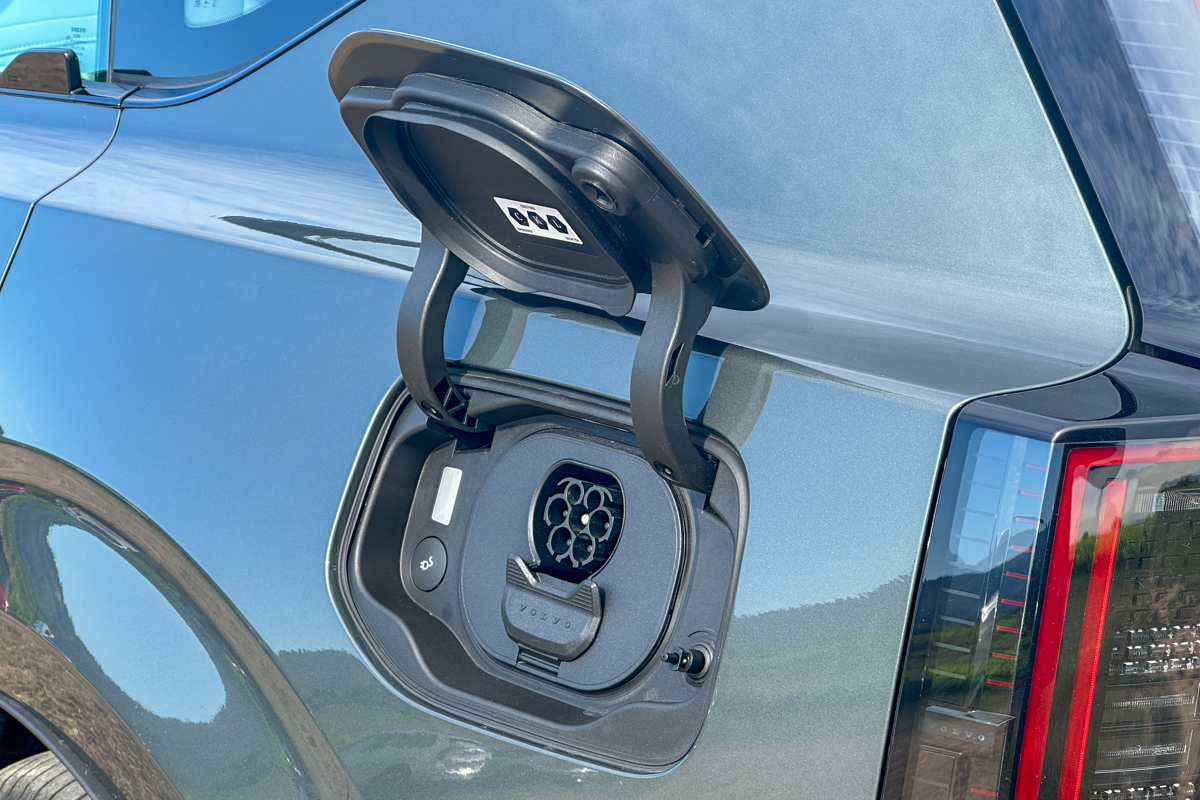
Charging speeds are the same on the two currently available EX60 powertrains: Volvo says both can charge from 10 to 80 percent in approximately 18 minutes on a sufficiently fast charger. We weren’t able to test this on the curated program we attended, but if it holds up in real-world use, it will place the EX60 among the faster-charging vehicles in its class. The upcoming P12 is supposed to require just one extra minute to achieve the same charge on its significantly larger 117-kWh battery, which is what delivers the headlining 400-mile range figure. The EX60 is the first Volvo for the US market to feature a native NACS charging port, giving owners access to Tesla’s Supercharger network of DC fast chargers.
EVs still tend to be treated as the more futuristic options in an automaker’s lineup, and therefore often feature newer technologies. In the EX60’s case, this includes a digital key. We’ve certainly seen this elsewhere–on Hyundai and Kia EVs, for example–but the others we’ve experienced also came with a traditional key fob. For the EX60, the backup is a key card, much like a credit card or a hotel key. Volvo reps allayed our concerns about relying on the phone, assuring us that the car will still open and run even if your phone battery dies. We didn't get a chance to test whether the phone key includes features like flashing the lights or beeping the horn, but the card certainly doesn't have that capability. That’s something we tend to rely on in parking lots, not only for locating the car, but also to signal to nearby drivers that the car’s owner is close and they should park carefully.
Cabin storage is not the EX60’s strongest suit. There is no traditional glove box, just a small covered compartment in the center stack, beneath the wireless charger. The upside of this is that the front passenger gets plenty of knee room. Our main beef with the design is actually not the capacity but the feel: Both the material and the action of the fold-out plastic cover felt cheap and plasticky, not in line with the rest of the experience or with what we expect from Volvo. The same is true of the plastic frame that can slide out from the armrest to convert a central tray into cupholders. It works fine, but it doesn’t feel sturdy when you move it back and forth, and in an otherwise elegant cabin, the contrast is jarring.
These are really the only misses in the EX60’s interior. Front seats are comfortable and highly adjustable, with a single four-way knob to manage adjustments in at least eight different directions. This may sound complicated, but operating it automatically calls up a responsive diagram on the central touchscreen, and we had no trouble figuring out how to fine-tune our seating position.
The screen is actually fundamental to several key driver adjustments, including side mirror and steering wheel positioning. A single joystick-style button on the steering wheel is responsible for adjusting each of these; selecting the relevant item on screen first is what cues it as to which element it should be operating this time. Climate control also lives in the touchscreen, but that’s not because Volvo isn’t listening. The automaker’s answer to shopper demand for physical climate controls was to dedicate screen space solely to them, and it would feel exceptionally nitpicky to refuse to call those persistent icons “buttons.”
Tri-zone automatic climate control is standard on both available trims, as are heated front seats. Heated rear seats and a heated steering wheel are standard on the EX60 Ultra and available on Plus through a reasonably priced $750 Climate Package, which also adds heated wiper blades. Standard seating surfaces are Nordico (Volvo's vegan leather) on the Plus trim or perforated genuine Nappa leather on Ultra. Buyers who prefer Volvo’s tailored Wool Blend can option it on the Ultra trim at no extra cost, though do be aware that it makes the ventilated front seats unavailable. These are a standard Ultra feature, offered on Plus for $850 as part of an upholstery and lumbar upgrade.
Rear outboard seats are also super comfortable, with a slightly scooped out shape to ensconce a passenger, and they have an adjustable recline managed through a control on the door armrest. Two rear USB-C ports are standard on both trims, joining two more up front. Families will want to note that the EX60 offers integrated booster cushions in the two outboard rear seats—standard on Ultra and available on Plus for $500. Volvo reps noted that this resolves a frustrating either/or choice that plagued shoppers considering the XC60, where heated rear seats and boosters are still mutually exclusive.
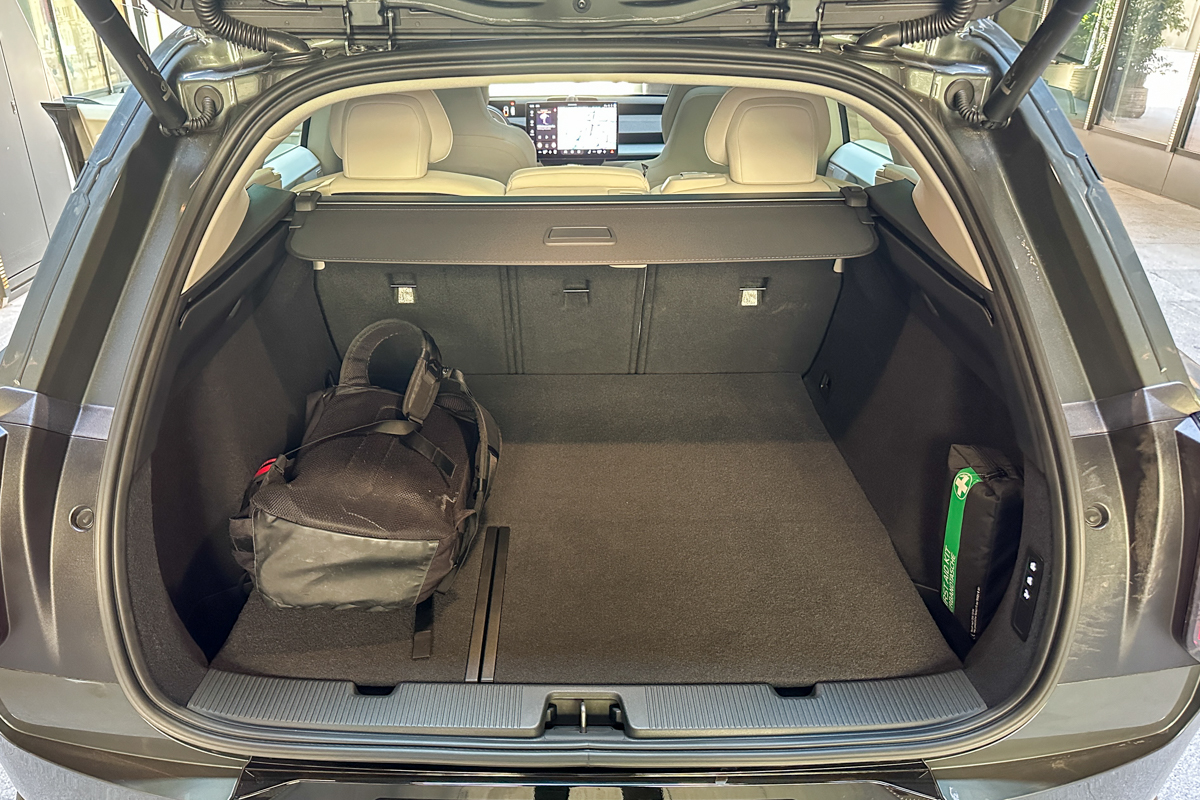
If the EX60’s cabin storage is a little weak, its cargo area is another story entirely. Here, Volvo has incorporated several handy features. The space under the load floor is easily accessed by folding up the cover, which is segmented in a 60/40 split just like the rear seats. A perfectly fitted bucket sits on the 40% side. It’s removable should you need to store something larger, but it also makes an ideal container for dirty shoes after a hike, ice at a camp-out, or the crabs you’ve caught at the beach, which a Volvo rep tells us is a common Swedish children’s activity. This is a family vehicle, after all.
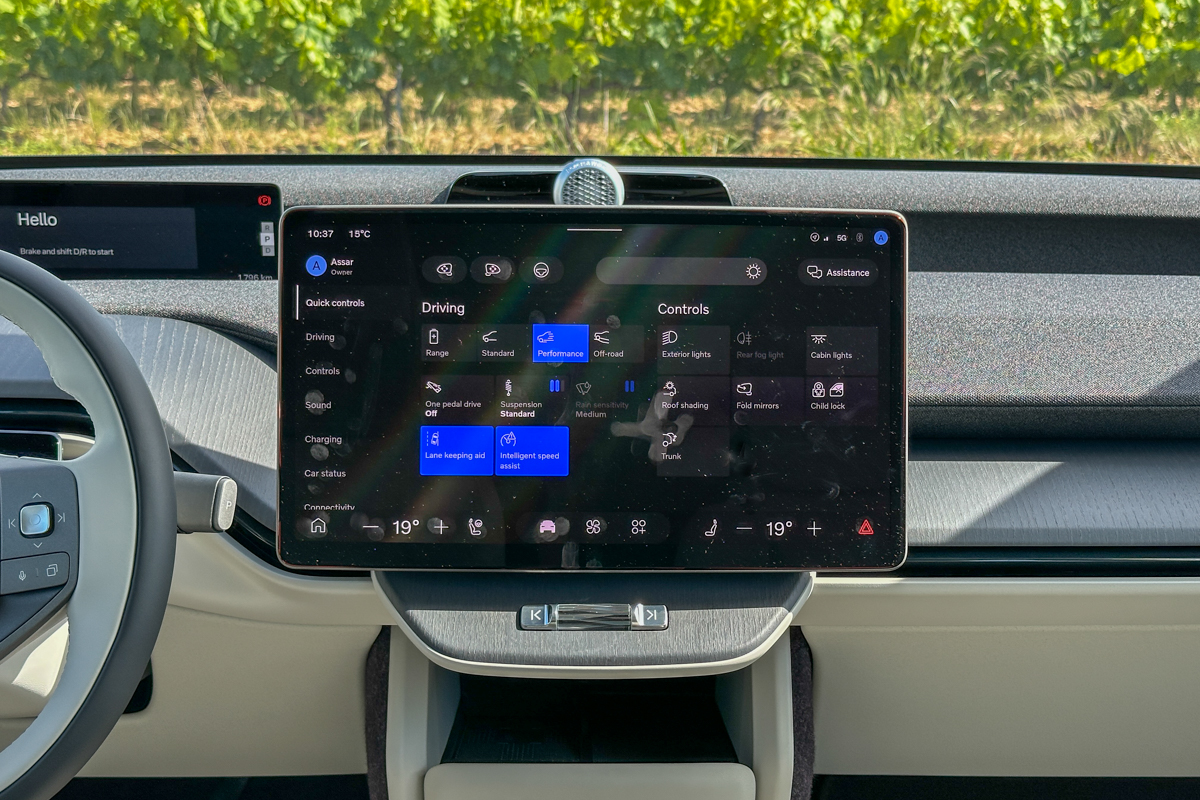
The EX60 has Volvo’s first-ever horizontal infotainment screen, which we thought looked much nicer than the portrait-style version found in the rest of the Volvo lineup (including the EX30 and EX90). The landscape orientation integrates more naturally with the sleek horizontal design elements of the dash. Its layout also allows for the aforementioned dedicated climate controls to stay anchored across the bottom of the screen, while a “context bar” lives along the left side for quick access to high-use functions. The overall experience is user-friendly and responsive, with no lag that we noticed.
A narrow strip of a driver-information display sits closer to the windshield than to the steering wheel. Its position worked well for us, and it achieved Volvo’s stated goal of minimizing our need to look away from the road, but we did find ourselves wondering how well it would work for drivers of different heights. We recommend shoppers dedicate some attention to checking their gauge visibility on a test drive.
In terms of standard and optional features, we can only speak right now to the two trims currently available: Plus and Ultra. Wireless Apple CarPlay and Android Auto are standard on both trims, and both use the same 15-inch OLED infotainment display with Google Built-In. This is an increasingly common feature these days, but the EX60 includes four years of service before it moves to a subscription basis. It also includes Gemini, Google’s conversational AI assistant, another Volvo first.
Gemini is positioned as a more natural, conversational alternative to traditional voice commands. We did not find the experience all that natural when we tested it: Gemini tended to keep talking until we interrupted it, which was uncomfortable, but we can imagine getting used to it. Early adopters will likely find that the system refines itself with time, as it is designed to improve via over-the-air (OTA) updates. "Hey Google" prompts to Google Built-In are a distinct function, entirely separate from Gemini, and these did work both with contextual comments (“Hey Google, it’s too warm in here”) and direct commands (“Hey Google, turn down the temperature”), though it insisted on making climate adjustments one degree at a time.
The EX60 is generally quite tech-forward, and the distinction between Plus and Ultra trims on this front lies primarily in audio. The Plus trim comes with a 21-speaker Bose Premium sound system, certainly a respectable offering, but Ultra gets a 28-speaker Bowers & Wilkins premium sound system, truly a standout feature. It embeds a speaker in the headrests of not only the two front seats but also the two outboard rear seats, and it allows audio to be directed to individual zones. For example, the driver could take a call through just their own headrest, or silence the rear-seat audio so children can sleep undisturbed while adults listen to a podcast up front. The EX60 Ultra also comes with Apple Music pre-installed with Dolby Atmos, delivering spatial audio that pairs well with the Bowers & Wilkins system.
Volvo pioneered the now-ubiquitous three-point seatbelt way back in 1959 and has maintained a strong reputation for safety ever since. In the EX60, the automaker introduces a significant evolution of that essential technology with its new “multi-adaptive safety belt.” In a nutshell, this refers to a seatbelt which is both more granularly adjustable and able to read and adapt to data from sensors both inside and outside the car. While most modern seatbelts have three load limiters, the mechanisms that prevent the belts from being too restrictive or providing too much slack, Volvo’s latest has eleven, and it receives an array of data inputs on the seat occupant’s size and the car’s current movement. This allows it to adjust for the best possible protection in the event of a collision without being uncomfortably or even dangerously tight during everyday driving, and Volvo says the system will learn over time, too.
Standard advanced driver-assistance systems (ADAS) on the 2027 Volvo EX60 Plus and Ultra include a blind-spot information system with interventional steering assist, cross-traffic alert with automatic emergency braking, and a collision-avoidance system. A 360-degree camera system and front, rear, and side parking assist are also standard on both available trims. We noted that Pilot Assist, a system which combines adaptive cruise control with lane-keeping and parking assist, also seemed to find the steering too light. It made frequent adjustments to stay in its lane, more than we felt were strictly necessary. We also noted one incident in which the steering pushed back rather firmly when Pilot Assist was engaged as we were steering toward an off ramp. This unsolicited steering input was not insistent enough that we were in danger of being unable to override it, but it did make the car jerk sideways as we corrected.
Crash-test scores from the National Highway Traffic Safety Administration (NHTSA) and the Insurance Institute for Highway Safety (IIHS) are not available as of this writing because the EX60 has not yet arrived stateside. However, we do know that the larger 2026 Volvo EX90 earned a 2026 Top Safety Pick+ award, the highest possible honor from the IIHS.
In an unusual move, Volvo has positioned the EX60 to cost just slightly less than the Volvo XC60 plug-in hybrid (PHEV). Typically when multiple powertrains are available for a single model, the gas-only will be least expensive, followed by the traditional (plugless) hybrid, the PHEV, and then the EV at top end of the pricing spectrum. The XC60 is unquestionably the EX60’s fossil-fueled analog, so we fully expected its price to land at least a few thousand dollars higher. We were pleasantly surprised by the 2027 EX60 P6 RWD’s base price of $59,795, which includes destination fees. “Base” here refers to the Plus trim, the lowest currently available. The P6 Ultra starts at $66,395, a solid step up which brings an equally substantial list of extra amenities, including Nappa leather, the superior Bowers & Wilkins sound system, the electrochromic panoramic roof, 21-inch wheels, the integrated rear booster seats, and heated rear seats, wiper blades, and steering wheel. For those who don’t need every one of those extras–and who will be satisfied with 21 Bose speakers–most are available as standalone options, as mentioned earlier in this review.
The AWD P10 powertrain, with its larger battery, active suspension, and customizable drive settings, adds just $2,350 compared to the P6 at either trim level, bringing the P10 AWD Plus to $62,145 and the P10 AWD Ultra to $68,745, both with destination. Both the P6 and the P10 are due to US customers in late summer of 2026. Pricing information is not yet available for the P12, which is expected closer to the end of this year.
Volvo’s timing with the EX60 seems well-judged, as its most obvious competitors are slated to arrive at nearly the same moment. The BMW iX3, also due this summer, starts at $62,850 and will put its best foot forward with the 400-mile-range version debuting first and the cheaper, single-motor version to follow. This puts the EX60 at risk of losing shoppers who prioritize maximum range and don’t want to wait to find out what that will cost or when it will be attainable on the Volvo. The 2027 Mercedes-Benz GLC EV is expected to arrive later in 2026 with similar range figures and pricing anticipated to start around $60,000, though official figures have not been confirmed as of this writing. Neither has been available for a direct comparison drive, but from what we know of current BMW and Mercedes EVs, we would bet that the iX3 will offer a fairly similar cabin experience to the EX60, while the GLC EV will likely lean into screens, quilting, and ambient lighting. To anyone drawn to Volvo’s signature blend of luxe simplicity and advanced safety, we have no hesitation in recommending the EX60, though we confess we’d hold off on spending our own dollars until we could compare the EX60 P12 against the iX3.
Finally, we would be remiss if we did not mention an exciting value add: Built in Torslanda, Sweden, the EX60 is the first EV to be offered with Volvo’s overseas delivery option. This selection includes two premium economy airline tickets and comes at no extra cost, making it a no-brainer for new-car shoppers who are able to take a few days for a trip and a rare experience.

User reviews for 2027 Volvo EX60
Write a review2027 Volvo EX60 Pricing
Trims & specs
Airbags
Dual front airbags · Driver knee airbags · Passenger airbag deactivation: occupant sensing deactivation · Front side airbags · Front side curtain airbags
Engine
EV battery capacity: 95 kWh · Electric Motor HP: 503 · Electric Motor Power Output (Kilowatts): 375 · Electric Motor Torque: 524
Airbags
Dual front airbags · Driver knee airbags · Passenger airbag deactivation: occupant sensing deactivation · Front side airbags · Rear side curtain airbags
Engine
EV battery capacity: 95 kWh · Electric Motor HP: 503 · Electric Motor Power Output (Kilowatts): 375 · Electric Motor Torque: 524

