2027 Mercedes-Benz GLC EV Reviews, Pricing & Specs

Pros & cons
What we like
Competitive range and charging performance
Comfortable
Standard all-wheel drive
What to consider
Potentially polarizing design
Excessive tech features
Poor value for money
Expert review
Mercedes’ compact crossover SUV goes electric for its next generation.
The Mercedes-Benz GLC is the automaker’s entry into the luxury car market’s most popular segment, competing against the Acura RDX, the Audi Q5, the BMW X3, the Genesis GV70, the Lexus NX, and the Volvo XC60, but it's been redesigned as an EV for the 2027 model year. The all-new electric GLC represents the model’s third generation, and the previous gasoline versions (covered separately) will continue to be sold alongside it for the time being.
Verdict: The GLC is a good EV, but its questionable styling and lack of standard equipment make it hard to love.
out of 10 expert review
Look & feel
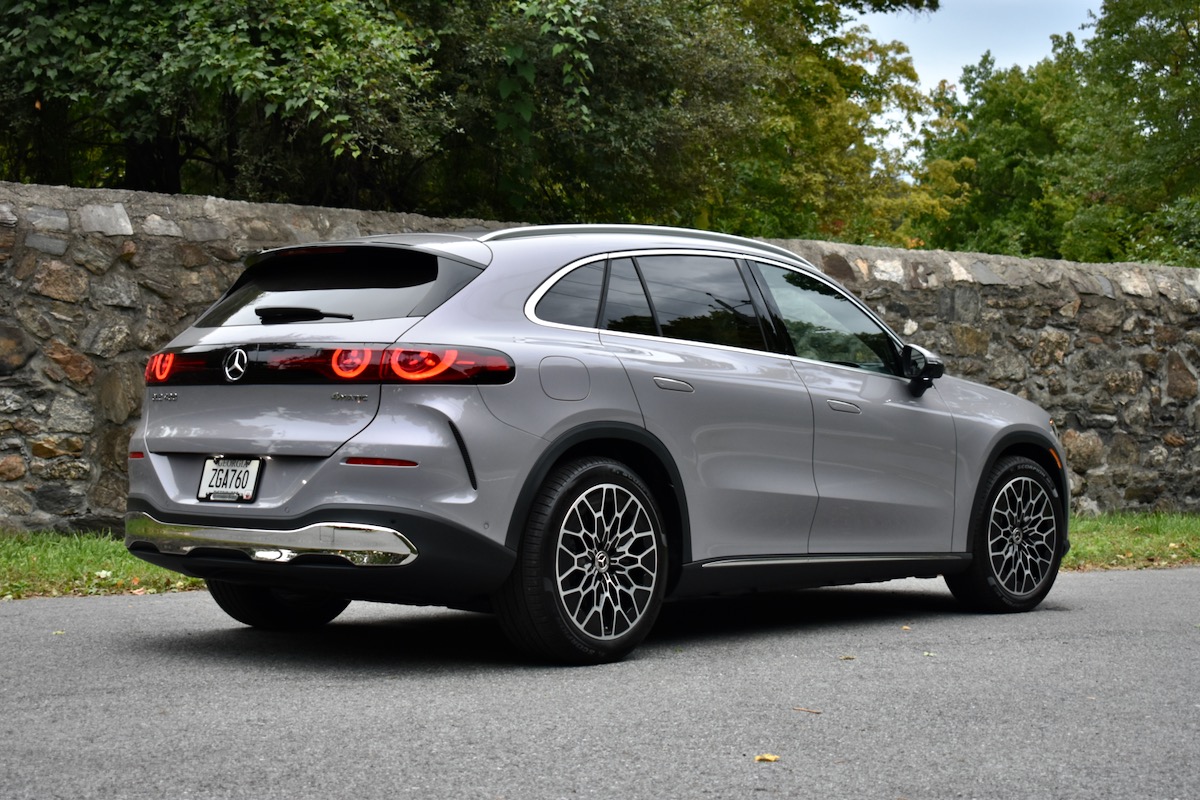
It may share a name with the familiar gasoline GLC models, but the GLC EV is based on a completely different architecture and wrapped in totally different styling. The most noticeable element is the massive grille, which looks like a tacked-on afterthought, and it's (optionally) illuminated, which admittedly looks pretty cool at night but also feels a bit gimmicky.
The backup dancers for this light show are headlights and taillights shaped like Mercedes’ three-pointed star logo. Mercedes is doing this throughout its lineup, because the giant badges in the grilles of most of its existing models apparently weren’t enough. The lighting is set in a body that has more definition than the lozenge-like EQE and EQS SUVs but still gives the GLC EV more the appearance of a station wagon than a true SUV. Flush-fitting door handles help lower aerodynamic drag.
Badged as the GLC 400 4Matic Electric, this EV is available in base, Exclusive, Pinnacle, and Pinnacle Plus trim levels (this review is based on a Pinnacle model). It comes standard with 20-inch wheels and 21s are available, along with multiple exterior design packages. Buyers can go sporty with the AMG Line Package, opt for blackout trim with the Night Package, or combine the two with the AMG Line Plus with the Night Package.
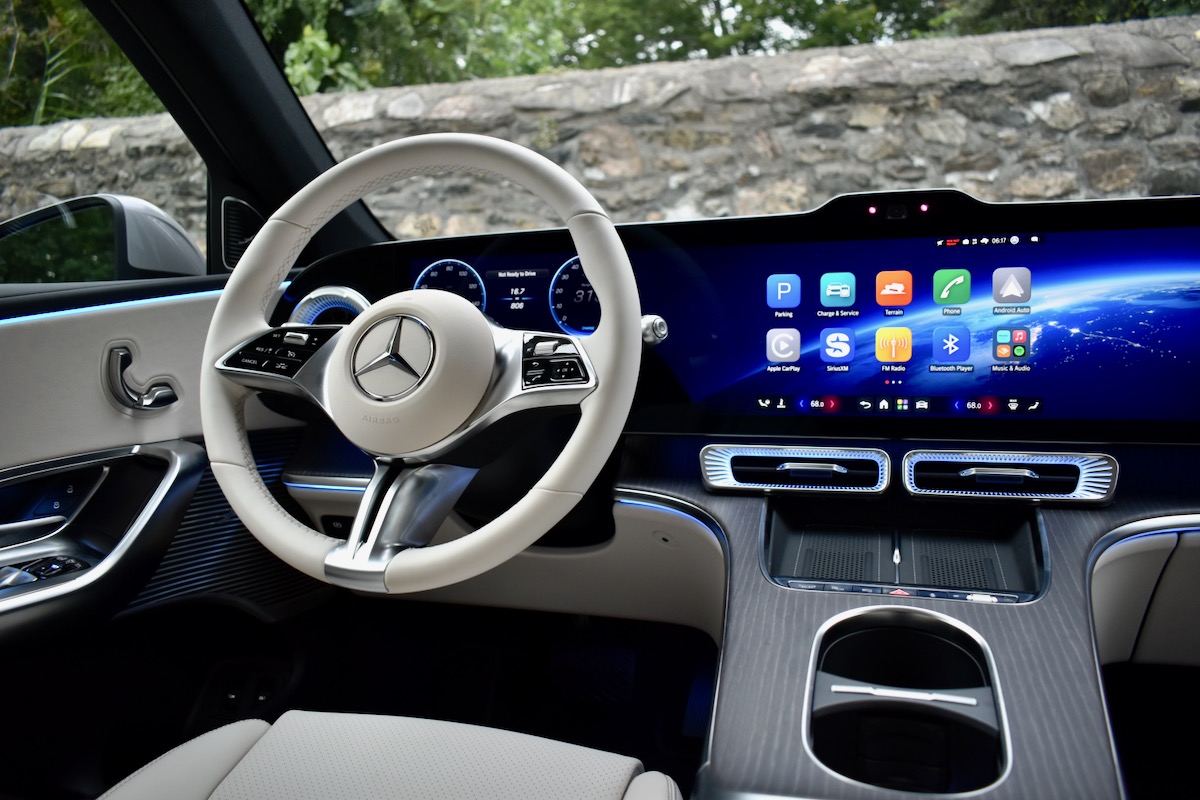
Inside, the GLC EV again throws out subtlety with a dashboard designed to accommodate three large screens. It isn’t attractive and doesn't feel premium, and many of the other cabin materials did not feel worthy of the price tag (although a Nappa leather steering wheel is standard). However, there are still some appealing elements, including backlit round air vents, intricate speaker grilles, and ambient lighting that encircles the dashboard and flows into the doors.
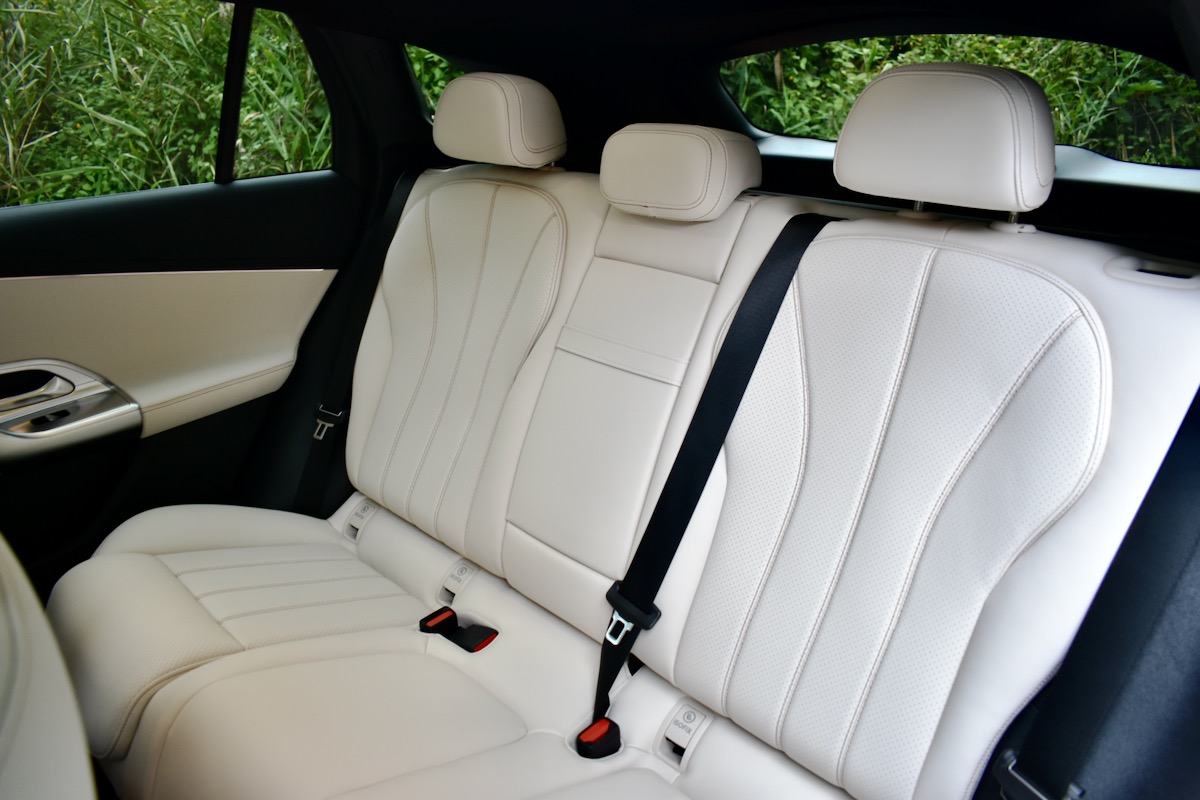
The look and feel is also very dependent on how deep into the options list buyers are willing to go. MB-Tex artificial leather upholstery is standard, but the real thing is available starting at $1,620 (there’s also a $2,590 Tartufo Brown/black option). Wood trim was a $325 option on our Pinnacle test car and is also available with the AMG Line Plus with Night Package, which includes sportier design elements and more firmly bolstered seats. A fixed panoramic glass roof is standard, while electronic dimming and illumination are optional.
Performance
The single GLC 400 4Matic Electric spec has dual-motor all-wheel drive (AWD) and is rated at 483 horsepower and 590 pound-feet of torque. The two motors get their electricity from a 94-kilowatt-hour (usable capacity) lithium-ion battery pack.
Mercedes says the GLC Electric will do 0–60 mph in 4.2 seconds, and the top speed is electronically limited to 130 mph. Acceleration is pretty competitive with other small luxury electric SUVs. The GLC is 0.7 seconds quicker to 60 mph than an Audi Q6 e-tron, and only 0.1 seconds slower than the sporty SQ6 e-tron. It’s also a half second quicker than a BMW iX3 50 xDrive, and 0.2 seconds quicker than a Volvo EX60 P10.
Off the line, the GLC Electric felt as energetic as the numbers suggest, yet we also found it easy to drive smoothly. There’s no gut-punch feel or wheelspin dramatics here. Tire noise was minimal, at least on our test car’s smaller 20-inch wheels and all-season tires (low-rolling-resistance tires are standard). That can often be a problem with EVs, where the lack of engine noise makes it more noticeable, but it wasn’t an issue in the GLC Electric’s cabin.
Our test car also had the optional rear-axle steering and air suspension, included with the $2,900 Agility & Comfort Package. The package is aptly named, as these features allowed the GLC EV to slip through corners like a smaller car, and enhanced the ride quality. The air suspension was well-damped to cushion occupants from bumps, while providing enough body control to prevent unwanted lateral movement. The GLC EV isn’t a driver’s car—it’s way too focused on comfort for that—but it’s genuinely luxurious.
Another plus is the strong level of regenerative braking—something Mercedes and the other German automakers previously shied away from. It's pretty possible to drive the GLC EV with just the accelerator pedal, and there are multiple levels of regen available to suit individual preferences. When drivers do have to use it, the brake pedal feels natural and progressive, which is a welcome change from previous Mercedes EVs.
A Terrain drive mode and “transparent hood” camera view that shows what’s around the front wheels are available, but the GLC EV is no off-roader. It has minimal ground clearance and isn’t available with all-terrain tires from the factory. To be fair, most of its competition doesn’t offer true off-road capability, either, leaving the Rivian R2 to dominate that niche.
Form & function
The two-row, five-seat GLC EV offers competitive interior space. Front-seat headroom is identical to the Rivian R2, nearly identical to the Volvo EX60, and greater than an Audi Q6 e-tron's. Legroom is a similar story, and we found the relatively low dashboard makes for an even greater feeling of space while offering good sightlines. Heated power front seats with four-way lumbar support and memory are standard. Ventilation and massage are part of the Pinnacle Plus trim level and AMG sport seats with thicker bolstering are also available.
Rear-seat headroom is about the same as most competitors, and the GLC EV has 2.6 inches more second-row legroom than its rivals from Audi and Volvo. The battery pack is under the floor, as it is in most EVs, but the floor is still at a fairly normal height, so passengers aren’t forced to sit with their knees uncomfortably high. Heated rear seats are also included with the Pinnacle Plus trim level.
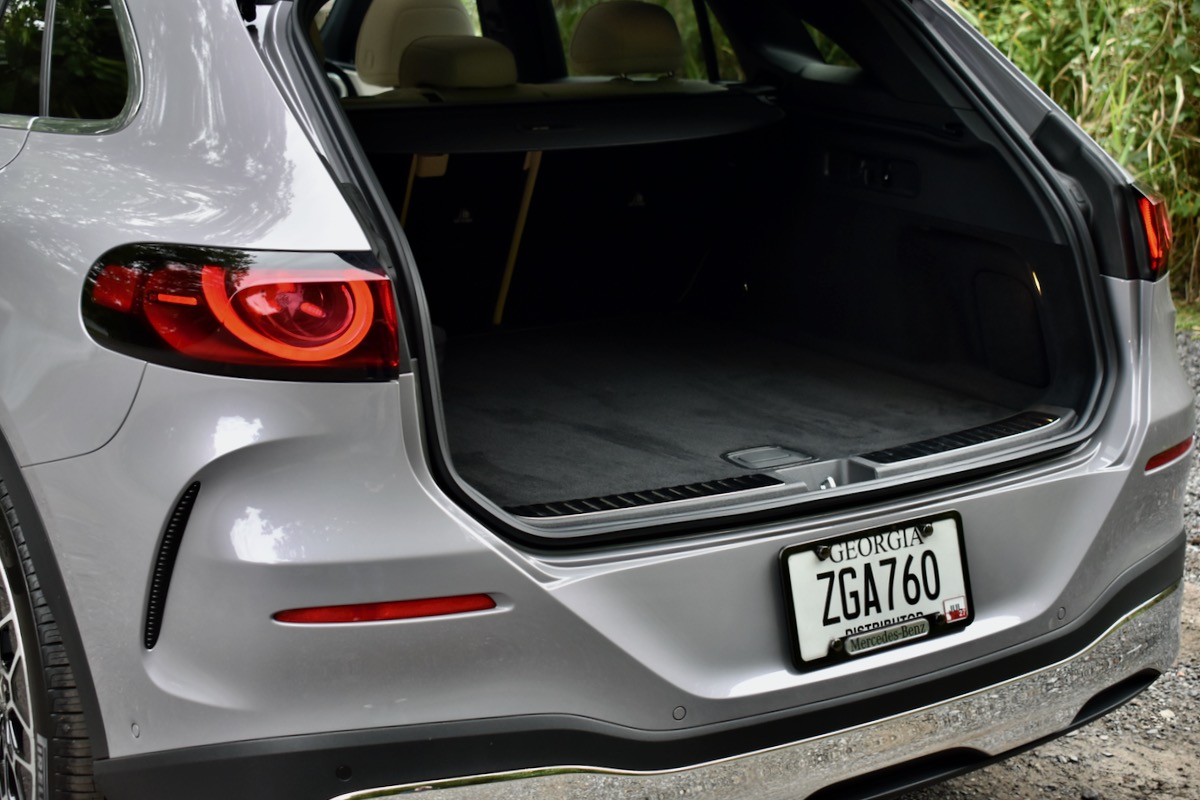
A power tailgate with hands-free activation (via a foot swipe below the rear bumper) is standard. Behind it is 20.1 cubic feet of cargo space, which is substantially less than all potential rivals except the EX60. Fold the rear seats, and available cargo space expands to 61.4 cubic feet. That’s more competitive, beating the EX60, the Genesis GV60, and the Audi Q6 e-tron. The GLC EV also has a 4.5-cubic-foot frunk that surpasses all but the Rivian R2’s in space and comes with dividers to ensure small items don’t roll around.
In the cabin, the tall center console houses dual wireless phone chargers and two large cupholders with adjusters to secure smaller cups and bottles. These items are a much better use of space than the trackpad infotainment controller Mercedes plants on the console in most of its other cars. Below is a storage nook with a strap to tie down items—a helpful touch most automakers miss.
Technology
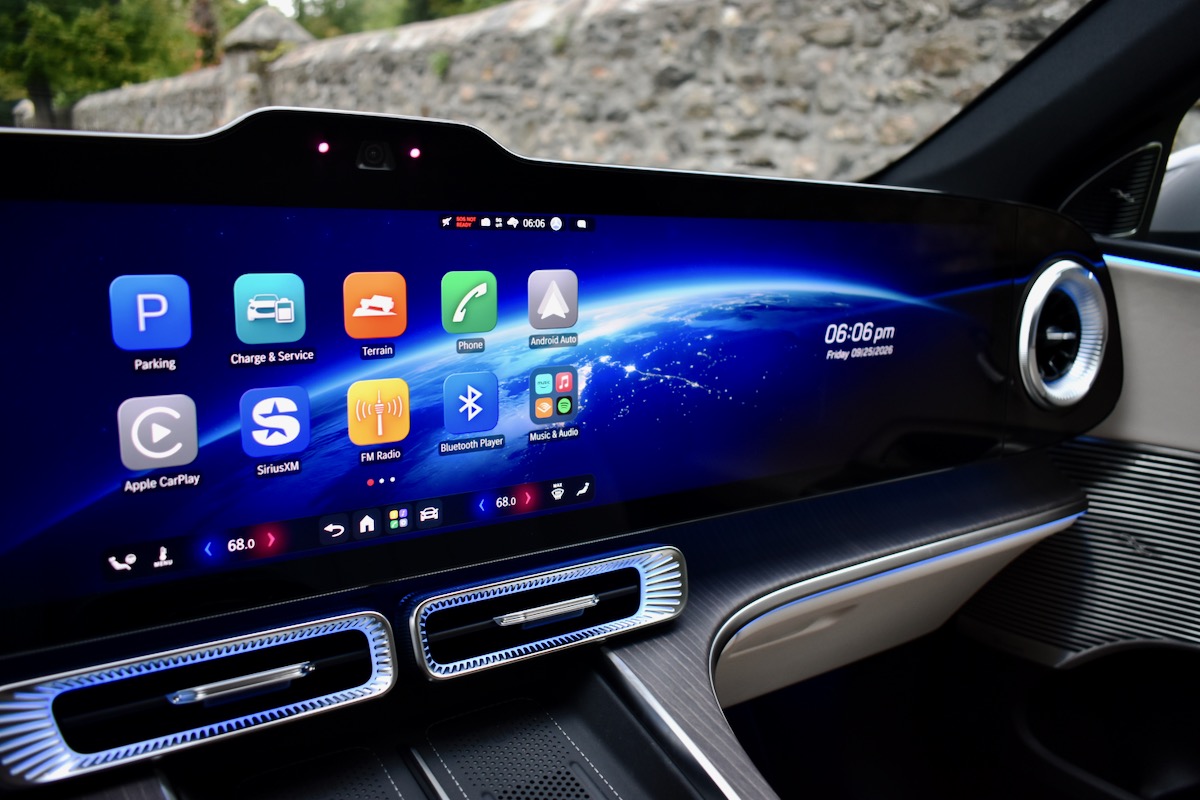
A 10.2-inch digital instrument cluster and 14-inch central touchscreen are standard, along with what Mercedes calls a 14-inch “digital trim panel”. The Hyperscreen setup (standard on the top Pinnacle Plus trim level, optional elsewhere) turns that into a second touchscreen for the front passenger. The MBUX infotainment system is the latest generation, running Mercedes’ own MB.OS operating system but retaining wireless Apple CarPlay and Android Auto.
The voice recognition system has also been upgraded with AI chatbots—plural. Mercedes integrated Microsoft and Google AI agents, as well as the ubiquitous ChatGPT. Microsoft Bing Search and ChatGPT handle general-knowledge questions, while Google’s Automotive AI Agent handles queries related to navigation. As before, all drivers need to do is say “Hey Mercedes,” and speak normally. Even before the AI integration, Mercedes’ voice recognition was one of the best around, and that remains the case. Drivers can also create profiles to save their presets using facial recognition.
Mercedes has reached the point where adding features doesn’t really improve the user experience. The new OS makes more features possible in the future, but buyers currently get pretty much the same interface as the previous generation of MBUX (not a bad thing, mind). Being able to ask the car questions is a novelty, but it’s not necessary. The same goes for the optional front-passenger touchscreen, which is often either ignored or turns into a distraction for the driver.
The base audio system is unbranded, with 15-speaker and 19-speaker Burmester systems available. These include ear-level speakers and seat recognition to send relevant audio (such as navigation directions) to the driver and to pick up voice commands. A head-up display is also available, including an augmented-reality function that highlights turns when using the navigation system.
Safety
Standard driver-assistance features on the 2027 Mercedes-Benz GLC EV include lane-keep assist, lane-departure warning, blind-spot monitors, traffic-sign recognition, automatic emergency braking, forward-collision warning, evasive-steering assist, and adaptive cruise control. The latter includes stop-and-go and route-based speed control functions. A surround-view camera, parking sensors, and a semi-automated park-assist system are also standard.
These features worked fairly well during our time with the GLC EV, although we experienced one unexplained automatic emergency braking event, and the lane-keep assist was a little too sensitive. The park-assist system also worked surprisingly well, performing maneuvers quickly enough to not hold up traffic and smoothly enough to not raise the driver’s heart rate.
A more advanced MB.Drive Assist suite of features, including steering assist and lane-change assist, is optional. MB.Drive Assist Pro, the automaker’s new hands-free driver-assist system, will be available at a later date.
The GLC EV is a new model, so safety ratings from the Insurance Institute for Highway Safety and National Highway Traffic Safety Administration were not available at the time of writing. The GLC EV is equipped with Mercedes’ Pre-Safe pre-collision system, including Pre-Safe Sound, which plays “pink noise” through the audio system’s speakers to prevent hearing loss during a crash.
Cost-effectiveness
EPA range estimates are 350 miles with the standard tires and 331 miles with the optional all-season tires. That’s comparable to most other EVs in this segment, although the BMW iX3 tops 400 miles. Our observed 3.3 miles per kWh indicates that getting the most out of the GLC’s 94-kWh pack should be easy in the real world.
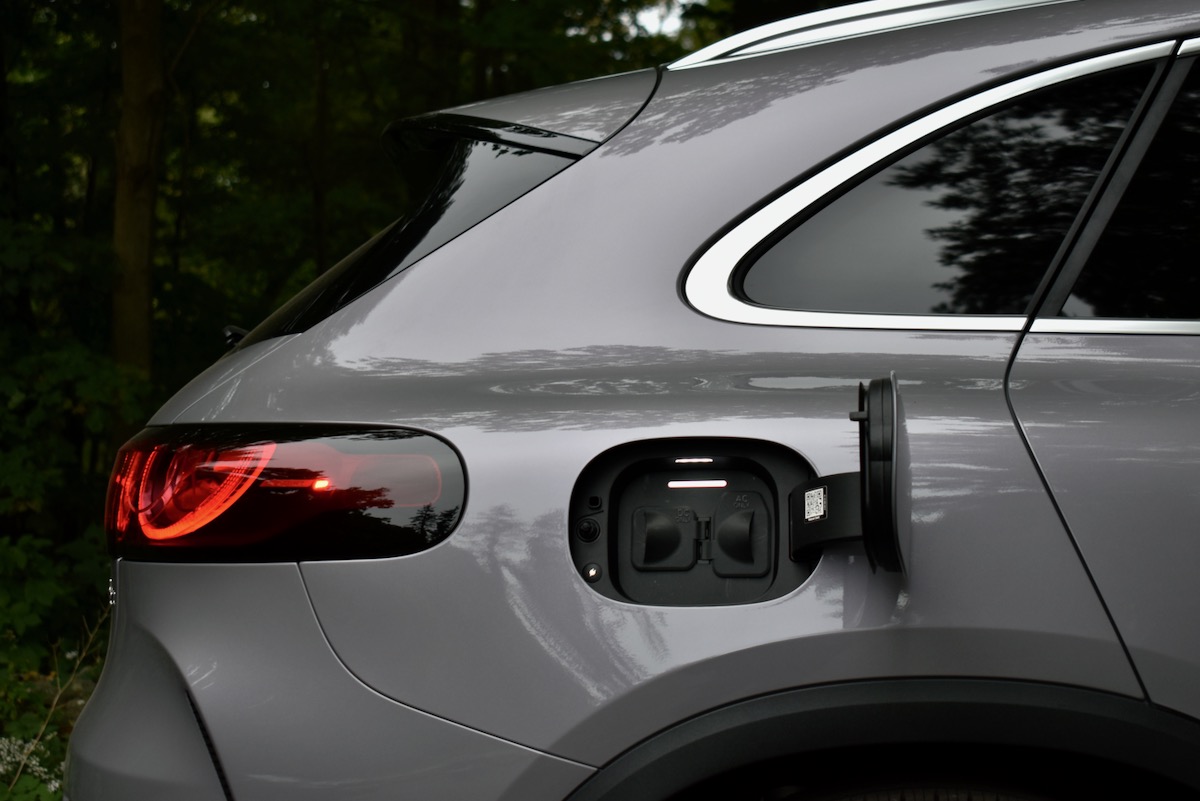
When it’s time to charge, a peak power rate of 330 kilowatts allows the GLC EV to DC fast-charge from 10% to 80% in 22 minutes, according to Mercedes. The GLC has a NACS port and can access Tesla Supercharger stations but can also charge at CCS stations on other networks with an adapter. Level 2 AC charging at up to 11.5 kW allows for a complete charge in 10 hours, Mercedes says.
Pricing starts at $64,950 (including a $1,450 destination charge) before options. The Exclusive trim adds $2,350, the Pinnacle trim $4,400, and the Pinnacle Plus $6,800. Our Pinnacle test car had optional paint, upholstery, and wood trim, as well as the Hyperscreen display, ambient lighting and electronic dimming for the glass roof, the Agility & Comfort Package, and prepaid access to MB.Drive Assist Pro for three years. That brought the as-tested price to $78,775 with destination.
The GLC EV is competitive with other small electric SUVs from luxury brands on price and range. The Genesis GV60 and the Rivian R2 start a lot lower, but they also have less range and can’t be optioned to the same level of opulence as the Mercedes. That said, leaving so many important features on the option list doesn’t help the GLC’s value case, and even in a well-equipped model like our tester, the cabin still feels cheap in places. The GLC is a good EV that can also be a good Mercedes, but having both means spending a lot of extra money.


