2027 Audi SQ9 Reviews, Pricing & Specs

Pros & cons
What we like
Robust power
Plentiful interior space
Bristles with technology
What to consider
High cost of entry
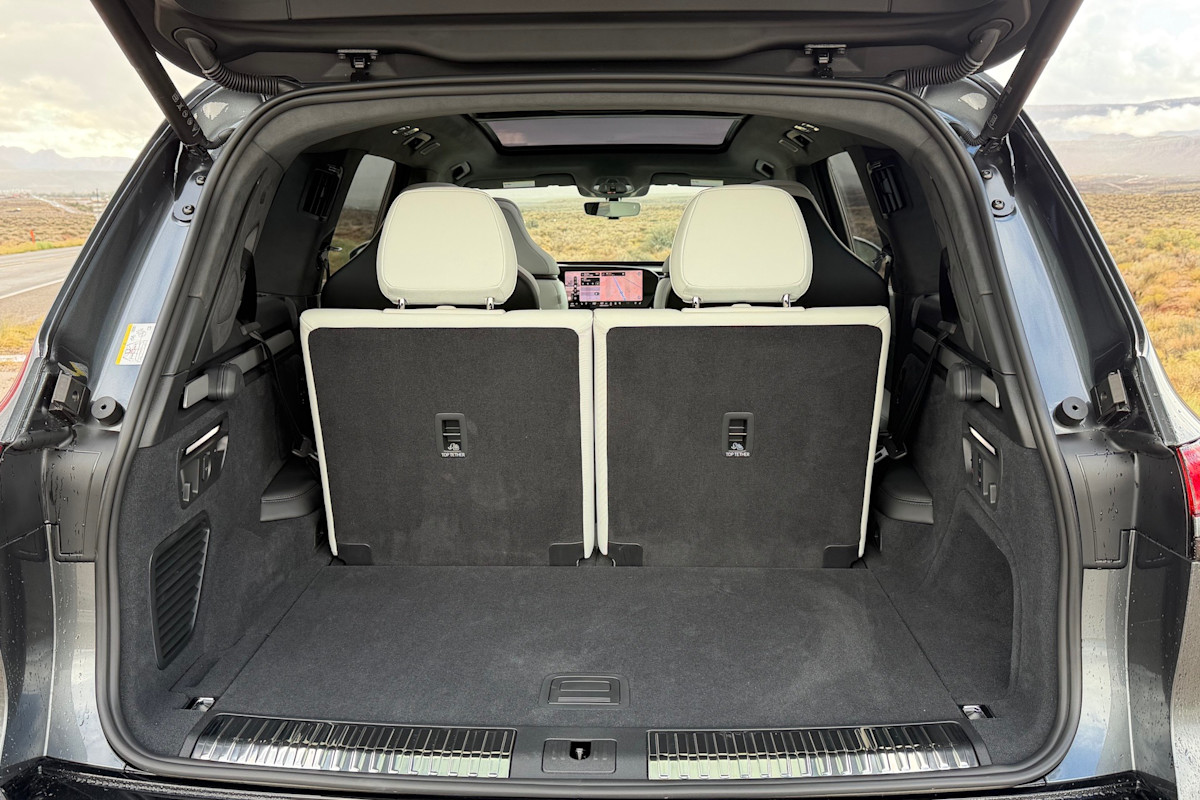
Captain’s chairs limit cargo space
Hands-free driving tech in infancy
Expert review
Audi has been missing out on a significant segment of the luxury market. The 2027 SQ9 is here to remedy that.
Audi says 80% of the luxury market is SUVs, yet the brand hasn’t had a full-size SUV to take on the likes of the Mercedes-Benz GLS, the Cadillac Escalade, and the Land Rover Range Rover, among others. The SQ9 is now here to compete with those models with signature Audi style, immense power, a spacious interior, the latest in interior and safety technology, and handling that belies its size.
Verdict: The 2027 Audi SQ9 is an immediate player in an important luxury segment that serves families well. It’s roomy, incredibly powerful, and drives smaller than its size. Buyers should drive it against the likes of the Mercedes-AMG GLS 63 and BMW X7 M60i to see which fits their taste best.
out of 10 expert review
Look & feel
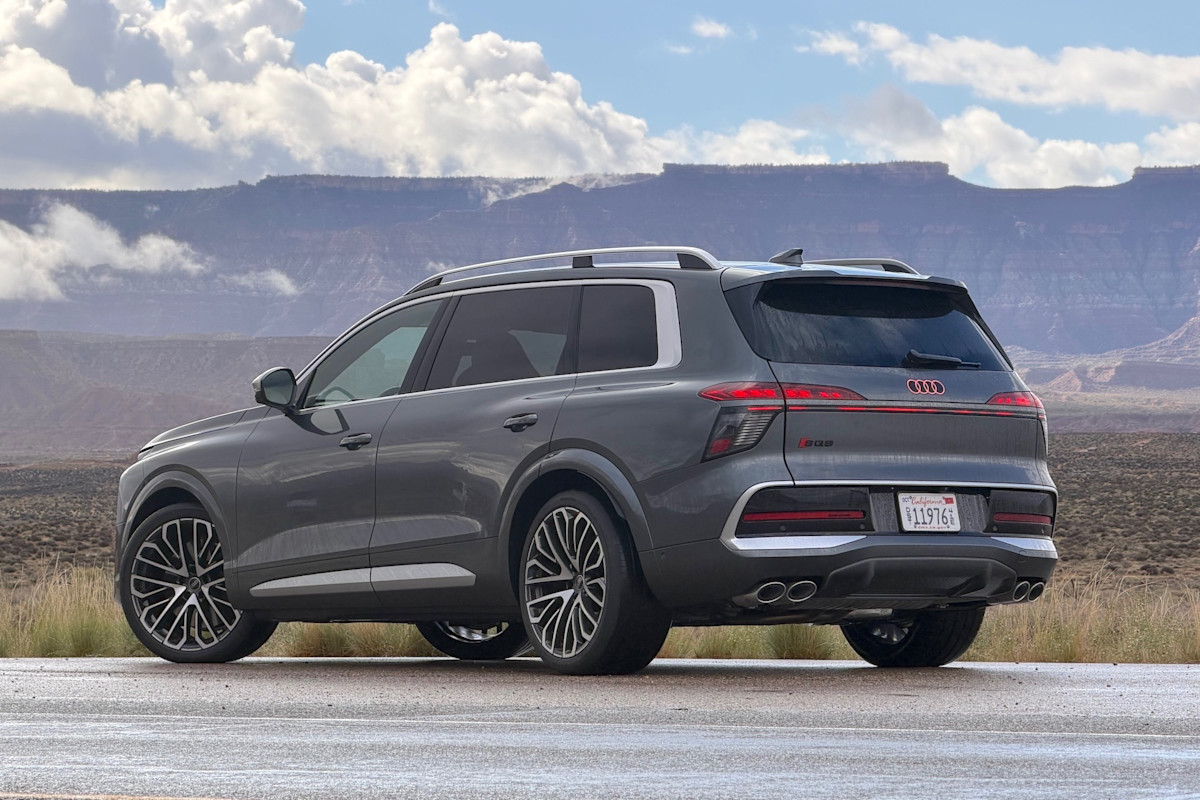
The Audi SQ9 is massive. At 209 inches long, 79.2 inches wide, and 71.4 inches tall, it’s just 2.3 inches shorter and 1.8 inches thinner than the Chevrolet Tahoe, though it sits 4.4 inches lower. It’s also 9.9 inches longer than the Audi Q7, which was Audi’s biggest SUV until the SQ9 and its more sober Q9 stablemate came along. Still, it boasts appealing and sporty looks.
The SQ9 is fronted by the biggest version of the Audi singleframe grille yet. Here, it has a black honeycomb mesh with metallic highlights. The grille is part of a black mask on the nose that encompasses the digital matrix LED headlights. Thin LED daytime running lights squint above the headlights and they, along with taillights, can be set to project eight different patterns. The turn signals also project arrows on the ground to help other cars see what the SQ9’s driver intends to do.
Along the sides, the SQ9 sports pronounced wheel arches, especially at the rear, to make it look like a big cat ready to pounce. The flanks also have rising character lines along the lower body to provide a sense of motion and a bit of a rake. The rear end’s OLED taillights are married to a full-width LED light strip across the middle of the tailgate. In the center is an illuminated Audi logo.
The SQ9 wears standard 22-inch wheels with staggered big and bigger tires, and buyers can trade up to 23s. The whole thing can look more sinister with the optional Black Optic package that darkens the look with Anthracite Audi rings, an all-black grille, dark chrome exhaust tips, and black wheels, exterior trim, roof rails, and exterior mirror housings.
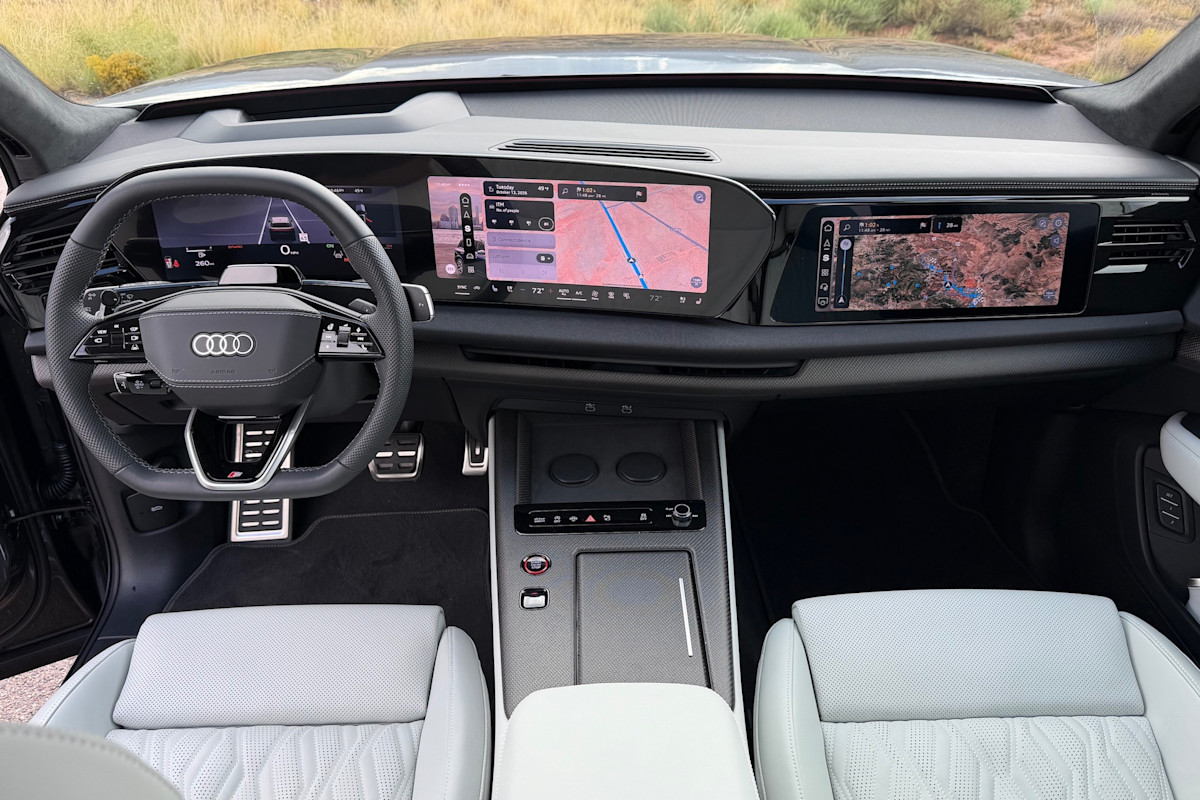
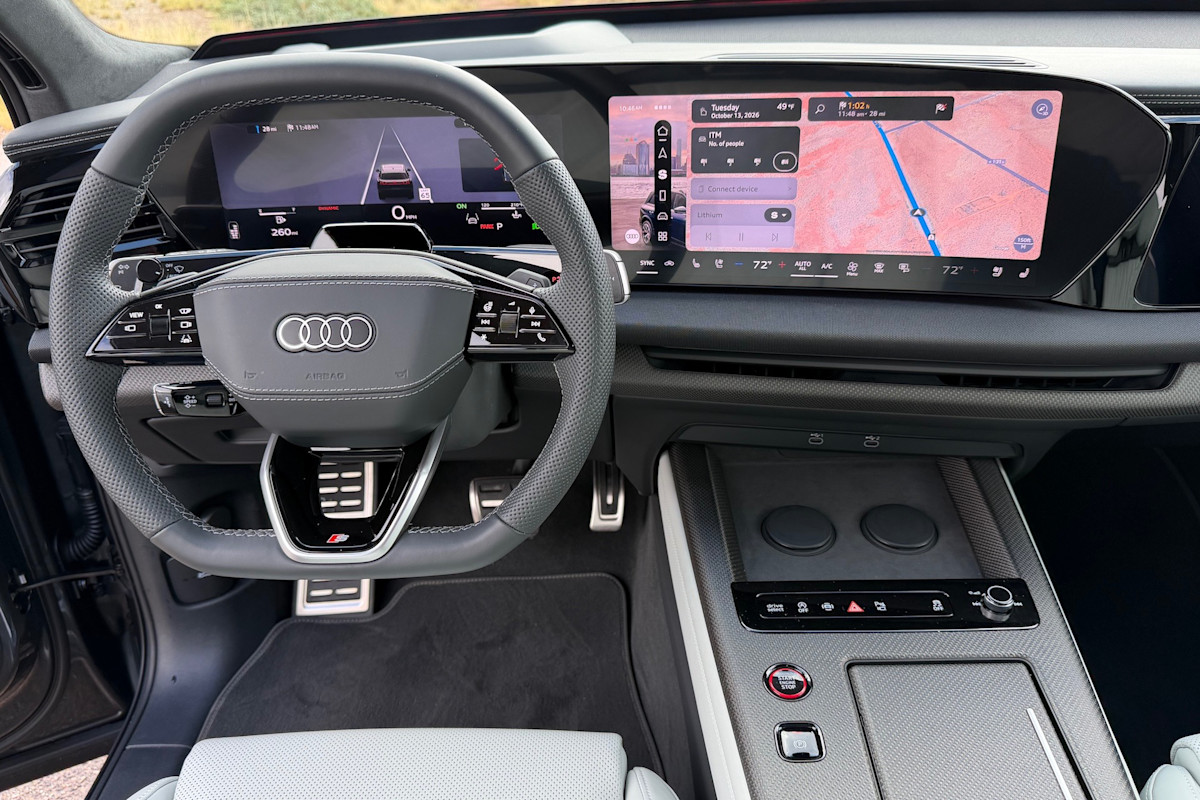
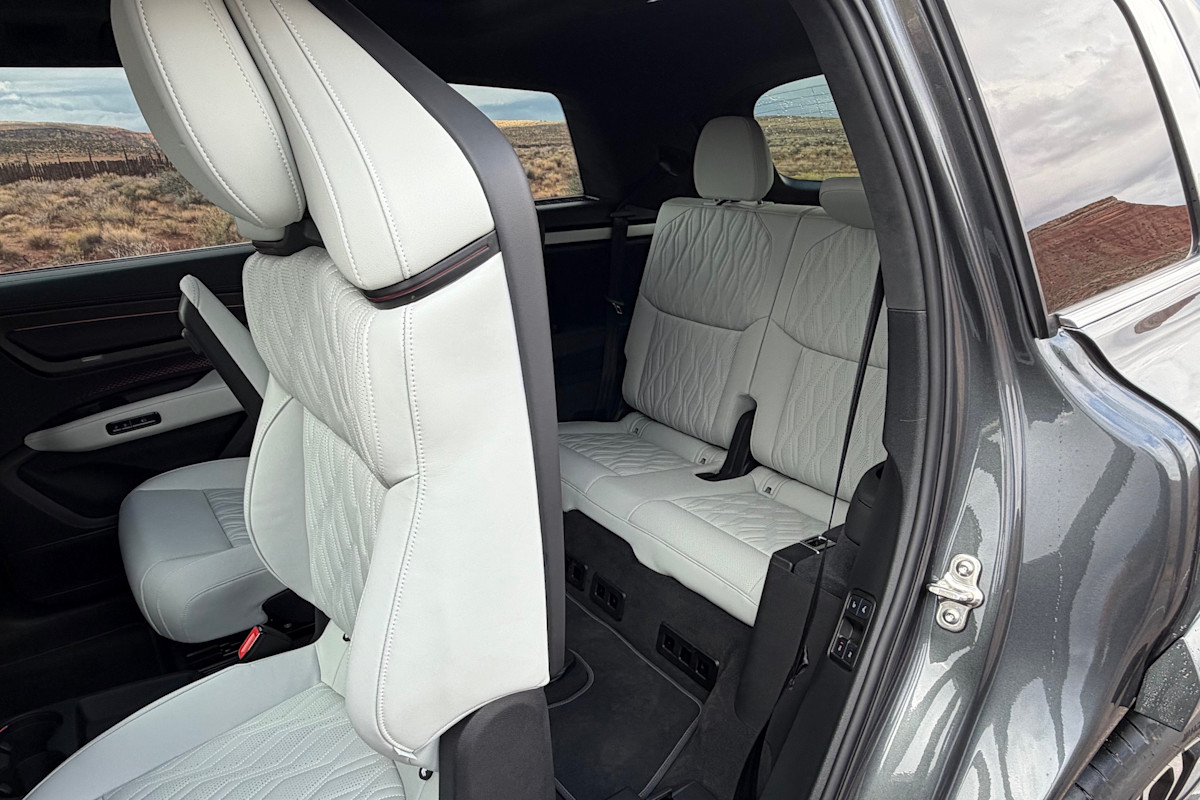
The interior mixes technology with sportiness and luxury. The screens don’t all sit under one piece of glass as they do in the comparable Mercedes-Benz GLS. Rather, the digital instrument cluster and center touchscreen are combined and curved, so the touchscreen is closer to the driver, while the front passenger screen is separate. Sporty elements include stainless-steel pedal caps, bucket seats, and a steering wheel that’s squared off at the top and bottom. Those seats have a diamond pattern, and contrast stitching can be found on the dash, doors, and steering wheel. The seats are upholstered in rich nappa leather, and they're available in white, black, red, or dark blue—the last for a considerable charge in the Audi Exclusive Design package. The leather extends to parts of the dash and doors.
Audi makes much of the trim on the center console and dash from raw carbon fiber. It’s an expensive, lightweight, and sturdy material with some texture to it, but comes off as looking like hard plastic. The resin-covered carbon-fiber we’re more accustomed to seems as though it's better quality.
Performance
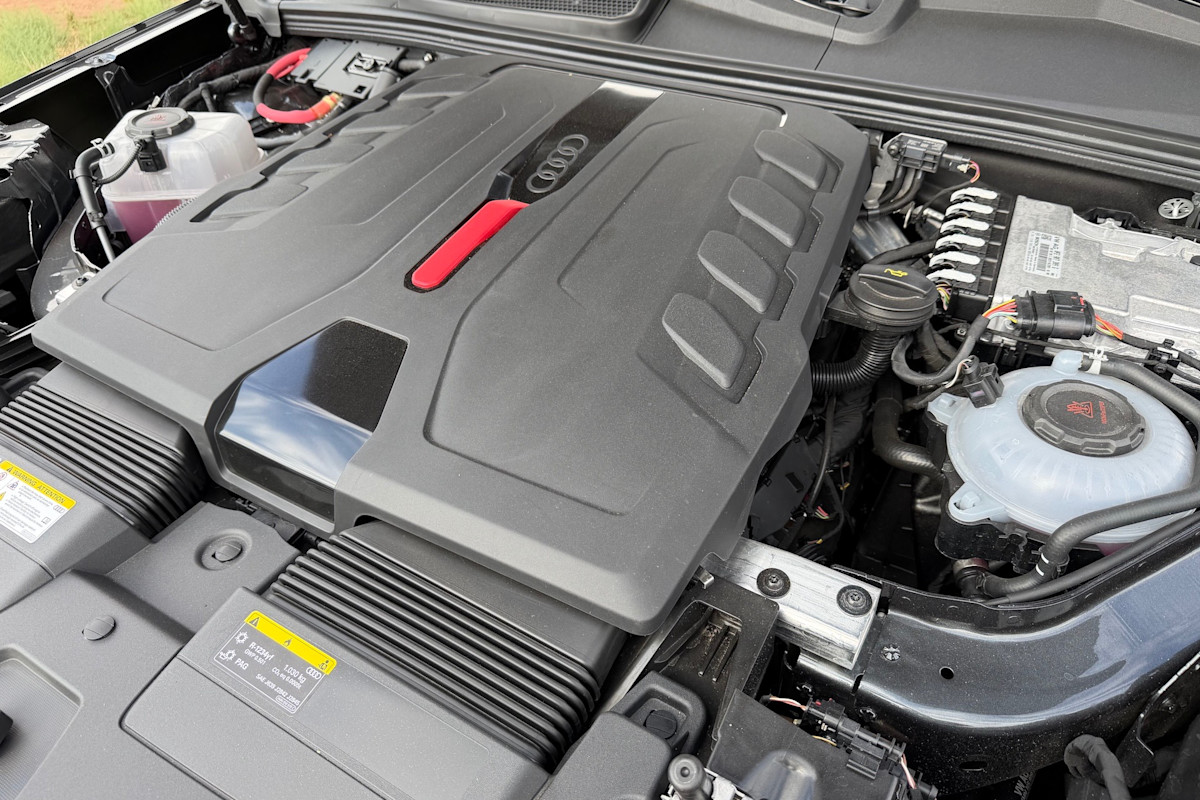
The SQ9 offers beastly power. It’s fitted with a twin-turbocharged 4.0-liter V8 that cranks out 590 horsepower and 591 pound-feet of torque. That power flows through an eight-speed automatic transmission to all four wheels via a performance version of Audi’s quattro all-wheel-drive (AWD) system.
To call the SQ9’s ability to accelerate robust is an understatement. It lacks the Mercedes-AMG GLS 63's mild-hybrid assist, so there is no immediate torque fill from a stop. That means there’s a bit of lag as the turbos spool up, but tromping on the throttle still launches 5,556 pounds of three-row SUV from 0–60 mph in a scant 3.8 seconds. The turbos are at the ready once underway, so passing punch is a simple twitch of the right foot.
Forward thrust is accompanied by a pleasing thrum from the V8 that isn’t as low or guttural as it is in the GLS 63. It’s a wonderful sound that’s one of many reasons to aspire to this vehicle. When drivers don’t go hard on the throttle, the SQ9’s cabin is a quiet, serene environment.
The transmission provides virtually imperceptible shifts most of the time, though they become more noticeable as it fires through gears under hard acceleration in the Dynamic drive mode. The power hits the pavement efficiently thanks to the fully variable AWD system, and the standard electronic locking rear differential not only ensures traction out of corners but can also send the power at the rear axle to the outside wheel to help this big beast rotate.
But the SQ9 doesn’t feel like a big beast from behind the wheel. Audi sets it on air springs with adaptive dampers and, oddly, the sport-tuned version of this suspension isn’t standard. Instead, it’s a modest $1,200 option that also comes with red brake calipers. Even without the sport tuning, the SQ9 feels smaller than it is. It leans in turns but not excessively and gathers its weight to head back in a new direction better than expected for its size. The staggered 285/35R23 front and 335/30R23 rear tires (the 21s and 22s are staggered as well) provide good grip, and the steering is sharp with some decent weight. It rides well, too, smothering bumps even on those 23s. Not bad for a monster that can tow up to 7,700 pounds.
The SQ9 isn’t meant as an off-roader, but its air suspension has an off-road mode that gives it nine inches of ground clearance to get over that log or rock on the way to the campsite. It lacks all-terrain tires, so drivers should avoid mud or sand.
Form & function
The SQ9 seats up to seven with three rows of seats. The front seats are well-bolstered and comfortable, and come with standard heating, ventilation, and massage functions. The front row is spacious and it’s easy to tailor an ideal seating position thanks to multiple power adjustments and a standard power tilt and telescopic steering column.
Buyers have a choice to make for the second row. It comes standard with a bench seat that allows maximum passenger capacity, but the available captain’s chairs are basically copies of the front seats, making two back there more comfortable. While the captain’s chairs tilt and slide forward to provide access to the third row, they don’t fold flat, severely limiting maximum cargo space.
Both the second- and third-row seats are heated, and the third row is power-folding. The third row is usable by adults, thanks to enough headroom and legroom for a six-footer, the latter as long as the third-row passengers can negotiate with those in the second row for legroom. However, the seat bottoms sit low, so the knees-up seating position inhibits comfort on long trips. All rear passengers also benefit from five-zone automatic climate control, and it all feels open and airy thanks to a standard panoramic sunroof.
Aside from the captain’s chairs issue, the SQ9 has good cargo space with 19.3 cubic feet of volume behind the third row. That’s more than the BMW X7 and Mercedes-Benz GLS, making it easier to carry passengers and their luggage. It also has 43.8–50 cubic feet behind the sliding second row, depending on its position, and 87.7 cubic feet behind the first row with the rear two rows folded flat (as long as buyers don’t choose the captain’s chairs). A hands-free power tailgate makes it easy to access the cargo area.
For an extra touch of luxury, the SQ9 is available with powered doors that can close automatically when a seat belt is buckled or when the driver hits the brake pedal.
Technology
Like the rival Mercedes-AMG GLS 63, the SQ9 comes with three screens, including one for the front passenger. They consist of an 11.9-inch digital instrument cluster Audi calls the Virtual Cockpit, a 14.5-inch infotainment touchscreen, and a 12.3-inch passenger touchscreen.
The infotainment system runs the Android Automotive operating system, and a standard Audi Connect Nav and Plus subscription provides navigation, streaming and gaming options, as well as access to a ChatGPT-powered Audi Assistant that can control in-vehicle functions and answer questions. The touchscreen is big and easy to reach thanks to its angle. It reacts quickly to inputs and offers all the connectivity functions anyone could want. Also standard are a dashcam, a head-up display, three months of satellite radio, dual wireless charging pads, and a Bang & Olufsen audio system.
Buyers can also pay for a 1,360-watt, 22-speaker Bang & Olufsen 4D audio system. The fourth dimension is actuators in the front seats that punctuate the bass beat with physical pulses. It’s adjustable so drivers and passengers can feel it more or less, and it’s not a necessity for anyone who doesn’t need to feel the groove, yo.
The programmable daytime running lights and OLED taillights are party tricks that buyers will play with once or maybe from time to time. We recommend going through the options, picking a smart design, and sticking with it.
Safety
The new SQ9 had no crash-test ratings at the time of writing. However, it comes standard with plenty of advanced driver-assistance features, including forward-collision warning with intersection assist, automatic emergency braking, adaptive cruise control, lane-departure warning, blind-spot monitors, safe-exit assist, rear cross-traffic alert, traffic-sign recognition, high-beam assist, a surround-view camera system, automatic parking, and front, rear, and side parking sensors.
Also available are a dashcam, a driver-attention monitor, rear automatic braking, remote parking, trailer assist that handles the steering when backing up a trailer, and a hands-free highway driving system.
This marks Audi’s first attempt at a hands-free system in the U.S. It’s a Level 2+ system that requires the driver to pay attention but can drive the vehicle essentially on its own on mapped, divided highways. We weren’t able to experience much of the system on the southwestern Utah highways of our test route, as it rarely engaged in this admittedly sparsely populated area.
When it did engage, it handled the controls well, then disengaged when the left lane ended while we were traveling in the center lane, when we passed off-ramps traveling in the right lane, and simply because it didn’t recognize the freeway as a mapped area. GM’s Super Cruise and Ford’s BlueCruise can handle these situations and seem to have more highways mapped for their use. The system will likely improve as Audis cover more miles on U.S. highways, but for now, it’s behind the leaders.
Audi is not behind the curve on headlights. The SQ9’s standard digital matrix LED headlights are each made up of 25,600 pixels. When the high beams are put on automatic mode, the pixels pointed toward an oncoming car, a car ahead, or a road sign dim to avoid blinding other drivers or reflecting harshly off road signs. This allows the driver to benefit from the extended lighting of high beams without adversely affecting other drivers.
Cost-effectiveness
As the top model in the Q9 range, the 2027 Audi SQ9 comes in just one trim that’s priced at $119,395 at launch, including a mandatory $1,395 destination fee. It hits dealers in November.
Unlike some competitors, the SQ9 does not benefit from electrification, even a mild-hybrid system like the one in the Mercedes-AMG GLS 63. That means fuel economy is likely to be poor (EPA ratings were not available at the time of writing). Given that it has an updated version of the same powertrain, expect ratings similar to the 2026 Audi SQ7’s 14 mpg city, 20 mpg highway, and 16 mpg combined. Over 158 miles of highway and canyon driving—some spirited and some slow for sightseeing in Zion National Park—we averaged a thirsty, but not horrible, 16.4 mpg.
The SQ9 is supposed to be the sporty model in the Q9 range, so for the full experience, buyers should spend the $1,200 for the sport suspension. It will never be truly sporty given its size, but the SQ9’s suspension has plenty of room for extra firmness without hurting ride quality too much.
Families will find few full-size SUVs that can do so much so well. The SQ9 drives far better than body-on-frame options such as the Cadillac Escalade and the Lincoln Navigator, and it has a bit more usable interior space for cargo and passengers than its BMW, Land Rover, and Mercedes rivals. It’s also priced lower than most of them.


