2026 Toyota GR86 Reviews, Pricing & Specs
Pros & cons
What we like
Great handling
Quick-revving engine
Engaging manual transmission
What to consider
Tight cargo and passenger space
Modest power
Ride can get hard
Expert review
Some people choose cars because they’re fun to drive, and the 2026 Toyota GR86 is one of the finest and most affordable of those choices.
The GR86 puts driver engagement first and practicality last. It offers fantastic handling, especially at the limit, and while power is modest, it’s delivered to maximize the fun. Buyers can choose all-season tires for tail-out fun or summer-performance tires for quicker track times. While the GR86 has four seats, it realistically seats two, but that’s OK because the GR86 is all about pleasing the driver.
Verdict: If driver engagement is at the top of the shopping list, the Toyota GR86 is one of the best choices on the market. It lacks practicality and its ride can be overly firm, but the GR86 delivers driving fun without big power.
out of 10 expert review
Look & feel
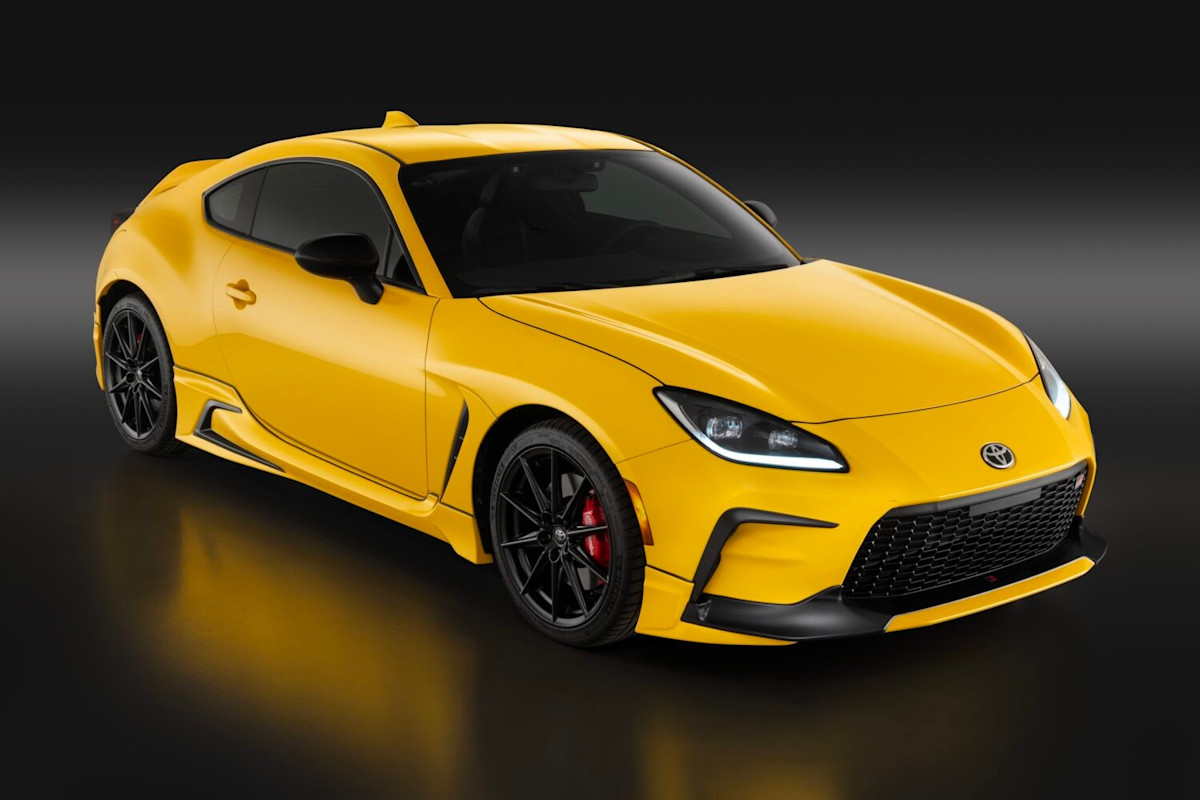
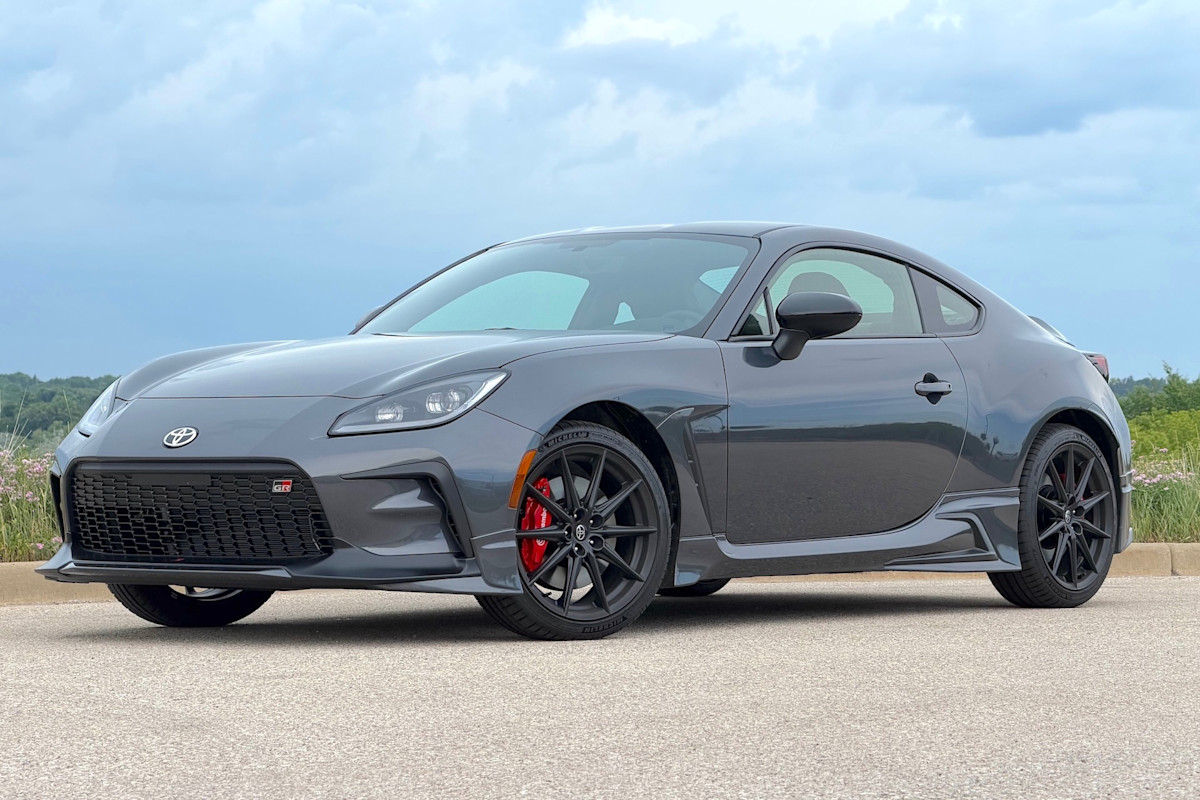
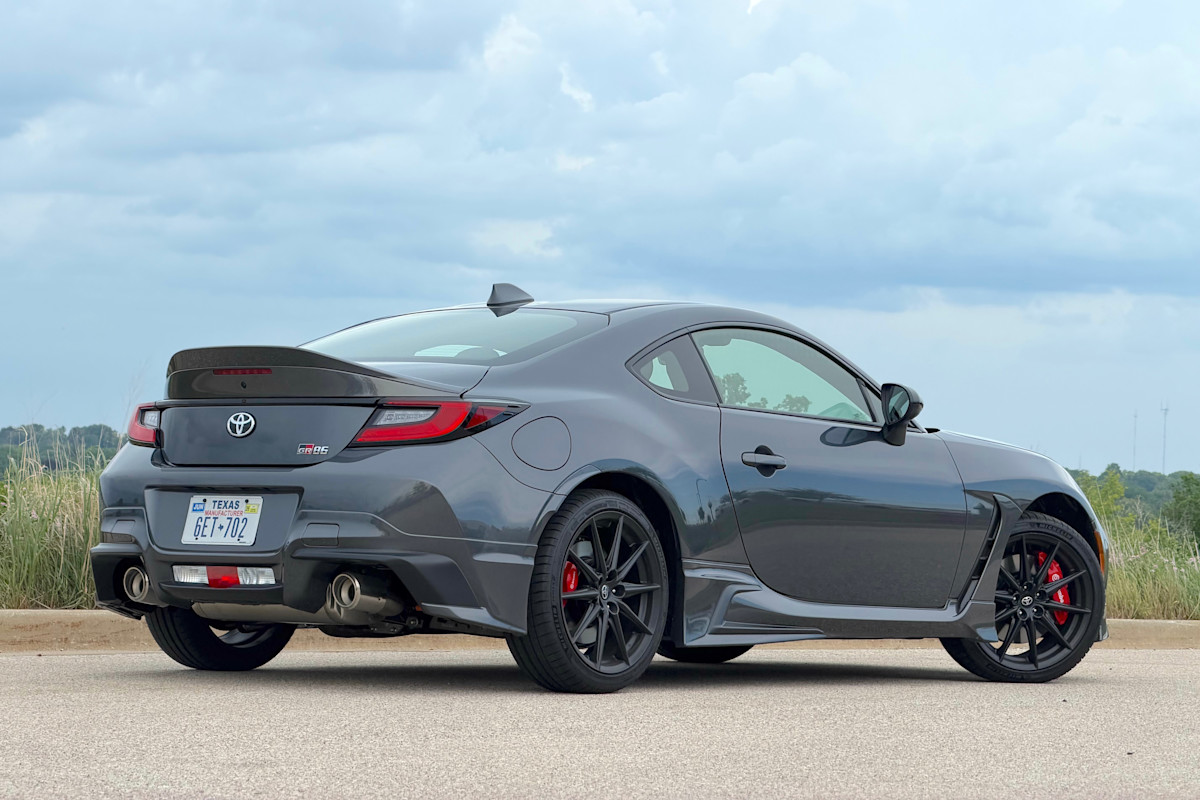
The GR86 is a tiny, low-set coupe with the long hood, short deck proportions of a classic sports car. It’s sleek, but not quite beautiful. The nose features a simple grille positioned low and flanked by prominent right-angle air intakes. The LED headlights lay at an angle leading into a hood that curves up from the nose to the windshield. The roof curves back down to an integrated ducktail spoiler. Along the sides, the wheels are pushed to the corners, air vents sit behind the front wheels, and the rocker panels rise toward the rear tires. The available GR Aero Kit adds side skirts over those rocker panels and comes with both a front splitter and a rear diffuser.
The wheel-and-tire package isn’t the typical stuff of sports cars. The wheels are relatively small at 17 or 18 inches, the tires aren’t staggered front to rear, and the GR86 even comes with standard all-season treads. Black wheels are standard on the Premium trim, and bronze wheels are available. A dual exhaust is standard and can be finished in black or swapped for a quad exhaust.
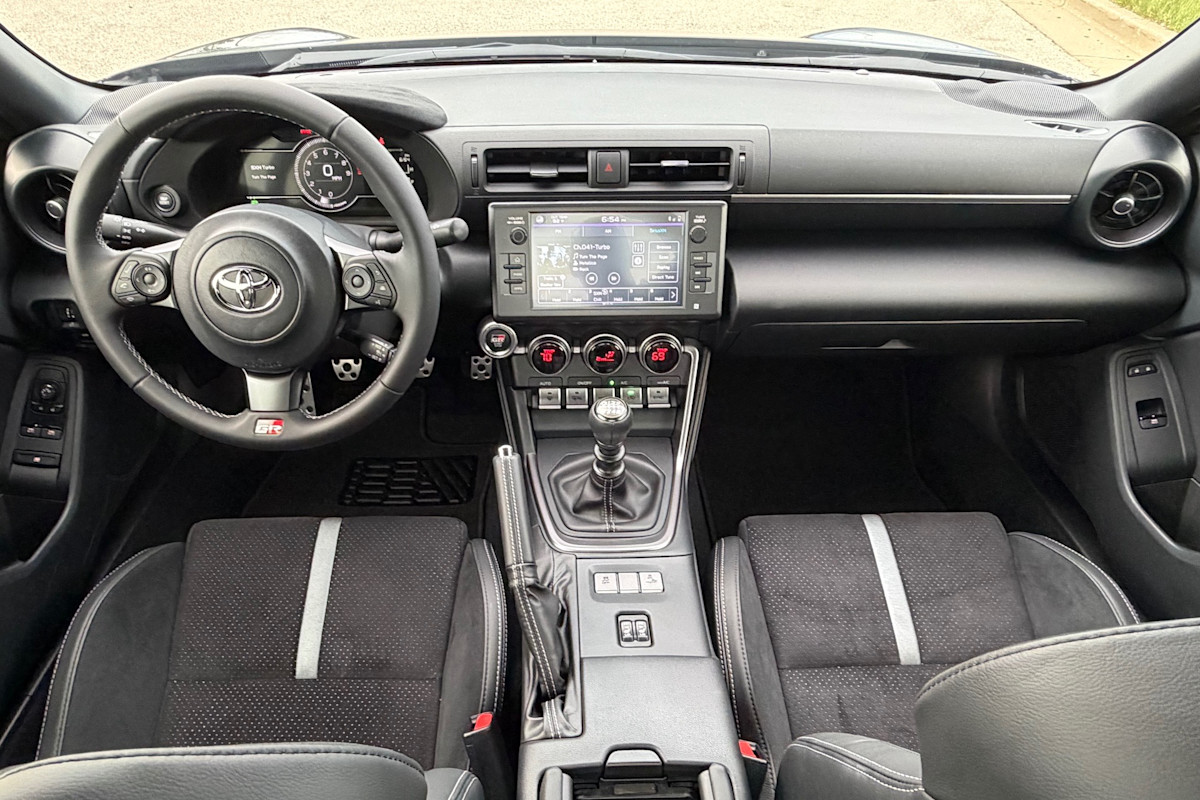
The interior is sporty but utilitarian. Performance-themed elements include a small steering wheel, metal-faced pedals (in all but the Core trim), sport bucket seats, and a traditional pull-up parking brake lever. The thickly bolstered front seats have cloth upholstery in the Core model and synthetic suede and leather upholstery in the Premium and Yuzu Editions, while all have contrast stitching that is also found on other surfaces. That stitching is yellow in the Yuzu Edition to go with the exterior. Otherwise, the cabin has a smallish eight-inch touchscreen and a lot of hard plastic surfaces, which are somewhat offset by synthetic suede door tops and soft-touch armrests on the door panels and center console. In all, it feels just above budget-grade.
Performance
Few vehicles are as fun to drive as the Toyota GR86. It’s right up there with the Mazda MX-5 Miata.
Buyers have a choice: Do they want their GR86s to grip or slide? The Core base model comes standard with 215/45R17 Michelin Primacy all-season tires—the type normally found on a sedan daily driver—and they’re no wider or grippier. With these tires, the GR86 can easily overcome the traction on the rear wheels to let the rear end kick out in corners.
The best part about that is how easy it is to handle the GR86 at or beyond the limit of adhesion. It’s very neutral, with a tendency for oversteer that is easily controlled with quick opposite-direction steering corrections or by simply letting off the throttle. At this point, drivers can balance the car with the throttle, adding gas to steer with the tail and letting off to allow the front tires to point the car in the desired direction.
The other choice is the Michelin Pilot Sport 4 tires on the Premium and Yuzu models. These summer-performance tires have more grip to shorten lap times, carve through corners, or tackle the lefts and rights of an autocross. These 215/40R18s are no wider than the standard tires, so while they add grip, the engine’s power can still break them free and turn the GR86 into a drift machine. With either setup, it’s incredibly fun.
But that’s not all to delight the driver. The quick, direct steering is among the sharpest on the market, aided by this light (it weighs only 2,833 pounds in Premium trim with the manual transmission), low-set car’s immediate turn-in response. The steering has some decent heft, too, to help make it stable. The GR86 changes direction even better than the Miata thanks to less body lean, though the lean there works as useful feedback.
Our Premium test vehicle came with four additional performance enhancements. The $2,700 GR Aero Kit features a front splitter, a rear diffuser, and side skirts for better airflow and downforce. The $1,500 Performance package adds Brembo brakes for better heat dissipation when running hard and Sachs dampers for greater body control. An accessory $640 GR Performance strut tie brace ties the front end together a little better for even quicker turn-in.
The $1,320 accessory GR Performance stabilizer bars are the most controversial to us, as they increase front stiffness by 200% and rear stiffness by 276%. While this helps to reduce body roll, it was likely the reason for our test vehicle's harsh ride. Every pavement seam and expansion joint became an enemy, not to mention potholes, as the suspension sent a shock through the cabin. Skip these bars, as they make an otherwise firm but pleasant ride overly harsh.
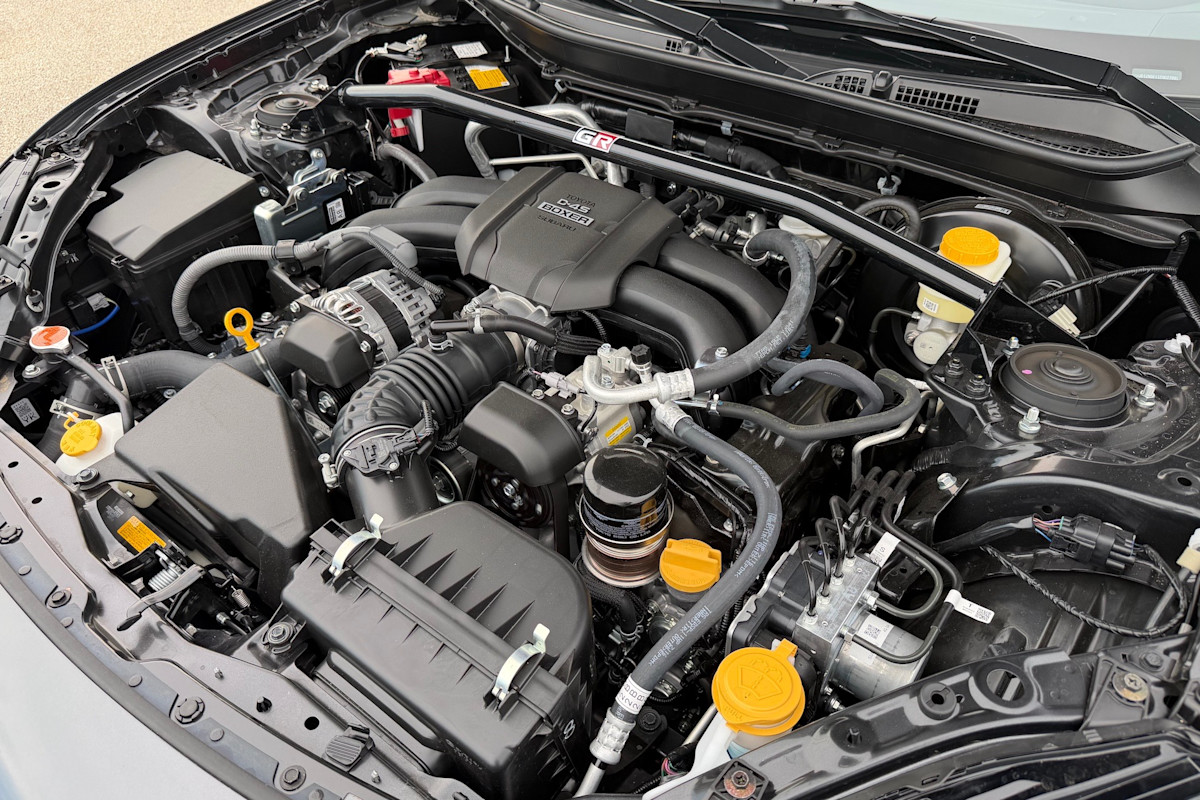
Power from the 2.4-liter flat-four engine is modest, at 228 horsepower and 184 pound-feet of torque, but the way it’s delivered makes it fun. The power flows to the rear wheels through a six-speed manual or a six-speed automatic transmission and goes to the pavement effectively thanks to a standard Torsen limited-slip rear differential that apportions power along the rear axle for maximum traction.
The manual is the clear choice here, as it has short shifts, positive engagement, and a natural clutch feel. Better yet, it’s the best way to take advantage of the engine’s willingness to rev all the way to its 7,500 rpm redline. That lets drivers get the most out of the family sedan power, unlocking a 0-60 mph time in the six-second range. With the automatic, the 0-60 mph sprint is in the mid-six-to-seven-second range.
The GR86 doesn’t do a great job of filtering noise out of its cabin, and the engine sings a flat, midrange tune that starts to intrude on conversation above 4,000 rpm. Sports car fans will like it but their passengers may not.
Form & function
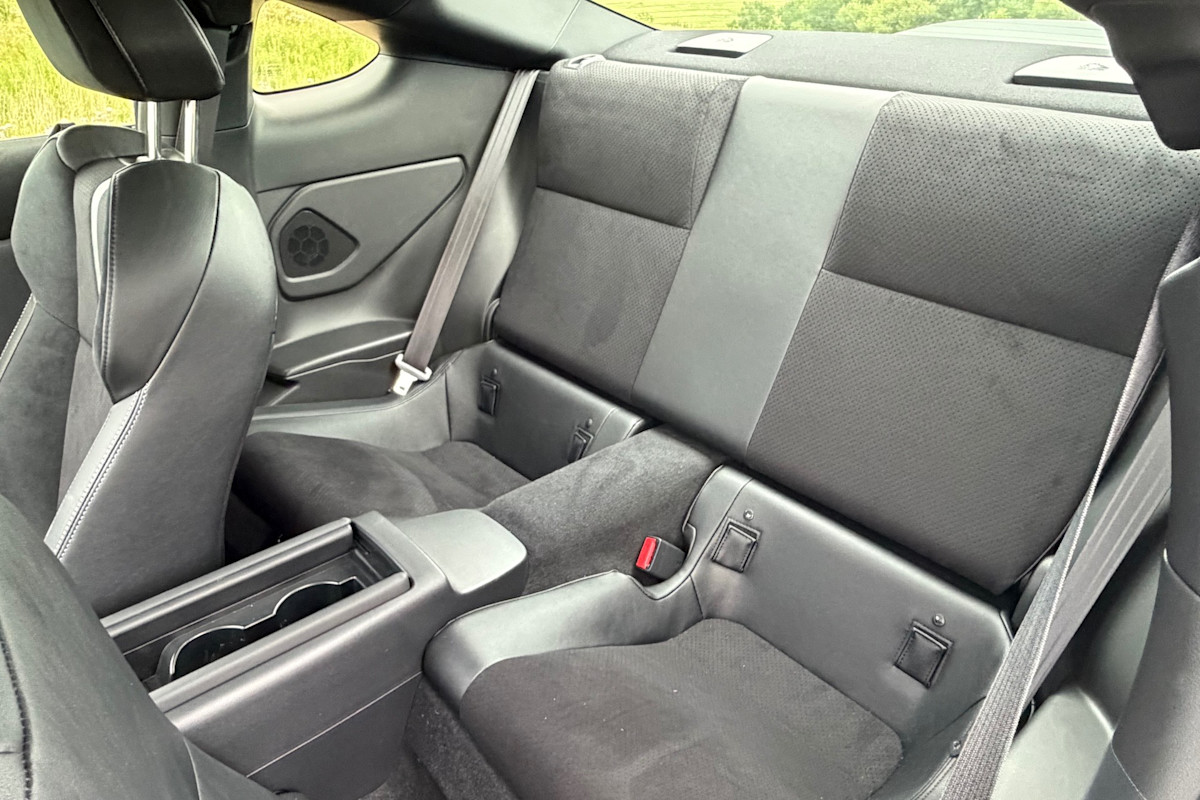
The GR86 has a tiny cabin to go with its tiny footprint. It lacks space up front and especially in the rear and requires a step down to get in and core strength to get out. A friend, who is a full-figured gentleman, asked if this car comes in extra-large.
Up front, the GR86 has a standard six-way manually adjustable driver's seat with a four-way passenger seat, both heated in the Premium and Yuzu. The seats are wide enough that they don’t pinch bigger backsides, but legroom can be cramped. At 5'9" and with short legs, our right knee made contact with the bezel around the start button on the dash, which prompted moving the seat back a little more than we would have preferred.
The center console itself is poorly laid out for ergonomics. It has no tray at the front for phones or keys or snacks, and the console bin sits behind the driver’s elbow where it’s hard to reach and can be intrusive when it's open.
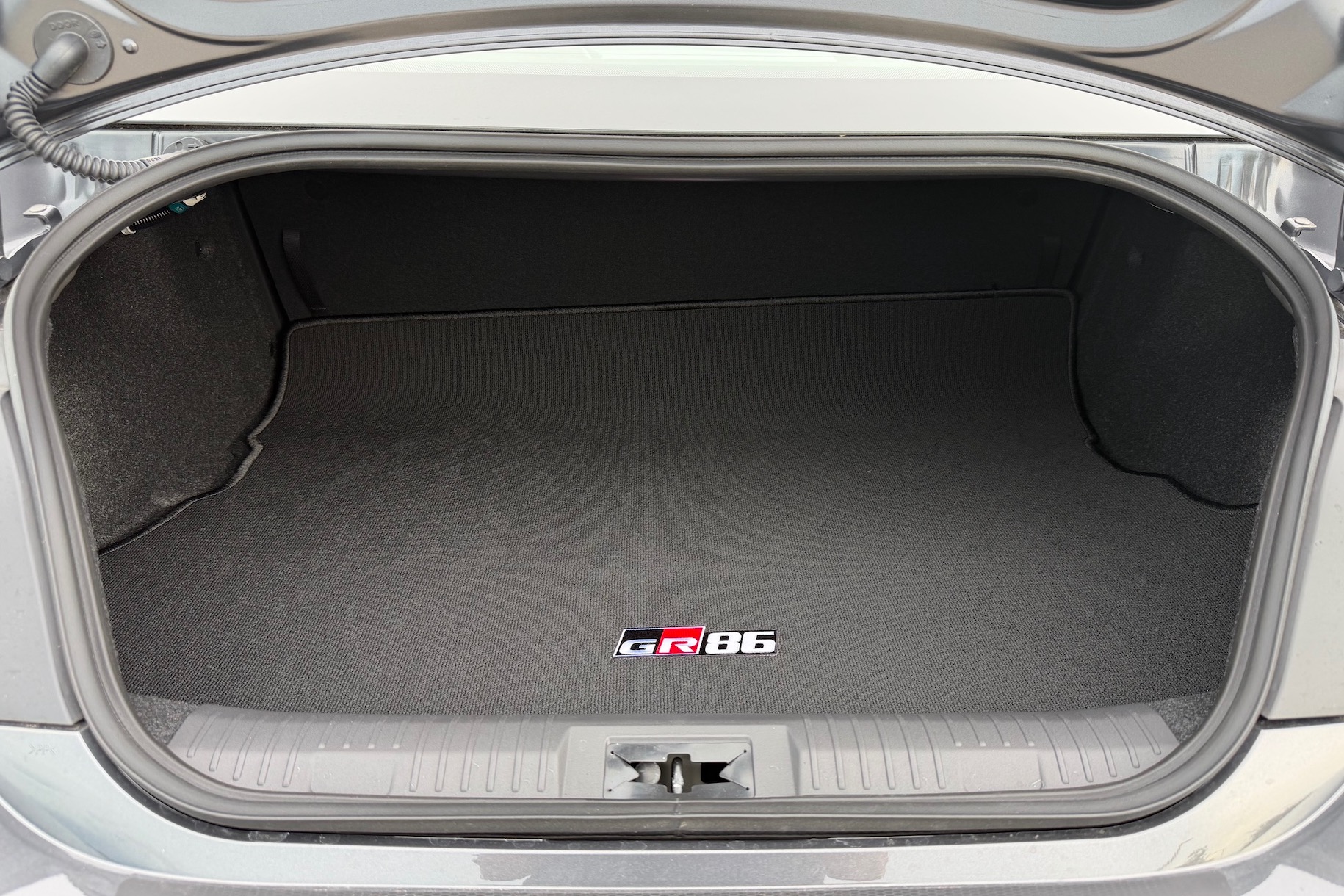
The rear seat is nigh-on useless. Few passengers will fit back there, so it’s better for packages. The rear seatback folds down as a single unit to improve on the cargo space of the tiny 6.26-cubic-foot trunk. Weekend racers can fit a set of four wheels and tires back there for a track day, so space is somewhat useful with the rear seatback down.
Technology
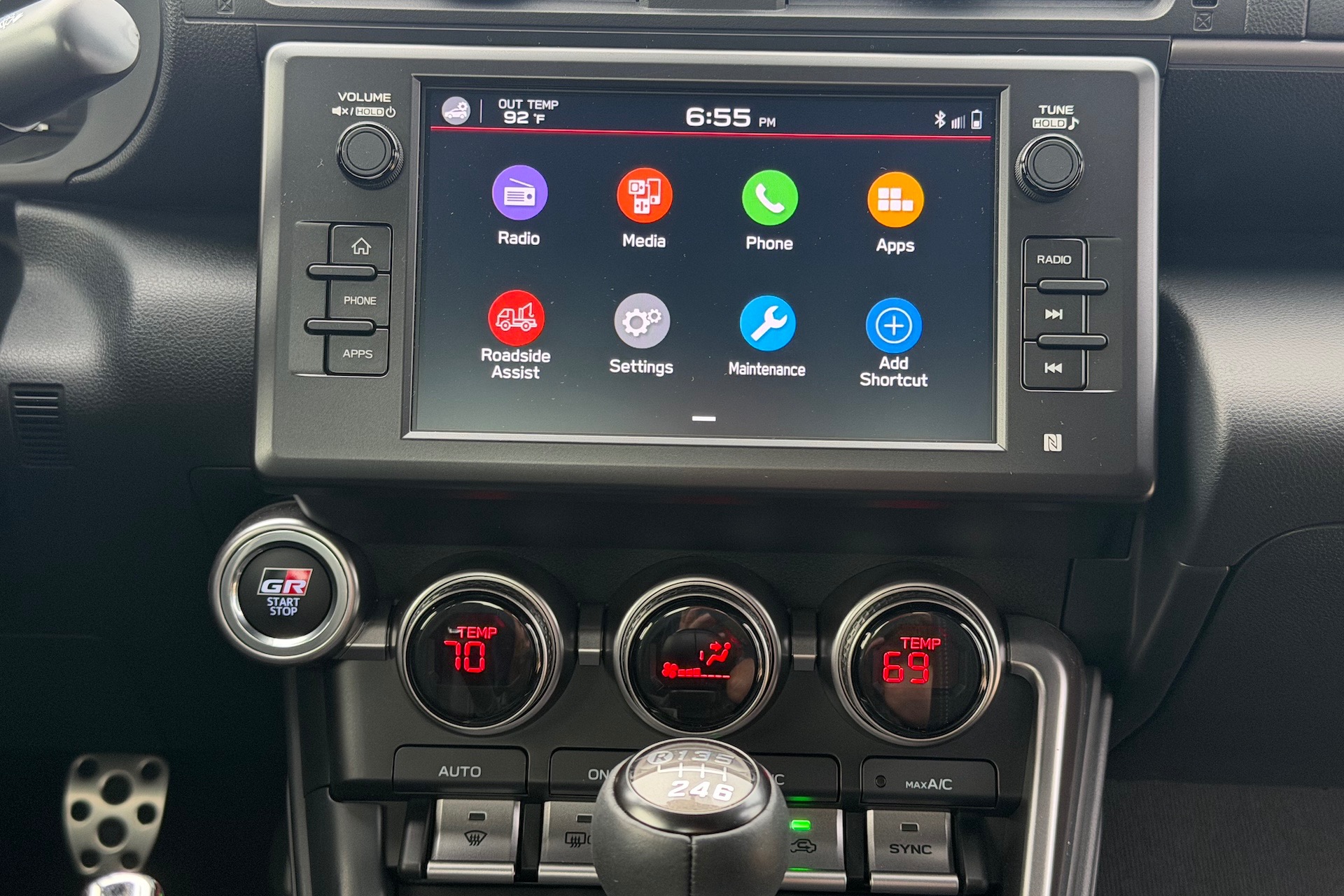
The GR86 doesn’t go big on tech, but it has the basics. The standard eight-inch touchscreen is small these days, but it sits in a small cabin. The screen layout feels dated with its home, phone, apps, and radio buttons, as well as up and down or next and back buttons. There is also a dial for radio tuning, which is ideal for scrolling through satellite radio stations.
The screen also works with Apple CarPlay and Android Auto, but they're wired. Under the Apps icon is SiriusXM Travel Link, which can show fuel prices, sports scores, stocks, weather, and local parking options.
Toyota also provides a 7-inch digital instrument cluster with a central tachometer and comes with Sport and Track layouts. The left and the right sides of the screen can show various types of information, including a lap timer, a g meter, rpm and horsepower/torque curves, fuel economy, trip meters, outside temperature, and engine coolant/oil temperatures, among others.
Buyers also get a year of Toyota Service Connect, Safety Connect, and Remote Connect. Service Connect provides vehicle health reports and maintenance updates. Safety Connect includes emergency assistance, roadside assistance, and a stolen vehicle locator. Remote Connect employs an app to do things like start the car or unlock/lock doors remotely, check parking location, and monitor guest drivers. After a year, these services require a subscription.
No GR86 has a thumpin’ audio system. The base version has six speakers, and an eight-speaker audio system comes in the Premium and Yuzu. A three-month satellite radio trial is standard, and a subscription is required after that.
Safety
How safe is the GR86? It’s hard to say. It comes with a basic level of standard safety equipment and has an incomplete crash-test record. The latter is likely because small-volume sports cars rarely get complete crash tests.
In IIHS testing, the GR86 gets only a Good rating for its headlights and for its front crash prevention vehicle-to-pedestrian collision prevention systems. It hasn’t been subjected to the IIHS’ other tests, so can’t get a Top Safety Pick or Top Safety Pick+ award from that organization. NHTSA crash-test ratings were also unavailable at the time of writing.
The GR86’s standard safety suite includes forward-collision warning, automatic emergency braking, adaptive cruise control, high-beam assist, adaptive headlights, lane-departure warning, and rear cross-traffic alert. Cars equipped with the automatic transmission add rear parking sensors, and the Premium and Yuzu get blind-spot monitors.
That’s not as many safety features as most cars have nowadays, and the GR86 offers no safety-related options. It’s a sports car, so a hands-free highway driving system doesn’t seem necessary, but front parking sensors would be a good idea, given how low the car sits. The systems it had worked well during our drive, without interfering too often.
Cost-effectiveness
Toyota offers the 2026 GR86 in three trim levels: Core, Premium, and the Yuzu Edition. The Core starts at $32,695, including a $1,295 destination fee. The Premium runs $35,295, and the Yuzu Edition costs $37,660. The six-speed automatic costs $1,100 more for each trim.
The Yuzu Edition is both a performance and an exterior package. It comes with matte-black wheels with gloss-black lug nuts, Brembo brakes, Sachs dampers, yellow interior accent stitching, black interior trim, a commemorative plaque, and Yuzu yellow paint.
The automatic transmission is the choice for fuel economy. Automatic models are EPA-rated at 21 mpg city, 30 mpg highway, and 24 mpg combined. With the manual, those numbers fall to 20/26/22 mpg. We did even better, averaging 25 mpg over 167 miles of mixed city and highway driving in our manual tester.
Given our tester's hard ride, we’d recommend going a Premium trim for the larger wheels and summer-performance tires and choosing the manual transmission and Performance package for its Brembo brakes and Sachs dampers. Skip the accessory GR Performance stabilizer bars, which are the likely culprit of the harsh ride, but maybe choose the GR Performance strut tie brace as well. Also pick a fun color because what’s a sports car for if not to show off?

What owners say
Trims & specs
Base MSRP $36,365 | Seating 4 |
Engine N/A | Cargo Capacity 6.3 cu ft |
Combined MPG N/A | Drivetrain N/A |
Base MSRP $34,000 | Seating 4 |
Engine N/A | Cargo Capacity 6.3 cu ft |
Combined MPG N/A | Drivetrain N/A |
Base MSRP $31,400 | Seating 4 |
Engine N/A | Cargo Capacity 6.3 cu ft |
Combined MPG N/A | Drivetrain N/A |