2026 Subaru Trailseeker Reviews, Pricing & Specs



Pros & cons
What we like
Great ride quality
Standard all-wheel drive
Plenty of cargo space
What to consider
Interior materials feel cheap
EV range less than 300 miles
Polarizing design
The CarGurus verdict
It looks like the old Outback but does 0-60 in 4.4 seconds.
The all-new 2026 Subaru Trailseeker is a purpose-built electric vehicle that leans hard into the brand’s outdoor identity. With standard all-wheel drive (AWD), legitimate off-road chops, and the sort of practicality that only a wagon can offer, the Trailseeker does a bit of everything, and with a starting price that undercuts much of the competition. It shares its bones with the Toyota bZ Woodland, which also wears a similarly distinctive Subaru exterior, and both vehicles carry enough real-world capability to earn those Subaru looks.
Verdict: The 2026 Subaru Trailseeker isn’t the flashiest EV on the market, and its interior reflects a sub-luxury experience. However, it’s comfortable, capable, and will remind you exactly what it is that makes a Subaru a Subaru. As an honest and practical electric wagon for people who want to get out of the city, it makes a compelling case.
out of 10 expert review
Look & feel
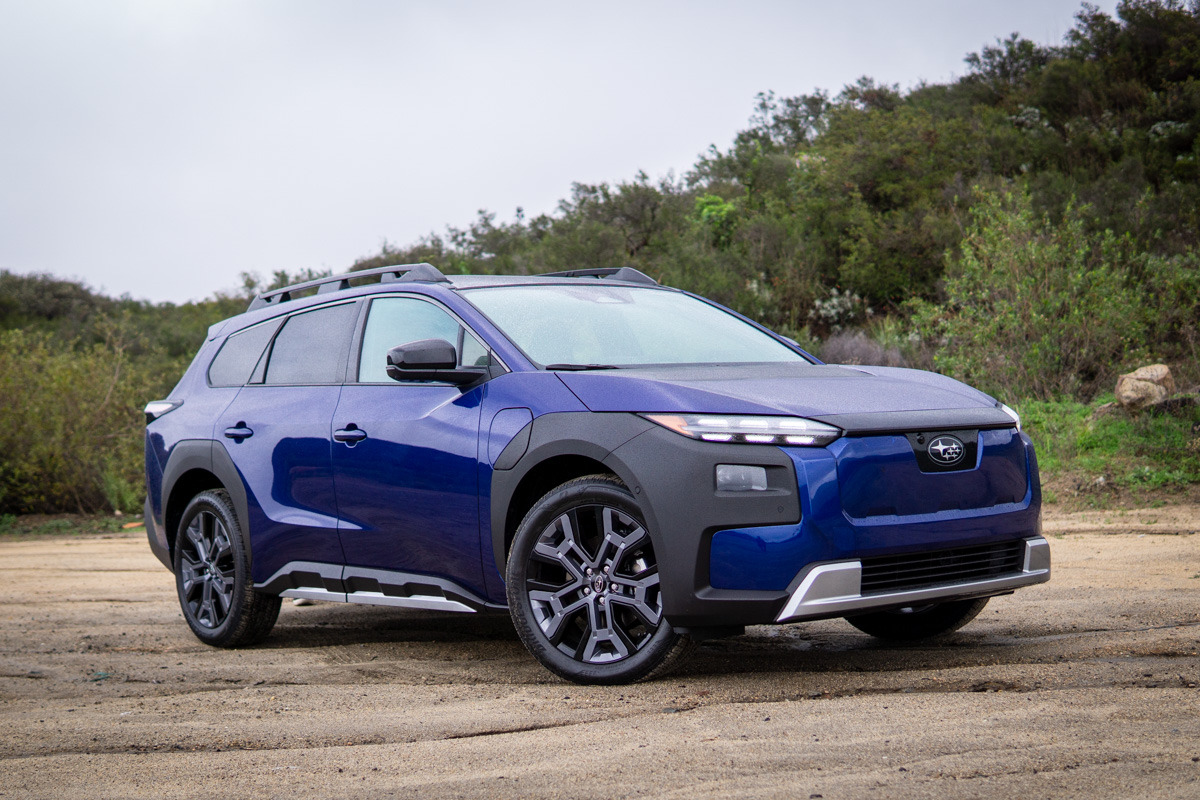
The 2026 Subaru Trailseeker is, without question, a Subaru. The wagon proportions, the black plastic body cladding, the raised roof rails—if you’ve spent any time around the brand’s lineup, this will all feel very familiar. That’s not a criticism so much as a statement of intent. Subaru knows its audience, and the Trailseeker is designed to look exactly like the kind of vehicle that audience wants to drive.
Of course, the flip side is that shoppers who don't buy into Subaru’s design aesthetic will likely think the Trailseeker is ugly. Luckily, this is an easy calculus: buyers either love it or they hate it.
The front end has a distinctive lighting signature, complete with an illuminated version of Subaru’s Pleiades six-star logo. The headlight stack is attractive, and the optional gloss black hood accent on the Touring trim adds a bit of visual sharpness. At the rear, SUBARU is spelled out across the tailgate in backlit three-dimensional lighting elements with a subtle infinity mirror effect when illuminated. After dark, the Trailseeker makes a stronger impression on the cars in its rearview mirror.
The volume of black plastic cladding is hard to ignore in daylight. It serves a purpose, because this is a vehicle meant to absorb the occasional brush with trail debris, but can feel like a lot of low-rent material on higher trim levels nudging a $50,000 MSRP. The 18-inch wheels on the base Premium trim level are functional but unremarkable, while the 20-inch alloys on the Limited and Touring trims are a meaningful visual improvement.
Inside, the cabin is clean and logically organized. Build quality feels solid, and most surfaces you regularly touch are soft. Harder plastics become more apparent below the belt line, which is typical in today’s era of car building but a noticeable degradation of quality, particularly on the Touring trim. The 14-inch touchscreen dominates the center stack, and the full-color driver information display sits atop the dash rather than beneath a binnacle. To help make that driver display more visible, Subaru has installed a squarish steering wheel with a flattened top. It’s a quirky arrangement, but does the job at maintaining sightlines to the display.
Outward visibility is good overall. Taller drivers may find the steeply raked windshield slightly limiting, but it’s unlikely to be a daily frustration for most.

Performance
The 2026 Subaru Trailseeker is the quickest production Subaru ever sold in the United States. Its dual-motor AWD setup produces 375 horsepower and gets the Trailseeker from 0 to 60 mph in 4.4 seconds. For context, that is—at minimum—a full second quicker than the current Subaru WRX, although the Uncharted EV is only a few tenths behind at 4.7 seconds. The power delivery is linear and immediate in a way that only electric motors can manage, and it doesn’t fade at highway speeds. This wagon can hustle.
Subaru estimates 274 miles of driving range for the Limited and Touring trims, which ride on larger 20-inch wheels, and 280 miles for the base Premium trim level and its 18-inch wheels. In real-world testing of the Touring, we observed 3.7 miles per kilowatt-hour, which works out to approximately 276 miles on a full charge. That’s a reassuring result and right in line with Subaru’s estimates.
The standard North American Charging Standard (NACS) charge port gives Trailseeker owners access to the Tesla Supercharger network, and DC fast charging can bring the battery from 10% to 80% in approximately 28 minutes at up to 150 kW, assuming the charging station can deliver at that rate. Battery preconditioning, activated automatically when navigating to a charging station (subscription required), helps maintain those speeds in cold weather.
The Trailseeker’s steering is excellent. Many EVs suffer from vague, numb steering that feels disconnected from the road, but the Trailseeker’s electric power-assisted rack is well-weighted and direct. The Toyota bZ Woodland shares this quality, and it makes both vehicles genuinely enjoyable to drive with enthusiasm.
Subaru engineered the AWD system specifically around the electric powertrain, with torque vectoring not just front to rear but also left to right. In off-road driving, the system demonstrates its ability to shift power to individual corners as the traction demands fluctuate beneath each wheel. X-Mode—Subaru’s off-road traction management system—offers Snow/Dirt and Deep Snow/Mud settings for more serious terrain. All-terrain tires are not a factory option on the Trailseeker (they are on the bZ Woodland), yet we didn’t need grippier rubber to make it through a short off-road loop in the Trailseeker. If anything, the Subaru Trailseeker proves that shoppers don’t need the all-terrain tires offered on the bZ Woodland, nor do they need the roughly 20-mile range penalty those off-road tires levy.
The Trailseeker Touring's ride quality is beautifully smooth. The 20-inch wheels don’t introduce the harsh ride that often comes with larger wheels, and the suspension absorbs road imperfections without drama. Despite its utilitarian styling, the Trailseeker impressed us as a genuinely good car to drive.

Form & function
The Trailseeker’s station wagon proportions translate directly into one of the more practical cargo areas in the EV segment. The Trailseeker doesn’t feel huge (and it isn’t), yet 31.3 cubic feet of space behind the rear seat is enough for four large suitcases, and it’s comparable to what buyers would find in a traditional midsize SUV. Fold the rear seatbacks down, and that figure grows to 74 cubic feet. The standard ladder-frame roof rails add further versatility with a 700-pound static load capacity for gear that won’t fit inside the Trailseeker—like a canoe or a mountain bike.
For buyers who need to tow, the Trailseeker is rated for up to 3,500 pounds. That won’t move a large boat or camper, but it’s sufficient for a small trailer.
The 120-volt, 1,500-watt outlet in the cargo area (standard on the Limited and Touring trim levels) is a genuinely useful feature. Whether it’s keeping an electric cooler running at a campsite or charging tools on a job site, it extends the Trailseeker’s usefulness beyond simply getting there.
Rear-seat space is impressive, too. Legroom feels generous with good knee clearance and foot room behind a front seat set for a six-foot driver. A fold-down center armrest, rear air vents, map pockets behind both seats, and a pair of 60-watt USB-C ports round out the rear passenger experience. Heated outboard rear seats are standard on Limited and Touring trims.
Up front, the center console opens from both ends and houses dual 15-watt wireless charging pads alongside well-placed cupholders. The Trailseeker has the sort of thoughtful, functional interior design that makes long drives enjoyable.

Technology
The Trailseeker’s 14-inch touchscreen is the largest ever fitted to a Subaru, and it's a genuinely good piece of technology. The tech is taken from the Toyota side of this partnership, so shoppers familiar with newer Toyota tech will find it very easy to understand. Rather than a traditional home screen, navigation is dock-based: a vertical strip of icons on the left side of the display gives quick access to settings, phone, music, navigation, and wireless Apple CarPlay or Android Auto. Both are standard on every trim level, and both are wireless.
The system is easy to navigate and responds without frustrating lag. A dark mode adapts automatically based on time of day. Fingerprints accumulate on the dark background, as they do on any large touch panel, but it's a minor complaint.
The physical climate controls (robbed from Toyota’s parts bin) are a highlight. Many vehicles at this price point have migrated climate functions into the touchscreen, making simple adjustments unnecessarily complicated. Subaru kept physical knobs for quick adjustment, although more nuanced HVAC changes rely on touchscreen icons.
The Harman Kardon premium audio system, standard on Limited and Touring trims, is a noticeable step up from the base speaker setup in both clarity and low-end response, and it sounds better than the JBL system installed in the Toyota bZ Woodland counterpart.
One critical note for buyers: several tech features in the Trailseeker require a subscription, including the navigation system, the Intelligent Assistant with dual-zone voice control, Traffic Jam Assist, and low-speed hands-free driving. That last one enables the Trailseeker to drive itself in stop-and-go traffic under 25 mph on supported roads. These are meaningful features, and their subscription requirement should factor into ownership cost calculations alongside the purchase price. Lessees don’t need to worry so much, as many of these features include lengthy trial periods, but shoppers should consider the incremental cost if they plan to keep their Trailseeker long-term.

Safety
Nine airbags are fitted through the 2026 Subaru Trailseeker’s cabin, including side-curtain airbags with a rollover sensor and knee airbags for both the driver and front passenger. As a brand new vehicle, the 2026 Subaru Trailseeker has not yet been rated by the Insurance Institute for Highway Safety (IIHS) or the National Highway Traffic Safety Administration (NHTSA). Although crash test evaluations hadn't been conducted at the time of writing, we can evaluate the Trailseeker based on its standard safety equipment.
And the good news there is that the list of standard equipment is extensive. Bundled under Subaru’s “EyeSight” suite, every trim includes automatic emergency braking, front cross-traffic assist, active lane-change assist, lane-departure warning and prevention, adaptive cruise control, and a driver-attention monitor. Blind-spot monitors, rear cross-traffic alert, and safe-exit assist, which warns of approaching vehicles when a door is being opened, are also standard across the board.
There are a handful of select features gated behind certain trim levels. The surround-view camera system, for instance, is standard only on the Limited and Touring trims. Some of the more advanced driver-assistance features, including Traffic Jam Assist and low-speed hands-free driving, require a subscription (as noted in the Technology section of this review). These are more in line with convenience features than active safety systems, and their absence doesn’t meaningfully diminish the Trailseeker’s credentials.
For a vehicle in this price range, the breadth and consistency of standard safety equipment is impressive, and it’s primarily the reason for the Trailseeker’s high score in this section.

Cost-effectiveness
The 2026 Subaru Trailseeker starts at $41,445 (including $1,450 destination) for the Premium trim. The Limited comes in at $45,445, and the Touring at $48,005. Optional leather upholstery on the Touring adds $300.
It's worth noting that the federal EV tax credit is no longer available, so the sticker price is the price.
The most natural comparison for the Trailseeker is the Toyota bZ Woodland, which shares its platform and powertrain. The bZ Woodland starts at $46,750 including destination—more than $5,000 more than the Trailseeker's base price. That gap narrows considerably as you move up the Trailseeker's trim ladder, but the Trailseeker's less-well-equipped entry point gives budget-conscious shoppers a meaningful advantage. Buyers who want the off-road capability and standard AWD of a purpose-built outdoor EV but don't need every premium feature can get into a Trailseeker for significantly less than any bZ Woodland configuration.
The Hyundai Ioniq 5 XRT is another relevant comparison, starting at $47,875. Like the Trailseeker, it's built around off-road credibility and standard AWD. However, it offers less ground clearance, a smaller infotainment screen, fewer standard luxury features, and less maximum cargo capacity. One area where the Ioniq 5 XRT has an edge is connected services, because several features that require a subscription on the Trailseeker are standard on the Hyundai.
For shoppers who want a capable, practical electric SUV without paying bZ Woodland prices, the Trailseeker makes a genuinely compelling case. The base Premium trim, in particular, represents strong value for the segment. If the price is right for buyers' budgets—and if they’re open to Subaru’s specific design aesthetic—it’s hard to find a reason to look elsewhere for a capable and spacious EV.

What owners say
Trims & specs
Base MSRP $43,995 | Seating 5 |
Engine N/A | Cargo Capacity 31.3 cu ft |
Combined MPG N/A | Drivetrain N/A |
Base MSRP $46,855 | Seating 5 |
Engine N/A | Cargo Capacity 30.4 cu ft |
Combined MPG N/A | Drivetrain N/A |
Base MSRP $39,995 | Seating 5 |
Engine N/A | Cargo Capacity 31.3 cu ft |
Combined MPG N/A | Drivetrain N/A |
Base MSRP $46,555 | Seating 5 |
Engine N/A | Cargo Capacity 30.4 cu ft |
Combined MPG N/A | Drivetrain N/A |
Base MSRP N/A | Seating N/A |
Engine N/A | Cargo Capacity N/A |
Combined MPG N/A | Drivetrain N/A |