2026 Kia K4 Hatchback Reviews, Pricing & Specs

Pros & cons
What we like
Stylish design
Plenty of cargo space
Impressive technology
What to consider
Uncomfortable seats
All-wheel drive not available
Hybrid option not available
Expert review
Hatchbacks have a cheap and cheerful reputation, but the new 2026 Kia K4 Hatchback is nothing but upmarket.
From its styling and technology to its quality and driving dynamics, the 2026 K4 Hatchback is an impressive car for the price. It joins the K4 sedan in Kia’s lineup, effectively replacing the discontinued Soul as an alternative to the company’s crossover SUVs. With up to 59.3 cubic feet of maximum cargo space, five-passenger seating, and numerous lifestyle accessories to support weekend adventures, the K4 Hatchback might make you forget all about wanting an SUV.
Verdict: After spending a day driving the turbocharged version of the K4 Hatchback, we think this stylish car should prove popular. Still, it could use an optional hybrid powertrain to improve fuel economy, an available all-wheel-drive system for extra traction in poor weather, and more supportive seats for long-distance driving.
out of 10 expert review
Look & feel
Kia offers the new K4 Hatchback in EX, GT-Line, and GT-Line Turbo trim levels. The base prices range from $26,235 to $30,135, including the $1,245 destination charge. Our fully-loaded test vehicle had GT-Line Turbo trim, Sparkling Yellow paint, carpeted floor mats, and the Technology Package. Those upgrades brought the manufacturer’s suggested retail price (MSRP) to $33,020, including the destination charge.
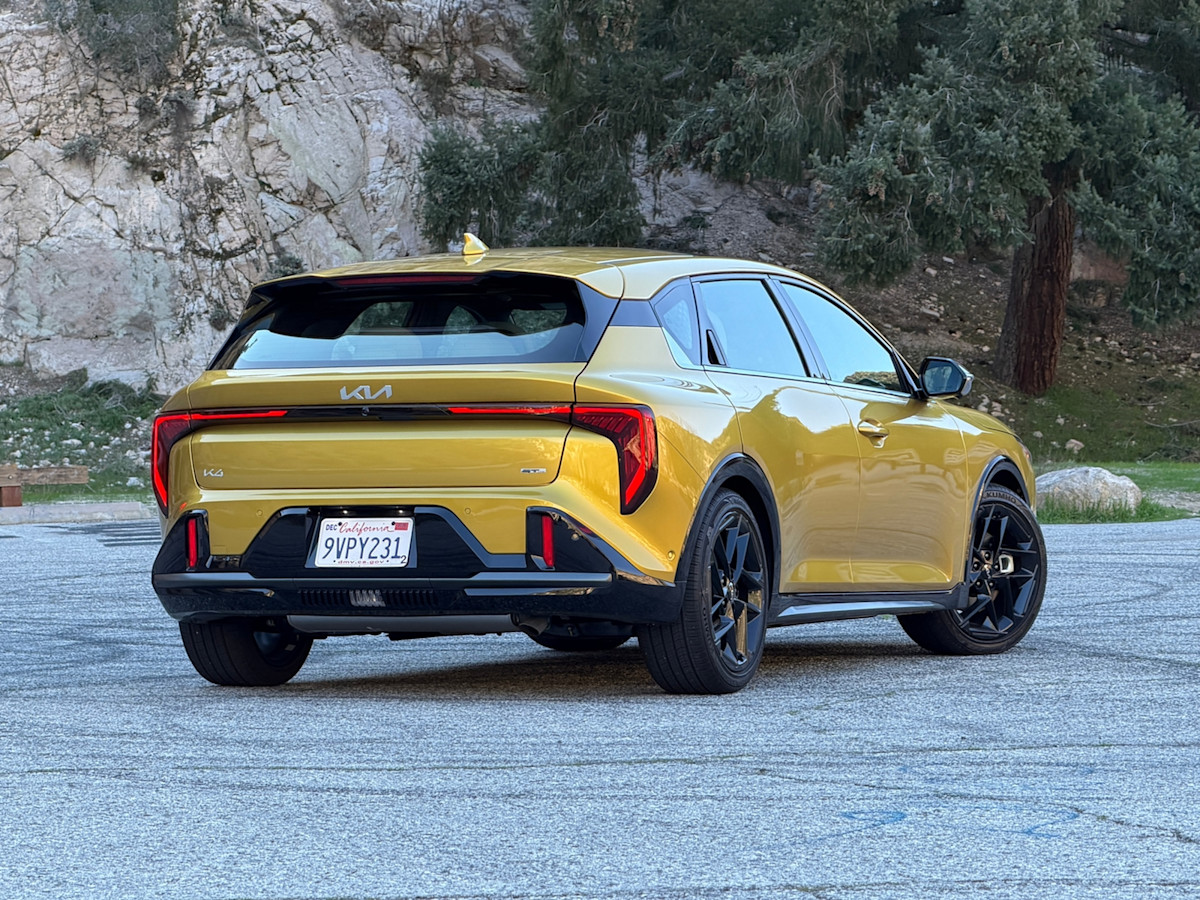
From a styling standpoint, there isn’t much difference between the three trim levels, aside from wheel size, design, and finish. The GT-Line models also feature exclusive gloss black and satin chrome exterior trim, while the GT-Line Turbo’s headlights and taillights look more sophisticated.
There is a significant difference between a K4 Hatchback and a K4 Sedan. The hatchback’s roof and bodywork aft of the rear doors is different, shrinking the hatch by 11 inches and ridding it of the sedan’s “baby got back” styling. Especially in GT-Line Turbo trim, the K4 Hatchback looks sensational, and to our eyes, is more appealing than the hatchback versions of the Honda Civic, the Subaru Impreza, and the Toyota Corolla.
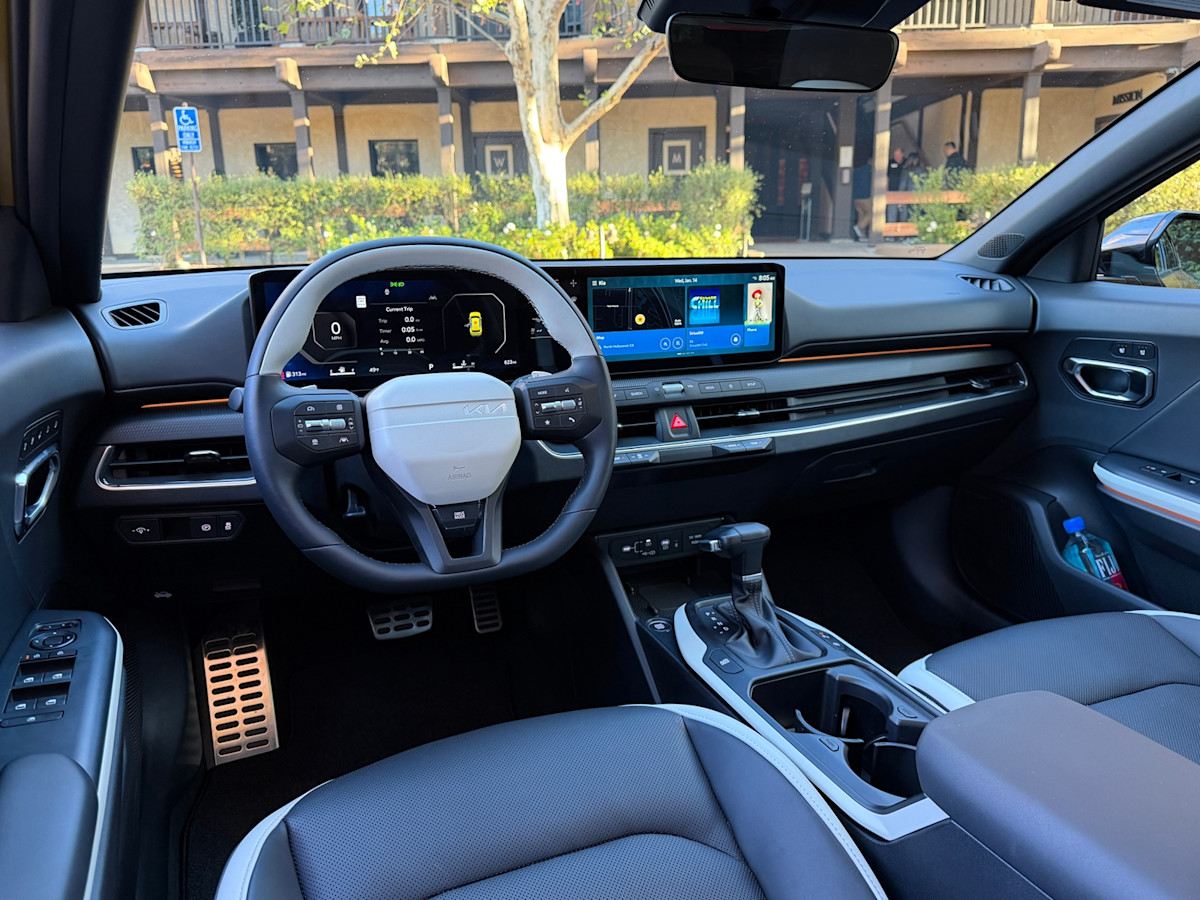
Open any of the K4 Hatchback GT-Line Turbo’s doors and you’ll question this model’s entry-level compact car status. Up front, a panoramic digital display dominates an interior showcasing modern and thoughtful switchgear. The transmission lever’s smoothness and solidity signal quality every time you shift into gear.
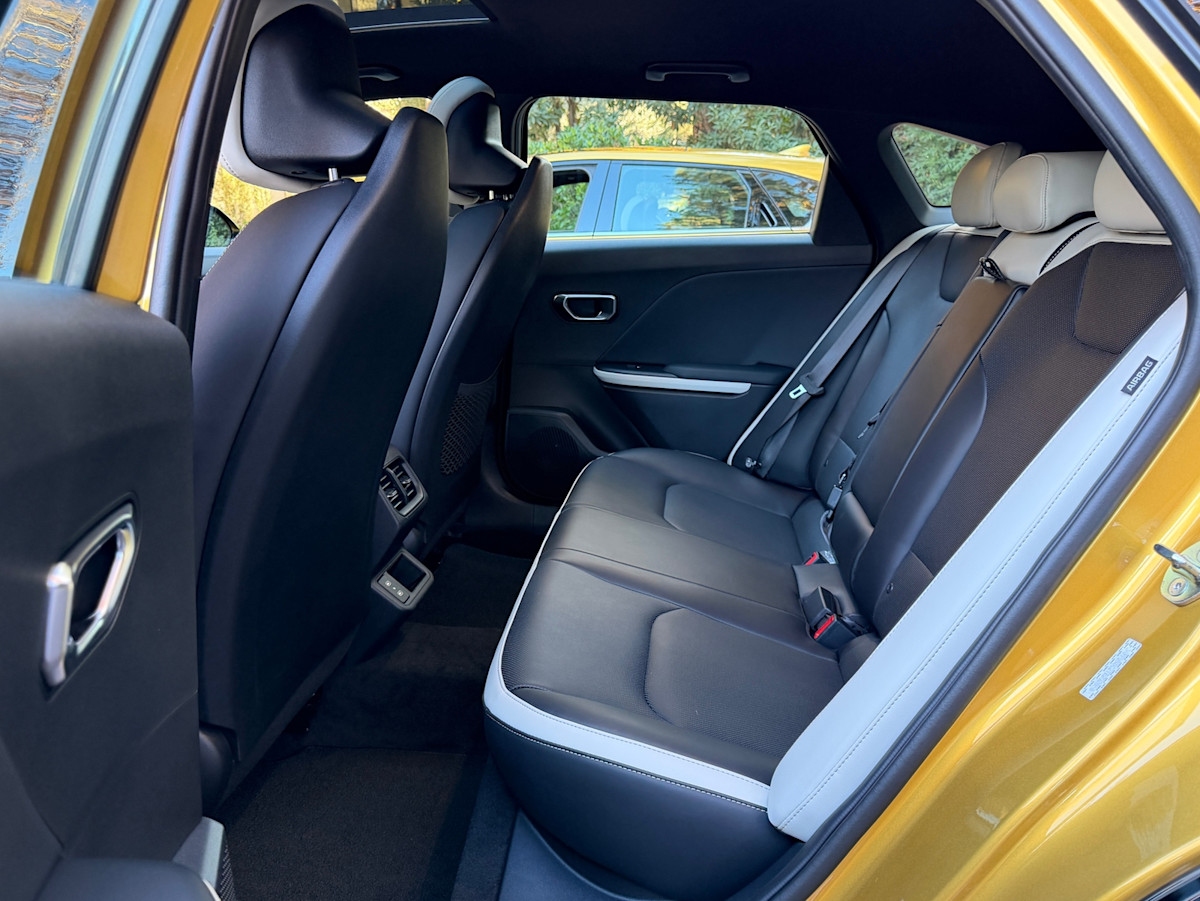
The interior materials support that impression for the most part. Our test car’s two-tone white and black artificial leather upholstery, stylish front head restraints, and arching front seatbacks lent the cabin a futuristic vibe. Kia could sell K4 Hatchback GT-Line Turbo models solely on the strength of their styling, but the beauty here is more than skin deep.
Performance
Kia equips the EX and GT-Line trim levels with an unremarkable powertrain pairing a 2.0-liter four-cylinder engine with a continuously variable automatic transmission. It makes 147 horsepower and 132 pound-feet of torque, the latter peaking at 4,500 rpm.
We didn’t drive a K4 Hatchback with this engine and transmission, but it is highly unlikely to exceed mere adequacy for the task at hand. At least the GT-Line gets a proper multi-link independent rear suspension, sport tuning for the dampers at each corner, and a set of paddle shifters to make the best of the meager power.
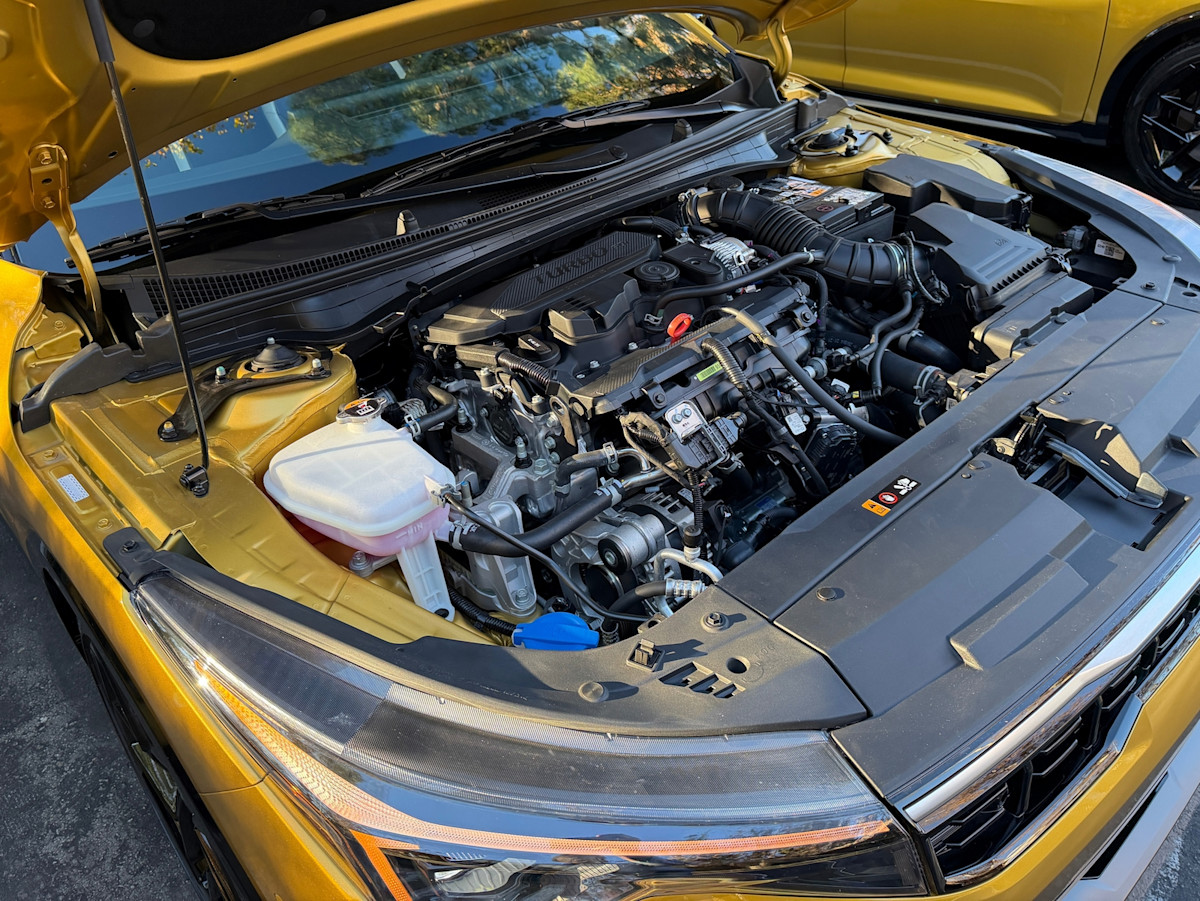
If you don’t mind spending a little more money, and accepting a little less in the fuel economy department, the GT-Line Turbo is the way to go. This version has a turbocharged 1.6-liter four-cylinder engine generating 190 hp (+43) and 195 lb-ft of torque (+58), the latter arriving at a much more accessible 1,700 rpm. The turbocharged engine pairs with a snappy and more satisfying eight-speed automatic transmission.
Kia estimates the GT Hatchback EX and GT-Line with the standard engine will average 30 mpg in combined driving. The GT-Line Turbo clocks in at 28 mpg, and we observed 27.5 mpg in suburban, highway, and mountain driving.
Don’t expect this version of the K4 hatch to behave like a Volkswagen Golf GTI. It can feel a little soft and vague compared to a typical sport compact car, displaying more body motion and less steering precision than enthusiasts would prefer. Nevertheless, the grip is decent, the brakes are responsive, and the handling is secure. You can get into a satisfying, predictable rhythm on a twisty road, and that puts a smile on your face.
The turbocharged engine’s torque can easily break the front tires loose under hard acceleration, and the GT-Line Turbo is genuinely quick. We had no trouble zooming onto freeways or getting up to speed on fast-flowing suburban boulevards, and the test car effortlessly zipped up the Angeles Crest Highway north of Los Angeles without breaking a sweat. On the highway, the GT-Line Turbo was quieter than expected.
The eight-speed automatic was agreeable, too. It was smoother than a dual-clutch automatic and more satisfying than the CVT in the EX and GT-Line. Generally, we have no complaints about how the K4 Hatchback GT-Line Turbo drove, regardless of the situation.
Form & function
The Kia’s front seats are not comfortable on longer drives. Wrapped in SynTex artificial leather, equipped with 10-way power adjustment for the driver (and a manual height adjuster for the passenger), and featuring heating and ventilation, you’d guess otherwise. But it didn't take long for the front seats to cause numbness and discomfort.
That’s a shame, because this otherwise impressive car deserves better. The heated steering wheel is stylish and pleasing to hold, and the K4 Hatchback’s rear seat is surprisingly roomy. We sat back there briefly, and aside from snug footroom, it was accommodating. Additionally, the test car had rear air conditioning vents and USB charging ports, and a center armrest equipped with cupholders.
Storage space is reasonably generous and convenient, particularly the center console’s adjustable cupholders that you can close to create a storage tray.
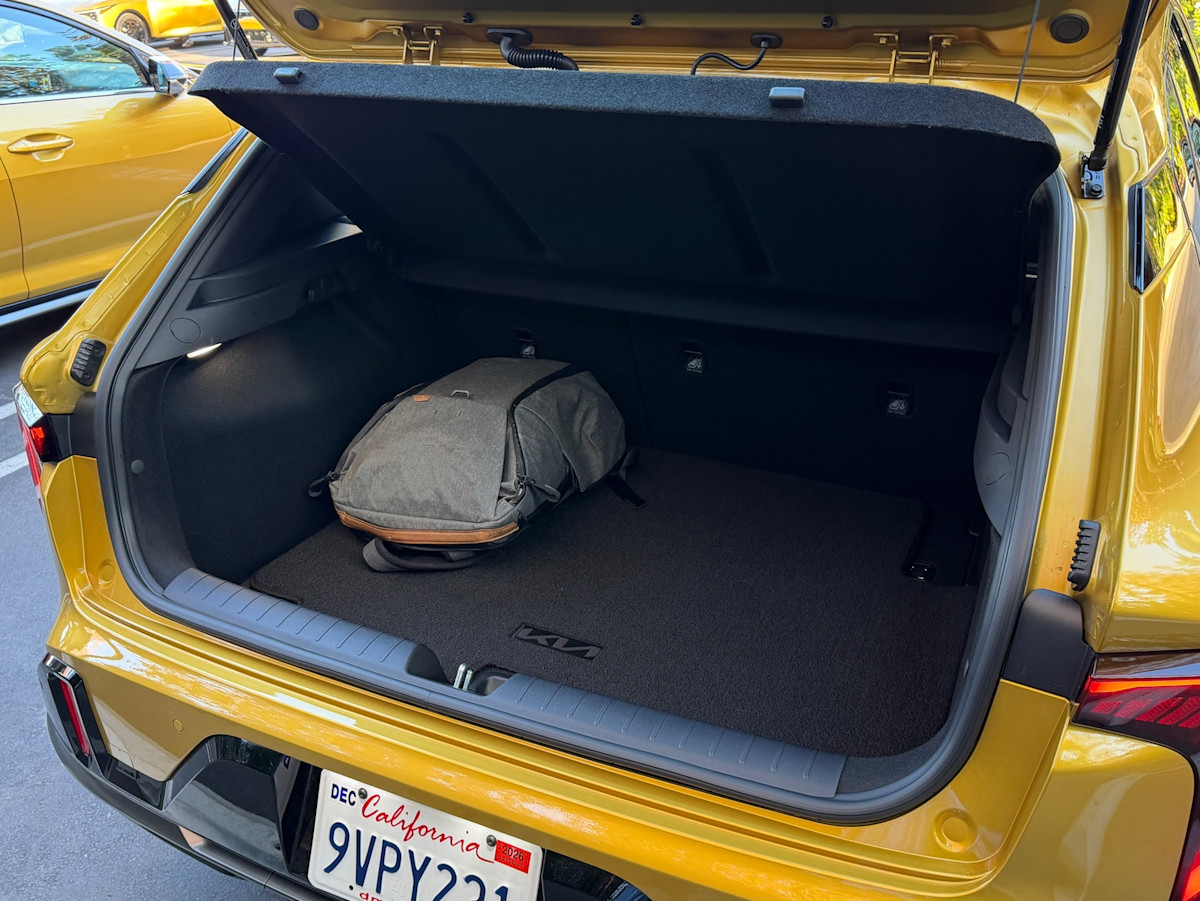
Of course, the point of a hatchback is to improve utility. Kia says the K4 Hatchback supplies 22.2 cubic feet of cargo space behind the rear seat, an increase over the K4 Sedan’s 14.6 cubic feet trunk. However, the room under the cargo cover and above the load floor actually seems smaller than the sedan's equivalents. Like the sedan, the K4 Hatchback has a temporary spare tire under the cargo floor.
If you fold the 60/40-split back seat down, the K4 Hatchback will hold 59.3 cubic feet of cargo on a flat, level loading surface. That’s a little less than the now-defunct Kia Soul could manage, and just shy of the Kia Seltos's capacity.
Technology
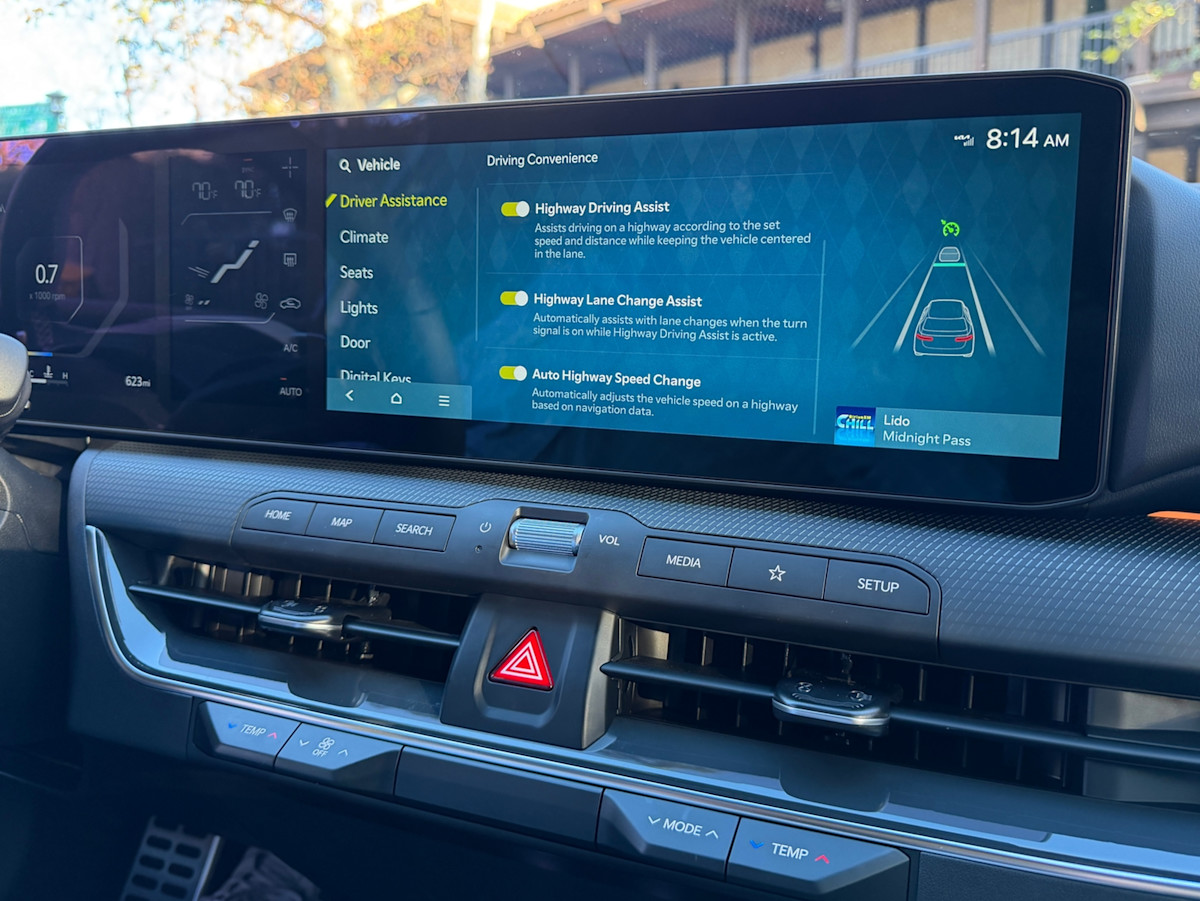
Another good reason to upgrade to the GT-Line Turbo is to enjoy the standard 12.3-inch digital driver display (an option for the GT-Line) and 12.3-inch touchscreen infotainment system. They live under a single panoramic glass screen, separated by a digital climate control panel partially blocked by the steering wheel rim. That’s not ideal.
With EX and GT-Line trim, you get a 4-inch digital driver display and a 12.3-inch touchscreen infotainment system featuring wireless Apple CarPlay, wireless Android Auto, SiriusXM satellite radio, and eight stereo speakers. As an option with the GT-Line and as standard equipment with the GT-Line Turbo trim, the system adds navigation, a Kia AI voice assistant, and an eight-speaker Harman Kardon premium sound system.
Kia ensured that our test car’s technology was active and ready to use. We turned on the “Hey Kia” wake phrase, and proceeded to request progressively more challenging tasks of the AI voice assistant. It quickly and accurately responded to each one, including activation of the car’s ventilated seats and heated steering wheel. It faltered only when requesting reggae music followed by a more specific ask to tune to the Bob Marley channel on satellite radio. We had to specifically request tuning to Channel 19 to make it happen.
Nevertheless, the Kia AI voice assistant technology was more user-friendly and capable than some systems we’ve evaluated in vehicles that cost three times as much.
Separately, pairing an iPhone to the wireless Apple CarPlay and streaming music was no problem. Usually, we like Harman Kardon sound systems. In the K4 Hatchback, it sounded good, but not great. At higher volume, the bass boomed too much, even with all the audio settings centered in their default positions.
Safety
Kia bundles its advanced driver assistance systems (ADAS) under the Drive Wise umbrella, and the list of standard safety features is long.
Every K4 Hatchback has forward-collision warning, automatic emergency braking, intersection turn assist, a blind-spot monitor, rear cross-traffic alert, safe exit warning, lane-departure warning, lane-keeping assist, lane-centering assist, adaptive cruise control, and automatic high-beam headlights.
Options for the GT-Line include a driver-selectable navigation-based speed reduction feature for the adaptive cruise control, which automatically reduces speed in curves. Additionally, Highway Driving Assist is available for the mid-level version of the K4 Hatchback, pairing the adaptive cruise control and lane-centering assist to create a semi-autonomous driving assistance system.
Upgrade to the GT-Line Turbo, and those two features are standard. Options include a camera-based blind-spot monitoring system, a lane-change assist function for Highway Driving Assist, front cross-traffic alert, evasive steering assist, parking sensors, a surround-view camera, and reverse automatic braking. Those are all part of the optional Technology Package.
Our test vehicle had all of these safety features and they behaved remarkably well. Highway Driving Assist 2 (with the lane-change assist function) will travel for miles with the driver lightly holding the steering wheel, feeling almost as capable as a hands-free system.
That’s why it's easy to become complacent. In one bend during our evaluation, the Kia ran wide in our lane, prompting the tech to immediately remind us to hold the steering wheel. We were, but we were also letting Highway Driving Assist do its thing. It was so capable, we didn’t respond quickly enough to a situation it was struggling to resolve.
As for the other technologies, we like the camera-based blind-spot view monitor, which shows a live video feed of what’s in the K4 Hatchback’s blind spots on the digital driver display. However, while driving, we rarely look at it, relying instead on the mirrors and traditional blind-spot monitor. Old habits die hard.
Still, for a compact Kia that barely breaks $33,000, the amount of tech available for the K4 Hatchback is stunning, and stunningly impressive. It puts some of this car’s rivals to absolute shame.
In crash testing, the National Highway Traffic Safety Administration (NHTSA) gives the K4 Hatchback an overall safety rating of five out of five stars. The Insurance Institute for Highway Safety (IIHS) hadn't rated the K4 Hatchback at the time of writing, but if it ultimately performs like the K4 Sedan, it will earn favorable ratings.
Cost-effectiveness
The Kia K4 Hatchback counts the Honda Civic Hatchback, the Mazda 3 Hatchback, the Subaru Impreza Hatchback, and Toyota Corolla Hatchback as its primary rivals. Some people might also cross-shop with the Volkswagen Golf GTI, but that's more performance oriented than the K4 Hatch and has a base price that’s a couple of grand higher than our test car's.
When comparing base-price ranges, the Honda, the Mazda, and the Subaru are more expensive than the Kia. The Civic is available with a powerful and efficient hybrid drivetrain, the Mazda offers available all-wheel drive and a more powerful turbocharged engine, and the Subaru features standard all-wheel drive. Each of those alternatives offers more standard power than the Kia and is similarly fuel efficient, but none of them can match the Kia’s excellent warranty coverage or roadside assistance plan.
The Toyota Corolla Hatchback is less expensive than the Kia, and includes a reputation for reliability paired with complimentary scheduled maintenance for two years or 25,000 miles. The Corolla’s standard engine is also more powerful and fuel efficient than the one Kia uses in the EX and the GT-Line, but unless you upgrade to the significantly more expensive performance-tuned GR Corolla, you can’t get turbocharging in the Toyota.
There is real value in choosing the Corolla Hatchback instead of the Kia K4 Hatchback. But it sure isn’t a looker, especially in comparison to the Kia. None of these Kia K4 Hatchback competitors are, except for the Mazda 3.
We think the Kia is undeniably appealing, and based on our day of test driving, it’s also impressive. With better seats, an all-wheel-drive option, and a hybrid powertrain choice, it could be the best car in the segment, no matter what you seek in a compact hatch.

What owners say
Trims & specs
Base MSRP N/A | Seating N/A |
Engine N/A | Cargo Capacity N/A |
Combined MPG N/A | Drivetrain N/A |
Base MSRP $26,090 | Seating 5 |
Engine N/A | Cargo Capacity 22.2 cu ft |
Combined MPG N/A | Drivetrain N/A |
Base MSRP $28,990 | Seating 5 |
Engine N/A | Cargo Capacity 22.2 cu ft |
Combined MPG N/A | Drivetrain N/A |
Base MSRP $25,090 | Seating 5 |
Engine N/A | Cargo Capacity 22.2 cu ft |
Combined MPG N/A | Drivetrain N/A |


