2026 Jeep Recon Reviews, Pricing & Specs


Pros & cons
What we like
Loaded with Jeep character—pop-out glass and removable doors
670 hp and a 3.6-second 0–60 are thrilling in any vehicle
Impressive, high-quality interior
What to consider
Expensive given its sub-par all-electric range
Suspension struggles to control its mass over undulating roads
Styling lacks the Wrangler's rugged presence
Expert review
Jeep's latest electric SUV nails the vibe but stumbles on value.
The 2026 Recon arrives loaded with genuine Jeep character: removable doors, pop-out glass, 670 horsepower, real-world space inside, and real off-road hardware, all enhanced by surprising refinement. But a 222-mile range in the Moab trim we tested—mixed with a $68,995 starting price—makes its value proposition the hardest part to reconcile.
Verdict: We're excited that the Recon exists, but its high price is going to be a key hurdle. If Jeep can follow up with a more affordable trim that doesn't give up any ruggedness—something this Recon could actually use more of—it could have a winner on its hands.
out of 10 expert review
Look & feel
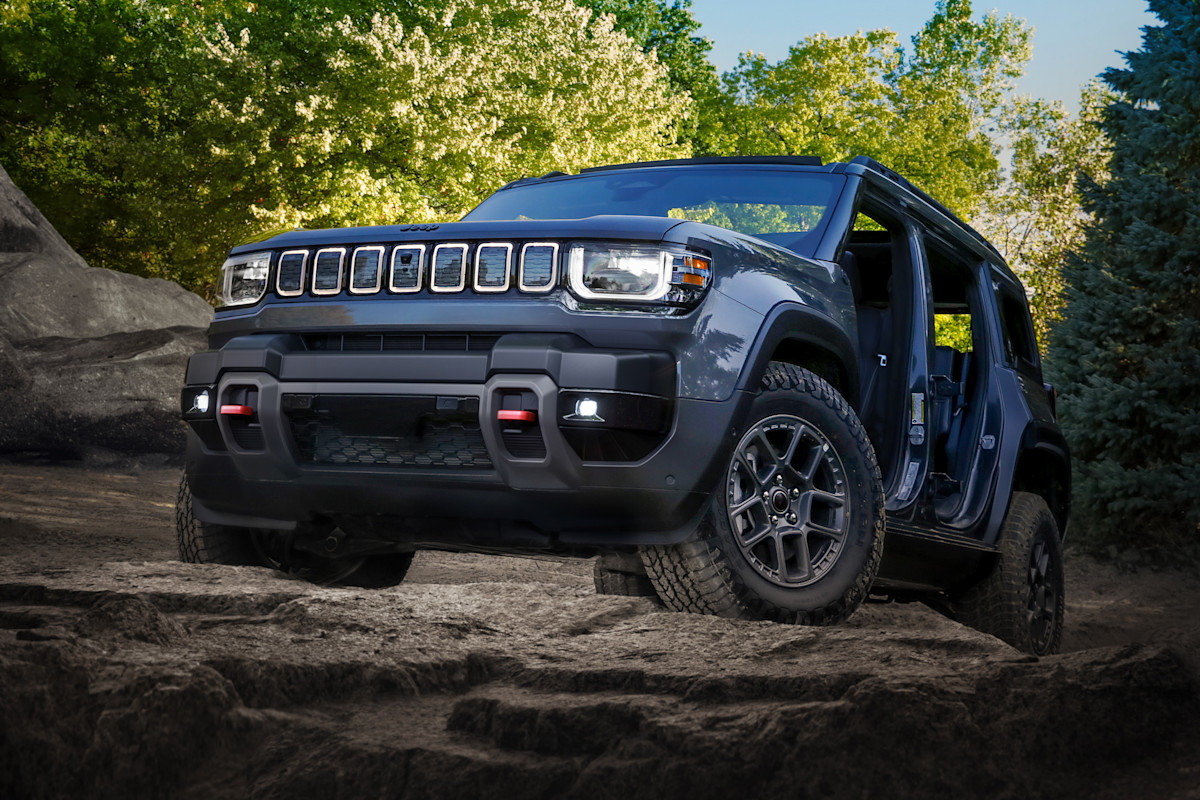
Let's start with the part we're not entirely sold on: the styling. In pictures and from a distance, the Recon looks a little too diminutive for a vehicle with a $70,000 sticker and this much on- and off-road capability. We found ourselves wishing for a touch more ruggedness built into its stance—as it is, it reads a little too much like a Ford Bronco Sport and not quite enough like Jeep's own Wrangler.
Yet up close and in person, this SUV is bigger than it presents. It is upright and boxy in a way that clearly plants it in the Jeep family, with illuminated seven-slot grille rings, U-shaped daytime running lights, a full suite of standard LED lighting and Wrangler-inspired LED taillamps. The Moab trim piles on additional rugged bits, while buyers can add a gloss-black roof and choose from a rotating roster of colors.
There are genuinely cool details, too—a full-size spare rides on the rear swing gate, and flush e-release handles keep the surfaces clean.
Inside is where the Recon really shines. The refinement we felt on the road is reinforced by an interior we came away very impressed by: the materials are high-end, and the general level of comfort and quality was surprisingly high.
The Moab trim debuts a Joshua Tree tan color scheme, with seats, console, doors and dash finished in a non-leather synthetic Jeep calls Capri, accented by metallic trim. Recycled content runs through the headliner and carpets, and rugged all-weather mats front, rear and in the cargo area shrug off trail grime.
A clean, symmetrical horizontal dash is anchored by a bold passenger-side grab handle and a modular accessory rail across the top of the instrument panel—Jeep will happily mount a camera, a navigation device or even a rubber duck up there—while scuff-resistant, vortex-textured surfaces lean into the adventure theme without feeling gimmicky.
Performance
The most remarkable thing about the Recon is its power. 670 horsepower is the headliner here, backed by a 0–60 mph time of 3.6 seconds. Jeep pairs that with 620 lb-ft of torque from a pair of electric motors—one front and one rear—each rated at 250 kilowatts and giving the Recon full-time four-wheel drive (4WD).
In our testing, we found that Sport mode was necessary to unlock the full grunt of this powertrain, but once engaged you could chirp the tires while already cruising down the freeway. Jeep says it tuned the throttle pedal to deliver all that torque in a controlled, precise way rather than an on/off rush, and it shows: even with 670 horsepower on tap, the Recon is easy to meter out smoothly at low speeds and while picking through obstacles.
Despite being marketed as a rugged, go-anywhere machine, it's the Recon's outright refinement that we found among its most notable and impressive features. While it isn't silent on the freeway, it's a vast, vast improvement over the Jeep Wrangler and gives the Recon a genuinely upscale, refined feel. This is a remarkably smooth and quiet vehicle, especially given its boxy shape.
There is one real flaw, and it isn't about rough pavement—it's the way the Recon handles its considerable mass (over 6,000 pounds!) over curvy or even slightly undulating roads. There's a slightly unsettling feel to how the body moves about, as though the suspension tuning needs another month or two in the lab. It was by no means a deal-breaker, and the Recon was otherwise very well composed, whether cruising the freeway or on the aggressively rugged trails we took it on for additional testing.
Underneath sit a short-long-arm front suspension and an integral-link rear, plus a 100-kWh, 400-volt battery pack wrapped in high-strength steel underbody skid plates.
Off-road, the hardware is legitimate. The Moab rides on standard 33-inch tires for 9.1 inches of ground clearance, with a 33.8-degree approach angle, a 33.1-degree departure angle and a 23.3-degree breakover angle.
Jeep's Selec-Terrain drive mode system adds a Moab-exclusive Rock mode to Auto, Sport, Snow and Sand. Jeep's low-speed Selec-Speed Control holds a set crawl speed on steep grades, and Rock mode's two-pedal calibration includes a hill-hold that lets you move from brake to throttle without rolling backward. All of this added up to formidable off-road prowess during our testing, as we took it over rock fields and up and down inclines steep enough to make a Wrangler proud. The Jeep genes run deep on this Recon.
Form & function
The news Jeep will make the most noise about—and will likely feature in nearly every Recon ad you see for practically the next five years—is the removable doors. Jeep says they come off fully without any tools, which is true, although you do need a Jeep-supplied hex key to attach the side mirrors if you intend to drive on public roads. And while the doors do come off tool-free, reconnecting them—particularly the electrical connection for the driver's door—is a little trickier than you might imagine.
What we were even bigger fans of were the removable glass pieces on the sides of the cargo area and the removable rear glass. These popped in and out quite easily and stowed in the rear cargo area. With the doors removed and the rear glass pulled—on a test vehicle also fitted with the optional $2,000 Sky One-Touch power top—the open-air feel of the cabin was striking, and really lived up to all the billing we constantly heard from Jeep.
Space inside is quite impressive, with plenty of room for five tall adults to ride simultaneously. This truck is definitely bigger than it looks, both inside and out. Cargo space is good—65.9 cubic feet with the second row folded, plus a 3.0-cubic-foot front trunk sized for a carry-on suitcase—though it trails the Wrangler a little. A two-tiered pass-through center console with an available wireless charger, and modular door panels with removable elastic straps round out a genuinely practical cabin for both people and gear.
The elephant in the room is range. The 2026 Moab we tested is rated at 222 miles, and that really isn't all that great for any EV in 2026—the longer-legged Overland trim is estimated at up to 240 miles, but neither figure sets the class alight, especially with the Rivian R2 also coming to market with better pricing and similar off-road chops.
It's one of the Recon's biggest shortcomings; we'd gladly trade 100 or even 200 horsepower for another 50 to 100 miles of range. It doesn't help that the 2026 Moab launches with a CCS charge port rather than NACS, which complicates access to the most convenient fast-charging network—though Jeep is switching the lineup to a NACS port for the 2027 model year.
Technology
Jeep threw its best technology at the Recon, and it mostly lands. The screens were bright and intuitive, part of more than 26 inches of combined display: a standard 12.3-inch driver cluster and a 14.5-inch horizontal touchscreen that Jeep says is the largest single usable screen it has ever fitted to one of its vehicles.
It runs Uconnect 5—the brand's most advanced infotainment system to date—behind a sleek, largely buttonless interface with digital icons sized to be usable even on rough terrain. In our time with it, the graphics were crisp and the menus easy to parse at a glance, and those bigger displays make the map and the various camera views genuinely easier to use on the move.
We were also happy to see that Jeep kept physical knobs for volume and tuning even as it moved climate control into the touchscreen, so the controls you reach for most stay tactile. Audio is a genuine highlight. A premium Alpine system comes standard—with speakers omitted from the doors so there's no loss in jamming out when they're removed.
Safety
Neither the Insurance Institute for Highway Safety (IIHS) nor the National Highway Traffic Safety Administration (NHTSA) has published crash-test ratings for the Recon yet.
Jeep claims the Recon sports more than 170 standard safety and security features, and nearly the entire driver-assistance suite is standard rather than optional. That includes full-speed Forward Collision Warning with advanced brake assist, adaptive cruise control, blind-spot monitoring with rear cross-path detection, Active Lane Management, drowsy-driver detection, traffic-sign recognition, intelligent speed assist, intersection collision assist, and side distance warning. Even extras like auto-hold braking, rough-road cruise control and an automatic high-beam system are included at no charge.
The few safety-related items that cost extra come bundled: the Comfort Package adds a digital rearview mirror and an interior camera, and the Trailer Tow Group adds blind-spot monitoring with trailer detection plus a zoomed hitch-view camera.
Cost-effectiveness
This is where the Recon has the most to prove. The 2026 model launches with one trim: the Moab. It technically carries a starting MSRP of $66,995 (including a $1,995 destination charge), but at the time of writing, the $2,000 Sky One-Touch top appears to be a mandatory option, as oxymoronic as that sounds. Including that Sky One-Touch top, our Moab-trim test vehicle landed close to $70,000. That price alone is a lot to stomach, especially when you consider the Wrangler or Bronco you could park in your driveway for similar money—or the aforementioned Rivian R2, which tops out at a tick over $60,000.
The value math gets harder because of range. A 222-mile Moab at roughly $70,000 simply isn't competitive in 2026, and because the 2026 car uses a CCS port rather than NACS, fast-charging on the go leans on adapters and non-Tesla networks for now (at least Jeep moves the lineup to a NACS port for the 2027 model year).
The Recon is asking Wrangler-and-Bronco money while giving up range and, to our eyes, some of the rugged presence that makes those rivals so appealing.
Thus, the takeaway is simple: the hardware is compelling, but the launch-spec Moab is priced for enthusiasts, not value-seekers. A more affordable, equally rugged trim would go a long way.

What owners say
Trims & specs
Base MSRP $65,000 | Seating 5 |
Engine 650 hp Electric | Cargo Capacity 30.3 cu ft |
Combined MPG 72 | Drivetrain 4X4 |